Rosanne Cash, Eric Bibb, John Phillips and Scott McKenzie sing Hedy West : 500 Miles

‘We leave something of ourselves behind when we leave a place, we stay there, even though we go away. And there are things in us that we can find again only by going back there’  (Pascal Mercier)

‘The desire to go home that is a desire to be whole, to know where you are, to be a point of intersection of all the lines drawn though all the stars, to be the constellation- maker and the center of the world, that center called love.’ (Rebecca Solnit)

‘You can’t go home again.’ (Thomas Wolfe)

‘Lord, I’m one, Lord, I’m two, Lord, I’m three, Lord, I’m four,

Lord, I’m five hundred miles away from home.’ (Hedy West)

Much meaning can be expressed in so few letters of the alphabet

Just four will do.

Good. Evil. Luck. Fate. Time. Fear. Hope. Hate. Womb. Tomb. Life. Love.

And one four letter word might contain them all.

Home. Home.

The home you were born in; the home you grew up in, the home that was your shelter and refuge.

The home you left with tears in your eyes.

The home that lives forever in your heart and your mind’s eye.

The home that was your prison.

The home you left without a backward look.

The home you’ll never go back to now you’ve made a home of your own.

Home, home, home.

Should you write a true song evoking the longing for home when the tides of time have taken you far away you’ll find singers to sing that song for evermore.

Hedy West wrote such a song, ‘500 Miles’


Crystal clear. Mountain dew.

Banjo, voice, Presence, centuries of the ballad tradition.

Fiddle tunes and songs called Rueben’s Train, The Railroader’s Lament and 900 Miles all swirl in the imagination of a young woman growing up in a home suffused with tunes and stories and songs.

Great Uncle Gus plays the fiddle, Gradma Lillie plays the Banjo and has a bottomless well of ballads and laments that seem to float on the breezes all around.

Dad, Don West, is a poet (‘Clods of Southern Earth’), a labor organiser, a civil rights activist, an oral historian and inspiration.

west_don_photo

Hedy has a voice. She plays the Banjo in her own style.

She has the austere gravitas of a classical bard.

When she sings the room stills. When she sings she has something to say.

She has a calling.

A calling to tell the stories of the disregarded rural poor.

A calling to tell their stories in songs that express, and more honour, the depth of their struggles and the fullness of their humanity.

In a career of more than five decades taking her from folk contests in her native Georgia to Greenwich Village, Carnegie Hall, London and venues all over the globe it’s a calling she fulfills with steadfast hope, faith and love.

In the 1950s folk world a song as true and singable as 500 Miles scorches across the continent like a raging forest fire.

It instantly becomes a folk standard with each group or artist adapting the lyric and instrumentation to suit their own style and the image of home they carry with them.

‘Lord, I’m one, Lord, I’m two, Lord, I’m three, Lord, I’m four,

Lord, I’m five hundred miles away from home.’

As far as I can tell the first notable recording of the song is by The Journeymen in 1961.

Now, you’d have to be a scholar of the American Folk Revival to sagely nod once their name is mentioned. Yet, almost all of us came to know the members of the group through their later careers.

journeymen

John Phillips became the leader of prolific hit makers The Mamas & the Papas, Scott McKenzie had a whole generation singing, ‘San Francisco (Be Sure To Wear Flowers In Your Hair) while Dick Weissman achieved eminence as a banjo picking musicologist and folklorist.


Listening to this time suspending version in soft sift black and white dreams I drift through the home of my own childhood.

Streetlights glow the palest yellow as they struggle to penetrate the blanket like London Fog of the 1950s.

Spectral trolley buses are boarded by attentively following their clanging sound until they suddenly loom up before you.

Snow surrounds market stalls piled high with cheap goods sold as wondrous bargains you must not be without – ‘Buy now Mrs! When they’re gone they’re gone!’

Cocooned in a two room first floor flat a young boy, certain in his bones that he is the constellation-maker and centre of the world, learns to read, ‘Treasure Island’ and dreaming of wooden ships, wooden legs, parrots, pirates and buried plunder begins to dream stories of his own.

‘Lord, I’m one, Lord, I’m two, Lord, I’m three, Lord, I’m four,

Lord, I’m five hundred miles away from home.’

As we have seen from the previous post here on The Jukebox when it comes to recognising an American standard Johnny Cash is your go to man.

Johnny took his curatorial role so seriously that he drew up, ‘The List’ – a compendium of great songs he entrusted to his daughter Rosanne.

Following her father’s death Rosanne returned over and over again to The List and the result was a luminously beautiful record featuring haunting tracks like Dylan’s , ‘Girl from the North Country’, ‘Long Black Veil’, Motherless Children’ and, ‘Miss the Mississippi and You’.

The one I come back to the most though is her devoutly heartfelt take on 500 Miles.


Johnny sure would have been proud.

‘Lord, I’m one, Lord, I’m two, Lord, I’m three, Lord, I’m four,

Lord, I’m five hundred miles away from home.’

Great songs call out across the miles, across genres and cultures and across time.

The veteran Acapella group The Persuasions uncover the longing, the loss, the mourning and the journey to the farther shore that awaits us all.

Their Gospel and Spiritual version of 500 Miles makes a congregation of us all.

‘Lord, I’m one, Lord, I’m two, Lord, I’m three, Lord, I’m four,

Lord, I’m five hundred miles away from home.’

500 Miles is a song that speaks from and to the bonds of familial love.

I’ll conclude with a blessed version by a father and son, Leon and Eric Bibb, which has the quality of a foot sore pilgrimage concluding in longed for peace and reconciliation.

‘Lord, I’m one, Lord, I’m two, Lord, I’m three, Lord, I’m four,

Lord, I’m five hundred miles away from home.’


We are all pilgrims.

May we all find peace reconciliation and the home we seek.

Notes:

I love every record made by Hedy West.

Seek out her CDs on the Vanguard, Topic and Bear Family labels for a lifetime of inspirational listening.

The only CD I can find by The Journeymen is, ‘New Directions In Folk Music’ on Collectors Choice from 2010 which is a nice collection of thistledown folk.

Eric and Leon Bibb’s, ‘A Family Affair’ hard to find is a gem well worth the search.


Johnny Cash, Debbie Harry & Gene Autry chase Ghost Riders In The Sky!

The ‘Way out West’ Series No 1

Music hath charms. Music hath charms.

And, among those charms is its uncanny ability to forge bonds of fellow feeling and friendship between people born in wildly different times, places and cultures.

Take me and Carl.

Carl came from the spice Island of Grenada in the Caribbean.

When we met he was seventy years old and I was a callow twenty two.

I had just emerged, blinking, from the ivory tower of Cambridge University awaiting my inevitable discovery as a great novelist.

Carl had spent decades in the fierce factories of Detroit and the searing cane fields of Florida.

We met in Hospital.

I was working there as a porter dramatically rushing the resuscitation trolley to people on the point of death and more prosaically ferrying patients to the X-Ray department and to the operating theatre for surgery.

Carl, having suffered a heart attack, came into Accident & Emergency by ambulance at 3am when I was on night shift.

I watched with a mixture of horror and fascination the team of doctors and nurses, with whom moments before I had been sharing idle banter,  urgently bring all their professional skills to the struggle to to save Carl’s life.

Happily they succeeded and before I left that morning I wheeled Carl to the ward where he would recover.

Normally that would have been the last time I saw him but as I was about to leave Carl said, ‘Will you come and see later?’.

A request I could hardly refuse.

So, that night I made the first of many visits to Carl’s bedside in the three weeks he spent in the hospital.

Walking into the ward I wondered what two such disparate individuals might find to talk about.

Almost without thinking I asked him, having learned of the time he had spent in America, what kind of music he had listened to there.

Given his age, and reading on his chart  that he was a Baptist by religion, I anticipated that he might answer Big Band Jazz or Gospel Music.

I was a little taken aback therefore when he answered by singing in a mellow baritone:

‘An old cowpoke went riding out one dark and windy day,

Upon a ridge he rested as he  went along his way,

When all at once a mighty herd of red-eyed cows he saw

Riding through the ragged skies and up a clouded draw …’

Now, my education, at University, might have been airily academic but luckily on those few occasions when I was not bent over some medieval text I could be found, a huge tub of popcorn by my side, obsessively watching every ‘A’, ‘B’ or series Western that ever came to town.

So, without missing a beat, I joined in as we sang:

‘Their brands were still on fire and their hooves were made of steel,

 Their horns were black and shiny and their hot breath he could feel,

 A bolt of fear went through him as they thundered through the sky,

For he saw the riders coming hard and he heard their mournful cry ..’

And then, to the incredulity of the rest of the ward, we lifted our voices up and sang together lustily:

‘Yippie I aye, Yippie I ooh,

 Yippie I aye, Yippie I ooh,

 Ghost Riders In The Sky’

Then we laughed and laughed until we nearly cried.

And, we sang that song, among many other Western favourites, every time we met until Carl died some two years later.

‘Ghost Riders In The Sky’ was Carl’s favourite song and the version he preferred, ‘Because he don’t mess about with the song’ was the one by Gene Autry from 1949.

This one’s for you Carl:


According to the Western Writers of America, ‘Ghost Riders In The Sky’ is the greatest of all Western songs and I whole heartedly agree with that august body.

The song was written in 1948 by Stan Jones and first recorded by him and his marvelously named, ‘Death Valley Rangers’ that same year.


stan-jones-2

Stan, then a Park Ranger in Death Valley, is reputed to have written the song on his 34th birthday as he recalled a legend told to him when he was 12 by an old cowboy.

Now, all stories told by Stan Jones need to be taken with a fistful of salt as he was a noted fabulist who often valued the effect of a tale above its veracity (as frequently do I!).

The tale of the spectral herd in the skies and the curse of, ‘Stampede Mesa’ probably traces its origins to mythical cautionary stories told around the cowboy campfire in nineteenth century Texas.

Whatever its cultural lineage Stan crafted a certifiable classic which is shot through with haunting images which never leave the mind once heard.

Burning in the mental firelight of my imagination as the song proceeds I feel the hot breath of those red-eyed cows and shudder with fear as their black and shiny horns and steely hooves thunder by.

In my dreams I’m there with the gaunt faced cowboys their shirts soaked with sweat as they endlessly pursue the cursed herd they never, ever, will catch.

Surely that’s my name I hear them calling in the wind at the dead of night!

‘Yippie I aye, Yippie I ooh,

 Yippie I aye, Yippie I ooh,

 Ghost Riders In The Sky’

Stan wrote many more fine Western ballads notably those featuring in the films of the greatest of all Western Film Directors – John Ford.

But, neither he, nor anyone else, ever wrote a better one than, ‘Ghost Riders In The Sky’.

The brilliance and mother lode Americana quality of the song has, for seven decades now, attracted hundreds and hundreds of artists to take a shot of rye, strap on their spurs and saddle up with the Ghost Riders to see if that herd can finally be corralled.

And, if anyone, by force of will and character could carry out that miracle it would surely be none other than Johnny Cash – no mean mythic figure himself.


Johnny sings the song with the oracular power an old testament prophet issuing a grave warning to his tribe to prevent them from sleepwalking to doom.

You want fire-snorting horses brought to life?

You want those ghostly riders coming hard right at you?

You want to feel those mournful cries in the pit of your stomach and the marrow of your bones?

Call for The Man in Black!

‘Yippie I aye, Yippie I ooh,

 Yippie I aye, Yippie I ooh,

 Ghost Riders In The Sky’

Stan Jones’ evocative melody has always attracted guitarists and instrumental groups who like to tell an atmospheric story using six resonant strings instead of the vocal chords.

Today I’ve chosen to feature a top 30 Billboard Chart hit from 1961 (and top 10 in the UK) by The Ramrods  – who had clearly listened closely to Duane Eddy.


The Ramrods were out of Connecticut and had brother and sister Claire and Rich Litke on drums and sax respectively.

Vinny Lee took the lead guitar role with Gene Moore in support.

Embed from Getty Images

They were essentially one hit wonders though I greatly enjoyed listening to their follow up, ‘Loch Lomond Rock’ which, probably uniquely, mashes up twangtastic guitar with a bagpipe solo!

And, now as they say, for something completely, completely different.

I have to say that when I started researching this post I never expected to feature a trance version by Debbie Harry!


‘Yippie I aye, Yippie I ooh, Yippie I aye, Yippie I ooh’ Indeed!

 Debbie’s version comes from Alex Cox’s 1998 film, ‘Three Businessmen’ and in my view is the best thing about it.

The production is by Dan Wool who had worked frequently with Stan Jones’ son who is a music editor – so legal clearances to use the song were easily arranged.

There’s definitely something sexily hypnotic about Debbie’s vocal adding an unexpected dimension to an established standard.

I’m going to conclude with another version out of left field or should I say the firmament.

And, versions of Ghost Riders don’t get more left field than the hipster version by Scatman Crothers!

‘Yippie I aye, Yippie I ooh,

 Yippie I aye, Yippie I ooh,

 Ghost Riders In The Sky’


Everyone has heard Scatman’s distinctive tones through his voice over work for TV and film. That’s Scatman as Hong Kong Phooey and as the hep Jazz playing feline in, ‘The Aristocats’.

Some may remember his appearances on TV in the show, ‘Chico and the Man’ or on film as Dick Halloran in Kubrick’s, ‘The Shining’ (one of four films he shared billing with Jack Nicholson).

Scatman was always a hep cat as evidenced by his drumming with Slim Gaillard. He brings all his vouty hipster presence to this version of Ghost Riders which has me cheering him on while doubled up with laughter.

There will be many more fine versions of Ghost Riders because we all love a good story.

Especially one that’s so incredible it just has to be true.

‘Yippie I aye, Yippie I ooh,

 Yippie I aye, Yippie I ooh,

 Ghost Riders In The Sky’


Notes:

There’s a fine biography of Stan Jones by Michal K Ward published by Rio Neuvo.

The major hit version was by Vaughn Monroe

Basso profundo versions by Lorne Green, Marty Robins, Burl Ives, Frankie Laine

Western versions by Sons of the Pioneers, Riders in the Sky, Chris Ledoux, Jimmy Wakeley, Mary McCaslin

Instrumental versions by The Ventures, The Shadows, The Spotniks, Glen Campbell/Roy Clark, Dick Dale

‘Other’ versions by Spike Jones, Blues Brothers, Brothers Four, Judy Collins, Christopher Lee


Dolores Keane : Never Be The Sun – Voice and Vision from Ireland

‘.. Every night their mouths filled with Atlantic storms and clouded-over stars and exhausted birds. And only when the danger was plain in the music could you know their true measure of rejoicing in finding a voice where they found a vision.’ (Eavan Boland)

‘As long as Dolores Keane is walking around this earth, I won’t call myself a singer. I think she’s the voice of Ireland.’ (Nanci Griffith)

To my mind the besetting malady of modern life is atomisation.

Meagre lives lived in migraine-fraught locked and barred isolation.

When I seek a musical antidote to my despair about this situation I turn most often to a singer, Dolores Keane, whose every breath embodies not atomisation but connection. Embed from Getty Images

Dolores had the immense good fortune to be born, in 1953, into a family who were keepers of the flame of Irish Traditional Music in a time when the deep treasures of the tradition were at risk of being swept aside by the glittering lures of commercial modernity.

From the age of four Dolores lived in Caherlistrane, County Galway, with her aunts Rita and Sarah.

The Keane sisters played accordion and fiddle but their greatest accomplishment was their heart stopping prowess as duet singers of ballads in the Sean-nos or old style.

Literally growing up at their feet Dolores imbibed their mastery through every pore of her being. In the kitchen and in the parlour songs sounding the depths of human experience were sung with full hearted candour and artistic delicacy.

Dolores, as a child, was exposed, initiated, into the, ‘Big Music’. Later, while still a young woman she was able to give life to the Big Music herself.

Knowing, in her heart and bones, where she was from set her free to voyage out into the wider world armed with a sense of inner poise.

The golden lesson Dolores learned from Rita and Sarah was that a singer’s duty was to devote all the emotional and technical resources in their gift in service of the song.

To bring a song to quickening life required discipline, engagement and above all attention. Attention to lyric, story and melody.

Attention to breath and pace.

Artistic, emotional and spiritual attention. Dolores listened with rapt attention to the artistry of her aunts. The proof of how diligently she attended can be heard through every moment of her sublime performance of, ‘The May Morning Dew’ from her debut solo record, ‘There Was A Maid’.

There can be no such thing as the definitive performance of such a song.

Traditional singers taking on the challenge are in pursuit of a wild hare which will always eludes capture.

There is always, always, more singing in the song.

Yet we can say that it is hard to imagine that anyone has ever engaged in a more thrilling pursuit than Dolores.

She inhabits, ‘The May Morning Dew’ so intensely that we feel connected to a complete world.

Connected to a living hospitable community.

Connected to the trees and the sky, the flowers in the valley, the calling of the small birds and the farmyard dogs.

Connected to the sound of the kettle boiling on the hob as neighbours converse on matters of great local import under the sky blue and clear.

Feeling the tender warmth of such a world we must feel too the chill and the pang of knowing that all things must pass, all things must pass.

So the beloved house will become but a stone on a stone and the lovingly tended garden a a riot of weeds.

And, like the red rose our parents, our friends and relations and, we cannot deny it ourselves, will perish in the May morning dew.

Dolores’ singing arrests time and allows us, each in our own way, according to our history, to contemplate and perhaps come to terms with the timeless truths of the song.

Next a contemporary song, ‘Never Be The Sun’ written by Donagh Long.

Every listener to this song will recall the one, who for them, will always be the light. Always be the light.

I have never listened to this performance without salt tears cascading down my face.

I really have no words to express how magnificent Dolores singing is here except to say that as she sings I leave the dusty Earth behind as she sets the very sun, the deepest ocean, the moon and the stars in sway.

Listening to Dolores singing epic ballads from the treasury of folk music history has convinced me that very few modern songwriters have works to compete with that great writer, ‘Trad’.

Still, we can all allow that Bob Dylan and Richard Thompson have added mighty stones to the cairn of the song hoard.

And, it is certain that the late Guy Clark, supreme craftsman of the narrative ballad, has too.

The pain and the promise of emigration seems to be always present in Ireland’s history and culture. As such it has proved a rich seam for songwriters to mine.

With, ‘Emigrant Eyes’ Guy Clark, with typical skill, yokes the sweep of history with the hope and the blood and the tears of generations to make a song crying out for a singer who can hold all these in balance.

A singer who can span oceans and centuries and set the heart and imagination ablaze.

In Dolores Keane he finds that singer.

I will leave you with a privileged glimpse into the roots of Dolores Keane’s art.

Together with her beloved Aunts Rita and Sarah she sings, ‘Once I Loved’ .

As they sing they evoke for me all time and no time.

History and pre-history.

Fairy forts and ancient barrows.

Passage graves, beehive chapels and high crosses.

Healing wells and hedge school philosophy.

Blind Harpers and hermit Saints.

The flight of the Heron and the Curlew.

The rush of the wind over the reeds.

The mysterious music of the constant moon and the day-blind stars.

Dolores Keane, while gifting us untold riches, has come through well documented struggles with depression, alcohol and cancer.

She is a singer of the stature of Bessie Smith, Umm Kulthum and Aretha Franklin.

She has sung herself, and us as listeners, back to where the singing comes from.

I wish her health and peace and songs to sing whenever she chooses to sing them.


Notes: Dolores Keane has an extensive catalogue.

Every record she has ever made is worth of your attention.

My personal favourites are:

‘There Was A Maid’

‘Solid Ground’ ‘

Broken Hearted I’ll Wander’ & ‘Farewell To Eirinn’ (With John Faulkner)

‘De Dannan’ & ‘Ballroom’ (from her time with the group De Dannan)


Rita & Sarah Keane’s mesmeric singing can be found on, ‘Once I Loved’ & ‘At The Setting Of  the Sun’.

There is a heart wrenching documentary, ‘A Storm in the Heart’ on Dolores’ life by Liam McGrath.

The best book on Traditional Music I have ever read is Ciaran Carson’s, ‘Last Night’s Fun’.

A fascinating insight into Caherlistrane where Dolores grew up can be found in the history/memoir, ‘Caherlistrane’ by Mary J Murphy – available online from Charlie Byrne’s Bookshop in Galway.

Phil Everly Remembered


Phil Everly’s physical voice was stilled four years ago.

Embed from Getty Images


Yet his voice on record and in the hearts of generations of listeners now and to come will surely never be stilled.

The keen in his and Don’s voices cuts deep. And deeper with the years.

So, its a rare week when I don’t find myself humming an Everly Brother’s song as I go about my daily life.

Phil and Don’s divine harmonies continue to strike chords in my heart.

Today, in his honour, a Reblog of one of the earliest posts on The Immortal Jukebox.

One where I felt my own voice called by Phil’s.

I hope I have done him justice.

There is a magical moment during the Everly Brothers celebrated and triumphant reunion concert at The Albert Hall in 1983 which goes some way to explaining the source of their enduring appeal.

After opening with a heart warming , ‘Bye Bye Love, a rocking Claudette, the magesterial, ‘Walk Right Back’  a forlorn, stately, ‘I’ll Do My Crying In The Rain and the knock-out punch of, ‘Cathy’s Clown’ the band, which featured England’s guitar legend Albert Lee, took a momentary breather.

The two brothers briefly smiled at each other knowing now that a decade apart had in no sense diminished their power as performers.  Reassured, they leaned their heads close together and began to sing acapella, ‘These are the words of a frontier lad who lost his love when he went bad.’

The opening lines of, ‘Take A Message to Mary’.  As their two voices entwined in a rich fraternal harmony of heartbreakingly vulnerable perfection you can feel the whole audience catch their breath as countless personal memories are evoked.

Memories of the passing years with all their freight of love, joy and loss.  Memories of friends, lovers and family happily present and memories of those now separated by distance, time and mortality.

Looking around the auditorium it was clear that few popular music figures have ever burrowed so deep into their fans emotional core or repaid that loyalty and affection with such tender grace.

Simply put the Everly Brothers were the greatest duet singers and brother act in the history of popular music.

It will remain a mystery as to why the sibling relationship and consanguinity combined to supercharge the emotional resonance of Phil and Don’s harmony vocals and how this mysterious power could survive and endure for virtually all their lifetimes as brothers – whatever the state of their personal relationship.

It was surely a mystery to them as much as to anyone else.

Phil Everly’s life began in Chicago but he was in every other sense a son of the South.  His parents were Kentuckians and musicians.  From the age of six he was singing on the radio with elder brother Don and his parents.

The songs they sang were country songs or those weird and wonderful folk songs as Dylan put it about, ‘Roses growing out of people’s heads’.

From the get-go it was clear that these two brothers, influenced by other brother acts like the Delmores and Blue Sky Boys, had a uniquely potent mystical chemistry that made their arousing and keening singing able to thrill and also to pierce the hardest heart.

As they grew older the cute boys became handsome young men, accomplished guitar players and confident performers.  They were thus in prime position in the late 1950’s to shoulder their jet black Gibson guitars ready to ride and help drive the runaway rock ‘n’ roll train as far as it could go.

Settling into their recording career at Cadence Records and supplied with a string of classic teenage angst songs by the likes of Felice and Boudleaux Bryant (‘Bye Bye Love’, ‘Wake Up Little Susie’, ‘All I Have To Do Is Dream’) the Everly’s took up residence in the hearts and memories of a generation.

Phil himself wrote one of their signature teenage classics, ‘When Will I Be Loved’.  Up until the advent of the Beatles led British invasion the Everlys were reigning rock ‘n’ roll royalty enjoying massive chart success and the esteem of their fellow artists.

They were also enormously influential – The Beatles, Simon and Garfunkel, The Hollies and The Beach Boys all freely acknowledged their admiration and desire to emulate the wonder of the brothers’ harmony singing.

Of the two brothers Phil was by all accounts the more outgoing, sensible and grounded of the two.  Though the younger brother it seemed that he was the one looking out for the more mercurial and vulnerable Don.

Don, whose voice seems able to cleave your ribs and pull your heart apart generally took the lead part while Phil intently, watchfully, with a brother’s love and care, held everything together with poignant poised harmony.

Together they made a sound that has rarely been matched for longevity of emotional impact.

Phil had some notable successes as a solo artist including recording the excellent, ‘Star Spangled Springer’ album (1973) which contains the wonderful tracks, ‘The Air That I Breathe’ and ‘Snowflake Bombadier’.

He also worked fruitfully on the soundtracks of the Clint Eastwood  movies, ‘Every Which Way But Loose’ and, ‘Any Which Way You Can’.

Genuine though these successes were they are minor in comparison to the luminous body of work he created with his elder brother.

They were great country singers, great rock ‘n’ roll singers and great pop singers.

Their body of work is sure to provide emotional sustenance and solace long into the forseeable future.  For people will always fall in and out of love and always carry the scars of past hurts even as they embrace new hope.

There will always be an Everly Brothers song to turn to.

Christmas Cornucopia 2016 : Ninth Day

Ninth Day

A Painting by Peter Paul Rubens (1577 to 1640)

A Poem by Norman Nicholson (1914 to 1987)

Music by  Chopin played by Claudio Arrau (1903 to 1991), Joe Tex and June Christy.


Our painting today is, ‘The Adoration of the Magi’ by Peter Paul Rubens.

More accurately, it is the the modello (a sketch shown to a patron for approval of the composition) for the altarpiece painted by Rubens for the convent of the Dames Blanches, Louvain now in King’s College Chapel, Cambridge.

rubens-adoration

There is a wonderful humanity in this work.

Though the event depicted was of universal importance it was witnessed, experienced, by, ‘ordinary’ men and women (and let us not forget animals as the peering camels here humorously demonstrate) on a day when the sun rose and set like any other.

Miracles take place (far more often than, ‘common sense’ will allow) against  the background of every day events.

Rubens manages to make each of the individual characters in the scene vividly present.

I feel as if I could  walk directly into this company and be made welcome.


Devotees of Chopin and his piano works, especially The Nocturnes, can spend long hours debating which great pianist has searched their depths most successfully.

I have never wavered in my conviction that the magical recordings made by Claudio Arrau must wear the crown.

His version of The Nocturnes has the quality of meditative prayer.


After the above and yesterday’s stop to gaze reverentially heavenward it’s time to turn to more earthly considerations.

The Greeks, as you might have expected, had different words to describe the varied forms of love we express and experience.

Yesterday we were concerned with Agape – the love of God for man and man for God. Today we will find songs that express Eros – sensuous, sexual love and the appreciation of beauty and Philia – the love expressed in affectionate regard and friendship.

Now we turn to a tremendous southern soul sermon from a master and mentor for the genre, Joe Tex. ‘I’ll Make Everyday Christmas (For My Woman)’ glows bright with Joe’s gently enveloping passion.

Joe’s forte was telling stories in song using humour and homespun wisdom so that you felt he was gifting you the hard won lessons of a richly lived life.


Joe had a country preacher’s sense of the hunger in the audience for parables that would make sense of the roadblocks and confusions assailing them in their lives and provide a route map for the way ahead.

Embed from Getty Images

They knew that Joe didn’t pretend that he had never been a rounder and a rogue as well as a true romantic and love disciple.

We often, rightly, pay more attention to the testimony of someone who admits to failure and frailty than those in their whited sepulchres who are quick to admonish our every fault.

Joe sings the song with a steadily growing intensity almost as if the promise he was making was as much to his own better self as to the woman it was made to.

When the record finishes its hard not to say, ‘Amen! Brother, Amen!’ and vow to make sure you too take care to make everyday Christmas for your own woman or man.

Next, the delightfully cool Miss June Christy with, ‘Christmas Heart’. June was a veteran big band vocalist who followed Anita O’Day as the singer with Stan Kenton.

As a solo artist she made a magnificent album, ‘Something Cool’ which should be on the shelves of anyone with an appreciation of the art of jazz singing.


I have always found something deeply engaging in the understated, wistful tone June Christy brings to a song.

It seems she has stripped out all unnecessary flourishes so that we hear the essence of the song as she steers us gently to understanding through her embrace of the melody and lyric.

The lack of hectoring or self regard in, ‘Christmas Heart’ makes its dreamlike plea for Christmas to be a day when all the wounded find rest and balm all the more affecting.

You never really need to ask who is your neighbour – just look around you.

Today’s poem is, ‘Carol For The Last Christmas Eve’ by a favourite poet of mine, Norman Nicholson from Millom in England’s rural Cumbria.

Never fashionable Nicholson’s work will endure.

‘The first night, the first night,
The night that Christ was born,
His mother looked in his eyes and saw
Her maker in her son.

The twelfth night, the twelfth night,
After Christ was born, the Wise Men found the child and knew
Their search had just begun.

But the last night, the last night,
Since ever Christ was born,
What his mother knew will be known again,
And what was found by the Three Wise Men,
And the sun will rise and so will we,

Umpteen hundred and eternity’


Christmas Cornucopia : Fourth Day

Fourth Day featuring :

A painting by Giorgione (1477 to 1510)

A poem by Christopher Smart (1772 to 1771)

Music by Mae McKenna & Mairi Macinnes and Roger Miller

Giorgione, a Venetian artist from the period of the High Renaissance, remains a figure of intense mystery.


giorgione_-_adoration_of_the_shepherds_-_national_gallery_of_art

What we can say from his, ‘The Adoration of the Shepherds’ (NGA Washington) is that he could suspend time and evoke awe and silent wonder.

This painting offers us a profound sense of reverence. The Nativity tableau shows Mary communing with her child as both motherly protector and prayerful worshiper.

Joseph, so often the forgotten man of the narrative, seems overwhelmed by the enormity and mystery of the events he has been caught up in.

Shepherds were ill-regarded outsiders in biblical times. Yet, it was they who were granted the blessing of an audience with the new born King.

This must be some new type of King who welcomes first the poor and the ragged before the rich and high born.

The sight greeting the Shepherds was beyond words.

Their attitude of humble surrender to an experience beyond their understanding is intensely moving.

Our contemplative music today comes from the Hebrides.

The Christ Child’s Lullaby or Taladh Chriosda in Scots Gaelic is full to the brim with maternal feeling for the vulnerable new born.

Mother and child, once one, now two, create together a sacred space where love and mutual regard dwells.

The standing stone vocals of Mae McKenna and Mairi Macinnes, switching fluently between languages, supported by the pellucid instrumental playing of William Jackson and Tony McManus casts a timeless spell.


Onward!

Our Sleigh cuts a deep track through the falling snow as it’s carrying a whole heap of presents for all the good boys and girls all around the world (the list has been checked twice and we surely know who has been naughty and who has been nice).

Our first song is, ‘Old Toy Trains’ by the one and only Roger Miller. He wrote a hatful of hit songs, was a multiple Grammy winner and admitted to the Country Music Hall Of Fame.

In addition he also had a theatrical Tony Award in his trophy cabinet for his score for the hit Broadway musical, ‘Big River’ which he based on the writings of Mark Twain.

Despite all the above he has always seemed to be to be under rated with many damning him with the faint praise of describing him as a writer of, ‘Novelty Songs’.

Certainly there is humour in his songs but as anyone who is any kind of honest writer will tell you it is much harder to write comedy than it is to write tragedy.

Embed from Getty Images

The key to understanding Miller’s very real eminence as a songwriter lies in the sharpness of his observations expressed in language that is simple in nature but complex in impact.

Roger Miller had a poor upbringing but as he said words became his toys and you can feel that in the playfulness and delight with which he uses the resources of the American language as spoken by the everyday working man and woman.

Roger Miller liked people and liked telling stories that would resonate with their common experiences. Listening to him you do feel spoken to by a ruminative and intelligent man who has seen enough of life to be slow to judge and quick to smile.

There’s often a metaphorical raised eyebrow in the tone of his language and vocals but never a raised fist.

‘Old Toy Trains’ is a simple song that catches the magic of Christmas Eve – a magic that it is easy to lose or forget as we grow in supposed sophistication. Miller taps into the time- suspended feeling as we approach a great event and the hope we all have that all will be calm and all will be well.

Most of us will look back on a present we received when we were young children and reflect that no later gift has ever so perfectly matched our dreams than the toy train, drum, doll (or in my case) a cowboy outfit we received and cherished all those years ago.

Today’s poem extract comes from, ‘Christmas Day’ by Christopher Smart – an 18th Century English poet who pursued his vocation steadfastly despite spells in an asylum and prison.

‘Spinks and ouzles sing sublimely,
We too have a saviour born,
Whiter blossoms burst untimely
On the blest Mosaic thorn

God all-bounteous, all-creative,
Whom no ills from good dissuade,
Is incarnate and a native
Of the very world he made.’

Christmas Cornucopia : Third Day

Third Day featuring :

A Painting by Federico Barocci (1526 to 1612)

A Poem by John Betjeman (1906 to 1984)

Music by Bill Evans, Elvis Presley and Tish Hinojosa


Above all Christmas celebrates a birth.

And, there is nothing more intimate than the bond between a mother and child after a birth.

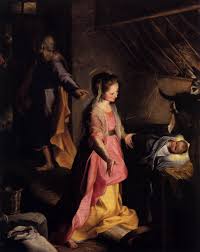
This intimacy is captured exquisitely by the Master of Urbino, Federico Barocci, in this Nativity which positively glows with the light of love.

federico-nativity

Bill Evans was the supreme lyric poet of the piano.

Listening to Bill’s unique sense of musical time and weight I find my spirit awakened, refreshed and released.

‘Blue in Green’ showcases the amazing precision and delicacy of his touch as a musician.

He is always instantly recognisable – the hallmark of true greatness.

This version of what has become a Jazz standard is from the Christmas 1959 session issued as, ‘Portrait in Jazz’.

You have to believe in telepathy when you hear Bill Evans play with Scott LaFaro (bass) and Paul Motion (drums)

This trio remains the benchmark for all piano trios.


Onward!

Onward our Sleigh proceeds cutting its way through the Christmas snow. Travel with me back in time now to Radio Recorders studios in Hollywood on September 7 1957.

A small group of men assemble to cut an album of Christmas songs. From Gadsden Tennessee the modestly brilliant guitarist Scotty Moore, from Memphis Tennessee the ever reliable bass player Bill Black and from Shreveport Louisiana the sprung-floor drummer D J Fontana.

Huddled together Gordon Stoker, Neal Matthews, Hoyt Hawkins and Hugh Jarrett – collectively the Jordanaires, a gospel quartet filled with the spirit. Today on piano sits Dudley Brooks.

Tuning up and swapping musicians banter they all look in the direction of a quietly spoken, respectful, hooded eyed, devestatingly handsome 22 year old from Tupelo Mississippi who has in the last few years recorded a series of records that seem to have shifted the axis of the planet.

In addition through his live shows and TV appearances he has set an entire generation ablaze to the marked discomfort of, ‘sensible’ folks who can’t bring themselves to approve of the shaky-legged, swivel-hipped singer who bears the ridiculous name of Elvis Aron Presley.

Embed from Getty Images

As usual the group will warm up by accompanying Elvis as he runs through some of the gospel songs that have surrounded him through his youth and adolescence.

If there’s one thing Elvis believes in and knows through his own bodily experience it’s the power of music to raise, thrill and sustain the spirit.

Neither he nor anyone else could have guessed when he started out that he would possess an almost unique capacity to supercharge a song, to sing with such relaxed intensity and charisma that the listener felt lifted up and transported whether the song was secular or sacred.

Given a half decent song Elvis always sang his heart out and on many occasions the results were and remain nothing short of miraculous.

Like the Beatles and Bob Dylan the best of Elvis’ records are if anything under rated for all the millions of copies they have sold.

I really don’t have a fixed position on many of the great political and cultural issues of our times though I’m happy to debate with anyone. What I am certain of and will jump up on any table anywhere, anytime, to proclaim before any audience is that Elvis was, is, and will always remain the King!

Elvis’ Christmas album was a massive success and continues to sell today. The cut featured above, ‘Santa Claus Is Back In Town’ was written by the whip smart pairing of Jerry Leiber and Mike Stoller who couldn’t have write a lifeless song if they had tried.

Here they provide Elvis with an opportunity to demonstrate his charm, his rhythm and blues chops and the sheer swaggering physical presence his vocals could embody.

I love the tip of the hat to Elvis’ love of the Cadillac and the erotic promise of the whole song incarnated in the line, ‘Hang up your pretty stockings, turn off the light …. ‘.

Christmas brings many forms of celebration not least the chance for lovers to share some quality time together. And, I can think of no one better to serenade such times than Elvis.

We move now from a lover’s serenade to a mother’s lullaby. ‘A la Nanita Nana’ is a traditional song from Mexico sung here with characteristic tenderness and care by Tish Hinojosa.

Tish (short for Leticia) grew up, the thirteenth child, in a crowded household in San Antonio, Texas. Through her brothers and sisters and the crowded radio waves she absorbed and was inspired by music from her native Mexican culture and the folk, country and rock ‘n’ roll traditions which suffice the very air of Texas.

I recommend her CDs, ‘Culture Swing’ and, ‘Frontejas’ for those of you inclined to further listening.


The historical facts of Jesus’ birth remain shrouded in the mysteries of antiquity. However, I think we can be sure mothers nursing their new born child have always sung songs to soothe the babe just exposed to the blooming buzzing confusion of this world of ours.

The first sound we hear as we grow in our mother’s womb is the beating of her heart and hers is the first face we come to recognise in those initial hours and days of life.

Similarly, our first sense of the musicality of language comes from the sound of our mother reassuring us that we are loved and all is well. If we are lucky we will carry this message with us throughout the whole of our lives.

I have no doubt that Mary, though she had much to ponder in her heart, will have sung to her precious babe a song that could we but hear it would sound very like, ‘A la Nanita Nana’.

Today’s poem is, ‘Christmas’ by John Betjeman a poet who managed to combine popularity with real poetic achievement.

‘ And is it true? And is it true?
This most tremendous tale of all,
Seen in a stained-glass Window’s hue,
The Maker of the stars and sea
Become a child on earth for me?

… No carolling in the frosty air,
Nor all the steeping-shaking bells
Can with this simple truth compare –
That God was Man in Palestine
And lives today in Bread and Wine.’

Christmas Cornucopia : Second Day

Second Day featuring:

A Painting by Fra Angelico (1395 to 1455)

A poem by U A Fanthorpe (1929 to 2009)

Music by Eartha Kitt, Harry Fontenot and Gustav Mahler sung by Kahleen Ferrier.


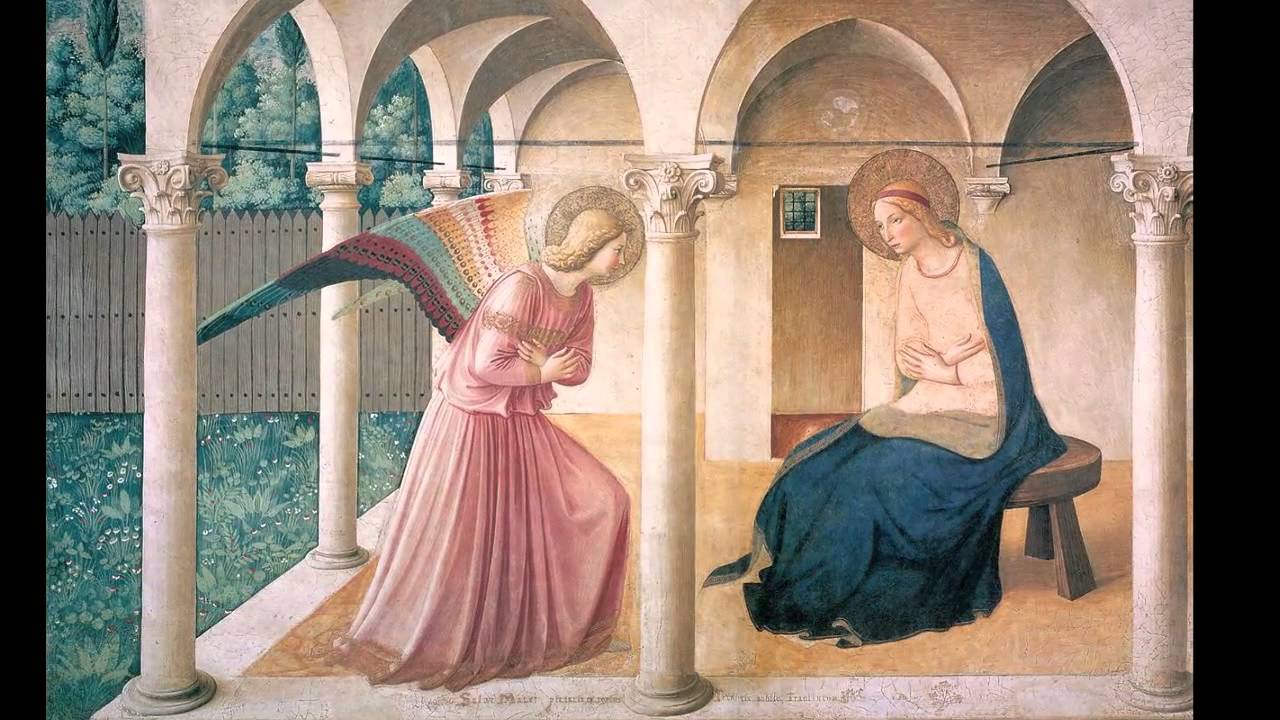
Today’s painting by Fra Angelico has long haunted my imagination since I first saw it in The Convent of San Marco in Florence.

It is a representation of an epochal event, The Annunciation, which holds human time and eternity in perfect balance.

fra-angelico-annuncition

When Kathleen Ferrier recorded, ‘Das Lied von der Erde’ the shadow of death was looming over her.

This is music making of the very highest order.

Here Kathleen Ferrier does not so much perform a song as become the song.

The rare emotional reach of her extraordinary voice bringing flesh and spirit to Mahler’s masterwork touches something very deep and unnameable within humanity.


Our sleigh moves on from yesterday sliding us forward on our Christmas journey.

Today we start with a song from an authentic show business legend – Miss Eartha Kitt and her classic, slinkily sensuous 1953 recording, ‘Santa Baby’.

Eartha performs the Springer brothers and Joan Javitt’s song in her trademark knowing style. As the song progresses Eartha makes a series of increasingly outrageous demands on Santa’s generosity.

All she wants is a sable, a convertible (light blue), a yacht, the deed to a platinum mine (gold being so common), a duplex, Tiffany jewellery and a ring (64 carat for sure).

Eartha’s vocal here supported by Henri Rene and his orchestra is a study in practiced come hither allure. The cynical lyric is caressed as she reels in our attention.

Seeing her perform the song live is to see a siren setting a song ablaze with the flames licking around the mesmerised audience.

Everything Eartha did carried a charge of the exotic – she looked, moved and spoke like no one else building on her black, Cherokee and White heritage and dance training to create a unique image that demanded the audience’s deference and worship.

Orson Welles famously called her the most exciting woman in the world and while others of her era like Marilyn Monroe and Elizabeth Taylor might have taken issue with that claim they too would surely have admired the sheer dramatic daring of Eartha’s regal performance of, ‘Santa Baby’.

Come on Santa – hurry down the chimney and don’t forget the sable.

Fr Josef Mohr wrote a poem in 1816 he called, ‘Stille Nacht’. Two years later on Christmas Eve 1818 with a midnight mass in prospect he decided to visit his friend Franz Gruber a choirmaster and organist to see if there was any chance of turning, ‘Stille Nacht’ from a poem into a carol to perform that night.

Mohr had to walk several kilometres to se his friend who set to work with such vigour and inspiration that an arrangement for guitar and voice of, ‘Stille Nacht’ was ready as the two set off to Fr Mohr’s church in Oberndorf.

So, in the cold of an Austrian night on Christmas Eve 1818 the carol, ‘Stille Nacht’ or, ‘Silent Night’ as it is known in the English speaking world was sung for the very first time.

Neither of the writers or the congregation could possible have known that the heartfelt simplicity of, ‘Silent Night’ contained a spiritual power and attractiveness that would go on to make it perhaps the most loved of all church based Christmas songs.

Congregations all over the world this Christmas Eve will echo the words and melody created nearly two hundred years ago and find that it’s magic never fades.

There is no counting the number of versions available of, ‘Silent Night’. The one I have chosen to showcase here is by a gorgeous Cajun version by accordionist Harry Fontenot.

I love the rustic simplicity of this version – it seems to me the kind of sound that would not have sounded out of place in a stable with animals and shepherds gathered around to witness an event that was at once entirely commonplace – the birth of a child.

And yet all present had the sense that this birth was something very special that would remake the world for all eternity.

‘Silent Night, Holy Night, All is calm, all is bright ……….

The poem providing our extract today is the short but immensely wise, ‘BC : AD’ by the much under rated U A Fanthorpe.

‘… And this was the moment
When a few farm workers and three
Members of an obscure Persian sect

Walked haphazard by starlight straight
Into the kingdom of heaven.’

On the cover of Sergeant Pepper: Dion – Runaround Sue!

You may recall that in the recent post about Captain Beefheart I mentioned selecting The Beatles, ‘Sergeant Pepper’ LP from my vinyl shelves.

That storied record is famous not only for its treasury of superb songs but also for its endlessly intriguing cover which features a gallery of contemporary and historical cultural icons.

The Beatles, typically eclectic, choices included Carl Jung, Oliver Hardy, Sonny Liston, Mae West, Lenny Bruce, Karl Marx, Lewis Carroll, Albert Einstein and Albert Stubbins (look him up!)

Surprisingly, only two contemporary American musicians made the hallowed cover.

Inevitably, one was Bob Dylan, who was an enormously influential figure in the development of The Beatles songwriting.

The other American legend they selected, proof of their unending devotion to the primal spirit of Rock ‘n’ Roll, was none other than Dion Francis DiMucci – the King of The Bronx and one of the very greatest artists in the history of the music.

Embed from Getty Images

Dion for an astonishing seven decades has shown himself to be a superlative singer with the ability to make songs come thrillingly alive.

Tracing his career you will find magnificent records displaying his empathy and mastery of virtually the entire spectrum of American roots music.

So, with The Belmonts we have the exuberant Doo-Wop of, ‘I Wonder Why’ and the delirious Pop angst of, ‘ A Teenager in Love’.

As a solo act he produced electrifying Rock ‘n’ Roll in, ‘The Wanderer’  and deep insights into the Blues with, ‘Hoochie Coochie Man’ and the scarifying, ‘Daddy Rollin’ (In Your Arms’).

As a singer-songwriter he was capable of a bone chilling confessional threnody like, ‘Your Own Backyard’ and the utterly charming, ‘New York City Song’.

He was quick to spot the distinctive talents of Bob Dylan and Tom Waits as his must hear covers of, ‘It’s All Over Now, Baby Blue’ and, ‘Heart of Saturday Night’ demonstrate in spades.

For insight into life on the gritty New York Streets only Lou Reed comes near Dion’s epic, ‘Midtown American Street Gang’.

You want Gospel balm? Listen up to the exquisite entreaty of Dion’s, ‘Abraham, Martin and John’.

Taken all in all Dion’s catalogue stands as the autobiography of an always questing pilgrim soul and the blazing testament of a true American Master.

And he did all this battling heroin addiction.

Notwithstanding the excellence of all the above tracks when it came to selecting a record to take its place on The Immortal Jukebox I didn’t hesitate for a micro-second.

No, it has to be, has to be, just has to be, ‘Runaround Sue’ a record I love to the point of near insanity.

Take it from Thom – no one has ever sung a Rock ‘n’ Roll song with such enthralling energy and sheer swagger as Dion does here!

Listen, people let me out you wise …


Great Gosh A Mighty!

Dion’s singing here leaves me exultant and breathless with joy filled admiration.

As he sings you are swept along on a magic carpet of delight almost sure there’s no mountain or skyscraper you couldn’t nonchalantly soar over as you follow Dion’s imperious vocal.

Listen, people what I’m telling you.

When it comes to Rock ‘n’ Roll singing Dion ain’t just the King of The Bronx!

No, he’s The Guy. The Guy who knows. The Guy who knows!

Where did all this mastery come from?

Why from Prospect Avenue, Belmont, The Bronx, New York City – that’s where.

Embed from Getty Images

As a  young boy growing up he was surrounded by a vibrant Italian/American community where the streets were alive with song – operatic arias, Tin Pan Alley crooning.

And from the stoops and the subways groups of young kids with hope in their hearts sending harmonies soaring high into the New York night sky.

As he sat on the fire escape shooting the breeze he was glued to the radio. Through the sacred ether came the transporting, life changing, life defining, sounds of Doo- Wop, Rhythm and Blues, Gospel and Rock ‘n’ Roll.

Unforgettable, emotion charged voices, voices like those of Hank Williams and Sam Cooke seemed to summon his own voice.

So, as a young man, seeking to find his own identity, he found that he had been blessed with a gift. A gift which would win him the admiration of the local bloods and the local belles.

And soon, when that sensational voice was captured on tape, the admiration of the whole wide world!

Dion brings all his heritage and all gifts to Runaround Sue.

There is love and laughter and life in abundance in every syllable that Dion sings.

So, he can invest deep emotion into wordless swoops and delicately evoke the romance of the touch of her hair and the (still felt and much missed) warmth of her lost embrace.

As Dion sings the story is sad but true. Everyone has had their heart broken by someone who ran around.

You don’t want to cry. But you do. You do.

He sings, ‘Runaround Sue’ like a man creating a moral and a story to console himself as he walks home. And as he walks he finds that his downcast grimace turns into a wry smile before becoming a broad grin.

Then he begins to laugh.

Laugh, with love in his heart as he admits to himself just how how much of a fool he has been.

Perhaps the beginning of wisdom is the admission we are all fools.

Fools for Love. Fools for Love.

And long may it remain so.

Notes:

The superb backing vocals on Runaround Sue are provided by The Del-Satins.

Runaround Sue was co-written by Ernie Maresca.

It was, of course, a multi million selling Number One on the 1961 Billboard Charts.

I have made it a point of honour to own every Record Dion has ever made.

For those of you yet to share my obsession as well as all the tracks referred to above I recommend:

‘The Very Best Of Dion & The Belmonts’ on One Day Music

‘Yo Frankie’ on Arista

‘New Masters’ on Collectables

‘Bronx in Blue’ and ‘Son of Skip James’ on SPV

‘New York Is My Home’ on Blue Horizon

‘Bronx Blues’ and ‘The Road I’m On’ on Columbia.

Dion’s autobiography, ‘The Wanderer’ is a fascinating read.

However, to my mind the most revealing insight into his life can be found on an article he wrote about his return to Catholicism. See Link below

http://www.chnetwork.org/story/dion-dimucci-the-wanderer/

And Finally!

Please don’t forget to vote for The Immortal Jukebox in The UK Blog Awards!

Voting remains open till 18 December.

Follow the link below and select Art & Culture from the drop down menu:

http://blogawardsuk.co.uk/ukba2017/entries/immortal-jukebox