Christmas Cornucopia 2016 : Ninth Day

Ninth Day

A Painting by Peter Paul Rubens (1577 to 1640)

A Poem by Norman Nicholson (1914 to 1987)

Music by  Chopin played by Claudio Arrau (1903 to 1991), Joe Tex and June Christy.


Our painting today is, ‘The Adoration of the Magi’ by Peter Paul Rubens.

More accurately, it is the the modello (a sketch shown to a patron for approval of the composition) for the altarpiece painted by Rubens for the convent of the Dames Blanches, Louvain now in King’s College Chapel, Cambridge.

rubens-adoration

There is a wonderful humanity in this work.

Though the event depicted was of universal importance it was witnessed, experienced, by, ‘ordinary’ men and women (and let us not forget animals as the peering camels here humorously demonstrate) on a day when the sun rose and set like any other.

Miracles take place (far more often than, ‘common sense’ will allow) against  the background of every day events.

Rubens manages to make each of the individual characters in the scene vividly present.

I feel as if I could  walk directly into this company and be made welcome.


Devotees of Chopin and his piano works, especially The Nocturnes, can spend long hours debating which great pianist has searched their depths most successfully.

I have never wavered in my conviction that the magical recordings made by Claudio Arrau must wear the crown.

His version of The Nocturnes has the quality of meditative prayer.


After the above and yesterday’s stop to gaze reverentially heavenward it’s time to turn to more earthly considerations.

The Greeks, as you might have expected, had different words to describe the varied forms of love we express and experience.

Yesterday we were concerned with Agape – the love of God for man and man for God. Today we will find songs that express Eros – sensuous, sexual love and the appreciation of beauty and Philia – the love expressed in affectionate regard and friendship.

Now we turn to a tremendous southern soul sermon from a master and mentor for the genre, Joe Tex. ‘I’ll Make Everyday Christmas (For My Woman)’ glows bright with Joe’s gently enveloping passion.

Joe’s forte was telling stories in song using humour and homespun wisdom so that you felt he was gifting you the hard won lessons of a richly lived life.


Joe had a country preacher’s sense of the hunger in the audience for parables that would make sense of the roadblocks and confusions assailing them in their lives and provide a route map for the way ahead.

Embed from Getty Images

They knew that Joe didn’t pretend that he had never been a rounder and a rogue as well as a true romantic and love disciple.

We often, rightly, pay more attention to the testimony of someone who admits to failure and frailty than those in their whited sepulchres who are quick to admonish our every fault.

Joe sings the song with a steadily growing intensity almost as if the promise he was making was as much to his own better self as to the woman it was made to.

When the record finishes its hard not to say, ‘Amen! Brother, Amen!’ and vow to make sure you too take care to make everyday Christmas for your own woman or man.

Next, the delightfully cool Miss June Christy with, ‘Christmas Heart’. June was a veteran big band vocalist who followed Anita O’Day as the singer with Stan Kenton.

As a solo artist she made a magnificent album, ‘Something Cool’ which should be on the shelves of anyone with an appreciation of the art of jazz singing.


I have always found something deeply engaging in the understated, wistful tone June Christy brings to a song.

It seems she has stripped out all unnecessary flourishes so that we hear the essence of the song as she steers us gently to understanding through her embrace of the melody and lyric.

The lack of hectoring or self regard in, ‘Christmas Heart’ makes its dreamlike plea for Christmas to be a day when all the wounded find rest and balm all the more affecting.

You never really need to ask who is your neighbour – just look around you.

Today’s poem is, ‘Carol For The Last Christmas Eve’ by a favourite poet of mine, Norman Nicholson from Millom in England’s rural Cumbria.

Never fashionable Nicholson’s work will endure.

‘The first night, the first night,
The night that Christ was born,
His mother looked in his eyes and saw
Her maker in her son.

The twelfth night, the twelfth night,
After Christ was born, the Wise Men found the child and knew
Their search had just begun.

But the last night, the last night,
Since ever Christ was born,
What his mother knew will be known again,
And what was found by the Three Wise Men,
And the sun will rise and so will we,

Umpteen hundred and eternity’


Christmas Cornucopia 2016 : Eighth Day

Eighth Day :

A Painting by El Greco (Domenikos Theotokopoulos 1541 to 1614)                                      

A Poem by Patrick Kavanagh (1904 to 1967)

Music by John Dowland (1563 to 1626) played by Julian Bream, The Chieftains with Nanci Griffith and The Trinity Lavra Choir


Our painting today, ‘The Adoration of the Shepherds’ is a work of blazing, visionary brilliance by El Greco who had the artistic bravery characteristic of genius in all ages.

el-greco-nativity

El Greco depicted the human body and used colour and perspective in a manner that was wholly individual.

The awe inspiring intensity of his vision breaks down any conventional, ‘tutored’ response.

To my mind his art is a true veil shredding glimpse into a co-existing reality : present then and present now.

This painting, more than any other I know, captures the enormity of the event which took place some two thousand years ago.

It is a peerless hymn of exultation and adoration.

Today’s spirit refreshing music comes courtesy of John Dowland who can genuinely be described as a Renaissance Man in view of the time he lived in and the depth of his talents as a composer, Lutenist and singer.

His works will enter your consciousness like a pebble dropped into a pond with ever widening circles of effect.

Julian Bream is another musician with, ‘The Touch’.

Music played by Bream flows purely and naturally from his fingers to our hearts.


Further music comes from two countries: Russia and Ireland which share a reverence for poets and prophets, visionaries, bards and shamans.

Both have produced more than their fair share of saints, scholars and wayward genuises.

In both lands a sense of the numinous pervades the air and prayers ascend unceasingly heavenward – even in the increasingly secular modern age.

Of course, both countries are filled with a hundred times the number of would be writers to actual page blackening writers and both have to deal with the drunken consequences of frustrated spirituality encountering the demon drink.

Still, veil-piercing poetry and song are central to the cultural life and achievements of Ireland and Russia.

Both peoples love to carouse until they are stupefied yet both are capable of being stilled to silence and tears by a simple lyric or an exquisite slow air.

Let’s listen now to the exquisite, ‘Wexford Carol’ performed by the veritable custodians of Ireland’s traditional music, The Chieftains (here accompanied by a Texas rose, Nanci Griffith).


The Wexford Carol may well date back to the twelfth century though it’s widespread popularity is due to the work of William Gratton Flood, who was musical director of Enniscorthy Cathedral in the late 19th century.

The Chieftains play with an authority born of thousands of hours of perfecting their craft as traditional musicians – always respectful of the source material while being alert to each other’s role in bringing a tune to shimmering life.

The Chieftains, led by Piper Paddy Moloney, who has proved to be a natural born networker, have recorded many inspired collaborations with leading artists in many musical genres (though their greatest collaboration is probably with an artist from their own island – Van Morrison).

Here, Nanci Griffith sings the carol with a beguiling gravity befitting the immensity of the events portrayed. Listening I feel as I were marching in a torchlit devotional procession with the same moon that shone over Bethlehem above the sentinel trees of the forest around me.

Next, from a powerhouse of Otthodox Russian monasticism, ‘The Song Of The Magi’. The choir is from the Trinity Lavra (monastery/hermitage) of St Sergius in Sergiyev Posad some 50 miles from Moscow.

This has to be the sound of the breath of the Russian soul. Russian Othodox services provide doorways to contemplate the divine – an opportunity in stillness to be lifted into a different realm of being.

Giving ourselves over to such an experience can be profoundly uplifting and over time transformative.


Russian spirituality opens itself to mystery and awe accepting that grace cannot be willed but only gratefully accepted.

The Magi travelled long miles in search of a new kind of King and gave their gifts to a babe in a manger. Perhaps, listening to this work we could learn to give the gift of an attentive soul.

The poem today, ‘A Christmas Childhood’ is provided by one of the great figures of 20th Century Irish Literature, the sage of Iniskeen, Patrick Kavanagh.

‘Cassioepeia was over
Cassidy’s hanging hill,
I looked and three whin bushes rode across
The horizon – the Three Wise Kings.

An old man passing said:
‘Can’t he make it talk –
The melodian’. I hid in the doorway
And tightened the belt of my box-pleated coat.

I nicked six nicks on the door-post
With my penknife’s big blade –
There was a little one for cutting tobacco.
And I was six Christmases of age.

My father played the melodeon,
My mother milked the cows,
And I had a prayer like a white rose pinned
On the Virgin Mary’s blouse’.


This post dedicated to the deceased members of The Chieftains:
Fiddler Martin Fay, Tin Whistle and Bodhran player Sean Potts and the mystical doyen of the Irish Harp, Derek Bell.


Christmas Cornucopia 2016 : Seventh Day

Seventh Day :

A Painting by Tintoretto (1518 to 1594)

A Poem by Richard Middleton (1882 to 1911)

Music by Gluck sung by Janet Baker, Chris Isaak and John Prine


tinteretto-nativity

Tintoretto’s wondrous Nativity shows how, ‘The Light Of The World’ once confined to a manger within a rude stable began to bestow grace on all the surrounding world.

This a dynamic painting which foreshadows the mission of redemption the tiny babe was born to accomplish.


Janet Baker is an artist of the highest order.

Her utter technical command and her ability to unerringly find emotional truth resulted in a legendary career garlanded with landmark recordings and never to be forgotten stage performances.

Her performance of, ‘Che faro senza Euridice’ will live with me always as I make my journey through the dark wood.

Onward!

Well our Sleigh has travelled more than halfway now on our journey to celebrate ChristmasTide.

Yesterday’s choices put me in something of a wistful contemplative mood and led to today’s selections by Chris Isaak and John Prine.

Christmas is a time when we often turn our minds to reflection on the health of our relationships. Relationships with our parents, our siblings, our children and our spouses or partners.

And, we remember bitterly or with rueful affection the relationships of old which are now part of our history – part of the person staring back at us in the mirror.

Christmas can be a healing and nurturing time for relationships it can also be the occasion for exhausting, tearful sunderings which will sully the season for years or decades to come.

As in all things some will say you get the Christmas your life through the preceding year has mapped out for you.

I now present a ballad of loss and longing from the golden boy out of Stockton, California – Chris Isaak. It’s not his fault that he looks like a matinee idol and that the microphone loves him almost as much as the camera.

‘Christmas On TV’ tells the sorry tale which Isaak sings without over emoting of a bereft husband with his nose pressed to the window glass watching the Christmas celebrations of his ex-wife and her well heeled new beau.

Though he’s only across the street from the happy pair (or so they seem to him) he might as well be a million miles away. It’s so easy to be all alone in the midst of the crowd as the carols play and the lights twinkle.

Sometimes only fortitude, a good whiskey and a ballad in blue will get you through.

Merry Christmas to the lost and the lonely, the abandoned, the abused and the outcasts.


Next John Prine who sits at the top table of American songwriters leaning back in his chair with either a rueful smile or a goofy grin depending on the circumstances of the day.

Prine has a glorious gift for examining the human heart and it’s myriad joys and travails with a the precision of a tender surgeon. It seems as if he has watched carefully and listened closely as he has moved through life – building up a store of experiences he can hone into humorous shaggy dog stories, touching love songs or heartbreaking tales of misspent or misshapen lives.


John Prine has wisdom which he wears lightly – we can all learn a lot from leaning in when he speaks.

Very few songwriters could match the songwriting carpentry Prine demonstrates in, Christmas In Prison’. I remember my intake of appreciative breath when I first heard the lines:

‘I dream of her always even when I don’t dream – her name’s on my tongue and her blood’s in my stream’.

The Big House searchlight spotlights the snowflakes like dust in the sun and the prisoners aching for those they love outside the walls make do with Turkey and pistols carved out of wood.

They’re all homesick waiting for eternity to release them. In the meantime nothing to do but sing up and hope the homesick blues fade away for one night at least.

John Prine has a heart as big as any goddamn jail and if I’m ever in Prison it’s his songs I would sing as the doors clanged shut each night.

Today’s poem, ‘The Carol Of The Poor Children’ is by Richard Middleton.

‘Are we naked, mother, and are we starving-poor
Oh, see what gifts the kings have brought outside the stable door
Are we cold, mother, the ass will give his hay
To make the manger warm and keep the cruel winds away
We are the poor children, but not so poor who sing Our Carols with our voiceless hearts to greet the new-born king
On this night of all nights, when in the frosty sky A new star, a kind star is shining on high!’.


Christmas Cornucopia : Sixth Day

Sixth Day :

A Painting by Geertgen tot Sint Jans (1465 to 1495)

A Poem by Christina Rossetti (1830 to 1894)

Music by Hildegard of Bingen (1098 to 1179) sung by Emma Kirkby and Gothic Voices, The Unthank Sisters and The Larks.


night-nativity

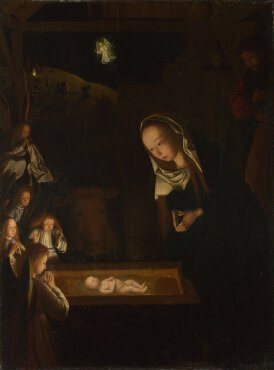
St Bridget of Sweden had a mystic vision of The Nativity.

Today’s painting by the Flemish artist Geertgen tot Sint Jans makes that ineffable vision a reality before our eyes and in our hearts through virtuoso deployment of light and shadow.

Looking at this tender scene we remember Christ’s statement:

‘ I am the light of the world: he that followeth me shall not walk in darkness, but shall have the light of life.’


Our heart stilling music today was composed by one of the most extraordinary figures of the Middle Ages (indeed of all Ages!).

Hildegard of Bingen was a Benedictine Abbess whose haunting compositions refelect her mystical experiences and her philosophical beliefs.

I vividly recall the first time I heard this music in Tower Records at Piccadilly Circus in London. As the gorgeous vocal lines enchanted me I knew, at once, that this record would be a life time companion. And so it has proved.

The majestic soprano Emma Kirkby wonderfully complemented by The Gothic Voices under the direction of Christopher Page takes us into mystical terrain where every hair is numbered like every grain of sand.

Terrain where Hildegard’s vision of herself as a feather on the breath of God makes perfect sense.

We are all feathers on the breath of God.

Now we return to our Sleigh which has been travelling for 6 days rushing towards its destination on Christmas Eve.

So, for today’s post we will apply the breaks to give ourselves and our willing reindeers a much needed rest.

Sometimes the preparations for Christmas can overwhelm us as we worry about all we have to do in such a short time. We can be in danger of falling into the trap of speeding through the season without stopping to savour its true joys and meaning.

Perhaps we should remember that at the heart of this event is a birth. A birth much awaited and anticipated by the contemporary family at the centre of the story and by the wider human family of time past, time present and time future.

At this birth time and eternity merged to create a new beginning of hope and promise for all of mankind.

Mothers have to learn to be still and patient as they wait (especially for their first birth) for the great day, the great moment, to arrive when they will no longer be a mother-to-be but a mother.

There comes a miraculous moment, a moment, when after all the waiting and worry that the baby, her child! who has been knit together in the safety of their womb emerges into the world as a unique new creation.

This is a moment for stillness and awe and for gratitude.

The next recording featured today is achingly filled with stillness and awe.


The Unthank Sisters from God haunted Northumberland perform Christina Rosetti’s, ‘In The Bleak ‘Midwinter’ with startling calm and grace allowing the song to breathe and bloom into something truly marvelous.

I imagine we all hold our breath throughout this performance as we are caught in the spell of the poet’s striking images and the heart piercing intensity of the siblings vocals.

Now, a recording by one of my favourite 50s vocal groups The Larks.

The sound here is hushed, seemingly suspended in time. Listening to, ‘All I Want For Christmas Is You’ I feel as if I were a snowflake caressed by gentle drafts and surrounded by millions of other snowflakes falling slowly, slowly, slowly to the earth below.


It would be perverse today to showcase any other poem but Christina Rosetti’s masterpiece, ‘In The Bleak Midwinter’.

‘Angels and archangels
May have gathered there,
Cherubim and seraphim
Thronged the air-
But only His mother
In her maiden bliss
Worshipped the Beloved
With a kiss

What can I give Him?
Poor as I am?
If I were a shepherd
I would bring a lamb;
If I were a wise man
I would do my part;
Yet what I can, I give Him-

Give my heart’


Christmas Cornucopia : Fifth Day

Fifth Day featuring :

A Painting by Taddeo Gaddi (1290 to 1366)

A Poem by Patric Dickinson (1919 to 1994)

Music by Louis Armstrong and Kay Starr

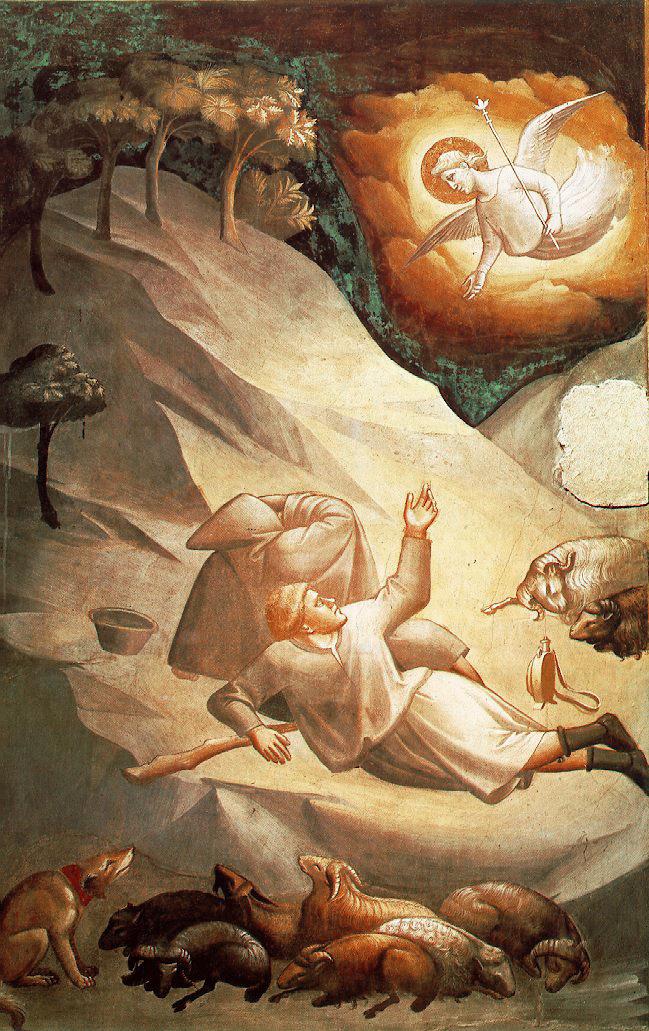
Today’s painting is by the Florentine Taddeo Gaddi who was the star pupil of the great Master, Giotto.

His, ‘The Angelic Announcement to the Shepherds’ can be seen in the Baroncelli Chapel within Santa Croce in his native Florence.

It is a wonderfully dramatic painting.


gaddi_taddeo_announcement

An Angel acts as God’s messenger alerting humankind to an event upon which all history will pivot.

The Sheep are stirring and the Dog’s keen senses alert him to the messenger from afar.

As the Angel speaks eternity merges with linear time.

How could the waking Shepherd find the words to tell his sleeping companion what he has learned?

Surely all he could say was:

‘Let us go – someone we must see is waiting for us just down the hill. Come now!’

It is an invitation which remains open.

Onward!

Our Sleigh is picking up a very special passenger today. He’s here to sing and play on a Christmas song, ‘Zat You, Santa Claus?’ that has the effervescence of a fine champagne.

Of course, I’m talking about Louis Armstrong.

If they ever get round to carving four heads into a mountain to celebrate musicians in the way that Presidents are celebrated at Mount Rushmore there can be no argument among men and women of reason that the first head to be carved must be that of Louis Armstrong.


Zat You, Santa? Zat You, Louis?

I could set out an exhaustive list of his astounding achievements as the preeminent musician of the 20th century with special reference to his role as the pioneer genius who transformed a pastime into an art form and who influenced everyone who ever had the good fortune to hear him play.

Others far better qualified than I have written major scholarly tomes on the subject. So, I will limit myself to a few remarks on the effect hearing the great man has had on me.

When I hear Louis play (at every period of his career) I hear the sound of a master musician revelling in the sheer joy of making music.

It was as if he lived and breathed through playing his horn – singing a song of exultation; using without reserve the wondrous gifts of imagination and creative daring yoked to technical brilliance that made him a such a unique musician.

Add to that his personal warmth and ebullience and you have a musician and a man who simply made everyone who encountered him feel better, more human and more glad to be alive.

Isn’t what Santa Claus is supposed to do too?

Next a singer, the late Kay Starr, who knew how to swing and who had the chops to share a bandstand with the finest musicians of her era.

Born on a reservation in Oklahoma with an Iroquois father and an Irish/Native American mother she was as American as you can be.

Maybe that’s how she could sing the hell out of any song in any genre of American popular music.

Embed from Getty Images

Kay had an inbuilt sense of rhythm and the ability to musically inhabit and sell a lyric. Listen here to how she brings out the drive and the humour of, ‘Everybody’s Waitin’ For The Man With The Bag’.

One of the co-writers of the song was Dudley Brooks who featured earlier in the list featuring Elvis Presley.

I can’t honestly say I have done everything I should this year (extra special good) but I can recognise an extra special good singer when I hear one and Kay Starr must be one of the best and merriest we ever did have!

Today’s poem is, ‘Advent: A Carol’ by Patric Dickinson a writer who revered and translated the Classical poets while looking at the world himself with a sharply individual measured intelligence.

‘What did you hear?
Said stone to echo:
All that you told me
Said echo to stone.

Tidings, said echo,
Tidings, said stone,
Tidings of wonder
Said echo to stone.

Who then shall hear them?
Said stone to echo:
All people on earth,
Said echo to stone.

Turned into one,
Echo and stone,
The world for all coming
Turned into one.’


Christmas Cornucopia : Fourth Day

Fourth Day featuring :

A painting by Giorgione (1477 to 1510)

A poem by Christopher Smart (1772 to 1771)

Music by Mae McKenna & Mairi Macinnes and Roger Miller

Giorgione, a Venetian artist from the period of the High Renaissance, remains a figure of intense mystery.


giorgione_-_adoration_of_the_shepherds_-_national_gallery_of_art

What we can say from his, ‘The Adoration of the Shepherds’ (NGA Washington) is that he could suspend time and evoke awe and silent wonder.

This painting offers us a profound sense of reverence. The Nativity tableau shows Mary communing with her child as both motherly protector and prayerful worshiper.

Joseph, so often the forgotten man of the narrative, seems overwhelmed by the enormity and mystery of the events he has been caught up in.

Shepherds were ill-regarded outsiders in biblical times. Yet, it was they who were granted the blessing of an audience with the new born King.

This must be some new type of King who welcomes first the poor and the ragged before the rich and high born.

The sight greeting the Shepherds was beyond words.

Their attitude of humble surrender to an experience beyond their understanding is intensely moving.

Our contemplative music today comes from the Hebrides.

The Christ Child’s Lullaby or Taladh Chriosda in Scots Gaelic is full to the brim with maternal feeling for the vulnerable new born.

Mother and child, once one, now two, create together a sacred space where love and mutual regard dwells.

The standing stone vocals of Mae McKenna and Mairi Macinnes, switching fluently between languages, supported by the pellucid instrumental playing of William Jackson and Tony McManus casts a timeless spell.


Onward!

Our Sleigh cuts a deep track through the falling snow as it’s carrying a whole heap of presents for all the good boys and girls all around the world (the list has been checked twice and we surely know who has been naughty and who has been nice).

Our first song is, ‘Old Toy Trains’ by the one and only Roger Miller. He wrote a hatful of hit songs, was a multiple Grammy winner and admitted to the Country Music Hall Of Fame.

In addition he also had a theatrical Tony Award in his trophy cabinet for his score for the hit Broadway musical, ‘Big River’ which he based on the writings of Mark Twain.

Despite all the above he has always seemed to be to be under rated with many damning him with the faint praise of describing him as a writer of, ‘Novelty Songs’.

Certainly there is humour in his songs but as anyone who is any kind of honest writer will tell you it is much harder to write comedy than it is to write tragedy.

Embed from Getty Images

The key to understanding Miller’s very real eminence as a songwriter lies in the sharpness of his observations expressed in language that is simple in nature but complex in impact.

Roger Miller had a poor upbringing but as he said words became his toys and you can feel that in the playfulness and delight with which he uses the resources of the American language as spoken by the everyday working man and woman.

Roger Miller liked people and liked telling stories that would resonate with their common experiences. Listening to him you do feel spoken to by a ruminative and intelligent man who has seen enough of life to be slow to judge and quick to smile.

There’s often a metaphorical raised eyebrow in the tone of his language and vocals but never a raised fist.

‘Old Toy Trains’ is a simple song that catches the magic of Christmas Eve – a magic that it is easy to lose or forget as we grow in supposed sophistication. Miller taps into the time- suspended feeling as we approach a great event and the hope we all have that all will be calm and all will be well.

Most of us will look back on a present we received when we were young children and reflect that no later gift has ever so perfectly matched our dreams than the toy train, drum, doll (or in my case) a cowboy outfit we received and cherished all those years ago.

Today’s poem extract comes from, ‘Christmas Day’ by Christopher Smart – an 18th Century English poet who pursued his vocation steadfastly despite spells in an asylum and prison.

‘Spinks and ouzles sing sublimely,
We too have a saviour born,
Whiter blossoms burst untimely
On the blest Mosaic thorn

God all-bounteous, all-creative,
Whom no ills from good dissuade,
Is incarnate and a native
Of the very world he made.’

Christmas Cornucopia : Third Day

Third Day featuring :

A Painting by Federico Barocci (1526 to 1612)

A Poem by John Betjeman (1906 to 1984)

Music by Bill Evans, Elvis Presley and Tish Hinojosa


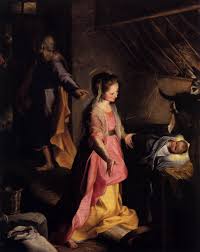
Above all Christmas celebrates a birth.

And, there is nothing more intimate than the bond between a mother and child after a birth.

This intimacy is captured exquisitely by the Master of Urbino, Federico Barocci, in this Nativity which positively glows with the light of love.

federico-nativity

Bill Evans was the supreme lyric poet of the piano.

Listening to Bill’s unique sense of musical time and weight I find my spirit awakened, refreshed and released.

‘Blue in Green’ showcases the amazing precision and delicacy of his touch as a musician.

He is always instantly recognisable – the hallmark of true greatness.

This version of what has become a Jazz standard is from the Christmas 1959 session issued as, ‘Portrait in Jazz’.

You have to believe in telepathy when you hear Bill Evans play with Scott LaFaro (bass) and Paul Motion (drums)

This trio remains the benchmark for all piano trios.


Onward!

Onward our Sleigh proceeds cutting its way through the Christmas snow. Travel with me back in time now to Radio Recorders studios in Hollywood on September 7 1957.

A small group of men assemble to cut an album of Christmas songs. From Gadsden Tennessee the modestly brilliant guitarist Scotty Moore, from Memphis Tennessee the ever reliable bass player Bill Black and from Shreveport Louisiana the sprung-floor drummer D J Fontana.

Huddled together Gordon Stoker, Neal Matthews, Hoyt Hawkins and Hugh Jarrett – collectively the Jordanaires, a gospel quartet filled with the spirit. Today on piano sits Dudley Brooks.

Tuning up and swapping musicians banter they all look in the direction of a quietly spoken, respectful, hooded eyed, devestatingly handsome 22 year old from Tupelo Mississippi who has in the last few years recorded a series of records that seem to have shifted the axis of the planet.

In addition through his live shows and TV appearances he has set an entire generation ablaze to the marked discomfort of, ‘sensible’ folks who can’t bring themselves to approve of the shaky-legged, swivel-hipped singer who bears the ridiculous name of Elvis Aron Presley.

Embed from Getty Images

As usual the group will warm up by accompanying Elvis as he runs through some of the gospel songs that have surrounded him through his youth and adolescence.

If there’s one thing Elvis believes in and knows through his own bodily experience it’s the power of music to raise, thrill and sustain the spirit.

Neither he nor anyone else could have guessed when he started out that he would possess an almost unique capacity to supercharge a song, to sing with such relaxed intensity and charisma that the listener felt lifted up and transported whether the song was secular or sacred.

Given a half decent song Elvis always sang his heart out and on many occasions the results were and remain nothing short of miraculous.

Like the Beatles and Bob Dylan the best of Elvis’ records are if anything under rated for all the millions of copies they have sold.

I really don’t have a fixed position on many of the great political and cultural issues of our times though I’m happy to debate with anyone. What I am certain of and will jump up on any table anywhere, anytime, to proclaim before any audience is that Elvis was, is, and will always remain the King!

Elvis’ Christmas album was a massive success and continues to sell today. The cut featured above, ‘Santa Claus Is Back In Town’ was written by the whip smart pairing of Jerry Leiber and Mike Stoller who couldn’t have write a lifeless song if they had tried.

Here they provide Elvis with an opportunity to demonstrate his charm, his rhythm and blues chops and the sheer swaggering physical presence his vocals could embody.

I love the tip of the hat to Elvis’ love of the Cadillac and the erotic promise of the whole song incarnated in the line, ‘Hang up your pretty stockings, turn off the light …. ‘.

Christmas brings many forms of celebration not least the chance for lovers to share some quality time together. And, I can think of no one better to serenade such times than Elvis.

We move now from a lover’s serenade to a mother’s lullaby. ‘A la Nanita Nana’ is a traditional song from Mexico sung here with characteristic tenderness and care by Tish Hinojosa.

Tish (short for Leticia) grew up, the thirteenth child, in a crowded household in San Antonio, Texas. Through her brothers and sisters and the crowded radio waves she absorbed and was inspired by music from her native Mexican culture and the folk, country and rock ‘n’ roll traditions which suffice the very air of Texas.

I recommend her CDs, ‘Culture Swing’ and, ‘Frontejas’ for those of you inclined to further listening.


The historical facts of Jesus’ birth remain shrouded in the mysteries of antiquity. However, I think we can be sure mothers nursing their new born child have always sung songs to soothe the babe just exposed to the blooming buzzing confusion of this world of ours.

The first sound we hear as we grow in our mother’s womb is the beating of her heart and hers is the first face we come to recognise in those initial hours and days of life.

Similarly, our first sense of the musicality of language comes from the sound of our mother reassuring us that we are loved and all is well. If we are lucky we will carry this message with us throughout the whole of our lives.

I have no doubt that Mary, though she had much to ponder in her heart, will have sung to her precious babe a song that could we but hear it would sound very like, ‘A la Nanita Nana’.

Today’s poem is, ‘Christmas’ by John Betjeman a poet who managed to combine popularity with real poetic achievement.

‘ And is it true? And is it true?
This most tremendous tale of all,
Seen in a stained-glass Window’s hue,
The Maker of the stars and sea
Become a child on earth for me?

… No carolling in the frosty air,
Nor all the steeping-shaking bells
Can with this simple truth compare –
That God was Man in Palestine
And lives today in Bread and Wine.’

Christmas Cornucopia : Second Day

Second Day featuring:

A Painting by Fra Angelico (1395 to 1455)

A poem by U A Fanthorpe (1929 to 2009)

Music by Eartha Kitt, Harry Fontenot and Gustav Mahler sung by Kahleen Ferrier.


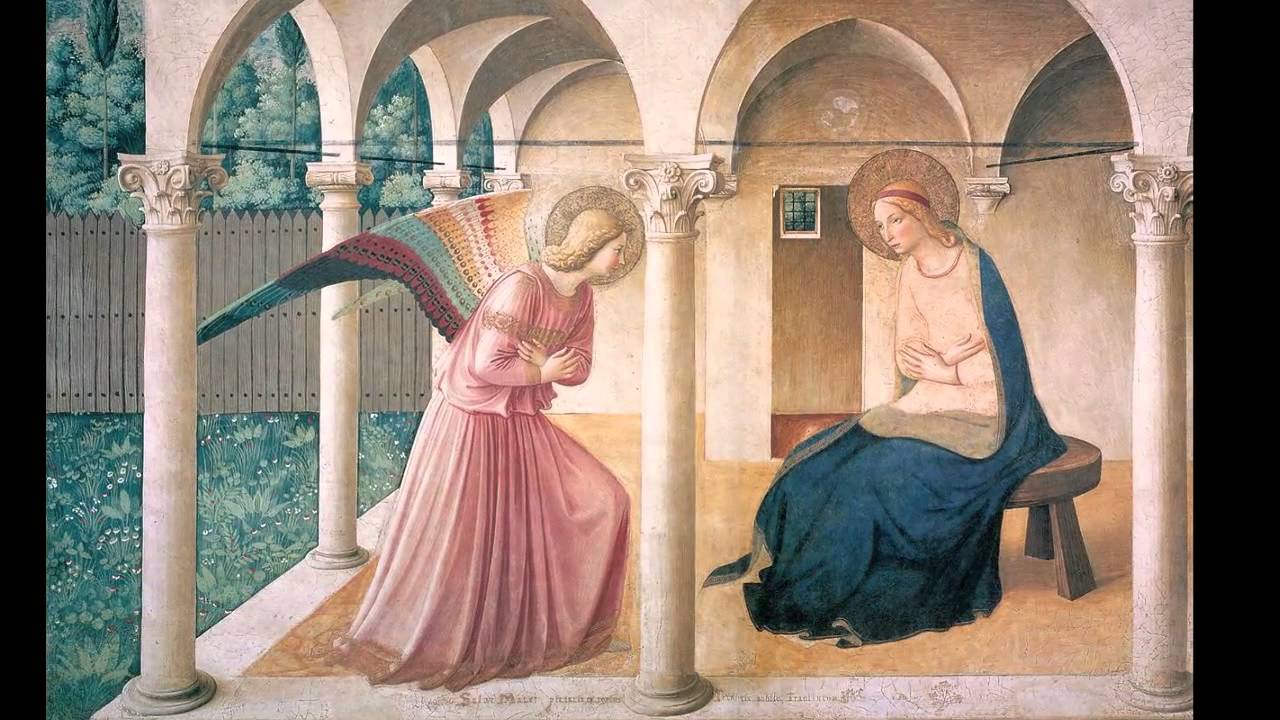
Today’s painting by Fra Angelico has long haunted my imagination since I first saw it in The Convent of San Marco in Florence.

It is a representation of an epochal event, The Annunciation, which holds human time and eternity in perfect balance.

fra-angelico-annuncition

When Kathleen Ferrier recorded, ‘Das Lied von der Erde’ the shadow of death was looming over her.

This is music making of the very highest order.

Here Kathleen Ferrier does not so much perform a song as become the song.

The rare emotional reach of her extraordinary voice bringing flesh and spirit to Mahler’s masterwork touches something very deep and unnameable within humanity.


Our sleigh moves on from yesterday sliding us forward on our Christmas journey.

Today we start with a song from an authentic show business legend – Miss Eartha Kitt and her classic, slinkily sensuous 1953 recording, ‘Santa Baby’.

Eartha performs the Springer brothers and Joan Javitt’s song in her trademark knowing style. As the song progresses Eartha makes a series of increasingly outrageous demands on Santa’s generosity.

All she wants is a sable, a convertible (light blue), a yacht, the deed to a platinum mine (gold being so common), a duplex, Tiffany jewellery and a ring (64 carat for sure).

Eartha’s vocal here supported by Henri Rene and his orchestra is a study in practiced come hither allure. The cynical lyric is caressed as she reels in our attention.

Seeing her perform the song live is to see a siren setting a song ablaze with the flames licking around the mesmerised audience.

Everything Eartha did carried a charge of the exotic – she looked, moved and spoke like no one else building on her black, Cherokee and White heritage and dance training to create a unique image that demanded the audience’s deference and worship.

Orson Welles famously called her the most exciting woman in the world and while others of her era like Marilyn Monroe and Elizabeth Taylor might have taken issue with that claim they too would surely have admired the sheer dramatic daring of Eartha’s regal performance of, ‘Santa Baby’.

Come on Santa – hurry down the chimney and don’t forget the sable.

Fr Josef Mohr wrote a poem in 1816 he called, ‘Stille Nacht’. Two years later on Christmas Eve 1818 with a midnight mass in prospect he decided to visit his friend Franz Gruber a choirmaster and organist to see if there was any chance of turning, ‘Stille Nacht’ from a poem into a carol to perform that night.

Mohr had to walk several kilometres to se his friend who set to work with such vigour and inspiration that an arrangement for guitar and voice of, ‘Stille Nacht’ was ready as the two set off to Fr Mohr’s church in Oberndorf.

So, in the cold of an Austrian night on Christmas Eve 1818 the carol, ‘Stille Nacht’ or, ‘Silent Night’ as it is known in the English speaking world was sung for the very first time.

Neither of the writers or the congregation could possible have known that the heartfelt simplicity of, ‘Silent Night’ contained a spiritual power and attractiveness that would go on to make it perhaps the most loved of all church based Christmas songs.

Congregations all over the world this Christmas Eve will echo the words and melody created nearly two hundred years ago and find that it’s magic never fades.

There is no counting the number of versions available of, ‘Silent Night’. The one I have chosen to showcase here is by a gorgeous Cajun version by accordionist Harry Fontenot.

I love the rustic simplicity of this version – it seems to me the kind of sound that would not have sounded out of place in a stable with animals and shepherds gathered around to witness an event that was at once entirely commonplace – the birth of a child.

And yet all present had the sense that this birth was something very special that would remake the world for all eternity.

‘Silent Night, Holy Night, All is calm, all is bright ……….

The poem providing our extract today is the short but immensely wise, ‘BC : AD’ by the much under rated U A Fanthorpe.

‘… And this was the moment
When a few farm workers and three
Members of an obscure Persian sect

Walked haphazard by starlight straight
Into the kingdom of heaven.’

Christmas Cornucopia First Day

First Day featuring:

A Painting by Piero della Francesca (1415/20 to 1492)

Music by Bobby Helms, Mary Chapin Carpenter and Arvo Part

Poetry by John Clare (1793 to 1864)

For 2016 I am presenting The Christmas Cornucopia first seen in 2014 with significant added material.

Many of you who have joined the Jukebox community since 2014 will not have delved so far back into the Jukebox Archives. For you it will all be new!

For my much cherished veteran supporters I hope you will relish re reading the original text but also appreciate the new elements.

Each post now includes a favourite painting related to the Nativity Story and an additional piece of music.

I believe one of Christmas Tide’s greatest gifts is the opportunity it offers us to take a long, slow breath and still our hearts.

An opportunity to listen, to contemplate, to open ourselves up spiritually.

Each of the paintings and additional pieces of music featured this year has been chosen because they seem to me to be works of contemplative grace.

Christmas.

A time much anticipated which yet seems a surprise each time it occurs.

We wait, in hope, in full hearted anticipation for Christmas.

As Mary waited, full hearted, watchful and still for the longed for the birth of her son.

His birth was a miracle. As is every birth. For every birth changes the world absolutely.

I know of no work of art which captures that sense of awed anticipation with such tenderness as Piero della Francesca’s, ‘Madonna del Parto’.

Piero somehow manages to make present through drawing and paint both the vulnerability of Mary in all her humanity and the immanent divine.

pdf-pregnant-mad-br

To maintain the contemplative mood I turn to the contemporary Estonian Composer, Arvo Part with his luminous, liminal setting of Mary’s eternal prayer, ‘The Magnificat’.

Part has been labelled a Minimalist and a retro Medievalist.

I prefer to think of him as having the gift to make time past, time present and time future bloom before us through his music.

Christmas comes but once a year. For some of us the very best of times – a reliable pleasure that grows more intense and treasured as the years go by.

Sadly, for others – the worst of times and an ordeal to be feared as it approaches and then endured until all the tinsel has been packed away for another year.

I am firmly in the Christmas is a glorious celebration camp. I love bright stars in dark December skies with flurries of snow dusting the earth beneath my feet. I love the gathering sense of anticipation as the season advances.

I love seeing people smiling to themselves as they go about their routine business now charged with a ‘this is the last time I’ll do this before Christmas’ awareness.

I love hunting out our well packed away- some would say well hidden – Christmas decorations and wondering if the expensive new lights from last year will work or should I have bought the sets I saw at such a discount only yesterday.

I love firmly deciding that of course only a real needle shedding tree will do with a wreath for the door and a crib for the hearth as well. I love the excitement of the children’s last week at school – what shall we buy for the teacher and this terms best friend?

I love remembering Christmases past: the ones when I was a child oblivious to all the work involved in ensuring everyone and everything was thought about and properly looked after.

The ones when I was a carefree and careless student carousing through every day and every night certain of my own immortality and soon to be recognised global significance.

The courting Christmases where love bloomed and plans were whispered for the Christmases we would make so magnificent in the years and decades ahead. The just married Christmases freighted with a ‘Are we really in charge now we and can do anything we want?’ thrill.

The ‘Now there’s a baby in the house Christmas here really is Christmas’ Christmas and the ones after where we solemnly said, ‘Well, he will expect us to maintain all our family traditions again this year’.

I remember and cherish the Christmas where the star present only arrived late on Christmas Eve packed by demonic elves who ensured only a chainsaw could remove the vacuum packing.

This was the star present that came with no assembly instructions apart from a minuscule diagram and a list of 56 parts to be tortured together before dawn broke and we all agreed that Santa Claus had got it exactly right this year too.

I remember the first Christmases after my father and my mother died when their absence was an ache that filled my stomach to bursting point and when I barely spoke their names for fear of breaking down.

I remember the Christmas when suddenly I started saying, ‘Mum and Dad would really have loved this’ and realising that I would always share that Christmas and every Christmas with them – for where did I learn to love but from them?

I remember the sound of off key Carollers outside our door somehow making it all the way through, ‘Silent Night’ and the sound of our rehearsed to infinity local church choir hushing the packed congregation with their perfect rendition of the same work and thinking both versions were what we needed to hear at that precise moment.

I remember lighting Christmas candles and knowing that my prayer would be answered even if I wouldn’t be able to recognise how or when.

I remember many, many Christmas songs from many different eras in many different styles (as you might expect if you are a regular Jukebox patron) that I resolve each year to start listening to earlier and earlier to get into the Christmas spirit.

So, harvesting a selection of personal favourites I propose to share a score or so of these with you over the next fortnight until we all raise our Christmas glasses in celebration of a birth and a beginning that continues to offer a blessed eternal hope for all mankind.

Let’s set this sleigh on its way with a Christmas classic from 1957. Bobby Helms’, ‘Jingle Bell Rock’ always raises good cheer every December (come to think of it the same can be said when we listen to it, as we do, in February, May and August).

This song summons up the, ‘I like Ike’ Ozzie and Harriet days of the comfortable blue skies 1950s for me like no other Christmas song. I’m surprised Bob Dylan didn’t include it in his tender and wholly successful homage to the era, ‘Christmas In The Heart’.

1956/1957 was Bloomington born Bobby’s golden time. He had a great country and pop hit with, Fräulein’ followed up with another substantial success in, ‘My Special Angel’.

But his pop immortality was sealed with the toe tapping, smile inducing, always coming up fresh and welcome 45 issued just days before Christmas in 1957, ‘Jingle Bell Rock’.

Written by Joseph Carleton Beale and James Ross Boothe the song has become a much loved and much recorded staple of the Christmas season.

Under the,’A’s’ alone I see it has been covered by everyone from Chet Atkins to Arcade Fire to Alvin And The Chipmunks (which I think we can all agree is quite a stretch!). Yet, no one has come anywhere near matching the easy charm and relaxed swing of the original. I’m already looking forward to hearing it next year!

Next a very different tone from one of the premier singer – songwriters of the modern era, Mary Chapin Carpenter.

‘Come Darkness, Come Light’ is the Christmas meditation of a schooled professional with a sharp eye and a battered heart.

Mary recognises that the spiritual message of Christmas is that a gift has been granted not to the grand and the deserving alone but to the broken and the wounded,the fearful and the doubting (which is most of us) as well.

It is those who know the fell dark who turn most gratefully to the light. So whether you come running or walking slow towards the light know that it was made to shine on you and that the darkness no matter how deep can never extinguish this light.

Mary has the confidence and steadiness of soul to let the song speak with minimal accompaniment. This is the title song of her 12 songs of Christmas CD which comes highly recommended along with her entire cannon.

Each post during this season will also include an extract from a favourite seasonal poem. Today it is, ‘December’ by John Clare a poet who was deeply atuned to the turning of the seasons and the rhythms of rural life.

‘… And some, to view the winter weathers,
Climb up the window-seat with glee,
Likening the snow to falling feathers,
In fancy’s infant ecstacy;
Laughing with superstitious love,
O’er visions wild that youth supplies’
Of people pulling geese above,
and keeping Christmas in the skies.’