Fanfare for Duke Snider – Brooklyn Dodgers Legend, Baseball Immortal

http://

Embed from Getty Images


One thing leads to another. The other morning I was listening to the glory that was the early 1940s Duke Ellington Orchestra playing, ‘Harlem Air Shaft’ – a four minute masterpiece evoking a world and a culture with thrillingly eloquent charm.

As the music faded the numbskulls (remember them?) in my brain, unbidden, went searching among my memory cells for other Dukes. Slim files came back marked : Duke of Wellington and Duke of Windsor. Middle size files had the titles Duke Fakir, David Duke, Duke Robillard and John ‘Duke’ Wayne.

However the two really bulky files bore the legends, ‘Duke Of Earl’ (a guaranteed jukebox selection for the future) and Duke Snider – the latter one of my very favourite baseball players from my favourite sports team of all time – the late, much lamented, Brooklyn Dodgers.

Here’s a fanfare for the Duke:

There have been few better times and places to have been a baseball fan than New York in the 1950s. The New York Yankees, the New York Giants and the Brooklyn Dodgers and their fanatical supporters played out an intense rivalry which was illuminated with iconic moments of drama in a series of historic pennant races and world-series finals.

The names and feats of players such as Yogi Berra, Don Mueller and Jackie Robinson are indelibly imprinted on the memory of baseball aficionados. However, it was the star centre-fielders for these teams – Mickey Mantle, Willie Mays and Duke Snider, who has died at the age of 84, who came to personify the arguments about which team should have superior bragging rights in the big apple.

Mantle was all explosive power and glamour while Mays was superhumanly enthusiastic and athletic. Duke Snider, the pride of Brooklyn , was a complete player with stellar achievements in all aspects of batting along with brilliant fielding skills combining speed and poise with a whiplash throwing arm.

In the four seasons, 1954-57 that Snider, Mantle and Mays went head to head as centre-fielders it was the Duke who hit the most homers and drove in the most runs. Indeed, throughout the entire 1950s it was Snider who slugged the most home runs (320) and RBIs (1031) as well as placing second in runs (970).

These numbers gave powerful ammunition to Brooklyn ’s blue collar fan base ‘them bums’ in the ceaseless argument as to whose centre-fielder was the best.

The Duke, named so by his father at the age of 5, was born far from Brooklyn in Los Angeles in 1926 (where ironically, chasing revenue, the Dodgers would relocate in 1958). From his early youth he excelled as an all round sportsman and it was no surprise when he was signed out of high school in 1943 by the Dodgers.

Following a brief period in the minors and military service in the navy he made his first appearance in blue in Ebbetts Field the legendary, now demolished, home of the Dodgers in 1947.

Ebbets Field with its short right field fence was ideally suited to a left handed power hitter like Snider and he would go on to become a regular home run hitter there. It was 1949 when he firmly established himself in the team and he was a fixture thereafter until he left in 1962.

During that time he became a key member of a great inter-racial team, a band of brothers, which included heroes such as Pee Wee Reese, Jackie Robinson, Roy Campanella and Gil Hodges. The glories, trials and tribulations of this remarkable team were immortalised in Roger Kahn’s classic memoir/history ‘The Boys of Summer’.

This team despite regularly winning the National League Pennant seemed fated to fall at the last hurdle, usually at the hands and bats of the hated Yankees, in their quest to be World Series champions.

The mantra of the long suffering Brooklyn fans became ‘Maybe next year’. In 1955 the dream at last became reality when the Dodgers triumphed against the Yankees with the Duke’s magnificent contribution being four home runs and seven runs batted in.

He became the only player to have twice hit four home runs in the fall classic having previously accomplished the feat in 1952 (though still on the losing team!)

Prior to the relocation of the Dodgers to Los Angeles , which the citizens of Brooklyn have never forgiven, it was fittingly the Duke who hit the last home run in the iconic stadium.

A combination of injuries and the design of the LA stadium meant that he was never the player he had been in Brooklyn on the West Coast though he was a member of the 1959 World Series Championship team. After leaving the dodgers in 1962 he played briefly for the New York Mets and the San Francisco Giants before retiring in 1964.

In his career as a whole he hit 407 home runs and was eight times selected as an all star. After retirement as a player he worked as a scout and later as an announcer for the Montreal Expos.

His global achievements were duly recognised in 1980 when he was elected into the Valhalla of Baseball – the Hall of Fame.
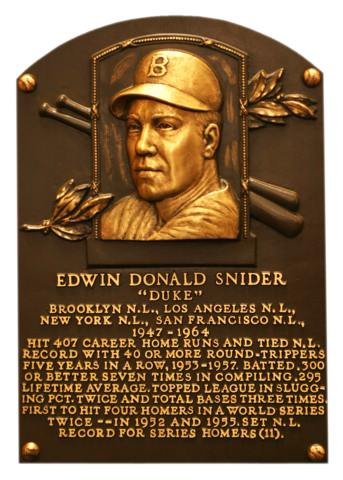
Image result for duke snider images

The ‘Duke of Flatbush’ will always be remembered for his heroic feats wearing No 4 for the boys of summer whose legend only grows brighter as the years roll on.

Edwin Donald (Duke Snider) born 19 September Los Angeles Ca

Died 27 February 2011 Escondido Ca.

Crying In The Rain : Phil Everly (1939 – 2014)

… A time to rise and a time to fallPhil Everly

Come fill to me the parting glass

Goodnight and joy be with you all.

There is a magical moment during the Everly Brothers celebrated and triumphant reunion concert at The Albert Hall in 1983 which goes some way to explaining the source of their enduring appeal.

After opening with a heart warming , ‘Bye Bye Love, a rocking Claudette, the magesterial, ‘Walk Right Back’  a forlorn, stately, ‘I’ll Do My Crying In The Rain and the knock-out punch of, ‘Cathy’s Clown’ the band, which featured England’s guitar legend Albert Lee, took a momentary breather.

The two brothers briefly smiled at each other knowing now that a decade apart had in no sense diminished their power as performers.

Reassured, they leaned their heads close together and began to sing acapella :

‘These are the words of a frontier lad who lost his love when he went bad.’

The opening lines of, ‘Take A Message to Mary’.

As their two voices entwined in a rich fraternal harmony of heartbreakingly vulnerable perfection you can feel the whole audience catch their breath as countless personal memories are evoked.

Memories of the passing years with all their freight of love, joy and loss.  Memories of friends, lovers and family happily present and memories of those now separated by distance, time and mortality.

Looking around the auditorium it was clear that few popular music figures have ever burrowed so deep into their fans emotional core or repaid that loyalty and affection with such tender grace.

Simply put the Everly Brothers were the greatest duet singers and brother act in the history of popular music.

It will remain a mystery as to why the sibling relationship and consanguinity combined to supercharge the emotional resonance of Phil and Don’s harmony vocals and how this mysterious power could survive and endure for virtually all their lifetimes as brothers – whatever the state of their personal relationship.

It was surely a mystery to them as much as to anyone else.

Phil Everly’s life began in Chicago but he was in every other sense a son of the South.  His parents were Kentuckians and musicians.

From the age of six he was singing on the radio with elder brother Don and his parents.

The songs they sang were country songs or those weird and wonderful folk songs as Dylan put it about, ‘Roses growing out of people’s heads’.

From the get-go it was clear that these two brothers, influenced by other brother acts like the Delmores and Blue Sky Boys, had a uniquely potent mystical chemistry that made their arousing and keening singing able to thrill and also to pierce the hardest heart.

As they grew older the cute boys became handsome young men, accomplished guitar players and confident performers.

They were thus in prime position in the late 1950’s to shoulder their jet black Gibson guitars ready to ride and help drive the runaway rock ‘n’ roll train as far as it could go.

Settling into their recording career at Cadence Records and supplied with a string of classic teenage angst songs by the likes of Felice and Boudleaux Bryant (‘Bye Bye Love’, ‘Wake Up Little Susie’, ‘All I Have To Do Is Dream’) the Everly’s took up residence in the hearts and memories of a generation.

Phil himself wrote one of their signature teenage classics, ‘When Will I Be Loved’.  Up until the advent of the Beatles led British invasion the Everlys were reigning rock ‘n’ roll royalty enjoying massive chart success and the esteem of their fellow artists.

They were also enormously influential – The Beatles, Simon and Garfunkel, The Hollies and The Beach Boys all freely acknowledged their admiration and desire to emulate the wonder of the brothers’ harmony singing.

Of the two brothers Phil was by all accounts the more outgoing, sensible and grounded of the two.

Though the younger brother it seemed that he was the one looking out for the more mercurial and vulnerable Don.

Don, whose voice seems able to cleave your ribs and pull your heart apart generally took the lead part while Phil intently, watchfully, with a brother’s love and care, held everything together with poignant poised harmony.

Together they made a sound that has rarely been matched for longevity of emotional impact.

Phil had some notable successes as a solo artist including recording the excellent, ‘Star Spangled Springer’ album (1973) which contains the wonderful tracks, ‘The Air That I Breathe’ and ‘Snowflake Bombadier’.

He also worked fruitfully on the soundtracks of the Clint Eastwood  movies, ‘Every Which Way But Loose’ and, ‘Any Which Way You Can’.

Genuine though these successes were they are minor in comparison to the luminous body of work he created with his elder brother.

They were great country singers, great rock ‘n’ roll singers and great pop singers.

Their body of work is sure to provide emotional sustenance and solace long into the forseeable future.

For people will always fall in and out of love and always carry the scars of past hurts even as they embrace new hope.

There will always be an Everly Brothers song to turn to.