One of those who knew a Rock ‘n’ Roll classic when he heard it was Dave Edmunds.
Dave is plugged into the very DNA of Rock ‘n’ Roll.
He is entirely capable of playing every instrument himself as with I Hear You Knocking.
But, get him onstage with sparring partner Nick Lowe and a dynamite drummer like Terry Williams and you can guarantee your wheels will be spinnin’ spinnin’ shootin’ sparks all around.
From 1977’s ‘Get It’ Dave’s riotous take on Get Out Of Denver.
Go! Go! Go!
From time to time I’m asked – what’s the greatest double live album of all time?
Now, that’s easy – Van Morrison’s, ‘Too Late To Stop Now’ for the genius of his singing across multiple musical genres and the empathetic brilliance of The Caledonia Soul Orchestra.
But, when I want the pure adrenaline rush of listening to a great Band setting the woods and ballroom on fire I always turn to Bob Seger’s ‘Live Bullet’ recorded in 1975 at The Cobo in Detroit.
When I perfect the time travel machine one of my first stops is going to be Detroit September 1975 so that I can go absolutely nuts the moment I hear Bob sing:
’I still remember it was autumn and the moon was shinin’ ….’
Fast forward to March 16 2004 Detroit’s State Theatre.
Bob Dylan, a mere 15 years into the, ‘Never Ending Tour’ has seemingly completed his encore with the incomparable one-two punch of, ‘Like A Rolling Stone’ and, ‘All Along The Watchtower’.
But, there’s a surprise in store even for fanatical Bob Cats who know every song Bob has ever played and who compile lists of songs he just might do one day (guilty).
For tonight, for one night only (or more circumspectly we might say for at least the next 14 years) Bob and the band – Larry Campbell, Freddie Koella (much missed by me), Richie Hayward, George Recile and on Bass that night – Tony Garnier launch to the roaring delight of the assembled Detroiters full tilt into, ‘Get Out Of Denver’
Bob must have learned that the day before had been officially declared Bob Seger Day by The Governor and decided to tip his hat in the best way possible from one songwriter and bandleader to another.
Bob, as we should know by now, is pretty much familiar with every great song that’s been written over the last two hundred years or so.
That’s why I have dubbed him The Keeper Of American Song.
It’s also worth noting that Bob Seger has said that the first artist who really got to him was Little Richard.
And, legendarily, Bob Dylan’s High School Yearbook records his ambition was to, ‘Join Little Richard’.
Hearing the two Bobs burnin’ burnin’ through Get Out Of Denver we can be sure both of them have joined Little Richard in the highest halls of Rock ‘n’ Roll’
‘Get out of Denver better go go, Get out of Denver go ….
Buddy Holly’s music woke deep passions and ambitions in a Minnesota kid who locked eyes with him in one of the last concerts he ever played.
Buddy Holly’s music woke deep passions and ambitions in two Liverpool teenagers who wanted to write and play their own songs and have a group just like The Crickets.
Buddy was the greatest Rock ‘n’ Roller ever to come out of Texas and though his sound echoes all over the world it’s in Texas that his Ghost speaks loudest.
Speaking in the song of the hot sun and the West Texas Wind.
Sonny Curtis knew Buddy well.
He had played with him and recorded with him.
So, when the plane went down that tragic day it seemed natural for The Crickets to turn to Sonny as a new Cricket and songwriter.
The first post Buddy Crickets album, ‘In Style’ was recorded in New York in 1959 and issued the following year.
Driving up to the Big Apple Jerry Mauldin and Jerry Allison asked Sonny if he had any songs for the new record.
Well .. I got this song, ‘I Fought the Law’ – I wrote last year, ain’t even written it down, kind of a country song, goes like this:
A-breaking rocks in the hot sun
I fought the law and the law won I fought the law and the law won
I miss my baby and a good fun
I fought the law and the law won
I fought the law and the law won
I left my baby and I feel so bad
Guess my race is run
She’s the best girl that I’ve ever had
I fought the law and the law won
I fought the law and the law won
A-robbin’ people with the zip gun
I fought the law and the law won
I fought the law and the law won
I needed money ’cause I had none
I fought the law and the law won
I fought the law and the law won
I left my baby and I feel so bad
Guess my race is run
She’s the best girl that I’ve ever had
I fought the law and the law won
I fought the law and the law won.
Wow! They could all tell this was some song.
A bad boy who ain’t so bad.
The best girl he he ever had.
An armed robbery that goes wrong.
The inexorable reach of the law.
But, not as a country ballad.
No, this needed some of that Buddy bounce.
Bright guitars, rock ‘n’ roll drums, a bright clear vocal (Earl Sinks would take care of that) and a killer chorus.
Put all that together and you’ve got a hell of a record.
And, it was a hell of a record.
It’s just that in 1960 the great record buying public in all its wisdom wasn’t listening closely to The Crickets anymore and neither were the radio programmers.
So, no hit for The Crickets and no royalties for Sonny Curtis.
Yet, as Jukeboxers know, a true message always gets through – it’s just a matter of how long it takes.
There is, of course, another audience for Songs.
An audience that hears things the public don’t always cotton onto straight away.
The audience of other songwriters and performers who hear a song and think – I know just how to do this one and really make it come alive.
So in 1962 Milwaukee’s Paul Stefan with The Royal Lancers issued a charming, if underpowered, version on Citation Records which won local approval.
A couple of years later Sammy Masters on Kapp recorded it Western recitation style.
Sonny still didn’t really have any royalties to bank but the message was rising above a whisper now.
And, the message was heard loudest and clearest of all by Bobby Fuller under the hot sun back in El Paso Texas.
Bobby was a natural rocker who loved the sheer sound of guitars turned up high supported by a driving beat and vocals that grabbed your attention from the get go and never let up.
And, Bobby likes to experiment in his basement – layering the instrumental and vocal sound until it rang out like lightning.
Bobby’s sharp ears heard, ‘I Fought the Law’ and he got to work.
He produced a demo, in 1964, that would lay the template for his monster hit of 1966 (the subsequent 1964 45 put out on his own Exeter label was a hit in the El Paso area but to my mind it is flatter, less resonant than the wonderful demo below).
it’s obvious that Bobby has been listening to the likes of The Ventures and Dick Dale as well as good old Buddy.
Now El Paso knew just how great a song this was.
All the elements of a classic were now in place.
What Bobby and the song needed now was a more punchy recording in a better studio along with national distribution and publicity.
Enter Bob Keane of Del Fi and Mustang Records who had lost his brightest star, Ritchie Valens, in the same crash that took away Buddy.
Setting up in Los Angeles Bobby, brother Randy (bass) Jim Reese (guitar) and DeWayne Quirico on drums laid down an all time rock ‘n’ roll classic that has the drive of the 50s forefathers with added 60s colour and brightness.
This one takes off like a dragster and smashes through the winning tape still accelerating.
Once this one got heard on the radio there was no stopping it and by mid March 1966 it was a top 10 hit.
I make that 132 seconds of Rock ‘n Roll bliss!
Sheer Bliss.
Of course, I can’t think of a occasion I’ve put this on my turntable and played it only once!
Eight years after that sandstormy day, at last, the royalties began to flow for Sonny Curtis.
A true message always gets through.
Always.
Now, you would think such a triumph would presage a stellar future for Bobby – especially as he was such a clued up musician, strong vocalist and a brilliant live performer.
However, those dreams died, in very dubious circumstances indeed, when in July 1966 Bobby was found, asphyxiated and doused in petrol in his car.
The official verdict was suicide.
It seems highly likely that it was malign forces, outside the Law, who took Bobby’s life away and shattered a very promising career.
Time moved on and music went through many phases.
British Beat. Folk Rock. Pyschedelia, Country Rock, Prog Rock, Glam Rock.
By the mid 70s in London a new generation of musicians and incendiary would be musicians intuited that it was time to get back to basics and hit the stage at a hundred miles and hour and let the audience catch up if they could.
Punk Rock was a two fingered salute to the worthy, corporate, Rock establishment.
Get out of the way!
Move it on over!
A new Gang’s in Town.
And, pogoing furiously in clubs all over London, it seemed to me that the coolest Gang and the one which truly understood the essence of real Rock ‘n Roll was The Clash.
Joe Strummer, Mick Jones, Paul Simonon and Topper Headon.
Joe and Mick took a trip to San Francisco in mid 78 to work on the second Clash album, ‘Give ‘Em Enough Rope’.
The Automatt Studio was furnished with vintage Jukeboxes and the record the needle dropped on the most for Joe and Mick was none other than Bobby Fuller’s I Fought The Law.
A true message always gets through.
I Fought the Law, in July 1979, would be the first Clash single issued in America and their first track to gain significant radio AirPlay.
This is truly a magnificent racket!
This one uses premium rocket fuel.
Best to strap yourself in before hitting the play button here!
I imagine it never occurred to Sonny that a bunch of West London Bad Boys would really whip up a Wild West Texas Typhoon on that song he wrote 21 years before!
Nor, that a bunch of American Rebels, The Stray Cats, would find their feet in London perfecting a raunchy Rockabilly attack that could ensure any song they took on would leave earth’s gravity in a single bound.
Brian Setzer, Lee Rocker and Slim Jim Phantom palyed with such sheer Joy in their live shows.
Whenever they played near me I was at the head of the queue and ready to elbow my way to my preferred front row centre stage spot!
The message still gets through.
Oh yes.
The message still gets through.
Crosing Continents and Oceans.
Vaulting Mountains.
Wherever there’s a bunch of musicians who need to ride the whirlwind the message gets through.
It came through on a clear channel to Mano Negra who fell on it like ravenous wolves howling at The Moon.
Ojo! Ojo! Ojo!
This Train ain’t gonna stop – stand well clear or you’ll get your head blown clean off!
And, if you’ve got your head blown off the least you can do is dance until the rest of your body runs out of blood to pump.
So, to conclude lets rock the joint with two scorching live takes on I Fought the Law.
First off The Clash flash flooding the senses.
Now, the man who put his stamp all over this song for all eternity – Bobby Fuller (dig those groovy dancers all you hep cats and kittens!).
One last word of advice to all you Bad Boys and Bad Girls out there – forget going robbing with a Zip Gun, a Six Gun or a Shotgun.
If you fight the law you’ll find the law wins.
No, get yourself a six string and crank it up to 11 and sing with all your heart for Sonny Curtis and Bobby Fuller:
I fought the law and the law won
I fought the law and the law won.
I fought the law and the law won
I fought the law and the law won.
Notes :
Other versions of I Fought the Law I approve of you might care to check out :
Bruce Springsteen, Tom Petty, Nanci Griffith with The Crickets, John Mellancamp, Mike Ness, The Grateful Dead.
Bobby Fuller – His tragic death was a great loss to music.
In many ways he’s the musical bridge between Buddy Holly and John Fogerty of Creedence Clearwater Revival.
I have two Box Sets ‘Never To Be Forgotten’ from Del Fi and ‘Texas Tapes Revisited’ – both crammed with rocking gems.
Sonny Curtis – Though I Fought the Law is his most valuable copyrighted Song Sonny has penned several other significant Songs including, ‘Walk Right Back’ for The Everly Brothers.
‘One day Frank started playing a little organ riff and we all really liked it a lot. I kinda came up with the chord riff … then Question Mark said he had words for it … I thought he was just singing off the top of his head.’ (Bobby Balderrama)
The 1960s, as any Baby Boomer will tell you, was the decade when Rock and Pop music peaked.
A tidal wave of creative energy was unleashed which is never likely to be matched.
Pick any week from the Billboard Hot 100 chart from the 1960s and you’ll be near overwhelmed by the number of truly great records you’ll find (and the memories they’ll generate).
Competition was fierce.
So, to ascend to the coveted Number One spot was a real achievement.
Take the top 5 for the last week in October 1966.
Pure Pop for Now people from The Monkees with, ‘Last Train to Clarkesville’.
A deep Soul cry (from the Ghetto, from the battlefields of Vietnam, from a tragic Lover’s heart) roared out by The Four Tops with, ‘Reach Out, I’ll Be There’.
An aching morality tale from Johnny Rivers with, ‘Poor Side of Town’ (previously featured here on The Jukebox).
An unfathomably deep, nay eternal, Pop Classic from 16 year old Michael Brown and The Left Banke with, ‘Walk Away Renee’ (also featured on The Jukebox).
Phew!
What record could possibly have kept those masterworks from the very summit of the charts?
Well, a record cut by a bunch of unknown Mexican-American teenagers from Michigan, with a lead singer known only by the ? symbol (where do you think Prince got the idea!) that will thrill the soul as long as there is electricity or some other means to power a Jukebox!
Too many teardrops for one heart to be crying!
Too many teardrops for one heart to carry on!
You’re gonna cry 96 tears!
You’re gonna cry 96 tears!
Watch Out Now!
Watch Out Now!
Cuidado Ahora!
Cuidado Ahora!
So, you take an insanely catchy organ riff, played on a Vox Continental or a Farfisa Combo Compact depending on which authority you believe, an increasingly crazed vocal extolling the sheer delight of anticipated romantic revenge (and who hasn’t felt that in their life?) a tempo that locks your attention in and you’ve got yourself a monster Hit!
This is Punk before Punk.
This is a wonderfully grimy garage classic just reeking of the greasepit.
This is a voodoo Mexican Folk Ballad.
This is pure unadulterated Rock ‘n’ Roll.
96 Tears lasts less than 3 minutes playing time.
Yet, I guarantee that everyone who hears it is chanting out:
with infinite gusto long before the 3 minutes has elapsed.
The definitive organ riff came from Frank Rodriguez who was all of 13 when 96 Tears was recorded in the Spring of 1966.
The guitarist was founding Mysterian Bobby Balderrama.
Eddie Serrano sat on the Drum Stool.
Bass was played by Fernando Aguilar.
The signature vocal was by the one and only hyper imaginative Question Mark ?
GIven his determination to be known by this name alone I’ve resolved to use only this name throughout.
The Mysterians all came from families that had followed the lure of employment and the Dollar Bill from Mexico taking in fruit picking before securing jobs in the Michigan Auto Plants.
They started out playing instrumentals in the dramatic style of Duane Eddy and Link Wray. When the British Invasion hit and as they watched Shindig and American Bandstand they realised they had to have a dynamic lead singer and that a powerful organ sound hit home every time.
Once Frank came up with the immortal riff they approached Lilly Gonzalez, a luminary of the local Mexican community, who found them a small recording studio and pressed up 500 copies of 96 Tears on her own Pa-Go-Go label.
The song was then take up by a relay of Radio Stations until demand became so great that Cameo Parkway took over and drove the single all the way to Number One!
My favourite moment in the song is the line where Question Mark ? momentarily pauses for breath before slamming home the killer line:
’And when the sun comes up I’ll be on top – You’ll be right down there looking up’.
Take that!
Now, it is a truth universally to be acknowledged that all Jukeboxes are in want of a Record which will get everyone onto their feet to dance furiously while rattling the walls and windows shouting out the chorus.
I think we can all agree that 96 Tears absolutely fulfils this need.
Which is why 96 Tears must take its place on The Immortal Jukebox as (what else) A 96.
Now, once such a Record is issued all over this wicked world gangs of young musicians hear it and think, ‘That will suit us very nicely indeed’.
The lead singer gets ready to hyperventilate and the organist thinks – they think they know how the organ goes on this one but they haven’t heard my version yet!
If they’re not in possession of an organ, Vox or Farfisa, the guitarist thinks – I’m gonna tear this one up so completely that no one will even remember there was an organ on the original.
Watch Out Now!
Watch Out Now!
Cuidad Ahora!
Cuidad Ahora!
A true message always gets through.
So, in 1976, frequenting London’s The Nashville and 100 Club venues I encountered a testosterone topped up the max outfit called Eddie and the Hot Rods who went full pelt at songs like, ‘Gloria’ and, ‘Get Out of Denver’ before thrashing the life out of 96 Tears.
Here’s their, ‘Live at The Marquee’ version from 1976 – I think I may have lost a few pounds while this one played and needed to sink a fair few pints to restore balance.
Such is Youth (and Thank God for it!)
The message certainly got through to Brooklyn.
That’s where Garland Jeffreys grew up listening to every style of music with a keen ear and the determination to meld these styles together in his own songwriting and performances.
Garland Jeffreys is one of those secret heroes of music whose prominent influence and regard among musicians is in stark contrast to his stature among the general record buying public.
Be assured The Jukebox will feature a considered tribute to him later.
For now let’s enjoy his distinctive take on 96 Tears.
The Band really got their groove happening here!
A true message always gets through.
And there was no more true hearted custodian of American Music than Doug Sahm – who is always warmly welcomed at The Jukebox.
Whenever Doug got together with Freddie Fender, Augie Myers and Flaco Jimenez the music flowed and everybody got to have a glorious party.
Let’s take 96 Tears down South to Texas with Doug and his faithful compadres.
They sure shake the flavour all over every one of those 96 Tears!
Too many teardrops for one heart to be crying.
Too many teardrops for one heart to carry on.
Oh, oh, oh, believe me, when the sun comes up …
You’re Gonna cry 96 Tears.
Youre gonna cry 96 Tears.
96 Tears.
96 Tears.
I’m gonna count every one.
Every single one.
96 Tears.
96 Tears.
Notes :
? and The Mysterains predictably fell foul of Music Biz moguls which resulted in long drawn out litigation, inadequate financial reward and a very messy discography.
However, there is a now a substantial collection of their Cameo Parkway material which amply demonstrates they were far more than one hit wonders.
The Kinks debut LP was rush released in October 1964 to capitalise on the enormous success of their third single, ‘You Really Got Me’ which shot to Number 1 in the UK Charts in mid September before hitting the Top 10 in the U.S.A.
You Really Got Me is the standout track from the LP.
Of course it bears saying that it was also one of the greatest and most influential recordings of the 1960s.
It exploded into the consciousness of listeners and fellow musicians all over the globe searing synapses with its astounding energy.
Dave Davies’ guitar solo, a product of fire and fury and a slashed little green amp, remains one of the most seismic ever recorded.
The Kinks couldn’t match the intensity of that performance on the other 13 tracks that made up, ‘The Kinks’.
Lightning is not caught in a botte to order.
11 of the other cuts on the LP are covers of Rock ‘n’ Roll and R&B classics from the likes of Chuck Berry, Bo Diddley and Slim Harpo.
The Kinks approach to these songs is not that of knowing reverential devotees like The Rolling Stones.
Rather, The Kinks come at these songs slant wise and when their feral energy locks in the results can be tremendously exciting.
But, as Ray Davies knew in his bones, the core of his and The Kinks creative energy was an amalgam of his (correct) sense that he was not like everybody else and thus an ideal observer of the world around him coupled with deep fraternal harmony only exceeded by fierce fraternal dischord.
The Kinks and Ray Davies in particular didn’t dream of being American.
Though they loved American Music and were inspired by it they sensed their own songs, if they were to have authenticity and authority, would have to be reflective of their own lives – reflecting Muswell Hill rather than Blueberry Hill.
The song on that debut record that demonstrated that Ray Davies and The Kinks could convey nuanced emotions and beguile an audience, as well as exhaust them, was the only other Ray Davies original present, ‘Stop Your Sobbing’.
Pure Pop for Now People!
Well … Pure Pop in the fragile melody and tremulous arrangement.
Pure Pop in the way Rasa Davies’ ghostly backing vocals shadow Ray’s lead.
Pure Pop in the way Dave Davies’ chiming guitar rhymes with our hearts as the song progresses.
Pure Pop in the way Pete Quaife and Mick Avory unobtrusively hold everything together.
But, but .. not so Pure in the emotional nuances of Ray Davies’ lyric and vocal.
Is he appalled by all the sobbing?
Or is he fascinated?
Does the sobbing turn him off or turn him on?
Is he a mixed up, frustrated, Lover or a disinterested observer carefully recording how the emotions play out?
Remember this is Ray Davies – a man of passion who is also a man of reflection and contemplation.
A Lover who can’t stop being a Loner.
A writer who has that chip of ice in the heart that tells him, whatever the situation, to observe and record.
Observe, record and remember.
There’s a Song in this. There’s a Song in this.
Ray Davies never was and never will be just like everybody else.
And, savvy songwriters with a sense of the history of Pop songwriting know that Ray Davies is a master of the craft.
A savvy songwriter like Chrissie Hynde who wanted the world to know she was special. That there was nobody else here and now like her.
She just had to have our attention and she was going to use all her resources to make sure she got it.
Most of all she was going to draw upon the deep well of her imagination.
An imagination that could relish the role reversal of a sassy woman singing, ‘Stop Your Sobbing’ and singing the hell out of it.
Singing with the seductive charm of oh, oh, won’t you be my baby, Ronnie Spector.
Singing with the, you sure gotta lot of gall, dismissiveness of Bob Dylan.
Singing with the, Oh No, no, no, no, no, dramatic soliloquy intensity, of The Shagri Las’ Mary Weiss.
Singing so our attention is immediately captured and never released.
Singing that inspired highly imaginative guitar playing from James Honeyman-Scott.
Nick Lowe produced The Pretenders version of Stop Your Sobbing in late 1979 but amazingly he thought they ‘were going nowhere’ and stepped away.
Nick, Nick, Nick – you got that one one Wrong!
The Pretenders proved to be unstoppable Hit Makers.
They had Style and they had Swagger and big time success with a Songwriter and Singer like Chrisie Hynde was guaranteed.
Now, if we are trawling the annals of modern songwriting for the, ‘Not like everybody else’ category there’s one thing we gotta do – call up the unique sensibility of Jonathan Richman!
‘I never get tired of singing Many Rivers to Cross, and you know why? .. ‘cause I still have many rivers to cross. They’re just different rivers.’ (Jimmy Cliff)
Many rivers to cross.
Many rivers to cross.
Just can’t seem to find our way over.
We are haunted by Waters.
Rivers flow through our imaginations.
As Rivers thirst for the Sea so we thirst for the sound of running water.
There is balm and there is healing in the sound of a flowing River.
The sound and the sight of The River invites movement towards the future.
Which surely lie somewhere downriver.
Downriver.
When you’re lost as you travel along if you can find The River you know you can find your way home or to your new destination.
When only your will keeps you alive stand by The River and resolve to carry on – to cross over and be born again in cool water.
Cross The Rubicon.
Cross The Delaware
Cross The Euphrates.
Cross The Volga.
Cross The Murray.
Cross The Nile, The Niger and The Congo.
Cross The Mackenzie, The Mekong, The Missouri and The Mississippi.
Cross The Lena and The Laune.
Cross The Brahmaputra, The Besós and The Brazos.
Cross The Thames, The Tiber and The Tyne.
Cross The Rhine and The Rhône.
Cross The Rappahannock, The Rio Grande and The Red.
Cross The Acheron, The Lethe and The Styx.
Wade across The Jordan.
Each River has its own song.
And, each of us hears different songs as we listen to The River.
We are all travelling from the Source to The Sea.
Oh, we really don’t know why.
We don’t know why.
But, I guess we have to try.
Have to try.
To cross over.
To Cross Over.
Jimmy Cliff has A Voice.
A Voice.
In the way that Sam Cooke has A Voice.
In the way that Nina Simone has A Voice.
In the way Ray Charles has A Voice.
In the way Van Morrison had A Voice.
It’s A Voice that once heard never leaves you.
A Voice that seems immediately familiar to you yet always capable of making you catch your breathe in surprise at its glory.
A Voice that has the authority of a River in full flow.
A Voice that you find yourself harmonising with in your head as the years and tears flow by.
A Voice that speaks truth about the trials of Life.
A Voice you’ll find yourself turning to when it seems Life has got you licked.
A Voice you’ll cling to when all around, including yourself, call you washed up.
A Voice that will whisper to you in the friendless Night.
A Voice that the lonely know knows loneliness too.
A Voice that will be a guiding Star in the heavens when you’re lost and wandering far from The River.
A Voice that will help you hold on, survive, until you’re ready to stand by The River again.
A Voice that will help you cross the many Rivers you’ll have to cross in Life.
Jimmy Cliff was a teenage star of the Jamaican Ska and Rocksteady scenes.
In addition to his obvious talents as a singer he soon showed himself to be a songwriter who had the rare ability to create songs that had the mysterious power and longevity of fables.
Songs like The Harder They Come and You Can Get It If You Really Want are instantly memorable while having a core of wisdom that comes from folk memory that chimes with our immediate lived experience.
Yet, Many Rivers To Cross has an extra dimension.
It’s a song written by a young man with an old Soul.
It speaks to our many defeats yet holds out Hope that these defeats are not final or eternal.
We are born by a River in our little tents and of course we’ve been running ever since.
Ever since.
Running towards Rivet after River after River.
We all have to cross so many Rivers.
It can be a long, long journey from the Source to the Sea.
So many Rivers to cross.
There is redemption and blessing in crossing over The River.
Keep your eyes on the farther ashore and trust that you’ll cross over.
Cross Over.
Notes :
Jimmy Cliff’s ‘Greatest Hits’ should have an honoured place in every collection.
These days I often find myself reaching for his glorious collection from 2012 ‘Rebirth’ which has deeply affecting songs of dignity and grace.
Some will tell you that you’re opening the door to a whole world of trouble.
Oh, oh, you are wrapping chains that will bind you tight until you just can’t breathe anymore.
Look out! Danger ahead!
Pain and sorrow goes with the territory.
No doubt about it the hurting will be certain.
But, but, but … take a tip.
Take a tip.
Whatever you think and feel about it ; no matter how many times Love has let you down, you just won’t be able to live without it.
Won’t be able to live without it.
Oh, oh, and when Love is in bloom and your heart is singing aria after aria of Joy you’ll cradle mountains in the palm of your hand.
Rivers running slow and lazy.
Crickets talking back and forth in rhyme.
You won’t wonder why the world spins around.
You’ll know.
You’ll believe in magic.
You’ll know that no matter how deep the ocean is it’s not as deep as this feeling.
Love makes the world go around.
It always has.
It always will.
And, if you lose that love you’ll ache for it to return.
Ache for the heat of that touch.
The healing power of that touch.
And, in the midnight watches when the Moon looms in the dark sky you’ll hope and pray that somehow, somehow, that lost Love will be found again.
Found again.
Turning the late night radio dial you’ll search for a song you used to sing in whispers to each other and maybe, just maybe, far, far away, the lost one is listening too.
And, that song will be your midnight prayer.
Your midnight prayer.
Who knows what the power of prayer is?
Except those who really pray.
Pray with all their heart.
And, as the lost one, far, far away, sings to themselves maybe, just maybe, they’ll remember who they used to sing it with and realise how much they miss that singing, the heat of that touch.
And, maybe, just maybe, they’ll drive all the way home – tuned in again, listening to the border radio.
Maybe, just maybe, the boy asleep in the next room, who looks just like his Dad, will wake up and hear his voice – not metallically on the phone but in his very room.
Call up to hear that song one more time again.
One more time.
Border Radio
One more midnight, her man is still gone The nights move too slow She tries to remember the heat of his touch While listening to the Border Radio
She calls toll-free and requests an old song Something they used to know She prays to herself that wherever he is He’s listening to the Border Radio
This song comes from nineteen sixty-two Dedicated to a man who’s gone Fifty thousand watts out of Mexico This is the Border Radio This is the Border Radio
She thinks of her son, asleep in his room And how her man won’t see him grow She thinks of her life and she hopes for a change While listening to the Border Radio
This song comes from nineteen sixty-two Dedicated to a man who’s gone Fifty thousand watts out of Mexico This is the Border Radio This is the Border Radio
They play her tune but she can’t concentrate She wonders why he had to go One more midnight and her man is still gone She’s listening to the Border Radio
This song comes from nineteen sixty-two Dedicated to a man who’s gone Fifty thousand watts out of Mexico This is the Border Radio This is the Border Radio
Border Radio first appeared on a 1982 CD from The Blasters which included Dave and brother Phil among its members.
That version is modern day Rockabilly and has the punch of the old Sun studio sound. I think Dave knew that the emotional core of the song – it’s sense of longing and loss and desperate hope had got somewhat lost in that production.
By the time of his solo record from 1987, ‘Romeo’s Escape’ he had figured out that the song needed to be performed slower and with more emotional intensity for it to fully bloom in the listeners imagination.
So, this version drips with emotional humidity.
There’s a palatable ache in Dave’s vocal and a tender tremor to Greg Leisz’s guitar and Katy Moffatt’s backup singing.
The song is now a country ballad – but a country ballad infused with southern soul stylings.
Like that song from 1962 Border Radio lingers in the mind echoing on and on as it encounters and colours the particular incidents and memories it evokes in each listeners own life.
Which is to say that Border Radio is a Keeper!
Dave Alvin is well aware of its merits and that its one of those songs whose power only grows over the years.
That’s why you can’t imagine a Dave Alvin concert without Border Radio.
And, it’s one of those songs that other songwriters, hard schooled in the craft, instantly recognise as a classic.
Here’s a live take on the song featuring David Hidalgo from Los Lobos and accordion maestro Flaco Jimenez that crosses back and forth across that borderline and rocks out too!
Why do we let time stand still and live in memory of the lonesome times?
Why not, by an act of will, stop this troublesome loving?
Useless to say.
Because, while you’re alive you’re in search of love.
Might as well ask the waves to cease surging to the shore.
Such folly!
Yes, but divine folly.
If you won’t risk being a Fool you’ll never find Love.
Oh, you’re crazy for crying and crazy for trying but it’s all worth it for Love, Love, Love, Crazy Love.
It often doesn’t travel on the broad highway.
No, true love often travels on a gravel road.
You can’t start it like a car – you can’t stop it with a gun.
And, in the end the love you take is equal to the love you make.
One more midnight, one more prayer, one more turn around the floor with the Border Radio playing that song from 1962.
One step for aching and two steps for breaking.
I can’t stop loving you.
Those happy hours that we once knew.
Those happy hours.
She calls toll free and requests an old song.
She prays to herself that wherever he is he’s listening to the Border Radio.
‘High Noon is a magical formula of elements. In two or three bars, the feeling of the song is telling you exactly what went on before, what’s happening now and what’s going to happen later’ (Ry Cooder)
The Ballad of High Noon (Dimitri Tiomkin/Ned Washington)
Do not, forsake me, oh my darlin’
On this, our weddin’ day
Do not forsake me, oh my darlin’
Wait, wait along
The noon train will bring Frank Miller
If I’m a man I must be brave
And I must face that deadly killer
Or lie a coward, a craven coward
Or lie a coward in my grave
Oh, to be torn twixt love and duty
S’posin’, I lose my fair-haired beauty
Look at that big hand move along
Nearin’ high noon
He made a vow while in state prison
Vowed it would be my life or his’n
I’m not afraid of death but, oh
What will I do if you leave me?
Do not forsake me, oh my darlin’
You made that promise when we wed
Do not forsake me, oh my darlin’
Although you’re grievin’, I can’t be leavin’
Until I shoot Frank Miller dead
Wait along, wait along
(Wait along)
Wait along, wait along
(Wait along, wait along, wait along, wait along)
Ry Cooder knows a thing or two about composing music for Film and about music for Westerns in particular.
So when he says the theme song for High Noon is magical I listen closely.
I advise you to do the same!
Now isn’t that a masterclass in how to ensnare an audience and prepare them for the tension and drama ahead!
As High Noon’s sweeping opening sequence proceeds we know that this will be an elemental drama played out in frontier country.
The frontier – where upholding the law is no simple matter of enforcing statutes in dusty volumes but a constant battle between order and peace and bloody chaos.
Our hero will need to stand tall with all his courage if civilisation is to prevail.
Such immense impact with so little instrumentation.
Musically everything is invitation and subdued suggestion.
Lyrically in a few short verses with the title only mentioned once the entire arc of the narrative is elegantly and tantalisingly laid out for us.
Tex Ritter sings like an oracle of the gods who knows the resolution of all stories.
Mere men and women have to attend, wait and falteringly live them out.
There is a wedding. But a wedding marred by dread that one party may be forsaken on what should be such a day of Joy.
A bad man with a gun, a deadly killer, bent on revenge, has left prison.
He will arrive on the Noon train.
So little time.
So little time.
A man, a western man, has to, must, face down his enemy and his fears.
Oh, oh, Love would say what does this matter today of all days?
But though the call of Love is loud the call of Duty is louder.
Louder.
Death is nothing but life as a craven coward always looking over your shoulder?
No. No. No.
Though you may lose your fair haired beauty you can’t, won’t, leave before that train arrives.
No man wants to die a coward.
No man wants to live forsaken.
The big Hand moves along.
Towards High Noon.
High Noon it is.
His life or mine.
High Noon.
Look at that big hand move along.
High Noon.
Settle down in your cinema seat, exchange smiles with your companion, this High Noon is sure to be one hell of a ride!
Dimitri Tiomkin who was born 1894 in Kremenchuk Russia – far, far, away from The American Frontier.
He had training with distinguished teachers in St Petersburg, Berlin and Paris and before he badly broke his arm he harboured dreams of stardom as a concert pianist.
After moving to America in 1925 he followed the golden trail West to Hollywood hoping to make a career as a Film Composer.
HIs big break came through writing and performing the score for Frank Capra’s ‘Lost Horizon’ in 1937.
He would go on to work on a series of Films with Capra including ‘It’s A Wonderful Life’.
He had already produced two wonderful Western scores for ‘Duel in the Sun’ in 1946 and ‘Red River’ in 1949 before the commission came for High Noon.
Tiomkin had a genius for embedding stirring, highly memorable, folk like melodies into his scores and for weaving them as charged motifs throughout the course of a film.
Melodies that aroused the emotions and subtly augmented the voices of the actors and the drama playing out on the screen.
As for composing music for Westerns when he had to evoke the majesty of the landscape and the iconic role of the Cowboy Tiomkin only had to recollect the endless steppe of Ukraine and the folkloric Cossack of Russian myth to find the melodies pouring out.
Now I’ll wager there’s more than a few of you who’ll be exclaiming Ned Who?
Yet, Ned has written a glorious gallery of Songs that pretty near everybody has heard and loved.
How about, ‘My Foolish Heart’, ‘Stella by Starlight’ and, ‘The Nearness of You’ for Golden Age classics.
And, as for Film Songs few can match him – ‘When You Wish upon a Star’ and, ‘Baby Mine’ for Disney.
Any good at Western Ballads?
Not bad at all if, ‘Gunfight at the O.K. Corral’, ‘3.10 to Yuma’ and the theme for ‘Rawhide’ are anything to go by!
Combining their immense talents and understanding of the role of music and song in Film Tiomkin and Washington composed a Song which is endlessly alluring.
Like a great Western it feels familiar and mysterious simultaneously.
It feels like a song, a melody and a a lyric, that has emerged into the daylight from the hazy depths of your dreams.
You can’t help singing along in whatever register of voice you have (I like to affect a basso profundo in my own version).
Amazingly, in view of its eventual immense success, initial previews of High Noon did not have those audiences cheering.
United Artists got cold feet and held off releasing the Movie.
Dimitri Tiomkin was certain however that the theme song was something special.
So while United Artists hesitated he bought the rights to the Song and arranged for it to be recorded by Frankie Laine who gave it his full throated turbo drama best – and the rest as they say is history!
There have been countless versions of tne song since (four other versions came at tne time of the Film’s release).
I’m going to leave you with a version that’s sure to please Jukebox aficionados as it’s by the twangtastic Duane Eddy (maybe my basso profundo version is my own tribute to Duane!)
Notes:
At the 1953 Oscars High Noon won for Best Song and Tiomkin won for Best Music.
Tex Ritter performed the Song at the Ceremony.
There’s a CD from Bear Family (who else!) with 27 versions of the song – I fully intend to hear them all.
Now, The Immortal Jukebox isn’t a Film Blog but while I don’t propose to go all Pauline Kael on you I couldn’t close without tipping my hat to some of those involved in the Film whose work has brought me immense delight.
Gary Cooper managed to carry off the trick of being both diffident and heroic and a regular guy who just happened to be fabulously handsome.
I’ve lost count of the times I’ve seen, ‘Wings’, ‘The Virginian’, ‘A Farewell to Arms’, ‘The Lives of a Bengal Lancer’, ‘Mr Deeds Goes to Town’, ‘Beau Geste’, ‘Sergeant York’, ‘The Pride of the Yankees’ and, ‘Ball of Fire’.
Of course he won the Best Actor Oscar for High Noon.
When they say they don’t make Film Stars like they used to it is always Coop I think of first.
Grace Kelly was only 21 in High Noon.
Her glowing youth made a marked and poignant contrast to Coop’s leathered maturity.
She really was ‘breathtakingly beautiful’ and her career as a whole demonstrated she was a fine actress who could be archly comic as well as the thriller heroine who would make any film hero (and every regular Joe in the cinema aisles) blithely risk life and limb to win her.
Fred Zinnemann was a consummate professional who understood every aspect of Film Making.
His work is distinguished by an intense humanity and acute insight into the revelation of character under pressure.
He was able to coax extraordinary performances from Actors as demonstrated by Montgomery Clift in, ‘The Search’, Robert Ryan and Janet Leigh in, ‘Act of Violence’ and Marlon Brando in, ‘The Men’.
Beyond, ‘High Noon’ I often reach for, ‘From Here to Eternity’, ‘The Nun’s Story’ (with Audrey Hepburn even more luminous than ever), ‘The Sundowners’ and, ‘Day of the Jackal’ when I want meaty entertainment.
The’ High Noon’ theme of the man alone – abandoned by all who might be expected to come to his aid – is often taken to be an allegory for America in the grip of McCarthyism. I am more inclined to think Zinnemann (if not screenwriter Carl Foreman) was thinking of the situation of his parents who perished in The Holocaust.
Regular readers will Know from the Post on ‘Jack Gets Up’ by Leo Kottke that Jack Elam is high in my pantheon of Jacks.
He doesn’t actually get a screen credit in High Noon but all of us who cherish Western Character Actors will have no trouble in spotting his distinctive visage.
You didn’t expect not to lionise the man who made ‘The Purple People Eater’ as well as appearing in ‘High Noon’, ‘The Outlaw Josey Wales’ and, ‘Rawhide’ now did you!
Thomas Mitchell
Very near to the top of my Pantheon of Toms is the great Character Actor Thomas Mitchell.
His role as Doc in john Ford’s epic , ‘Stagecoach’ alone makes him one of Hollywood’s Immortals.
And, of course, he had important roles in, ‘Lost Horizon’, ‘The Hunchback of Notre Dame’, ‘Mr Smith Goes to Washington’ and, ‘Gone with the Wind’ in addition to his part in High Noon.
Thomas Mitchell made very part he ever took an important part.
Special Bonus!!
Still adrenaline surfing after my celebrations of St Patrick’s Day, Ireland’s Grand Slam triumph in 6 Nations Rugby and some long price winners at Cheltenham Horse Racing I’m signing off with a gift to you all of a joyous celebration of Western themes from Arthur Fiedler and The Boston Pops.
Today one of the definitive Irish Traditional Songs sung by the regal Mary Black and an extraordinarily powerful Poem by an Irish Poet of world stature, Eavan Boland.
The Painting today is by a contemporary Irish Artist, Peter Dee, whose arresting and highly covetable Still Life works are the fruit of deep contemplation and confident technical accomplishment.
She Moves Through The Fair is a Song that we will never get to the bottom of.
It contains details of everyday life and a mysterious, swirling, intermingling of the known and supernatural Worlds we all move within.
There are some sorrows, some griefs, that can only be borne through Song being too deep for common speech.
The common speech of hand clapping dealers striking bargains at the fair.
While we move, half-blind, through our lives the stars look down and the swans fly over the lake.
All the while the soft fluttering of moths fill the night and dew will glisten on the meadow.
While we bear our burden of loss and longing the wide world turns and turns oblivious.
All as we move through the fair.
Through the fair.
Mary Black’s singing embodies the humanity and the other worldliness of the song with glowing assurance.
Mary Black can flat out sing!
She Moves Through The Fair
I once had a sweetheart, I loved her right well
I loved her far better than my tongue can tell
Her parents did slight me for the want of guile
Adieu to all pleasure since I lost my dear
She went away from me and moved through the fair
Where hand-clapping dealers’ loud shouts rent the air
The sunlight around her did sparkle and play
Saying, “It will not be long, love, ’til our wedding day”
When dew falls on meadows and moths fill the night
When glow from the greesach on half-froze, half-light
I’ll slip from my casement and I’ll run away
Then it will not be long, love, ’til our wedding day
I dreamed last night that my love came in
She came in so easy, her feet made no din
She came stepping up to me and this she did say
“It will not be long, love, ’til our wedding day”
Eavan Boland’s Poetry is characterised by fierce intelligence and a determination to fearlessly examine the toxins of Ireland’s history as understood and experienced by a modern Irish Woman.
So, it is a Poetry which utters outrage, anger and bewildered frustration as well as ease and joy.
I sometimes feel as if her work has served to redraw the map of Irish Poetry – significantly expanding the imaginative territory and cutting a path for others to follow.
The Poem I have selected today is the work of a Major Poet.
Eavan Boland : Quarantine
In the worst hour of the worst season
of the worst year of a whole people
a man set out from the workhouse with his wife.
He was walking — they were both walking — north.
She was sick with famine fever and could not keep up.
He lifted her and put her on his back.
He walked like that west and west and north.
Until at nightfall under freezing stars they arrived.
In the morning they were both found dead.
Of cold. Of hunger. Of the toxins of a whole history.
But her feet were held against his breastbone.
The last heat of his flesh was his last gift to her.
Let no love poem ever come to this threshold.
There is no place here for the inexact
praise of the easy graces and sensuality of the body.
There is only time for this merciless inventory:
Their death together in the winter of 1847.
Also what they suffered. How they lived.
And what there is between a man and woman.
And in which darkness it can best be proved.
A Poem written and read by Richard Murphy (1927 – 2018)
A Painting by Paul Kelly
Today a farewell homage to one of Ireland’s most treasured Poets – Richard Murphy and what I am sure for many of you will be an introduction to a singer/songwriter particularly close to my own heart, Ger Wolfe, whose stature as an artist has not yet been properly reflected in popular awareness.
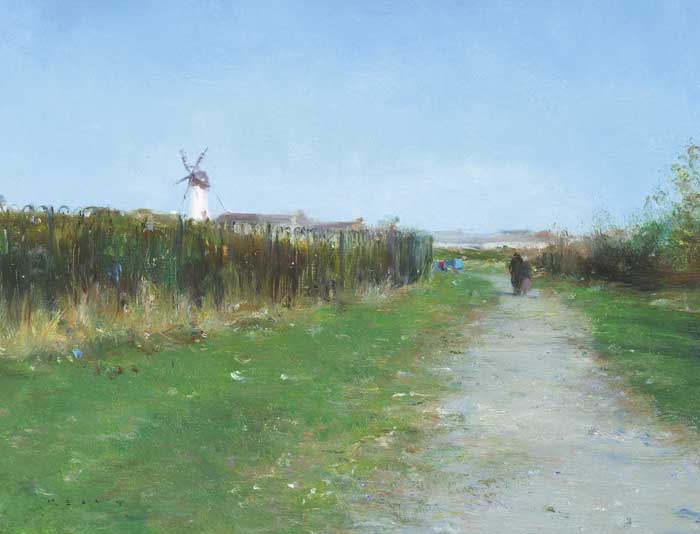
The painting today is by a contemporary Irish Artist, Paul Kelly, whose landscapes of County Dublin cast a spell.
Ger Wolfe in ‘The Curra Road’ has written a song that beautifully captures the sense of being at home and at peace in the physical, emotional and spiritual landscape of Home.
The hallowed Home we always want to carry within us as we walk down other roads on our pilgrimage through Life..
The Curra Road is undoubtedly a classic Irish Song and its luminous lyricism is entirely characteristic of Ger Wolfe’s catalogue.
I heard a story the other day that Bob Dylan would test out the compatibility of prospective musicians by asking, sotto voce, do you know, ‘Pretty Peggy-O’?
If the answer was Yes and they could follow and augment Bob’s version they were hired!
I have the same sort of test for anyone who considers themselves well informed on Irish Music – Do you know, ‘The Curra Road’?
If the answer is Yes I’m up to the Bar to buy them a pint – content there will lots to talk about that evening!
The Curra Road
In the summer we’ll go walking
Way down to the river down the Curra road
There’s a blue sky we’ll walk under
Listen to the humming bees and on we’ll go
We won’t worry about the Winter
Worry ‘bout it raining , worry about the snow
In the summer we’ll go walking
Way down to the river down the Curra road
Past the cattle at their grazing
Through the woods of hazel, holly, birch and oak
Past the robin on the gatepost
Singing to the bluebells, sunlight is their host
We won’t worry about the radio
Worry about the traffic, worry about the phone
In the summer we’ll go laughing
Way down to the river down the dusty road
There is music in the river
Listen to it dancing underneath the bridge
And the wind is hardly breathing
Words onto the willow branches overhead
We won’t worry about the government
Worry about the video, worry about the day
In the summer we’ll go waltzing
Hand in hand together down the dusty way
You can’t go wrong with any of his CDs – my favourites are, ‘I Have Been Loved’, ‘No Bird Sang’ and, ‘The Ragged Ground’.
I’m eagerly anticipating a forthcoming compilation, ‘The Lark Of Mayfield’.
Richard Murphy, who died at the end of January this year, had tremendous poetic gifts and a capacity for disciplined hard work at his craft over many decades.
His collection, ‘The Pleasure Ground: Poems 1952-2012’ (Lilliput Press) is a must-have for anyone interested in modern Irish Poetry.
Murphy had deep feeling for the Irish landscape and the Seas around The Island (and its offshore Islands).
There is a profound physicality present in his verse which makes responding to his work an uplifting whole-body experience..
I have always been particularly impressed by his ability to make history come alive in verse especially through long narratives allowing for exposition, diversions and deliberation.
Reading Richard Murphy will open up new imaginative territory and offer revelatory perspectives on the worlds we imagined we knew well.
Listen to him below reading one of his early triumphs – ‘Sailing To An Island’
Such sinewy, living language!
SAILING TO AN ISLAND
The boom above my knees lifts, and the boat
Drops, and the surge departs, departs, my cheek
Kissed and rejected, kissed, as the gaff sways
A tangent, cuts the infinite sky to red
Maps, and the mast draws eight and eight across
Measureless blue, the boatmen sing or sleep.
We point all day for our chosen island,
Clare, with its crags purpled by legend:
There under castles the hot O’Malleys,
Daughters of Granuaile, the pirate queen
Who boarded a Turk with a blunderbuss,
Comb red hair and assemble cattle.
Across the shelved Atlantic groundswell
Plumbed by the sun’s kingfisher rod,
We sail to locate in sea, earth and stone
The myth of a shrewd and brutal swordswoman
Who piously endowed an abbey.
Seven hours we try against wind and tide,
Tack and return, making no headway.
The north wind sticks like a gag in our teeth.
Encased in a mirage, steam on the water,
Loosely we coast where hideous rocks jag,
An acropolis of cormorants, an extinct
Volcano where spiders spin, a purgatory
Guarded by hags and bristled with breakers.
The breeze as we plunge slowly stiffens:
There are hills of sea between us and land,
Between our hopes and the island harbour.
A child vomits. The boat veers and bucks.
There is no refuge on the gannet’s cliff.
We are far, far out: the hull is rotten,
The spars are splitting, the rigging is frayed,
And our helmsman laughs uncautiously.
What of those who must earn their living
On the ribald face of a mad mistress?
We in holiday fashion know
This is the boat that belched its crew
Dead on the shingle in the Cleggan disaster.
Now she dips, and the sail hits the water.
She luffs to a squall; is struck; and shudders.
Someone is shouting. The boom, weak as scissors,
Has snapped. The boatman is praying.
Orders thunder and canvas cannodades.
She smothers in spray. We still have a mast;
The oar makes a boom. I am told to cut
Cords out of fishing-lines, fasten the jib.
Ropes lash my cheeks. Ease! Ease at last:
She wings to leeward, we can safely run.
Washed over rails our Clare Island dreams,
With storm behind us we straddle the wakeful
Waters that draw us headfast to Inishbofin.
The bows rock as she overtakes the surge.
We neither sleep nor sing nor talk,
But look to the land where the men are mowing.
What will the islanders think of our folly?
The whispering spontaneous reception committee
Nods and smokes by the calm jetty.
Am I jealous of these courteous fishermen
Who hand us ashore, for knowing the sea
Intimately, for respecting the storm
That took nine of their men on one bad night
And five from Rossadillisk in this very boat?
Their harbour is sheltered. They are slow to tell
The story again. There is local pride
In their home-built ships.
We are advised to return next day by the mail.
But tonight we stay, drinking with people
Happy in the monotony of boats,
Bringing the catch to the Cleggan market,
Cultivating fields, or retiring from America
With enough to soak till morning or old age.
The bench below my knees lifts, and the floor
Drops, and words depart, depart, with faces
Blurred by the smoke. An old man grips my arm,
His shot eyes twitch, quietly dissatisfied.
Ha has lost his watch, an American gold
From Boston gas-works. He treats the company
To the secretive surge, the sea of his sadness.
I slip outside, fall among stones and nettles,
Crackling dry twigs on an elder tree,
While an accordion drones above the hill.
Later, I reach a room, where the moon stares
Through a cobwebbed window. The tide has ebbed,
Boats are careened in the harbour. Here is a bed.
The song today is featured in Neil Jordan’s wonderful Film from 1997, ‘The Butcher Boy’ adapted from Patrick McCabe’s astonishing novel.
In my view Sinead O’Connor has shamanistic gifts as a singer and performer (with all the blessings and trials imposed by such gifts).
A performer like Sinead comes along about as often as apples grow on an ivy tree.
If you want to imagine what it might be to die for Love and have a strong heart surrender to Sinead’s incandescent performance here.
In Dublin Town where I did dwell ….
The Butcher Boy
In Dublin town where I did dwell
A butcher boy I loved so well
He courted me, my life away
And now with me he will not stay
I wish I wish but I wish in vain
I wish I was a maid again
But a maid again I ne’er can be
Till apples grow on an ivy tree
She went upstairs to go to bed
And calling to her mother said
Bring me a chair till I sit down
And a pen and ink till I write down
I wish I wish but I wish in vain
I wish I was a maid again
But a maid again I ne’er can be
Till apples grow on an ivy tree
He went upstairs and the door he broke
And found her hanging from her rope
He took his knife
And cut her down and in her pocket
These words he found
“Oh, make my grave large, white, and deep
Put a marble stone at my head and feet
And in the middle a turtle dove
So the world may know I died of love
Geraldine Plunkett Dillon (1891 – 1986) had a fascinating life and after many decades of neglect at last her contribution to Irish culture and letters is being recognised.
’Magnificat’ her only collection of Poems was published by Candle Press of Rathgar in 1917.
It is a work of considerable luminous power.
She also wrote a fascinating memoir, ‘All In The Blood’ which was edited by her grand niece Honor O’ Brolchain.
Geraldine Plunkett Dillon : June
I fill my heart with stores of memories,
Lest I should ever leave these loved shores;
Of lime trees humming with slow drones of bees,
And honey dripping sweet from sycamores.
Of how a fir tree set upon a hill,
Lifts up its seven branches to the stars;
Of the grey summer heats when all is still,
And even grasshoppers cease their little wars.
Of how a chestnut drops its great green sleeve,
Down to the grass that nestles in the sod;
Of how a blackbird in a bush at eve,
Sings to me suddenly the praise of God.
William Orpen (1878 – 1931) was a highly gifted and highly successful Portrait Painter.


:format(jpeg):mode_rgb():quality(40)/discogs-images/A-396788-1191008078.jpeg.jpg)




 The Immortal Jukebox