To initiate the contemplative mood I turn to the contemporary Estonian Composer, Arvo Part with his luminous, liminal setting of Mary’s eternal prayer, ‘The Magnificat’.
Part has been labelled a Minimalist and a retro Medievalist.
I prefer to think of him as having the gift to make time past, time present and time future bloom before us through his music.
When Kathleen Ferrier recorded, ‘Das Lied von der Erde’ the shadow of death was looming over her.
This is music making of the very highest order.
Here Kathleen Ferrier does not so much perform a song as become the song.
The rare emotional reach of her extraordinary voice bringing flesh and spirit to Mahler’s masterwork touches something very deep and unnameable within humanity.
Bill Evans was the supreme lyric poet of the piano.
Listening to Bill’s unique sense of musical time and weight I find my spirit awakened, refreshed and released.
‘Blue in Green’ showcases the amazing precision and delicacy of his touch as a musician.
He is always instantly recognisable – the hallmark of true greatness.
This version of what has become a Jazz standard is from the Christmas 1959 session issued as, ‘Portrait in Jazz’.
You have to believe in telepathy when you hear Bill Evans play with Scott LaFaro (bass) and Paul Motion (drums)
This trio remains the benchmark for all piano trios.
From the Hebrides.
The Christ Child’s Lullaby or Taladh Chriosda in Scots Gaelic is full to the brim with maternal feeling for the vulnerable new born.
Mother and child, once one, now two, create together a sacred space where love and mutual regard dwells.
The standing stone vocals of Mae McKenna and Mairi Macinnes, switching fluently between languages, supported by the pellucid instrumental playing of William Jackson and Tony McManus casts a timeless spell.
Now Heart stilling music composed by one of the most extraordinary figures of the Middle Ages (indeed of all Ages!).
Hildegard of Bingen was a Benedictine Abbess whose haunting compositions refelect her mystical experiences and her philosophical beliefs.
I vividly recall the first time I heard this music in Tower Records at Piccadilly Circus in London. As the gorgeous vocal lines enchanted me I knew, at once, that this record would be a life time companion. And so it has proved.
The majestic soprano Emma Kirkby wonderfully complemented by The Gothic Voices under the direction of Christopher Page takes us into mystical terrain where every hair is numbered like every grain of sand.
Terrain where Hildegard’s vision of herself as a feather on the breath of God makes perfect sense.
Last year I included a Christmas themed painting in the Cornucopia series.
A number of you have suggested I collect these together for this Christmas Tide.
Delighted to oblige!
Piero della Francesca – ‘Madonna del Parto’
I know of no work of art which captures the sense of awed anticipation surrounding the nativity story with such tenderness as Piero della Francesca’s, ‘Madonna del Parto’.
Piero somehow manages to make present through drawing and paint both the vulnerability of Mary in all her humanity and the immanent divine.
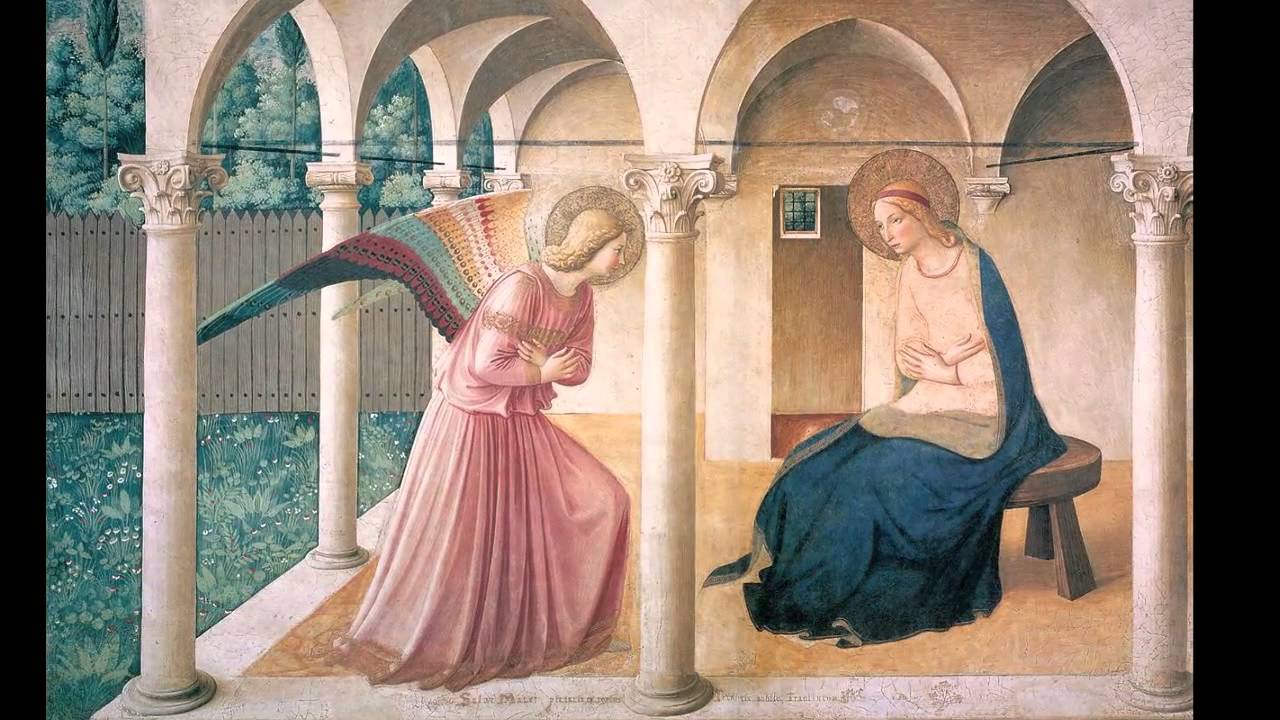
Fra Angelico – The Annunciation
This painting by Fra Angelico has long haunted my imagination since I first saw it in The Convent of San Marco in Florence.
It is a representation of an epochal event, The Annunciation, which holds human time and eternity in perfect balance.
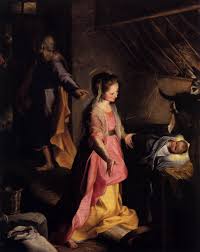
Federico Barocci – Nativity
There is nothing more intimate than the bond between a mother and child after a birth.
This intimacy is captured exquisitely by the Master of Urbino, Federico Barocci, in this Nativity which positively glows with the light of love.
Giorgione – ‘The Adoration of the Shepherds’
Giorgione, a Venetian artist from the period of the High Renaissance, remains a figure of intense mystery.
What we can say from his, ‘The Adoration of the Shepherds’ (NGA Washington) is that he could suspend time and evoke awe and silent wonder.
This painting offers us a profound sense of reverence. The Nativity tableau shows Mary communing with her child as both motherly protector and prayerful worshiper.
Joseph, so often the forgotten man of the narrative, seems overwhelmed by the enormity and mystery of the events he has been caught up in.
Shepherds were ill-regarded outsiders in biblical times.
Yet, it was they who were granted the blessing of an audience with the new born King.
This must be some new type of King who welcomes first the poor and the ragged before the rich and high born.
The sight greeting the Shepherds was beyond words.
Their attitude of humble surrender to an experience beyond their understanding is intensely moving.
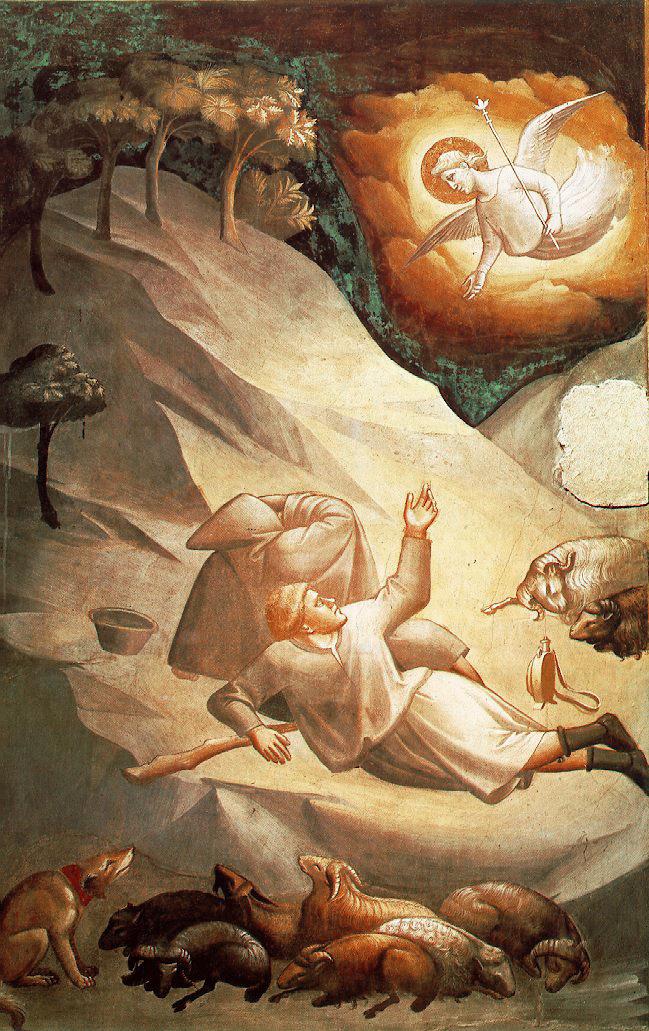
Taddeo Gaddi – ‘The Angelic Announcement to the Shepherds’
The Florentine Taddeo Gaddi was the star pupil of the great Master, Giotto.
His, ‘The Angelic Announcement to the Shepherds’ can be seen in the Baroncelli Chapel within Santa Croce in his native Florence.
It is a wonderfully dramatic painting.
An Angel acts as God’s messenger alerting humankind to an event upon which all history will pivot.
The Sheep are stirring and the Dog’s keen senses alert him to the messenger from afar.
As the Angel speaks eternity merges with linear time.
How could the waking Shepherd find the words to tell his sleeping companion what he has learned?
Surely all he could say was:
‘Let us go – someone we must see is waiting for us just down the hill. Come now!’
It is an invitation which remains open.
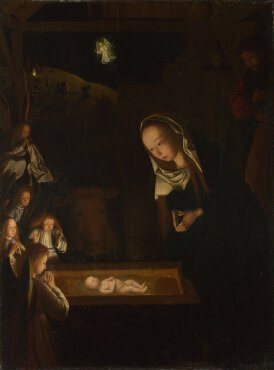
Geertgen tot Sint Jans – Nativity
St Bridget of Sweden had a mystic vision of The Nativity.
The painting by the Flemish artist Geertgen tot Sint Jans makes that ineffable vision a reality before our eyes and in our hearts through virtuoso deployment of light and shadow.
Looking at this tender scene we remember Christ’s statement:
‘ I am the light of the world: he that followeth me shall not walk in darkness, but shall have the light of life.’
I don’t know about you but the emotional intensity of the last two Posts in The Christmas Alphabet series has sent me searching for something a little lighter in tone!
So I call upon a premier party band.
Heroes of the Hoedown and the Hootenanny.
Brimful of Texas Texture.
Wild with Western Swing.
Asleep At The Wheel.
Merry Texas Christmas Y’all!
Find yourself a well sprung floor and get dancing!
They’re playing, ‘Jingle Bells’ and, ‘White Christmas’ in the shopping malls.
A marching Salvation Army brass band wrings the heart with, ‘In The Bleak Winter’.
There’s a tree dressed in tinsel and flickering lights in the Town Square.
Someone said the Reindeer are arriving soon.
Words like Holy, Saviour, Joy and Peace fill the Winter air.
Yet, yet, for some Christmas is not a time of unalloyed Joy.
It’s a time when, whether you want to or not, you’re reminded of Christmases past and the past that haunts your present and is sure to haunt your future.
What happened to the dreams of the 6 year old who believed in the magic of Christmas with all their heart?
The child who whooped with delight as they left crazy spiralling tracks all across the freshly fallen snow?
What became of all those promises the 16 year old made about the world they were going to make – once they were in charge.
It takes time to learn how easy it was to make promises and how hard they are to keep.
How hard to keep.
When you look in the mirror it’s not hard to see someone sad and selfish.
Someone who has made themselves hard to handle.
Someone who is responsible for tears beyond their own.
Tears beyond their own.
The snow when it falls from the sky covers a multitude of sins.
A multitude.
No snow now.
Hard wet ground.
Oh, oh, I wish I had a River I could skate away on.
A river so long my feet would fly, fly, fly.
A river to skate away from all the burdens of the years.
A river to skate away from all the flowing tears.
A river to skate away on.
Away, away, away.
Joni Mitchell from her career peak Record, ‘Blue’.
River is a song that speaks to the grief and loneliness many people experience at Christmas.
Grief for the loss of loved ones to death.
Grief for the loss of a secure self.
Grief for the casualties of this crazy scene.
Grief for the loss of a place that was your Home.
Loneliness remembering severed Love.
Loneliness remembering severed Friendship.
Grief and loneliness and longing to escape miraculously captured in the heart clutching beauty of Joni Mitchell’s voice each time she sings the word, ‘fly’.
Oh to skate away into the cauterising cold air over the frozen river.
Last month I went, for the fourth time, to see Conor Macpherson’s modern masterpiece Play ‘The Weir’.
It’s a comic tragedy or a tragic comedy depending on your point of view.
The whole action of the Play takes place on a single evening in an Irish rural bar.
As the drinks flow the four characters tell, in sequential monologue form, riveting stories imbued with puzzled pain, aching regret and unending longing.
Strings break in Heaven.
As each story unfolds more is revealed by the tale than the teller had ever expected.
By the end of the play though they are raw from the experience there is a shared sense of catharsis and, almost miraculously, a feeling that the surrounding darkness is pierced by rays of light and fragile hope.
The search for that fragile hope is one of the main reasons we tell stories – both to others and to ourselves.
As I drove home a song began to play in my head.
A song that is a comic tragedy or a tragic comedy depending on your point of view.
A song of puzzled pain that tells more about the teller than ever anticipated.
A song filled with aching regret and unending longing.
A song that breaks strings in Heaven.
A song that has achieved a sense of catharsis by its conclusion.
A song that, almost miraculously, ends on a note of fragile hope.
A song that takes place at Christmas Time when even the most cynical like to believe in Hope – however faintly it glimmers.
A song by a supreme storyteller.
Tom Waits.
‘Christmas Card From a Hooker in Minneapolis’.
Now, aint that just Grand!
Tom Waits, in this freewheeling pre Swordfish Trombones period, wore a baggy coat with pockets stuffed with the works of John Fante, Lawrence Ferlinghetti, Charles Bukowski and Alan Ginsberg.
Playing in his head were the recordings of Lenny Bruce, Lord Buckley, Howling Wolf, Bob Dylan and Hank Williams.
He had pretty much taken up residence on the Lost Highway.
Because, of course, it’s the best way to see the Moon and Stars clearly and to find out what kind of storyteller you might become.
Tom Waits became the kind of storyteller who could make you gasp, make you laugh out loud and then cry hot tears as his crazy lyrical stories unfolded.
A Tom Waits song makes you relish the details.
I love the way while the piano rolls meanderingly along the lyric seems to spontaneously emerge out of thin air.
The use of ‘And’ and, ‘Hey’ to kick off each exhalation of thought and invention gives the song a tremendous immediacy.
Hey Charley I’m pregnant
and living on 9-th street
right above a dirty bookstore
off Euclid avenue
It’s important that the song is addressed to a specific person.
It’s thinking of that person, that one person, who might, just might, make it all right again, that makes a person put pen to paper.
And you should always kick off with the news that’ll make the reader sit bolt upright and want to read on.
Read on.
And I stopped taking dope
and I quit drinking whiskey
and my old man plays the trombone
and works out at the track
You want to convince Charley and yourself that things have changed.
They really have changed.
You’ve changed.
Those vices you shared are memories now.
And, you found a guy.
A guy who plays the trombone and brings the dollar bills home.
And he says that he loves me
even though its not his baby
and he says that he’ll raise him up
like he would his own son
And, hey .. a guy who won’t let you down.
Not like all the other Guys.
A guy who will raise up your unborn son – even though he’s not his own son.
And, he gave me a ring
that was worn by his mother
and he takes me out dancin
every saturday nite.
Now, Charley knows somewhere in his heart that there’s no woman who ever lived who doesn’t want their Darling to give them a ring that was worn by his Mother.
And, Hey, whatever anyone tells you there ain’t no feeling better than goin’ out dancin’ on a Saturday Night – just the two of you.
Just the two of you.
And, I still have that record
of Little Anthony & The Imperials
but someone stole my record player
how do you like that?
When you’re lost and you think you’re going out of your head and your heart’s about to jump right out of your chest you can’t help but remember those old songs.
There are some songs you’ll never get out of your head.
Little Anthony with the soaring voice.
Tears on my pillow, pain in my heart, caused by you, you
If we could start anew, I wouldn’t hesitate
I’d gladly take you back, and tempt the hand of fate
Tears on my pillow, pain in my heart, caused by you
Wo oh oh oh oh oh oh oh oh
Wo oh oh oh oh oh oh oh oh
Wo oh oh oh oh oh oh oh oh
hey Charley … I went back to Omaha to
live with my folks
Charley knows, like you do, that you can never really go back to the home you grew up in.
If you ever had a reason to leave you’re never going to be happy back in Omaha.
And, hey, you had so many reasons to leave.
Reasons to leave.
and I wish I had all the money
that we used to spend on dope
I’d buy me a used car lot
and I wouldn’t sell any of em
I’d just drive a different car every day dependin on how I feel.
You and Charley, his hair all slicked back with grease used to drive with the top down at ninety miles an hour on the two lane blacktop.
And, hey, wouldn’t it be great if you had all that wasted cash and could roll down the highway every day in a different car.
Just the two of you.
You can almost feel the warm air caressing you both.
Dreams are like that.
Dreams are like that.
Sometimes dreams are all that can keep you going.
All that can keep you going.
hey Charley
for chrissakes
do you want to know
the truth of it?
I don’t have a husband he don’t play the trombone and I need money to pay this lawyer
But. But. It takes a lot of energy to dream.
And, hey, sometimes you just don’t have the strength anymore.
Just don’t have the strength.
So, you breathe deep and let it out.
Let it out.
All of it.
The blood and the guts and the tears.
And, hey, you find yourself saying the thing you promised yourself you’d never say.
The thing you promised yourself you’d never say.
and Charley, hey
I’ll be eligible for parole
come valentines day.
In December 1965 Frank Borman and Jim Lovell were far, far from Home.
They were astronauts – the crew of Gemini 7 orbiting The Earth on a 14 day mission.
Naturally as they looked down on their home Planet their thoughts turned to the upcoming Christmas celebrations.
So when they were asked by Mission Control if there was any music they wanted to hear their reply was unhesitating – ‘I’ll be home for Christmas’.
It’s the wish, the fondest hope, of every soldier who has soldiered in every war since Christmas was first celebrated.
Nothing makes the heart yearn for Home like the approach of Christmas.
Whether it’s your childhood Home or the Home you’ve made for yourself as an adult, Home attracts with a primordial power.
And, if you can’t make it Home in person because of a War or the tides of life then you can, you can, be Home – if only in your dreams.
I don’t know which version of Kim Gannon, Walter Kent and Buck Ram’s Song the Gemini 7 Crew listened to (probably the masterful Bing Crosby original) but the one I always turn to is by the enigmatic Leon Redbone.
Rarely for me I’m going to give you no disquisition on Leon except to say that you will be doing yourself a great favour if you invest in his records forthwith!
I’ll be home for Christmas
You can plan on me
Please have snow and mistletoe
And presents on the tree
Christmas Eve will find me
Where the lovelight gleams
I’ll be home for Christmas
If only in my dreams
I hope you make it home for Christmas wherever you may be today.
And if you just can’t make it Home I hope that the Home you find in your dreams is the one you have always been searching for.
Roy Orbison was far from his Texas Home and assailed by a raging fever.
He was in Britain following a successful tour supported by a new Beat Group, The Beatles, who really seemed to be tearing up the place.
They were nice guys.
Every night they stood on the side of the stage to watch Roy – open mouthed as he effortlessly hit operatic notes and held the crowd, frantic when they’d performed, spellbound without moving a muscle.
Though the thermometer showed 102 and rising Roy had a job to do.
His producer and mentor Fred Foster had found a Christmas song from a fellow Texan, Willie Nelson, called, ‘Pretty Paper’ that might just give Roy another big fat hit.
No one could write a better heart tugging song than Willie and damn sure No One, absolutely No One, could sing such a song to rival The Big O!
So, in Pye Studios, the cream of London’s session men under the supervision of Bill Justis and Ivor Raymonde got everybody miked up and the Orchestra set because Roy was fading away before their eyes.
We’re only going to get one shot at this!
The term ‘Unique’ is thrown about far too carelessly when discussing the merits of great singers.
In the case of Roy Orbison no other description will do.
It’s the whispering sound of your subconscious.
It’s the whispering all around you of the West Texas Wind.
It’s the whisper of your thoughts and dreams and memories.
The ones you smile when you recall and the ones that make you wince.
It’s the sound of a bruised and battered heart that scarce knows how it’s beating on.
It’s a plea to The Moon and The Stars when all the earthly powers have turned away.
Turned away.
It’s the unique sound of Roy Orbison.
There’s quite a story behind Willie’s song.
On his regular visits to Fort Worth he had noticed a man selling pencils and paper outside landmark Department Store, Leonard’s.
Now this was a man you wouldn’t easily forget once seen.
For he was severely crippled and moved about by hauling himself along the sidewalk protected by heavy gloves and knee pads made out of old tires.
In all weathers he was there selling his wares.
‘Pretty Paper! Pretty Paper!’ he would call out to attract customers – hoping for a few more coins to drop into his cup.
Walking his farm in search of inspiration Willie remembered this cry and soon putting his own pencil to work a classic Christmas Song was born.
Characteristically Willie uses words sparingly to paint the picture.
The promise, the pleasure and the pathos of the Christmas Season are captured.
The love and the longing and the loss.
My how time does fly.
My how time does fly.
Pretty paper, pretty ribbons of blue
Wrap your presents to your darling from you
Pretty pencils to write I love you
Pretty paper, pretty ribbons of blue
Crowded street, busy feet, hustle by him
Downtown shoppers, Christmas is nigh
There he sits all alone on the sidewalk
Hoping that you won’t pass him by
Should you stop? Better not, much too busy
You’re in a hurry, my how time does fly
In the distance the ringing of laughter
And in the midst of the laughter he cries
Pretty paper, pretty ribbons of blue
Wrap your presents to your darling from you
Pretty pencils to write I love you
Pretty paper, pretty ribbons of blue
Now, I love the original version.
The backing singers and the Orchestra and the deliberate pace all evoke the era perfectly for me (I would have been 8 years old when the record was released).
But. But.
When I play, ‘Pretty Paper’ I always turn to the live version below.
The sheer majesty and magnetism of Roy Orbison’s voice cuts straight to the core.
Roy didn’t know the name of the man the song was written about.
But Frankie Brierton could have had no more tender salute than that so indelibly sung by Roy here.
Maybe we could all take a look around as we hurry on busy feet through the crowded streets.
Maybe we as we accumulate the pretty paper and the ribbons of blue we could stop for a moment and remember Frankie in all his dignity.
Maybe we could find a cup to drop more than a few coins into and spare a word of good cheer to one finding the days hard and the nights long.
Then we could say with a full heart Merry Christmas to all we meet.
There is a power beyond all analysis in the Christmas Carol – especially those which emerged from the folkloric tradition of England’s rural heartlands.
I could give you a learned analysis of, ‘The Holly and the Ivy’ noting it is numbered 514 in the Roud Folk Song Index and waxing lyrical on its symbolism and use of Christian iconography.
Somehow, as soon as Kate Rusty starts to sing all that appears superfluous.
For Kate is for my money the finest English Folk Singer since Sandy Denny and you would have to be made of stone not to be moved by the tender beauty of her voice.
Hearing her singing such a song I feel as if I had wandered from the snow into a Yorkshire Romanesque church.
Resting in a time worn pew, hunched against the draughts all around I am startled by the emerging sound of a rustic band straight out of a Thomas Hardy novel.
As the sound swells and soars to the rafters my eyes sting with tears as Kate in a voice at once wholly of the people and wholly unique brings all the moods and colours of the carol to blood beating life.
In Kate’s vocal you can feel in your heart and soul the rising of the sun and the quick running of the deer.
Oh such sweet singing in the choir!
The revelation of the mythical, mystical, significance of the landscape of the natural world is one of the glories of Folk Song.
Intertwined in Nature and our lives are the blossom, the Berry and the prickle of the thorn.
Even as we dance to the merry Organ we know (we know) that no life escapes bitter gall and no life needs not redemption.
Sinners need a Saviour.
Of all the trees that are in the wood the Holly bears the crown.



 The Immortal Jukebox