Rosanne Cash, Eric Bibb, John Phillips and Scott McKenzie sing Hedy West : 500 Miles

‘We leave something of ourselves behind when we leave a place, we stay there, even though we go away. And there are things in us that we can find again only by going back there’  (Pascal Mercier)

‘The desire to go home that is a desire to be whole, to know where you are, to be a point of intersection of all the lines drawn though all the stars, to be the constellation- maker and the center of the world, that center called love.’ (Rebecca Solnit)

‘You can’t go home again.’ (Thomas Wolfe)

‘Lord, I’m one, Lord, I’m two, Lord, I’m three, Lord, I’m four,

Lord, I’m five hundred miles away from home.’ (Hedy West)

Much meaning can be expressed in so few letters of the alphabet

Just four will do.

Good. Evil. Luck. Fate. Time. Fear. Hope. Hate. Womb. Tomb. Life. Love.

And one four letter word might contain them all.

Home. Home.

The home you were born in; the home you grew up in, the home that was your shelter and refuge.

The home you left with tears in your eyes.

The home that lives forever in your heart and your mind’s eye.

The home that was your prison.

The home you left without a backward look.

The home you’ll never go back to now you’ve made a home of your own.

Home, home, home.

Should you write a true song evoking the longing for home when the tides of time have taken you far away you’ll find singers to sing that song for evermore.

Hedy West wrote such a song, ‘500 Miles’


Crystal clear. Mountain dew.

Banjo, voice, Presence, centuries of the ballad tradition.

Fiddle tunes and songs called Rueben’s Train, The Railroader’s Lament and 900 Miles all swirl in the imagination of a young woman growing up in a home suffused with tunes and stories and songs.

Great Uncle Gus plays the fiddle, Gradma Lillie plays the Banjo and has a bottomless well of ballads and laments that seem to float on the breezes all around.

Dad, Don West, is a poet (‘Clods of Southern Earth’), a labor organiser, a civil rights activist, an oral historian and inspiration.

west_don_photo

Hedy has a voice. She plays the Banjo in her own style.

She has the austere gravitas of a classical bard.

When she sings the room stills. When she sings she has something to say.

She has a calling.

A calling to tell the stories of the disregarded rural poor.

A calling to tell their stories in songs that express, and more honour, the depth of their struggles and the fullness of their humanity.

In a career of more than five decades taking her from folk contests in her native Georgia to Greenwich Village, Carnegie Hall, London and venues all over the globe it’s a calling she fulfills with steadfast hope, faith and love.

In the 1950s folk world a song as true and singable as 500 Miles scorches across the continent like a raging forest fire.

It instantly becomes a folk standard with each group or artist adapting the lyric and instrumentation to suit their own style and the image of home they carry with them.

‘Lord, I’m one, Lord, I’m two, Lord, I’m three, Lord, I’m four,

Lord, I’m five hundred miles away from home.’

As far as I can tell the first notable recording of the song is by The Journeymen in 1961.

Now, you’d have to be a scholar of the American Folk Revival to sagely nod once their name is mentioned. Yet, almost all of us came to know the members of the group through their later careers.

journeymen

John Phillips became the leader of prolific hit makers The Mamas & the Papas, Scott McKenzie had a whole generation singing, ‘San Francisco (Be Sure To Wear Flowers In Your Hair) while Dick Weissman achieved eminence as a banjo picking musicologist and folklorist.


Listening to this time suspending version in soft sift black and white dreams I drift through the home of my own childhood.

Streetlights glow the palest yellow as they struggle to penetrate the blanket like London Fog of the 1950s.

Spectral trolley buses are boarded by attentively following their clanging sound until they suddenly loom up before you.

Snow surrounds market stalls piled high with cheap goods sold as wondrous bargains you must not be without – ‘Buy now Mrs! When they’re gone they’re gone!’

Cocooned in a two room first floor flat a young boy, certain in his bones that he is the constellation-maker and centre of the world, learns to read, ‘Treasure Island’ and dreaming of wooden ships, wooden legs, parrots, pirates and buried plunder begins to dream stories of his own.

‘Lord, I’m one, Lord, I’m two, Lord, I’m three, Lord, I’m four,

Lord, I’m five hundred miles away from home.’

As we have seen from the previous post here on The Jukebox when it comes to recognising an American standard Johnny Cash is your go to man.

Johnny took his curatorial role so seriously that he drew up, ‘The List’ – a compendium of great songs he entrusted to his daughter Rosanne.

Following her father’s death Rosanne returned over and over again to The List and the result was a luminously beautiful record featuring haunting tracks like Dylan’s , ‘Girl from the North Country’, ‘Long Black Veil’, Motherless Children’ and, ‘Miss the Mississippi and You’.

The one I come back to the most though is her devoutly heartfelt take on 500 Miles.


Johnny sure would have been proud.

‘Lord, I’m one, Lord, I’m two, Lord, I’m three, Lord, I’m four,

Lord, I’m five hundred miles away from home.’

Great songs call out across the miles, across genres and cultures and across time.

The veteran Acapella group The Persuasions uncover the longing, the loss, the mourning and the journey to the farther shore that awaits us all.

Their Gospel and Spiritual version of 500 Miles makes a congregation of us all.

‘Lord, I’m one, Lord, I’m two, Lord, I’m three, Lord, I’m four,

Lord, I’m five hundred miles away from home.’

500 Miles is a song that speaks from and to the bonds of familial love.

I’ll conclude with a blessed version by a father and son, Leon and Eric Bibb, which has the quality of a foot sore pilgrimage concluding in longed for peace and reconciliation.

‘Lord, I’m one, Lord, I’m two, Lord, I’m three, Lord, I’m four,

Lord, I’m five hundred miles away from home.’


We are all pilgrims.

May we all find peace reconciliation and the home we seek.

Notes:

I love every record made by Hedy West.

Seek out her CDs on the Vanguard, Topic and Bear Family labels for a lifetime of inspirational listening.

The only CD I can find by The Journeymen is, ‘New Directions In Folk Music’ on Collectors Choice from 2010 which is a nice collection of thistledown folk.

Eric and Leon Bibb’s, ‘A Family Affair’ hard to find is a gem well worth the search.


Johnny Cash, Debbie Harry & Gene Autry chase Ghost Riders In The Sky!

The ‘Way out West’ Series No 1

Music hath charms. Music hath charms.

And, among those charms is its uncanny ability to forge bonds of fellow feeling and friendship between people born in wildly different times, places and cultures.

Take me and Carl.

Carl came from the spice Island of Grenada in the Caribbean.

When we met he was seventy years old and I was a callow twenty two.

I had just emerged, blinking, from the ivory tower of Cambridge University awaiting my inevitable discovery as a great novelist.

Carl had spent decades in the fierce factories of Detroit and the searing cane fields of Florida.

We met in Hospital.

I was working there as a porter dramatically rushing the resuscitation trolley to people on the point of death and more prosaically ferrying patients to the X-Ray department and to the operating theatre for surgery.

Carl, having suffered a heart attack, came into Accident & Emergency by ambulance at 3am when I was on night shift.

I watched with a mixture of horror and fascination the team of doctors and nurses, with whom moments before I had been sharing idle banter,  urgently bring all their professional skills to the struggle to to save Carl’s life.

Happily they succeeded and before I left that morning I wheeled Carl to the ward where he would recover.

Normally that would have been the last time I saw him but as I was about to leave Carl said, ‘Will you come and see later?’.

A request I could hardly refuse.

So, that night I made the first of many visits to Carl’s bedside in the three weeks he spent in the hospital.

Walking into the ward I wondered what two such disparate individuals might find to talk about.

Almost without thinking I asked him, having learned of the time he had spent in America, what kind of music he had listened to there.

Given his age, and reading on his chart  that he was a Baptist by religion, I anticipated that he might answer Big Band Jazz or Gospel Music.

I was a little taken aback therefore when he answered by singing in a mellow baritone:

‘An old cowpoke went riding out one dark and windy day,

Upon a ridge he rested as he  went along his way,

When all at once a mighty herd of red-eyed cows he saw

Riding through the ragged skies and up a clouded draw …’

Now, my education, at University, might have been airily academic but luckily on those few occasions when I was not bent over some medieval text I could be found, a huge tub of popcorn by my side, obsessively watching every ‘A’, ‘B’ or series Western that ever came to town.

So, without missing a beat, I joined in as we sang:

‘Their brands were still on fire and their hooves were made of steel,

 Their horns were black and shiny and their hot breath he could feel,

 A bolt of fear went through him as they thundered through the sky,

For he saw the riders coming hard and he heard their mournful cry ..’

And then, to the incredulity of the rest of the ward, we lifted our voices up and sang together lustily:

‘Yippie I aye, Yippie I ooh,

 Yippie I aye, Yippie I ooh,

 Ghost Riders In The Sky’

Then we laughed and laughed until we nearly cried.

And, we sang that song, among many other Western favourites, every time we met until Carl died some two years later.

‘Ghost Riders In The Sky’ was Carl’s favourite song and the version he preferred, ‘Because he don’t mess about with the song’ was the one by Gene Autry from 1949.

This one’s for you Carl:


According to the Western Writers of America, ‘Ghost Riders In The Sky’ is the greatest of all Western songs and I whole heartedly agree with that august body.

The song was written in 1948 by Stan Jones and first recorded by him and his marvelously named, ‘Death Valley Rangers’ that same year.


stan-jones-2

Stan, then a Park Ranger in Death Valley, is reputed to have written the song on his 34th birthday as he recalled a legend told to him when he was 12 by an old cowboy.

Now, all stories told by Stan Jones need to be taken with a fistful of salt as he was a noted fabulist who often valued the effect of a tale above its veracity (as frequently do I!).

The tale of the spectral herd in the skies and the curse of, ‘Stampede Mesa’ probably traces its origins to mythical cautionary stories told around the cowboy campfire in nineteenth century Texas.

Whatever its cultural lineage Stan crafted a certifiable classic which is shot through with haunting images which never leave the mind once heard.

Burning in the mental firelight of my imagination as the song proceeds I feel the hot breath of those red-eyed cows and shudder with fear as their black and shiny horns and steely hooves thunder by.

In my dreams I’m there with the gaunt faced cowboys their shirts soaked with sweat as they endlessly pursue the cursed herd they never, ever, will catch.

Surely that’s my name I hear them calling in the wind at the dead of night!

‘Yippie I aye, Yippie I ooh,

 Yippie I aye, Yippie I ooh,

 Ghost Riders In The Sky’

Stan wrote many more fine Western ballads notably those featuring in the films of the greatest of all Western Film Directors – John Ford.

But, neither he, nor anyone else, ever wrote a better one than, ‘Ghost Riders In The Sky’.

The brilliance and mother lode Americana quality of the song has, for seven decades now, attracted hundreds and hundreds of artists to take a shot of rye, strap on their spurs and saddle up with the Ghost Riders to see if that herd can finally be corralled.

And, if anyone, by force of will and character could carry out that miracle it would surely be none other than Johnny Cash – no mean mythic figure himself.


Johnny sings the song with the oracular power an old testament prophet issuing a grave warning to his tribe to prevent them from sleepwalking to doom.

You want fire-snorting horses brought to life?

You want those ghostly riders coming hard right at you?

You want to feel those mournful cries in the pit of your stomach and the marrow of your bones?

Call for The Man in Black!

‘Yippie I aye, Yippie I ooh,

 Yippie I aye, Yippie I ooh,

 Ghost Riders In The Sky’

Stan Jones’ evocative melody has always attracted guitarists and instrumental groups who like to tell an atmospheric story using six resonant strings instead of the vocal chords.

Today I’ve chosen to feature a top 30 Billboard Chart hit from 1961 (and top 10 in the UK) by The Ramrods  – who had clearly listened closely to Duane Eddy.


The Ramrods were out of Connecticut and had brother and sister Claire and Rich Litke on drums and sax respectively.

Vinny Lee took the lead guitar role with Gene Moore in support.

Embed from Getty Images

They were essentially one hit wonders though I greatly enjoyed listening to their follow up, ‘Loch Lomond Rock’ which, probably uniquely, mashes up twangtastic guitar with a bagpipe solo!

And, now as they say, for something completely, completely different.

I have to say that when I started researching this post I never expected to feature a trance version by Debbie Harry!


‘Yippie I aye, Yippie I ooh, Yippie I aye, Yippie I ooh’ Indeed!

 Debbie’s version comes from Alex Cox’s 1998 film, ‘Three Businessmen’ and in my view is the best thing about it.

The production is by Dan Wool who had worked frequently with Stan Jones’ son who is a music editor – so legal clearances to use the song were easily arranged.

There’s definitely something sexily hypnotic about Debbie’s vocal adding an unexpected dimension to an established standard.

I’m going to conclude with another version out of left field or should I say the firmament.

And, versions of Ghost Riders don’t get more left field than the hipster version by Scatman Crothers!

‘Yippie I aye, Yippie I ooh,

 Yippie I aye, Yippie I ooh,

 Ghost Riders In The Sky’


Everyone has heard Scatman’s distinctive tones through his voice over work for TV and film. That’s Scatman as Hong Kong Phooey and as the hep Jazz playing feline in, ‘The Aristocats’.

Some may remember his appearances on TV in the show, ‘Chico and the Man’ or on film as Dick Halloran in Kubrick’s, ‘The Shining’ (one of four films he shared billing with Jack Nicholson).

Scatman was always a hep cat as evidenced by his drumming with Slim Gaillard. He brings all his vouty hipster presence to this version of Ghost Riders which has me cheering him on while doubled up with laughter.

There will be many more fine versions of Ghost Riders because we all love a good story.

Especially one that’s so incredible it just has to be true.

‘Yippie I aye, Yippie I ooh,

 Yippie I aye, Yippie I ooh,

 Ghost Riders In The Sky’


Notes:

There’s a fine biography of Stan Jones by Michal K Ward published by Rio Neuvo.

The major hit version was by Vaughn Monroe

Basso profundo versions by Lorne Green, Marty Robins, Burl Ives, Frankie Laine

Western versions by Sons of the Pioneers, Riders in the Sky, Chris Ledoux, Jimmy Wakeley, Mary McCaslin

Instrumental versions by The Ventures, The Shadows, The Spotniks, Glen Campbell/Roy Clark, Dick Dale

‘Other’ versions by Spike Jones, Blues Brothers, Brothers Four, Judy Collins, Christopher Lee


Dolores Keane : Never Be The Sun – Voice and Vision from Ireland

‘.. Every night their mouths filled with Atlantic storms and clouded-over stars and exhausted birds. And only when the danger was plain in the music could you know their true measure of rejoicing in finding a voice where they found a vision.’ (Eavan Boland)

‘As long as Dolores Keane is walking around this earth, I won’t call myself a singer. I think she’s the voice of Ireland.’ (Nanci Griffith)

To my mind the besetting malady of modern life is atomisation.

Meagre lives lived in migraine-fraught locked and barred isolation.

When I seek a musical antidote to my despair about this situation I turn most often to a singer, Dolores Keane, whose every breath embodies not atomisation but connection. Embed from Getty Images

Dolores had the immense good fortune to be born, in 1953, into a family who were keepers of the flame of Irish Traditional Music in a time when the deep treasures of the tradition were at risk of being swept aside by the glittering lures of commercial modernity.

From the age of four Dolores lived in Caherlistrane, County Galway, with her aunts Rita and Sarah.

The Keane sisters played accordion and fiddle but their greatest accomplishment was their heart stopping prowess as duet singers of ballads in the Sean-nos or old style.

Literally growing up at their feet Dolores imbibed their mastery through every pore of her being. In the kitchen and in the parlour songs sounding the depths of human experience were sung with full hearted candour and artistic delicacy.

Dolores, as a child, was exposed, initiated, into the, ‘Big Music’. Later, while still a young woman she was able to give life to the Big Music herself.

Knowing, in her heart and bones, where she was from set her free to voyage out into the wider world armed with a sense of inner poise.

The golden lesson Dolores learned from Rita and Sarah was that a singer’s duty was to devote all the emotional and technical resources in their gift in service of the song.

To bring a song to quickening life required discipline, engagement and above all attention. Attention to lyric, story and melody.

Attention to breath and pace.

Artistic, emotional and spiritual attention. Dolores listened with rapt attention to the artistry of her aunts. The proof of how diligently she attended can be heard through every moment of her sublime performance of, ‘The May Morning Dew’ from her debut solo record, ‘There Was A Maid’.

There can be no such thing as the definitive performance of such a song.

Traditional singers taking on the challenge are in pursuit of a wild hare which will always eludes capture.

There is always, always, more singing in the song.

Yet we can say that it is hard to imagine that anyone has ever engaged in a more thrilling pursuit than Dolores.

She inhabits, ‘The May Morning Dew’ so intensely that we feel connected to a complete world.

Connected to a living hospitable community.

Connected to the trees and the sky, the flowers in the valley, the calling of the small birds and the farmyard dogs.

Connected to the sound of the kettle boiling on the hob as neighbours converse on matters of great local import under the sky blue and clear.

Feeling the tender warmth of such a world we must feel too the chill and the pang of knowing that all things must pass, all things must pass.

So the beloved house will become but a stone on a stone and the lovingly tended garden a a riot of weeds.

And, like the red rose our parents, our friends and relations and, we cannot deny it ourselves, will perish in the May morning dew.

Dolores’ singing arrests time and allows us, each in our own way, according to our history, to contemplate and perhaps come to terms with the timeless truths of the song.

Next a contemporary song, ‘Never Be The Sun’ written by Donagh Long.

Every listener to this song will recall the one, who for them, will always be the light. Always be the light.

I have never listened to this performance without salt tears cascading down my face.

I really have no words to express how magnificent Dolores singing is here except to say that as she sings I leave the dusty Earth behind as she sets the very sun, the deepest ocean, the moon and the stars in sway.

Listening to Dolores singing epic ballads from the treasury of folk music history has convinced me that very few modern songwriters have works to compete with that great writer, ‘Trad’.

Still, we can all allow that Bob Dylan and Richard Thompson have added mighty stones to the cairn of the song hoard.

And, it is certain that the late Guy Clark, supreme craftsman of the narrative ballad, has too.

The pain and the promise of emigration seems to be always present in Ireland’s history and culture. As such it has proved a rich seam for songwriters to mine.

With, ‘Emigrant Eyes’ Guy Clark, with typical skill, yokes the sweep of history with the hope and the blood and the tears of generations to make a song crying out for a singer who can hold all these in balance.

A singer who can span oceans and centuries and set the heart and imagination ablaze.

In Dolores Keane he finds that singer.

I will leave you with a privileged glimpse into the roots of Dolores Keane’s art.

Together with her beloved Aunts Rita and Sarah she sings, ‘Once I Loved’ .

As they sing they evoke for me all time and no time.

History and pre-history.

Fairy forts and ancient barrows.

Passage graves, beehive chapels and high crosses.

Healing wells and hedge school philosophy.

Blind Harpers and hermit Saints.

The flight of the Heron and the Curlew.

The rush of the wind over the reeds.

The mysterious music of the constant moon and the day-blind stars.

Dolores Keane, while gifting us untold riches, has come through well documented struggles with depression, alcohol and cancer.

She is a singer of the stature of Bessie Smith, Umm Kulthum and Aretha Franklin.

She has sung herself, and us as listeners, back to where the singing comes from.

I wish her health and peace and songs to sing whenever she chooses to sing them.


Notes: Dolores Keane has an extensive catalogue.

Every record she has ever made is worth of your attention.

My personal favourites are:

‘There Was A Maid’

‘Solid Ground’ ‘

Broken Hearted I’ll Wander’ & ‘Farewell To Eirinn’ (With John Faulkner)

‘De Dannan’ & ‘Ballroom’ (from her time with the group De Dannan)


Rita & Sarah Keane’s mesmeric singing can be found on, ‘Once I Loved’ & ‘At The Setting Of  the Sun’.

There is a heart wrenching documentary, ‘A Storm in the Heart’ on Dolores’ life by Liam McGrath.

The best book on Traditional Music I have ever read is Ciaran Carson’s, ‘Last Night’s Fun’.

A fascinating insight into Caherlistrane where Dolores grew up can be found in the history/memoir, ‘Caherlistrane’ by Mary J Murphy – available online from Charlie Byrne’s Bookshop in Galway.

Christmas Cornucopia 2106 : Eleventh Day


Eleventh day:

A Painting by Duccio (c1255 to c1319)

A poem by Lawrence Sail

Music by  The Voice Squad, Patty Griffin and Emmylou Harris

Our Nativity painting today is by a great Master from Sienna, Duccio Di Buoninsegna.

Since I first discovered the work of Duccio as a teenager I have been in thrall to the luminous beauty of his works.

His paintings seem to me to have been deeply pondered in his heart which gives them qualities of stillness and humility which I find overwhelmingly moving.

In particular, something about, ‘Duccio Blue’ sets my heart aflame.


duccio-the-nativity-with-the-prophets-isaiah-and-ezekiel-1308-1311-dw7c5b

For music to take you away from the daily tumult I offer you a precious work of the heart.

‘A Stor mo Chroi’ as performed by The Voice Squad (Phil Callery, Fran McPhail and Gerry Cullen) insists that we each attend to what is truly important in all our lives; the love we offer and the love we share.

Where else is your treasure to be found?


Onward!

We are nearing the end of our journey now with our Sleigh still moving forward following a star.

As you approach the end of any journey there is space for reflection on the path already traveled and anticipation of the welcome to be found at the destination.

The Holy Family, weary and anxious about the straitened circumstances surrounding the impending birth of Jesus had to hold on and have faith that somehow all would be well and they would be a family.

Above all Mary had to have faith that her encounter with the heavenly realm at the annunciation and the event foretold by the Angel Gabriel was miraculously true and that she would indeed be a mother to a saviour (though one she would have to nurse and nurture like any other human child).

There would have been no Christmas birth without Mary’s assent at the Annunciation. From that leap of faith heaven and earth became joined and history eternally altered.

Mary was in a very real sense the first disciple: accepting God’s call and following it never knowing the joys and sorrows it would entail as her son too accepted his destiny.

I was an altar server from the age of seven and I can still recite the responses to the Latin mass if I close my eyes.

I can also recall the way certain prayers had a profound impact on me that was probably based more on their literary and musical cadences than any theological understanding given my youth.

The prayer that always moved me the most was the Loreto Litany Of Mary, the reciting of which even in an almost empty church seemed to set up a palpable spiritual vibration in my being.

‘Mother most admirable, Mother of good Counsel, Mother of our Creator, Mother of our Saviour, ….
Mirror of Justice, Seat of wisdom, Cause of our joy, Spiritual vessel, vessel of honour …..
Mystical rose, Tower of David, Tower of ivory, House of gold ……. ‘

Those flowing phrases will never leave me.

Now a music choice which shares the Litany’s hypnotic attraction.

From Patty Griffin, one of the brim full jars of American song, ‘Mary’.


I spoke earlier about nursing and nurturing and I can think of no more apposite artist to express those qualities than Emmylou Harris as she invokes in, ‘Light Of The Stable’ the glorious mystery which kindled a light which still burns bright today some two thousand years and more since it first shone in Bethlehem.


The poem today is, ‘Christmas Night’ by a contemporary English poet, Lawrence Sail.

‘On the wind, a drifting echo
Of simple songs. In the city
the streetlamps, haloed innocents,
click into instant sleep.
The darkness at last breathes.

In dreams of wholeness, irony
is a train melting to distance;
and the word, a delighted child
Gazing in safety at
a star solid as flesh.


Christmas Cornucopia 2016 : Eighth Day

Eighth Day :

A Painting by El Greco (Domenikos Theotokopoulos 1541 to 1614)                                      

A Poem by Patrick Kavanagh (1904 to 1967)

Music by John Dowland (1563 to 1626) played by Julian Bream, The Chieftains with Nanci Griffith and The Trinity Lavra Choir


Our painting today, ‘The Adoration of the Shepherds’ is a work of blazing, visionary brilliance by El Greco who had the artistic bravery characteristic of genius in all ages.

el-greco-nativity

El Greco depicted the human body and used colour and perspective in a manner that was wholly individual.

The awe inspiring intensity of his vision breaks down any conventional, ‘tutored’ response.

To my mind his art is a true veil shredding glimpse into a co-existing reality : present then and present now.

This painting, more than any other I know, captures the enormity of the event which took place some two thousand years ago.

It is a peerless hymn of exultation and adoration.

Today’s spirit refreshing music comes courtesy of John Dowland who can genuinely be described as a Renaissance Man in view of the time he lived in and the depth of his talents as a composer, Lutenist and singer.

His works will enter your consciousness like a pebble dropped into a pond with ever widening circles of effect.

Julian Bream is another musician with, ‘The Touch’.

Music played by Bream flows purely and naturally from his fingers to our hearts.


Further music comes from two countries: Russia and Ireland which share a reverence for poets and prophets, visionaries, bards and shamans.

Both have produced more than their fair share of saints, scholars and wayward genuises.

In both lands a sense of the numinous pervades the air and prayers ascend unceasingly heavenward – even in the increasingly secular modern age.

Of course, both countries are filled with a hundred times the number of would be writers to actual page blackening writers and both have to deal with the drunken consequences of frustrated spirituality encountering the demon drink.

Still, veil-piercing poetry and song are central to the cultural life and achievements of Ireland and Russia.

Both peoples love to carouse until they are stupefied yet both are capable of being stilled to silence and tears by a simple lyric or an exquisite slow air.

Let’s listen now to the exquisite, ‘Wexford Carol’ performed by the veritable custodians of Ireland’s traditional music, The Chieftains (here accompanied by a Texas rose, Nanci Griffith).


The Wexford Carol may well date back to the twelfth century though it’s widespread popularity is due to the work of William Gratton Flood, who was musical director of Enniscorthy Cathedral in the late 19th century.

The Chieftains play with an authority born of thousands of hours of perfecting their craft as traditional musicians – always respectful of the source material while being alert to each other’s role in bringing a tune to shimmering life.

The Chieftains, led by Piper Paddy Moloney, who has proved to be a natural born networker, have recorded many inspired collaborations with leading artists in many musical genres (though their greatest collaboration is probably with an artist from their own island – Van Morrison).

Here, Nanci Griffith sings the carol with a beguiling gravity befitting the immensity of the events portrayed. Listening I feel as I were marching in a torchlit devotional procession with the same moon that shone over Bethlehem above the sentinel trees of the forest around me.

Next, from a powerhouse of Otthodox Russian monasticism, ‘The Song Of The Magi’. The choir is from the Trinity Lavra (monastery/hermitage) of St Sergius in Sergiyev Posad some 50 miles from Moscow.

This has to be the sound of the breath of the Russian soul. Russian Othodox services provide doorways to contemplate the divine – an opportunity in stillness to be lifted into a different realm of being.

Giving ourselves over to such an experience can be profoundly uplifting and over time transformative.


Russian spirituality opens itself to mystery and awe accepting that grace cannot be willed but only gratefully accepted.

The Magi travelled long miles in search of a new kind of King and gave their gifts to a babe in a manger. Perhaps, listening to this work we could learn to give the gift of an attentive soul.

The poem today, ‘A Christmas Childhood’ is provided by one of the great figures of 20th Century Irish Literature, the sage of Iniskeen, Patrick Kavanagh.

‘Cassioepeia was over
Cassidy’s hanging hill,
I looked and three whin bushes rode across
The horizon – the Three Wise Kings.

An old man passing said:
‘Can’t he make it talk –
The melodian’. I hid in the doorway
And tightened the belt of my box-pleated coat.

I nicked six nicks on the door-post
With my penknife’s big blade –
There was a little one for cutting tobacco.
And I was six Christmases of age.

My father played the melodeon,
My mother milked the cows,
And I had a prayer like a white rose pinned
On the Virgin Mary’s blouse’.


This post dedicated to the deceased members of The Chieftains:
Fiddler Martin Fay, Tin Whistle and Bodhran player Sean Potts and the mystical doyen of the Irish Harp, Derek Bell.


Christmas Cornucopia 2016 : Seventh Day

Seventh Day :

A Painting by Tintoretto (1518 to 1594)

A Poem by Richard Middleton (1882 to 1911)

Music by Gluck sung by Janet Baker, Chris Isaak and John Prine


tinteretto-nativity

Tintoretto’s wondrous Nativity shows how, ‘The Light Of The World’ once confined to a manger within a rude stable began to bestow grace on all the surrounding world.

This a dynamic painting which foreshadows the mission of redemption the tiny babe was born to accomplish.


Janet Baker is an artist of the highest order.

Her utter technical command and her ability to unerringly find emotional truth resulted in a legendary career garlanded with landmark recordings and never to be forgotten stage performances.

Her performance of, ‘Che faro senza Euridice’ will live with me always as I make my journey through the dark wood.

Onward!

Well our Sleigh has travelled more than halfway now on our journey to celebrate ChristmasTide.

Yesterday’s choices put me in something of a wistful contemplative mood and led to today’s selections by Chris Isaak and John Prine.

Christmas is a time when we often turn our minds to reflection on the health of our relationships. Relationships with our parents, our siblings, our children and our spouses or partners.

And, we remember bitterly or with rueful affection the relationships of old which are now part of our history – part of the person staring back at us in the mirror.

Christmas can be a healing and nurturing time for relationships it can also be the occasion for exhausting, tearful sunderings which will sully the season for years or decades to come.

As in all things some will say you get the Christmas your life through the preceding year has mapped out for you.

I now present a ballad of loss and longing from the golden boy out of Stockton, California – Chris Isaak. It’s not his fault that he looks like a matinee idol and that the microphone loves him almost as much as the camera.

‘Christmas On TV’ tells the sorry tale which Isaak sings without over emoting of a bereft husband with his nose pressed to the window glass watching the Christmas celebrations of his ex-wife and her well heeled new beau.

Though he’s only across the street from the happy pair (or so they seem to him) he might as well be a million miles away. It’s so easy to be all alone in the midst of the crowd as the carols play and the lights twinkle.

Sometimes only fortitude, a good whiskey and a ballad in blue will get you through.

Merry Christmas to the lost and the lonely, the abandoned, the abused and the outcasts.


Next John Prine who sits at the top table of American songwriters leaning back in his chair with either a rueful smile or a goofy grin depending on the circumstances of the day.

Prine has a glorious gift for examining the human heart and it’s myriad joys and travails with a the precision of a tender surgeon. It seems as if he has watched carefully and listened closely as he has moved through life – building up a store of experiences he can hone into humorous shaggy dog stories, touching love songs or heartbreaking tales of misspent or misshapen lives.


John Prine has wisdom which he wears lightly – we can all learn a lot from leaning in when he speaks.

Very few songwriters could match the songwriting carpentry Prine demonstrates in, Christmas In Prison’. I remember my intake of appreciative breath when I first heard the lines:

‘I dream of her always even when I don’t dream – her name’s on my tongue and her blood’s in my stream’.

The Big House searchlight spotlights the snowflakes like dust in the sun and the prisoners aching for those they love outside the walls make do with Turkey and pistols carved out of wood.

They’re all homesick waiting for eternity to release them. In the meantime nothing to do but sing up and hope the homesick blues fade away for one night at least.

John Prine has a heart as big as any goddamn jail and if I’m ever in Prison it’s his songs I would sing as the doors clanged shut each night.

Today’s poem, ‘The Carol Of The Poor Children’ is by Richard Middleton.

‘Are we naked, mother, and are we starving-poor
Oh, see what gifts the kings have brought outside the stable door
Are we cold, mother, the ass will give his hay
To make the manger warm and keep the cruel winds away
We are the poor children, but not so poor who sing Our Carols with our voiceless hearts to greet the new-born king
On this night of all nights, when in the frosty sky A new star, a kind star is shining on high!’.


Christmas Cornucopia : Sixth Day

Sixth Day :

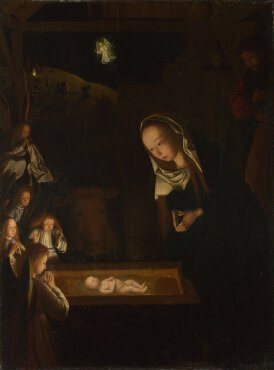
A Painting by Geertgen tot Sint Jans (1465 to 1495)

A Poem by Christina Rossetti (1830 to 1894)

Music by Hildegard of Bingen (1098 to 1179) sung by Emma Kirkby and Gothic Voices, The Unthank Sisters and The Larks.


night-nativity

St Bridget of Sweden had a mystic vision of The Nativity.

Today’s painting by the Flemish artist Geertgen tot Sint Jans makes that ineffable vision a reality before our eyes and in our hearts through virtuoso deployment of light and shadow.

Looking at this tender scene we remember Christ’s statement:

‘ I am the light of the world: he that followeth me shall not walk in darkness, but shall have the light of life.’


Our heart stilling music today was composed by one of the most extraordinary figures of the Middle Ages (indeed of all Ages!).

Hildegard of Bingen was a Benedictine Abbess whose haunting compositions refelect her mystical experiences and her philosophical beliefs.

I vividly recall the first time I heard this music in Tower Records at Piccadilly Circus in London. As the gorgeous vocal lines enchanted me I knew, at once, that this record would be a life time companion. And so it has proved.

The majestic soprano Emma Kirkby wonderfully complemented by The Gothic Voices under the direction of Christopher Page takes us into mystical terrain where every hair is numbered like every grain of sand.

Terrain where Hildegard’s vision of herself as a feather on the breath of God makes perfect sense.

We are all feathers on the breath of God.

Now we return to our Sleigh which has been travelling for 6 days rushing towards its destination on Christmas Eve.

So, for today’s post we will apply the breaks to give ourselves and our willing reindeers a much needed rest.

Sometimes the preparations for Christmas can overwhelm us as we worry about all we have to do in such a short time. We can be in danger of falling into the trap of speeding through the season without stopping to savour its true joys and meaning.

Perhaps we should remember that at the heart of this event is a birth. A birth much awaited and anticipated by the contemporary family at the centre of the story and by the wider human family of time past, time present and time future.

At this birth time and eternity merged to create a new beginning of hope and promise for all of mankind.

Mothers have to learn to be still and patient as they wait (especially for their first birth) for the great day, the great moment, to arrive when they will no longer be a mother-to-be but a mother.

There comes a miraculous moment, a moment, when after all the waiting and worry that the baby, her child! who has been knit together in the safety of their womb emerges into the world as a unique new creation.

This is a moment for stillness and awe and for gratitude.

The next recording featured today is achingly filled with stillness and awe.


The Unthank Sisters from God haunted Northumberland perform Christina Rosetti’s, ‘In The Bleak ‘Midwinter’ with startling calm and grace allowing the song to breathe and bloom into something truly marvelous.

I imagine we all hold our breath throughout this performance as we are caught in the spell of the poet’s striking images and the heart piercing intensity of the siblings vocals.

Now, a recording by one of my favourite 50s vocal groups The Larks.

The sound here is hushed, seemingly suspended in time. Listening to, ‘All I Want For Christmas Is You’ I feel as if I were a snowflake caressed by gentle drafts and surrounded by millions of other snowflakes falling slowly, slowly, slowly to the earth below.


It would be perverse today to showcase any other poem but Christina Rosetti’s masterpiece, ‘In The Bleak Midwinter’.

‘Angels and archangels
May have gathered there,
Cherubim and seraphim
Thronged the air-
But only His mother
In her maiden bliss
Worshipped the Beloved
With a kiss

What can I give Him?
Poor as I am?
If I were a shepherd
I would bring a lamb;
If I were a wise man
I would do my part;
Yet what I can, I give Him-

Give my heart’


Christmas Cornucopia : Fifth Day

Fifth Day featuring :

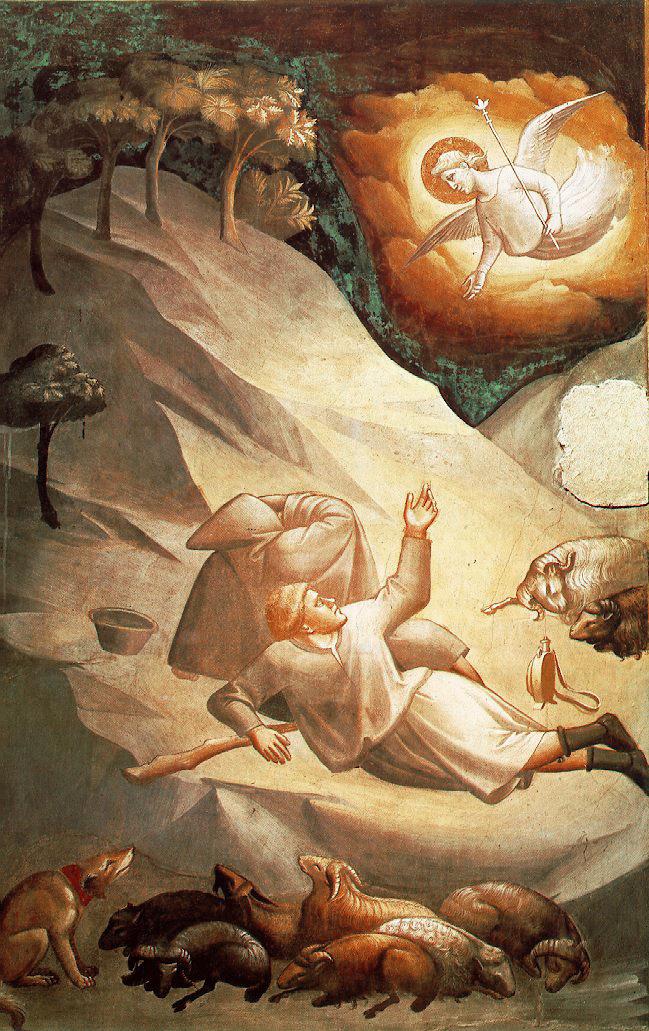
A Painting by Taddeo Gaddi (1290 to 1366)

A Poem by Patric Dickinson (1919 to 1994)

Music by Louis Armstrong and Kay Starr

Today’s painting is by the Florentine Taddeo Gaddi who was the star pupil of the great Master, Giotto.

His, ‘The Angelic Announcement to the Shepherds’ can be seen in the Baroncelli Chapel within Santa Croce in his native Florence.

It is a wonderfully dramatic painting.


gaddi_taddeo_announcement

An Angel acts as God’s messenger alerting humankind to an event upon which all history will pivot.

The Sheep are stirring and the Dog’s keen senses alert him to the messenger from afar.

As the Angel speaks eternity merges with linear time.

How could the waking Shepherd find the words to tell his sleeping companion what he has learned?

Surely all he could say was:

‘Let us go – someone we must see is waiting for us just down the hill. Come now!’

It is an invitation which remains open.

Onward!

Our Sleigh is picking up a very special passenger today. He’s here to sing and play on a Christmas song, ‘Zat You, Santa Claus?’ that has the effervescence of a fine champagne.

Of course, I’m talking about Louis Armstrong.

If they ever get round to carving four heads into a mountain to celebrate musicians in the way that Presidents are celebrated at Mount Rushmore there can be no argument among men and women of reason that the first head to be carved must be that of Louis Armstrong.


Zat You, Santa? Zat You, Louis?

I could set out an exhaustive list of his astounding achievements as the preeminent musician of the 20th century with special reference to his role as the pioneer genius who transformed a pastime into an art form and who influenced everyone who ever had the good fortune to hear him play.

Others far better qualified than I have written major scholarly tomes on the subject. So, I will limit myself to a few remarks on the effect hearing the great man has had on me.

When I hear Louis play (at every period of his career) I hear the sound of a master musician revelling in the sheer joy of making music.

It was as if he lived and breathed through playing his horn – singing a song of exultation; using without reserve the wondrous gifts of imagination and creative daring yoked to technical brilliance that made him a such a unique musician.

Add to that his personal warmth and ebullience and you have a musician and a man who simply made everyone who encountered him feel better, more human and more glad to be alive.

Isn’t what Santa Claus is supposed to do too?

Next a singer, the late Kay Starr, who knew how to swing and who had the chops to share a bandstand with the finest musicians of her era.

Born on a reservation in Oklahoma with an Iroquois father and an Irish/Native American mother she was as American as you can be.

Maybe that’s how she could sing the hell out of any song in any genre of American popular music.

Embed from Getty Images

Kay had an inbuilt sense of rhythm and the ability to musically inhabit and sell a lyric. Listen here to how she brings out the drive and the humour of, ‘Everybody’s Waitin’ For The Man With The Bag’.

One of the co-writers of the song was Dudley Brooks who featured earlier in the list featuring Elvis Presley.

I can’t honestly say I have done everything I should this year (extra special good) but I can recognise an extra special good singer when I hear one and Kay Starr must be one of the best and merriest we ever did have!

Today’s poem is, ‘Advent: A Carol’ by Patric Dickinson a writer who revered and translated the Classical poets while looking at the world himself with a sharply individual measured intelligence.

‘What did you hear?
Said stone to echo:
All that you told me
Said echo to stone.

Tidings, said echo,
Tidings, said stone,
Tidings of wonder
Said echo to stone.

Who then shall hear them?
Said stone to echo:
All people on earth,
Said echo to stone.

Turned into one,
Echo and stone,
The world for all coming
Turned into one.’


Christmas Cornucopia : Fourth Day

Fourth Day featuring :

A painting by Giorgione (1477 to 1510)

A poem by Christopher Smart (1772 to 1771)

Music by Mae McKenna & Mairi Macinnes and Roger Miller

Giorgione, a Venetian artist from the period of the High Renaissance, remains a figure of intense mystery.


giorgione_-_adoration_of_the_shepherds_-_national_gallery_of_art

What we can say from his, ‘The Adoration of the Shepherds’ (NGA Washington) is that he could suspend time and evoke awe and silent wonder.

This painting offers us a profound sense of reverence. The Nativity tableau shows Mary communing with her child as both motherly protector and prayerful worshiper.

Joseph, so often the forgotten man of the narrative, seems overwhelmed by the enormity and mystery of the events he has been caught up in.

Shepherds were ill-regarded outsiders in biblical times. Yet, it was they who were granted the blessing of an audience with the new born King.

This must be some new type of King who welcomes first the poor and the ragged before the rich and high born.

The sight greeting the Shepherds was beyond words.

Their attitude of humble surrender to an experience beyond their understanding is intensely moving.

Our contemplative music today comes from the Hebrides.

The Christ Child’s Lullaby or Taladh Chriosda in Scots Gaelic is full to the brim with maternal feeling for the vulnerable new born.

Mother and child, once one, now two, create together a sacred space where love and mutual regard dwells.

The standing stone vocals of Mae McKenna and Mairi Macinnes, switching fluently between languages, supported by the pellucid instrumental playing of William Jackson and Tony McManus casts a timeless spell.


Onward!

Our Sleigh cuts a deep track through the falling snow as it’s carrying a whole heap of presents for all the good boys and girls all around the world (the list has been checked twice and we surely know who has been naughty and who has been nice).

Our first song is, ‘Old Toy Trains’ by the one and only Roger Miller. He wrote a hatful of hit songs, was a multiple Grammy winner and admitted to the Country Music Hall Of Fame.

In addition he also had a theatrical Tony Award in his trophy cabinet for his score for the hit Broadway musical, ‘Big River’ which he based on the writings of Mark Twain.

Despite all the above he has always seemed to be to be under rated with many damning him with the faint praise of describing him as a writer of, ‘Novelty Songs’.

Certainly there is humour in his songs but as anyone who is any kind of honest writer will tell you it is much harder to write comedy than it is to write tragedy.

Embed from Getty Images

The key to understanding Miller’s very real eminence as a songwriter lies in the sharpness of his observations expressed in language that is simple in nature but complex in impact.

Roger Miller had a poor upbringing but as he said words became his toys and you can feel that in the playfulness and delight with which he uses the resources of the American language as spoken by the everyday working man and woman.

Roger Miller liked people and liked telling stories that would resonate with their common experiences. Listening to him you do feel spoken to by a ruminative and intelligent man who has seen enough of life to be slow to judge and quick to smile.

There’s often a metaphorical raised eyebrow in the tone of his language and vocals but never a raised fist.

‘Old Toy Trains’ is a simple song that catches the magic of Christmas Eve – a magic that it is easy to lose or forget as we grow in supposed sophistication. Miller taps into the time- suspended feeling as we approach a great event and the hope we all have that all will be calm and all will be well.

Most of us will look back on a present we received when we were young children and reflect that no later gift has ever so perfectly matched our dreams than the toy train, drum, doll (or in my case) a cowboy outfit we received and cherished all those years ago.

Today’s poem extract comes from, ‘Christmas Day’ by Christopher Smart – an 18th Century English poet who pursued his vocation steadfastly despite spells in an asylum and prison.

‘Spinks and ouzles sing sublimely,
We too have a saviour born,
Whiter blossoms burst untimely
On the blest Mosaic thorn

God all-bounteous, all-creative,
Whom no ills from good dissuade,
Is incarnate and a native
Of the very world he made.’

Christmas Cornucopia : Third Day

Third Day featuring :

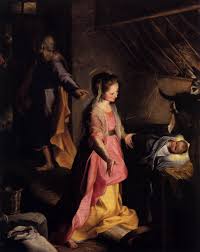
A Painting by Federico Barocci (1526 to 1612)

A Poem by John Betjeman (1906 to 1984)

Music by Bill Evans, Elvis Presley and Tish Hinojosa


Above all Christmas celebrates a birth.

And, there is nothing more intimate than the bond between a mother and child after a birth.

This intimacy is captured exquisitely by the Master of Urbino, Federico Barocci, in this Nativity which positively glows with the light of love.

federico-nativity

Bill Evans was the supreme lyric poet of the piano.

Listening to Bill’s unique sense of musical time and weight I find my spirit awakened, refreshed and released.

‘Blue in Green’ showcases the amazing precision and delicacy of his touch as a musician.

He is always instantly recognisable – the hallmark of true greatness.

This version of what has become a Jazz standard is from the Christmas 1959 session issued as, ‘Portrait in Jazz’.

You have to believe in telepathy when you hear Bill Evans play with Scott LaFaro (bass) and Paul Motion (drums)

This trio remains the benchmark for all piano trios.


Onward!

Onward our Sleigh proceeds cutting its way through the Christmas snow. Travel with me back in time now to Radio Recorders studios in Hollywood on September 7 1957.

A small group of men assemble to cut an album of Christmas songs. From Gadsden Tennessee the modestly brilliant guitarist Scotty Moore, from Memphis Tennessee the ever reliable bass player Bill Black and from Shreveport Louisiana the sprung-floor drummer D J Fontana.

Huddled together Gordon Stoker, Neal Matthews, Hoyt Hawkins and Hugh Jarrett – collectively the Jordanaires, a gospel quartet filled with the spirit. Today on piano sits Dudley Brooks.

Tuning up and swapping musicians banter they all look in the direction of a quietly spoken, respectful, hooded eyed, devestatingly handsome 22 year old from Tupelo Mississippi who has in the last few years recorded a series of records that seem to have shifted the axis of the planet.

In addition through his live shows and TV appearances he has set an entire generation ablaze to the marked discomfort of, ‘sensible’ folks who can’t bring themselves to approve of the shaky-legged, swivel-hipped singer who bears the ridiculous name of Elvis Aron Presley.

Embed from Getty Images

As usual the group will warm up by accompanying Elvis as he runs through some of the gospel songs that have surrounded him through his youth and adolescence.

If there’s one thing Elvis believes in and knows through his own bodily experience it’s the power of music to raise, thrill and sustain the spirit.

Neither he nor anyone else could have guessed when he started out that he would possess an almost unique capacity to supercharge a song, to sing with such relaxed intensity and charisma that the listener felt lifted up and transported whether the song was secular or sacred.

Given a half decent song Elvis always sang his heart out and on many occasions the results were and remain nothing short of miraculous.

Like the Beatles and Bob Dylan the best of Elvis’ records are if anything under rated for all the millions of copies they have sold.

I really don’t have a fixed position on many of the great political and cultural issues of our times though I’m happy to debate with anyone. What I am certain of and will jump up on any table anywhere, anytime, to proclaim before any audience is that Elvis was, is, and will always remain the King!

Elvis’ Christmas album was a massive success and continues to sell today. The cut featured above, ‘Santa Claus Is Back In Town’ was written by the whip smart pairing of Jerry Leiber and Mike Stoller who couldn’t have write a lifeless song if they had tried.

Here they provide Elvis with an opportunity to demonstrate his charm, his rhythm and blues chops and the sheer swaggering physical presence his vocals could embody.

I love the tip of the hat to Elvis’ love of the Cadillac and the erotic promise of the whole song incarnated in the line, ‘Hang up your pretty stockings, turn off the light …. ‘.

Christmas brings many forms of celebration not least the chance for lovers to share some quality time together. And, I can think of no one better to serenade such times than Elvis.

We move now from a lover’s serenade to a mother’s lullaby. ‘A la Nanita Nana’ is a traditional song from Mexico sung here with characteristic tenderness and care by Tish Hinojosa.

Tish (short for Leticia) grew up, the thirteenth child, in a crowded household in San Antonio, Texas. Through her brothers and sisters and the crowded radio waves she absorbed and was inspired by music from her native Mexican culture and the folk, country and rock ‘n’ roll traditions which suffice the very air of Texas.

I recommend her CDs, ‘Culture Swing’ and, ‘Frontejas’ for those of you inclined to further listening.


The historical facts of Jesus’ birth remain shrouded in the mysteries of antiquity. However, I think we can be sure mothers nursing their new born child have always sung songs to soothe the babe just exposed to the blooming buzzing confusion of this world of ours.

The first sound we hear as we grow in our mother’s womb is the beating of her heart and hers is the first face we come to recognise in those initial hours and days of life.

Similarly, our first sense of the musicality of language comes from the sound of our mother reassuring us that we are loved and all is well. If we are lucky we will carry this message with us throughout the whole of our lives.

I have no doubt that Mary, though she had much to ponder in her heart, will have sung to her precious babe a song that could we but hear it would sound very like, ‘A la Nanita Nana’.

Today’s poem is, ‘Christmas’ by John Betjeman a poet who managed to combine popularity with real poetic achievement.

‘ And is it true? And is it true?
This most tremendous tale of all,
Seen in a stained-glass Window’s hue,
The Maker of the stars and sea
Become a child on earth for me?

… No carolling in the frosty air,
Nor all the steeping-shaking bells
Can with this simple truth compare –
That God was Man in Palestine
And lives today in Bread and Wine.’