Music by Chopin played by Claudio Arrau (1903 to 1991), Joe Tex and June Christy.
Our painting today is, ‘The Adoration of the Magi’ by Peter Paul Rubens.
More accurately, it is the the modello (a sketch shown to a patron for approval of the composition) for the altarpiece painted by Rubens for the convent of the Dames Blanches, Louvain now in King’s College Chapel, Cambridge.
There is a wonderful humanity in this work.
Though the event depicted was of universal importance it was witnessed, experienced, by, ‘ordinary’ men and women (and let us not forget animals as the peering camels here humorously demonstrate) on a day when the sun rose and set like any other.
Miracles take place (far more often than, ‘common sense’ will allow) against the background of every day events.
Rubens manages to make each of the individual characters in the scene vividly present.
I feel as if I could walk directly into this company and be made welcome.
Devotees of Chopin and his piano works, especially The Nocturnes, can spend long hours debating which great pianist has searched their depths most successfully.
I have never wavered in my conviction that the magical recordings made by Claudio Arrau must wear the crown.
His version of The Nocturnes has the quality of meditative prayer.
After the above and yesterday’s stop to gaze reverentially heavenward it’s time to turn to more earthly considerations.
The Greeks, as you might have expected, had different words to describe the varied forms of love we express and experience.
Yesterday we were concerned with Agape – the love of God for man and man for God. Today we will find songs that express Eros – sensuous, sexual love and the appreciation of beauty and Philia – the love expressed in affectionate regard and friendship.
Now we turn to a tremendous southern soul sermon from a master and mentor for the genre, Joe Tex. ‘I’ll Make Everyday Christmas (For My Woman)’ glows bright with Joe’s gently enveloping passion.
Joe’s forte was telling stories in song using humour and homespun wisdom so that you felt he was gifting you the hard won lessons of a richly lived life.
Joe had a country preacher’s sense of the hunger in the audience for parables that would make sense of the roadblocks and confusions assailing them in their lives and provide a route map for the way ahead.
They knew that Joe didn’t pretend that he had never been a rounder and a rogue as well as a true romantic and love disciple.
We often, rightly, pay more attention to the testimony of someone who admits to failure and frailty than those in their whited sepulchres who are quick to admonish our every fault.
Joe sings the song with a steadily growing intensity almost as if the promise he was making was as much to his own better self as to the woman it was made to.
When the record finishes its hard not to say, ‘Amen! Brother, Amen!’ and vow to make sure you too take care to make everyday Christmas for your own woman or man.
Next, the delightfully cool Miss June Christy with, ‘Christmas Heart’. June was a veteran big band vocalist who followed Anita O’Day as the singer with Stan Kenton.
As a solo artist she made a magnificent album, ‘Something Cool’ which should be on the shelves of anyone with an appreciation of the art of jazz singing.
I have always found something deeply engaging in the understated, wistful tone June Christy brings to a song.
It seems she has stripped out all unnecessary flourishes so that we hear the essence of the song as she steers us gently to understanding through her embrace of the melody and lyric.
The lack of hectoring or self regard in, ‘Christmas Heart’ makes its dreamlike plea for Christmas to be a day when all the wounded find rest and balm all the more affecting.
You never really need to ask who is your neighbour – just look around you.
Today’s poem is, ‘Carol For The Last Christmas Eve’ by a favourite poet of mine, Norman Nicholson from Millom in England’s rural Cumbria.
Never fashionable Nicholson’s work will endure.
‘The first night, the first night, The night that Christ was born, His mother looked in his eyes and saw Her maker in her son.
The twelfth night, the twelfth night, After Christ was born, the Wise Men found the child and knew Their search had just begun.
…
But the last night, the last night, Since ever Christ was born, What his mother knew will be known again, And what was found by the Three Wise Men, And the sun will rise and so will we,
A Painting by Geertgen tot Sint Jans (1465 to 1495)
A Poem by Christina Rossetti (1830 to 1894)
Music by Hildegard of Bingen (1098 to 1179) sung by Emma Kirkby and Gothic Voices, The Unthank Sisters and The Larks.
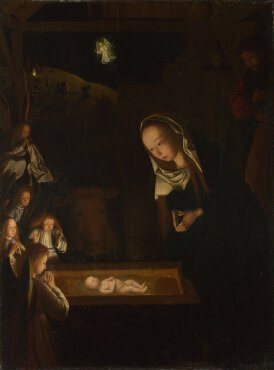
St Bridget of Sweden had a mystic vision of The Nativity.
Today’s painting by the Flemish artist Geertgen tot Sint Jans makes that ineffable vision a reality before our eyes and in our hearts through virtuoso deployment of light and shadow.
Looking at this tender scene we remember Christ’s statement:
‘ I am the light of the world: he that followeth me shall not walk in darkness, but shall have the light of life.’
Our heart stilling music today was composed by one of the most extraordinary figures of the Middle Ages (indeed of all Ages!).
Hildegard of Bingen was a Benedictine Abbess whose haunting compositions refelect her mystical experiences and her philosophical beliefs.
I vividly recall the first time I heard this music in Tower Records at Piccadilly Circus in London. As the gorgeous vocal lines enchanted me I knew, at once, that this record would be a life time companion. And so it has proved.
The majestic soprano Emma Kirkby wonderfully complemented by The Gothic Voices under the direction of Christopher Page takes us into mystical terrain where every hair is numbered like every grain of sand.
Terrain where Hildegard’s vision of herself as a feather on the breath of God makes perfect sense.
We are all feathers on the breath of God.
Now we return to our Sleigh which has been travelling for 6 days rushing towards its destination on Christmas Eve.
So, for today’s post we will apply the breaks to give ourselves and our willing reindeers a much needed rest.
Sometimes the preparations for Christmas can overwhelm us as we worry about all we have to do in such a short time. We can be in danger of falling into the trap of speeding through the season without stopping to savour its true joys and meaning.
Perhaps we should remember that at the heart of this event is a birth. A birth much awaited and anticipated by the contemporary family at the centre of the story and by the wider human family of time past, time present and time future.
At this birth time and eternity merged to create a new beginning of hope and promise for all of mankind.
Mothers have to learn to be still and patient as they wait (especially for their first birth) for the great day, the great moment, to arrive when they will no longer be a mother-to-be but a mother.
There comes a miraculous moment, a moment, when after all the waiting and worry that the baby, her child! who has been knit together in the safety of their womb emerges into the world as a unique new creation.
This is a moment for stillness and awe and for gratitude.
The next recording featured today is achingly filled with stillness and awe.
The Unthank Sisters from God haunted Northumberland perform Christina Rosetti’s, ‘In The Bleak ‘Midwinter’ with startling calm and grace allowing the song to breathe and bloom into something truly marvelous.
I imagine we all hold our breath throughout this performance as we are caught in the spell of the poet’s striking images and the heart piercing intensity of the siblings vocals.
Now, a recording by one of my favourite 50s vocal groups The Larks.
The sound here is hushed, seemingly suspended in time. Listening to, ‘All I Want For Christmas Is You’ I feel as if I were a snowflake caressed by gentle drafts and surrounded by millions of other snowflakes falling slowly, slowly, slowly to the earth below.
It would be perverse today to showcase any other poem but Christina Rosetti’s masterpiece, ‘In The Bleak Midwinter’.
‘Angels and archangels May have gathered there, Cherubim and seraphim Thronged the air- But only His mother In her maiden bliss Worshipped the Beloved With a kiss
What can I give Him? Poor as I am? If I were a shepherd I would bring a lamb; If I were a wise man I would do my part; Yet what I can, I give Him-
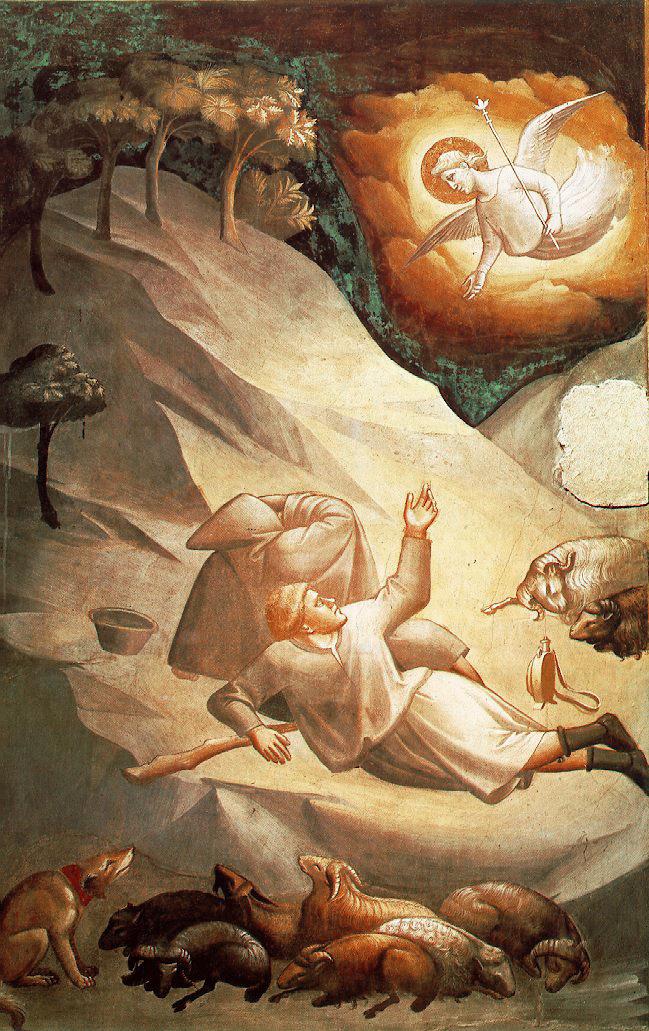
Today’s painting is by the Florentine Taddeo Gaddi who was the star pupil of the great Master, Giotto.
His, ‘The Angelic Announcement to the Shepherds’ can be seen in the Baroncelli Chapel within Santa Croce in his native Florence.
It is a wonderfully dramatic painting.
An Angel acts as God’s messenger alerting humankind to an event upon which all history will pivot.
The Sheep are stirring and the Dog’s keen senses alert him to the messenger from afar.
As the Angel speaks eternity merges with linear time.
How could the waking Shepherd find the words to tell his sleeping companion what he has learned?
Surely all he could say was:
‘Let us go – someone we must see is waiting for us just down the hill. Come now!’
It is an invitation which remains open.
Onward!
Our Sleigh is picking up a very special passenger today. He’s here to sing and play on a Christmas song, ‘Zat You, Santa Claus?’ that has the effervescence of a fine champagne.
Of course, I’m talking about Louis Armstrong.
If they ever get round to carving four heads into a mountain to celebrate musicians in the way that Presidents are celebrated at Mount Rushmore there can be no argument among men and women of reason that the first head to be carved must be that of Louis Armstrong.
Zat You, Santa? Zat You, Louis?
I could set out an exhaustive list of his astounding achievements as the preeminent musician of the 20th century with special reference to his role as the pioneer genius who transformed a pastime into an art form and who influenced everyone who ever had the good fortune to hear him play.
Others far better qualified than I have written major scholarly tomes on the subject. So, I will limit myself to a few remarks on the effect hearing the great man has had on me.
When I hear Louis play (at every period of his career) I hear the sound of a master musician revelling in the sheer joy of making music.
It was as if he lived and breathed through playing his horn – singing a song of exultation; using without reserve the wondrous gifts of imagination and creative daring yoked to technical brilliance that made him a such a unique musician.
Add to that his personal warmth and ebullience and you have a musician and a man who simply made everyone who encountered him feel better, more human and more glad to be alive.
Isn’t what Santa Claus is supposed to do too?
Next a singer, the late Kay Starr, who knew how to swing and who had the chops to share a bandstand with the finest musicians of her era.
Born on a reservation in Oklahoma with an Iroquois father and an Irish/Native American mother she was as American as you can be.
Maybe that’s how she could sing the hell out of any song in any genre of American popular music.
Kay had an inbuilt sense of rhythm and the ability to musically inhabit and sell a lyric. Listen here to how she brings out the drive and the humour of, ‘Everybody’s Waitin’ For The Man With The Bag’.
One of the co-writers of the song was Dudley Brooks who featured earlier in the list featuring Elvis Presley.
I can’t honestly say I have done everything I should this year (extra special good) but I can recognise an extra special good singer when I hear one and Kay Starr must be one of the best and merriest we ever did have!
Today’s poem is, ‘Advent: A Carol’ by Patric Dickinson a writer who revered and translated the Classical poets while looking at the world himself with a sharply individual measured intelligence.
‘What did you hear? Said stone to echo: All that you told me Said echo to stone.
Tidings, said echo, Tidings, said stone, Tidings of wonder Said echo to stone.
Who then shall hear them? Said stone to echo: All people on earth, Said echo to stone.
Turned into one, Echo and stone, The world for all coming Turned into one.’
Music by Mae McKenna & Mairi Macinnes and Roger Miller
Giorgione, a Venetian artist from the period of the High Renaissance, remains a figure of intense mystery.
What we can say from his, ‘The Adoration of the Shepherds’ (NGA Washington) is that he could suspend time and evoke awe and silent wonder.
This painting offers us a profound sense of reverence. The Nativity tableau shows Mary communing with her child as both motherly protector and prayerful worshiper.
Joseph, so often the forgotten man of the narrative, seems overwhelmed by the enormity and mystery of the events he has been caught up in.
Shepherds were ill-regarded outsiders in biblical times. Yet, it was they who were granted the blessing of an audience with the new born King.
This must be some new type of King who welcomes first the poor and the ragged before the rich and high born.
The sight greeting the Shepherds was beyond words.
Their attitude of humble surrender to an experience beyond their understanding is intensely moving.
Our contemplative music today comes from the Hebrides.
The Christ Child’s Lullaby or Taladh Chriosda in Scots Gaelic is full to the brim with maternal feeling for the vulnerable new born.
Mother and child, once one, now two, create together a sacred space where love and mutual regard dwells.
The standing stone vocals of Mae McKenna and Mairi Macinnes, switching fluently between languages, supported by the pellucid instrumental playing of William Jackson and Tony McManus casts a timeless spell.
Onward!
Our Sleigh cuts a deep track through the falling snow as it’s carrying a whole heap of presents for all the good boys and girls all around the world (the list has been checked twice and we surely know who has been naughty and who has been nice).
Our first song is, ‘Old Toy Trains’ by the one and only Roger Miller. He wrote a hatful of hit songs, was a multiple Grammy winner and admitted to the Country Music Hall Of Fame.
In addition he also had a theatrical Tony Award in his trophy cabinet for his score for the hit Broadway musical, ‘Big River’ which he based on the writings of Mark Twain.
Despite all the above he has always seemed to be to be under rated with many damning him with the faint praise of describing him as a writer of, ‘Novelty Songs’.
Certainly there is humour in his songs but as anyone who is any kind of honest writer will tell you it is much harder to write comedy than it is to write tragedy.
The key to understanding Miller’s very real eminence as a songwriter lies in the sharpness of his observations expressed in language that is simple in nature but complex in impact.
Roger Miller had a poor upbringing but as he said words became his toys and you can feel that in the playfulness and delight with which he uses the resources of the American language as spoken by the everyday working man and woman.
Roger Miller liked people and liked telling stories that would resonate with their common experiences. Listening to him you do feel spoken to by a ruminative and intelligent man who has seen enough of life to be slow to judge and quick to smile.
There’s often a metaphorical raised eyebrow in the tone of his language and vocals but never a raised fist.
‘Old Toy Trains’ is a simple song that catches the magic of Christmas Eve – a magic that it is easy to lose or forget as we grow in supposed sophistication. Miller taps into the time- suspended feeling as we approach a great event and the hope we all have that all will be calm and all will be well.
Most of us will look back on a present we received when we were young children and reflect that no later gift has ever so perfectly matched our dreams than the toy train, drum, doll (or in my case) a cowboy outfit we received and cherished all those years ago.
Today’s poem extract comes from, ‘Christmas Day’ by Christopher Smart – an 18th Century English poet who pursued his vocation steadfastly despite spells in an asylum and prison.
‘Spinks and ouzles sing sublimely, We too have a saviour born, Whiter blossoms burst untimely On the blest Mosaic thorn
God all-bounteous, all-creative, Whom no ills from good dissuade, Is incarnate and a native Of the very world he made.’
Music by Bill Evans, Elvis Presley and Tish Hinojosa
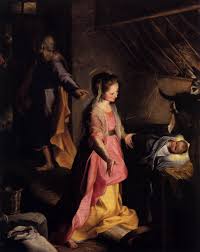
Above all Christmas celebrates a birth.
And, there is nothing more intimate than the bond between a mother and child after a birth.
This intimacy is captured exquisitely by the Master of Urbino, Federico Barocci, in this Nativity which positively glows with the light of love.
Bill Evans was the supreme lyric poet of the piano.
Listening to Bill’s unique sense of musical time and weight I find my spirit awakened, refreshed and released.
‘Blue in Green’ showcases the amazing precision and delicacy of his touch as a musician.
He is always instantly recognisable – the hallmark of true greatness.
This version of what has become a Jazz standard is from the Christmas 1959 session issued as, ‘Portrait in Jazz’.
You have to believe in telepathy when you hear Bill Evans play with Scott LaFaro (bass) and Paul Motion (drums)
This trio remains the benchmark for all piano trios.
Onward!
Onward our Sleigh proceeds cutting its way through the Christmas snow. Travel with me back in time now to Radio Recorders studios in Hollywood on September 7 1957.
A small group of men assemble to cut an album of Christmas songs. From Gadsden Tennessee the modestly brilliant guitarist Scotty Moore, from Memphis Tennessee the ever reliable bass player Bill Black and from Shreveport Louisiana the sprung-floor drummer D J Fontana.
Huddled together Gordon Stoker, Neal Matthews, Hoyt Hawkins and Hugh Jarrett – collectively the Jordanaires, a gospel quartet filled with the spirit. Today on piano sits Dudley Brooks.
Tuning up and swapping musicians banter they all look in the direction of a quietly spoken, respectful, hooded eyed, devestatingly handsome 22 year old from Tupelo Mississippi who has in the last few years recorded a series of records that seem to have shifted the axis of the planet.
In addition through his live shows and TV appearances he has set an entire generation ablaze to the marked discomfort of, ‘sensible’ folks who can’t bring themselves to approve of the shaky-legged, swivel-hipped singer who bears the ridiculous name of Elvis Aron Presley.
As usual the group will warm up by accompanying Elvis as he runs through some of the gospel songs that have surrounded him through his youth and adolescence.
If there’s one thing Elvis believes in and knows through his own bodily experience it’s the power of music to raise, thrill and sustain the spirit.
Neither he nor anyone else could have guessed when he started out that he would possess an almost unique capacity to supercharge a song, to sing with such relaxed intensity and charisma that the listener felt lifted up and transported whether the song was secular or sacred.
Given a half decent song Elvis always sang his heart out and on many occasions the results were and remain nothing short of miraculous.
Like the Beatles and Bob Dylan the best of Elvis’ records are if anything under rated for all the millions of copies they have sold.
I really don’t have a fixed position on many of the great political and cultural issues of our times though I’m happy to debate with anyone. What I am certain of and will jump up on any table anywhere, anytime, to proclaim before any audience is that Elvis was, is, and will always remain the King!
Elvis’ Christmas album was a massive success and continues to sell today. The cut featured above, ‘Santa Claus Is Back In Town’ was written by the whip smart pairing of Jerry Leiber and Mike Stoller who couldn’t have write a lifeless song if they had tried.
Here they provide Elvis with an opportunity to demonstrate his charm, his rhythm and blues chops and the sheer swaggering physical presence his vocals could embody.
I love the tip of the hat to Elvis’ love of the Cadillac and the erotic promise of the whole song incarnated in the line, ‘Hang up your pretty stockings, turn off the light …. ‘.
Christmas brings many forms of celebration not least the chance for lovers to share some quality time together. And, I can think of no one better to serenade such times than Elvis.
We move now from a lover’s serenade to a mother’s lullaby. ‘A la Nanita Nana’ is a traditional song from Mexico sung here with characteristic tenderness and care by Tish Hinojosa.
Tish (short for Leticia) grew up, the thirteenth child, in a crowded household in San Antonio, Texas. Through her brothers and sisters and the crowded radio waves she absorbed and was inspired by music from her native Mexican culture and the folk, country and rock ‘n’ roll traditions which suffice the very air of Texas.
I recommend her CDs, ‘Culture Swing’ and, ‘Frontejas’ for those of you inclined to further listening.
The historical facts of Jesus’ birth remain shrouded in the mysteries of antiquity. However, I think we can be sure mothers nursing their new born child have always sung songs to soothe the babe just exposed to the blooming buzzing confusion of this world of ours.
The first sound we hear as we grow in our mother’s womb is the beating of her heart and hers is the first face we come to recognise in those initial hours and days of life.
Similarly, our first sense of the musicality of language comes from the sound of our mother reassuring us that we are loved and all is well. If we are lucky we will carry this message with us throughout the whole of our lives.
I have no doubt that Mary, though she had much to ponder in her heart, will have sung to her precious babe a song that could we but hear it would sound very like, ‘A la Nanita Nana’.
Today’s poem is, ‘Christmas’ by John Betjeman a poet who managed to combine popularity with real poetic achievement.
‘ And is it true? And is it true? This most tremendous tale of all, Seen in a stained-glass Window’s hue, The Maker of the stars and sea Become a child on earth for me?
… No carolling in the frosty air, Nor all the steeping-shaking bells Can with this simple truth compare – That God was Man in Palestine And lives today in Bread and Wine.’
Music by Eartha Kitt, Harry Fontenot and Gustav Mahler sung by Kahleen Ferrier.
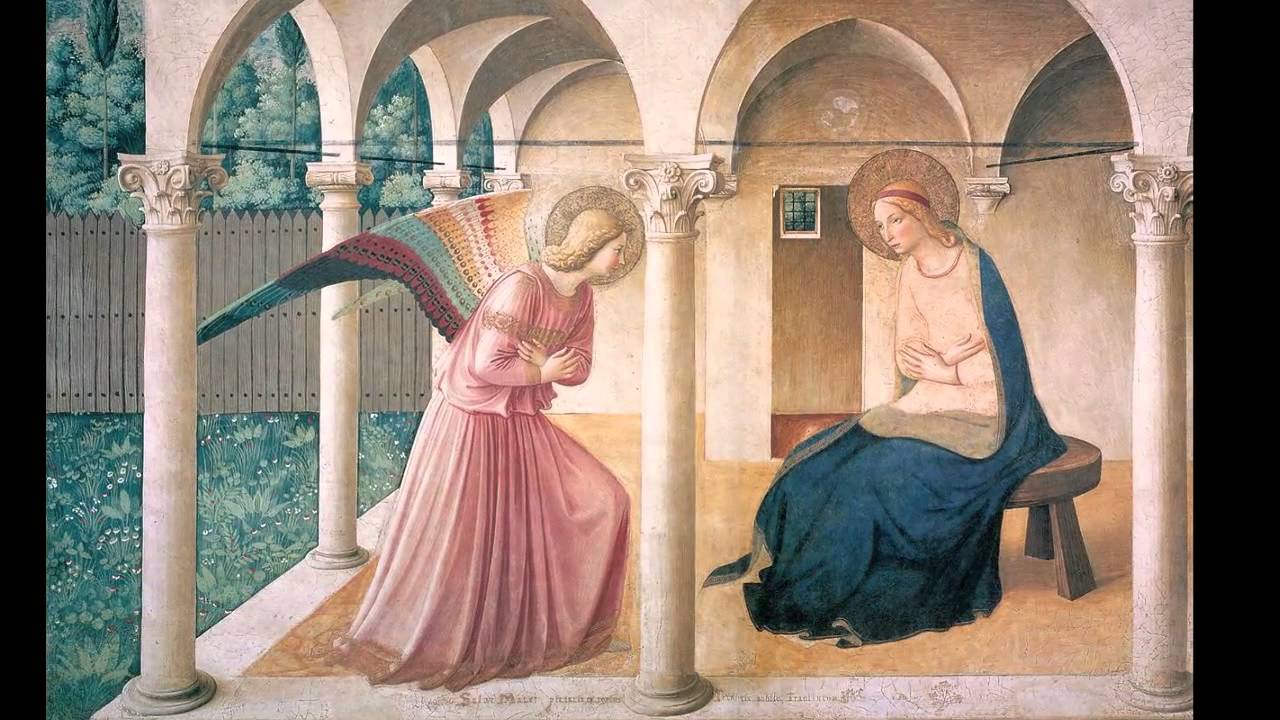
Today’s painting by Fra Angelico has long haunted my imagination since I first saw it in The Convent of San Marco in Florence.
It is a representation of an epochal event, The Annunciation, which holds human time and eternity in perfect balance.
When Kathleen Ferrier recorded, ‘Das Lied von der Erde’ the shadow of death was looming over her.
This is music making of the very highest order.
Here Kathleen Ferrier does not so much perform a song as become the song.
The rare emotional reach of her extraordinary voice bringing flesh and spirit to Mahler’s masterwork touches something very deep and unnameable within humanity.
Our sleigh moves on from yesterday sliding us forward on our Christmas journey.
Today we start with a song from an authentic show business legend – Miss Eartha Kitt and her classic, slinkily sensuous 1953 recording, ‘Santa Baby’.
Eartha performs the Springer brothers and Joan Javitt’s song in her trademark knowing style. As the song progresses Eartha makes a series of increasingly outrageous demands on Santa’s generosity.
All she wants is a sable, a convertible (light blue), a yacht, the deed to a platinum mine (gold being so common), a duplex, Tiffany jewellery and a ring (64 carat for sure).
Eartha’s vocal here supported by Henri Rene and his orchestra is a study in practiced come hither allure. The cynical lyric is caressed as she reels in our attention.
Seeing her perform the song live is to see a siren setting a song ablaze with the flames licking around the mesmerised audience.
Everything Eartha did carried a charge of the exotic – she looked, moved and spoke like no one else building on her black, Cherokee and White heritage and dance training to create a unique image that demanded the audience’s deference and worship.
Orson Welles famously called her the most exciting woman in the world and while others of her era like Marilyn Monroe and Elizabeth Taylor might have taken issue with that claim they too would surely have admired the sheer dramatic daring of Eartha’s regal performance of, ‘Santa Baby’.
Come on Santa – hurry down the chimney and don’t forget the sable.
Fr Josef Mohr wrote a poem in 1816 he called, ‘Stille Nacht’. Two years later on Christmas Eve 1818 with a midnight mass in prospect he decided to visit his friend Franz Gruber a choirmaster and organist to see if there was any chance of turning, ‘Stille Nacht’ from a poem into a carol to perform that night.
Mohr had to walk several kilometres to se his friend who set to work with such vigour and inspiration that an arrangement for guitar and voice of, ‘Stille Nacht’ was ready as the two set off to Fr Mohr’s church in Oberndorf.
So, in the cold of an Austrian night on Christmas Eve 1818 the carol, ‘Stille Nacht’ or, ‘Silent Night’ as it is known in the English speaking world was sung for the very first time.
Neither of the writers or the congregation could possible have known that the heartfelt simplicity of, ‘Silent Night’ contained a spiritual power and attractiveness that would go on to make it perhaps the most loved of all church based Christmas songs.
Congregations all over the world this Christmas Eve will echo the words and melody created nearly two hundred years ago and find that it’s magic never fades.
There is no counting the number of versions available of, ‘Silent Night’. The one I have chosen to showcase here is by a gorgeous Cajun version by accordionist Harry Fontenot.
I love the rustic simplicity of this version – it seems to me the kind of sound that would not have sounded out of place in a stable with animals and shepherds gathered around to witness an event that was at once entirely commonplace – the birth of a child.
And yet all present had the sense that this birth was something very special that would remake the world for all eternity.
‘Silent Night, Holy Night, All is calm, all is bright ……….
The poem providing our extract today is the short but immensely wise, ‘BC : AD’ by the much under rated U A Fanthorpe.
‘… And this was the moment When a few farm workers and three Members of an obscure Persian sect
Walked haphazard by starlight straight Into the kingdom of heaven.’
A Painting by Piero della Francesca (1415/20 to 1492)
Music by Bobby Helms, Mary Chapin Carpenter and Arvo Part
Poetry by John Clare (1793 to 1864)
For 2016 I am presenting The Christmas Cornucopia first seen in 2014 with significant added material.
Many of you who have joined the Jukebox community since 2014 will not have delved so far back into the Jukebox Archives. For you it will all be new!
For my much cherished veteran supporters I hope you will relish re reading the original text but also appreciate the new elements.
Each post now includes a favourite painting related to the Nativity Story and an additional piece of music.
I believe one of Christmas Tide’s greatest gifts is the opportunity it offers us to take a long, slow breath and still our hearts.
An opportunity to listen, to contemplate, to open ourselves up spiritually.
Each of the paintings and additional pieces of music featured this year has been chosen because they seem to me to be works of contemplative grace.
Christmas.
A time much anticipated which yet seems a surprise each time it occurs.
We wait, in hope, in full hearted anticipation for Christmas.
As Mary waited, full hearted, watchful and still for the longed for the birth of her son.
His birth was a miracle. As is every birth. For every birth changes the world absolutely.
I know of no work of art which captures that sense of awed anticipation with such tenderness as Piero della Francesca’s, ‘Madonna del Parto’.
Piero somehow manages to make present through drawing and paint both the vulnerability of Mary in all her humanity and the immanent divine.
To maintain the contemplative mood I turn to the contemporary Estonian Composer, Arvo Part with his luminous, liminal setting of Mary’s eternal prayer, ‘The Magnificat’.
Part has been labelled a Minimalist and a retro Medievalist.
I prefer to think of him as having the gift to make time past, time present and time future bloom before us through his music.
Christmas comes but once a year. For some of us the very best of times – a reliable pleasure that grows more intense and treasured as the years go by.
Sadly, for others – the worst of times and an ordeal to be feared as it approaches and then endured until all the tinsel has been packed away for another year.
I am firmly in the Christmas is a glorious celebration camp. I love bright stars in dark December skies with flurries of snow dusting the earth beneath my feet. I love the gathering sense of anticipation as the season advances.
I love seeing people smiling to themselves as they go about their routine business now charged with a ‘this is the last time I’ll do this before Christmas’ awareness.
I love hunting out our well packed away- some would say well hidden – Christmas decorations and wondering if the expensive new lights from last year will work or should I have bought the sets I saw at such a discount only yesterday.
I love firmly deciding that of course only a real needle shedding tree will do with a wreath for the door and a crib for the hearth as well. I love the excitement of the children’s last week at school – what shall we buy for the teacher and this terms best friend?
I love remembering Christmases past: the ones when I was a child oblivious to all the work involved in ensuring everyone and everything was thought about and properly looked after.
The ones when I was a carefree and careless student carousing through every day and every night certain of my own immortality and soon to be recognised global significance.
The courting Christmases where love bloomed and plans were whispered for the Christmases we would make so magnificent in the years and decades ahead. The just married Christmases freighted with a ‘Are we really in charge now we and can do anything we want?’ thrill.
The ‘Now there’s a baby in the house Christmas here really is Christmas’ Christmas and the ones after where we solemnly said, ‘Well, he will expect us to maintain all our family traditions again this year’.
I remember and cherish the Christmas where the star present only arrived late on Christmas Eve packed by demonic elves who ensured only a chainsaw could remove the vacuum packing.
This was the star present that came with no assembly instructions apart from a minuscule diagram and a list of 56 parts to be tortured together before dawn broke and we all agreed that Santa Claus had got it exactly right this year too.
I remember the first Christmases after my father and my mother died when their absence was an ache that filled my stomach to bursting point and when I barely spoke their names for fear of breaking down.
I remember the Christmas when suddenly I started saying, ‘Mum and Dad would really have loved this’ and realising that I would always share that Christmas and every Christmas with them – for where did I learn to love but from them?
I remember the sound of off key Carollers outside our door somehow making it all the way through, ‘Silent Night’ and the sound of our rehearsed to infinity local church choir hushing the packed congregation with their perfect rendition of the same work and thinking both versions were what we needed to hear at that precise moment.
I remember lighting Christmas candles and knowing that my prayer would be answered even if I wouldn’t be able to recognise how or when.
I remember many, many Christmas songs from many different eras in many different styles (as you might expect if you are a regular Jukebox patron) that I resolve each year to start listening to earlier and earlier to get into the Christmas spirit.
So, harvesting a selection of personal favourites I propose to share a score or so of these with you over the next fortnight until we all raise our Christmas glasses in celebration of a birth and a beginning that continues to offer a blessed eternal hope for all mankind.
Let’s set this sleigh on its way with a Christmas classic from 1957. Bobby Helms’, ‘Jingle Bell Rock’ always raises good cheer every December (come to think of it the same can be said when we listen to it, as we do, in February, May and August).
This song summons up the, ‘I like Ike’ Ozzie and Harriet days of the comfortable blue skies 1950s for me like no other Christmas song. I’m surprised Bob Dylan didn’t include it in his tender and wholly successful homage to the era, ‘Christmas In The Heart’.
1956/1957 was Bloomington born Bobby’s golden time. He had a great country and pop hit with, Fräulein’ followed up with another substantial success in, ‘My Special Angel’.
But his pop immortality was sealed with the toe tapping, smile inducing, always coming up fresh and welcome 45 issued just days before Christmas in 1957, ‘Jingle Bell Rock’.
Written by Joseph Carleton Beale and James Ross Boothe the song has become a much loved and much recorded staple of the Christmas season.
Under the,’A’s’ alone I see it has been covered by everyone from Chet Atkins to Arcade Fire to Alvin And The Chipmunks (which I think we can all agree is quite a stretch!). Yet, no one has come anywhere near matching the easy charm and relaxed swing of the original. I’m already looking forward to hearing it next year!
Next a very different tone from one of the premier singer – songwriters of the modern era, Mary Chapin Carpenter.
‘Come Darkness, Come Light’ is the Christmas meditation of a schooled professional with a sharp eye and a battered heart.
Mary recognises that the spiritual message of Christmas is that a gift has been granted not to the grand and the deserving alone but to the broken and the wounded,the fearful and the doubting (which is most of us) as well.
It is those who know the fell dark who turn most gratefully to the light. So whether you come running or walking slow towards the light know that it was made to shine on you and that the darkness no matter how deep can never extinguish this light.
Mary has the confidence and steadiness of soul to let the song speak with minimal accompaniment. This is the title song of her 12 songs of Christmas CD which comes highly recommended along with her entire cannon.
Each post during this season will also include an extract from a favourite seasonal poem. Today it is, ‘December’ by John Clare a poet who was deeply atuned to the turning of the seasons and the rhythms of rural life.
‘… And some, to view the winter weathers,
Climb up the window-seat with glee,
Likening the snow to falling feathers,
In fancy’s infant ecstacy;
Laughing with superstitious love,
O’er visions wild that youth supplies’
Of people pulling geese above,
and keeping Christmas in the skies.’
‘How sweet the moonlight sleeps upon this bank!
here will we sit and let the sounds of music
Creep in our ears; soft stillness and the night
Become the touches of sweet harmony.’
(Shakespeare from The Merchant of Venice)
While The Akkadians slept the Moon shone down.
While The Hittites dreamed of an eternal empire the Moon set the tides a flowing.
While The Assyrians and The Phoenicians marched the Moon shone down.
While The Babylonians, The Persians and The Etruscans dreamed of eternal empires the Moon set the tides a flowing.
While The Greeks and The Romans rose and fell the Moon shone down.
While the empires of great Alexander and that of Chandragupta Mauraya rose and fell the Moon set the tides a flowing.
And, looking up, we can’t help but feel the Moon looks down on us knowing all the secrets of our hearts.
Sometimes we shiver as we realise we know so little of what the Moon has known and seen and is yet to see.
Yet, somewhere within us we feel that the Moon is a mother and a mentor.
So we address the Moon in worship, in stone, in ritual, in story and poetry and song.
Somehow we feel the Moon understands.
So night after night, for century after century, for millennia after millennia we look up.
We look up as the Moon looks down. We look up as the Moon looks down.
And, looking up we see the Wolf Moon. Or the Snow Moon. Or perhaps the Pink Moon or the Milk Moon.
Sometimes above us we see a Strawberry Moon or a Mourning Moon. Sometimes the Thunder Moon or the Harvest Moon.
Sometimes as we look up and ponder our fates we are blessed by a Blue Moon.
The song Blue Moon came from the fabled Broadway Golden Age partnership of Richard Rogers and Lorenz Hart. It was written in 1933/34 and went through several iterations before becoming the song we all know and love.
Initially Rodgers’ limpid melody so redolent of the moonlight was called, ‘Prayer’ and intended for Jean Harlow. Unused, it became, ‘Manhattan Melodrama’ then, ‘The Bad in Every Man’ before by the power of commerce (MGM demanded a hit!) and the alchemy of the tortured genius of Lorenz Hart it became the eternal yearning prayer of the heart that is, ‘Blue Moon’.
All Lorenz Hart’s great romantic songs are distinguished by their lyrical felicity and sophistication. But, with Hart, there is also always a melancholic core, a subliminal shadow of foreboding, a sense that isolation and the curse of loneliness can only be eluded momentarily – if at all.
Without a love of his own he sensed that his dream, his prayer for someone to care for, would almost certainly go unanswered and that the blue moon above would cruelly stay blue and never, ever, glow gold.
In his version from 1949 Billy Eckstine’s burnished tones evoke a man walking down the moonlight city streets at four o’ clock in the morning.
Amid the rapt surrounding stillness he offers up his prayer in a stately voice that suggests the rarely glimpsed gold moon is a passing dream or chimera not the harbinger of a bright future.
Still, he walks on. For, whatever else befalls, he knows he can rely on the Moon to light the world tomorrow night and every night that he can look up to see it. And, there is comfort in that.
Elvis recorded his ghostly take on Blue Moon in the summer of 1954 for Sun Records with the wind whispering percussion probably played by Buddy Cunningham. Elvis takes the song far, far, away from The Great White Way.
Elvis’ Blue Moon shines over Southern soil. I have always heard his eerie crooning here as a keen for the lost thousands of Southern men and boys who perished in the Civil War.
Elvis, normally a singer of enormous physicality, here, miraculously achieves a wraithlike weightlessness that evokes the silent smoke drifting over the battlefield after the living and the wounded have withdrawn leaving the charred earth to the care of the unnumbered dead and their departing spirits.
Lately, when the sky is clear and the moon is high, I’ve taken to heading off into the dark woods in search of clarity of mind and peace of the spirit. It’s my habit to read a passage from a beloved book to inspire and sustain my thoughts before I set off.
Last week it was James Joyce’s masterpiece Ulysses.
Over the course of five days I recited over and over again the following passage until I knew it by heart and could chant it out to the Moon above as it bathed me in the balm of its light:
‘Her antiquity in preceding and surviving succeeding tellurian generations; her nocturnal predominance; her satellite dependence; her luminary reflection; her constancy under all her phases, rising and setting by her appointed times, waxing and waning: the forced invariability of her aspect; her indeterminate response to inaffirmative interrogation, her potency over effluent and refluent waters; her power to to enamour, to mortify, to invest with beauty, to render insane, to incite and aid delinquency; the tranquil inscrutability of her visage, the terribility of her isolated dominant propinquity; her omens of tempest and of calm; the stimulation of her light, her motion and her presence; the admonition of her craters, her arid seas, her silence, her splendour, when visible; her attractions when invisible.’
Perhaps after such an exhalation of genius there is no more to be said about The Moon.
Yet, our imaginations cannot exist on a diet of the sublime alone. We also need more than once in a while to throw our heads back, laugh out loud, and ask the silent moon to share in our good humour.
So, on other nights, as the moon shines through crowded trees I dare to sing with all the force at my command to the distant satellite the joyful Esperanto which kick starts The Marcels 1961 worldwide No 1 hit version of Blue Moon (All together now!)
‘Bom ba ba bom ba bom ba bom bom ba bom ba ba bom ba ba dang a dang dang
Ba ba ding a dong ding Blue Moon moon blue moon dip di dip di dip
Moo Moo Moo Blue Moon dip di dip di dip Moo Moo Blue Moon dip di dip di dip
Bom ba ba boom ba bom ba bom bom ba ba bom ba ba bom ba ba dang a dang dang
Ba ba ding a dong ding …’
Now, don’t that make you feel mighty, mighty, fine!
The Marcels (named after the hairstyle) were five high school (multi-racial) friends from Pittsburgh who in 1959 bonded over their love of Doo-Wop and Rhythm & Blues music.
Richard Knauss was the baritone, Fred Johnson hit those low, low notes on bass, Ron ‘Bingo’ Mundy was first tenor with Gene Bricker second. Out front was the happily named Cornelius Harp.
A demo tape of theirs found its way to sharp eared Stu Phillips at Colpix Records. He was particularly taken by their arrangement of The Cadillacs, ‘Zoom’ with its ‘Bom ba ba bom ba bom ba bom bom ba bom ba ba bom ba ba dang a dang dang’ intro.
When he had a little time free in Colpix studio on 15 February 1961 Stu asked them to sing, ‘Heart and Soul’ but found they didn’t have it worked up.
So instead, in a glorious example of serendipity he said let’s do, ‘Blue Moon’ using that intro to, ‘Zoom’ – and thus a classic was cut in two takes!
I recommend you listen first to the song for the sheer thrill of it then listen again to all the wonderful ensemble vocal work going on behind Cornelius Harp’s stellar lead.
I have to say that my heart is always uplifted by the hosanna in excelcis passage that starts at 1.53 and lasts for ten ecstatic seconds – providing enough joy to blast you all the way to the moon and back!
Sometimes I look up at the Moon and wonder if she ( the Moon is surely a she?) is sad and lonely in all that immensity of space – perhaps recalling her traumatic birth some 4.5 billion years ago when cruel Theia hit the Earth broadsde and brought her into independent being.
Does her ache carry across the lonely miles to Earth. Is that the ache you feel in the pit of your stomach, for no discernible reason, on certain moonlit nights?
Does her ache call forth the howling of the wolves?
Sometimes, as Shelley wrote the Moon does seem to be a dying lady lean and pale wrapped in a gauzy veil.
Now, if its ache you want I defy you to find any group to match The Cowboy Junkies.
Listen to them here taking Blue Moon with riveting gentleness into the cold dark realms of inter stellar space. The Timmins siblings assisted by Jeff Bird and Jaro Czewinec will slow down the beating of your heart and let it find a contemplative rhythm that may just open up interior worlds normally barred and shut in the hurly-burly of our everyday lives.
It seems to me that this version is an exquisite hymn to and lament for two of the greatest American artists; Lorenz Hart and Elvis Presley whose tenure on this Earth was so brief yet whose music will echo on through the centuries.
We humans have been looking up at the Moon in wonderment throughout all of our existence as a species. Contemplating the Moon has stirred us to puzzle about the meaning of becoming, birth, death and resurrection.
We come to understand that life is a series of cycles.
How many cycles and how they continue we know not.
We know not.
So we look to the Moon. And the Moon looks down on us.
‘During the final mix down of the album, I started to feel kind of funny and that feeling turned into an even weirder feeling that had to do with work and love and the past and morality and so forth.
I wouldn’t complete another CD until 1993. So I’m glad I made The Nightfly before a lot of the kid-ness was beat the hell out of me, as happens to us all’ (Donald Fagen)
‘You’ll walk between the raindrops, between the raindrops,
Walk between the raindrops back to your door’ (Donald Fagen)
Qualities that are hard to define. Yet most of us will recognise and admire (grudgingly or otherwise) those who are authentically hip, hep and cool.
Cultural insiders who are ahead of the curve and opening up new territory before the masses come to settle on the old.
In the 1970s, as co-leader of Steely Dan, Donald Fagen was a veritable tenured Professor of Cool.
His partnership with Walter Becker in the peerless Steely Dan had illuminated the 1970s music scene with astonishing lightning bolts of twisted, subversive, hyper intelligence, lyrical misdirection, mystery and musical sophistication.
They had pop smarts, jazzbo chops and rock clout all in one sleek package. Lauded with critical garlands each of their 70s albums also featured solid commercial hits.
But, as the 1980s dawned the golden days were dimming fast for Steely Dan. With Walter Becker hors de combat Donald Fagen set to work on a solo record.
He was then in his early 30s and aware that the tides of time were inescapably moving him into a new phase of life. Of course, like the tides there were powerful attractions both to the push towards the future and the alluring pull of the past.
And, standing on the shore gazing at the inherently mysterious immensity of those seas it was natural for him to reflect with amazement, affection and no little rueful wonder at the times he had lived through and the evolution of the naive young man he had been into the puzzled, grizzled veteran who was kept awake by the questions we all have to face – sooner or later.
Where have I been?
What was all that about?
How did I end up like this?
Who am I
What do I do now?
The Nightfly is his attempt to answer all those questions. It’s a record that shows us an artist brilliantly finding the means to come to terms with the challenges of perspective.
Fagen’s triumph is the way the individual songs and the architecture of the album as a whole honour and celebrate the hopes and dreams of the youth he was while allowing his older self to offer, without spite or scorn, insightful and sometimes painful illuminations of how easily those tender hopes and dreams could be wrecked upon the rocks.
And, the diligent listener to The Nightfly will find themselves glancingly educated (which is often the very best way to be educated) about the moral, social, commercial, political and cultural history of the United States at the hinge of the 1950s and 1960s.
Oh, and you’ll also find this all lovingly wrapped in cannily composed, superlatively played music produced with technical assurance. The lyrics, sung with cool deliberation and swing, have both immediate attraction and depths to be studied.
And, you can listen to it all the way through at any time of the day or night!
That’s what I call a classic!
So let’s kick off as the album does with the glorious, ‘I. G. Y.’
I. G. Y. stands for International Geophysical Year. The reference books tell me this took place between July 1957 to December 1958 when Donald Fagen was not yet a teenager.
Yet, you can be sure a whip smart, newspaper reading, TV watching, cinema going, obsessive radio listener like young Donald would have, by a process of osmosis, been saturated in the optimism of the age.
So we have American technology promising a glittering future where New York to Paris will take a mere ninety minutes and the city will be lit up by solar power. What a glorious time to be free!
Artists will have tons of leisure time to create their masterpieces while fellows with compassion and vision will make wise decisions with the aid of just machines.
What a beautiful world.
What white 10 year old looking around the picket fenced suburbs in Ike’s America wouldn’t have felt this way?
There’s a swelling uplift in the music amplified by the characteristically elegant orchestration of the instrumental palette of sound to signal the dazzle of the road ahead to the future.
There is something deeply touching and poignant with dramatic irony about the boy’s faith in that scientifically led future and in the fellows who will bring this Utopia to shining life.
A theremin shimmer, redolent of so many science fiction movies, part thrilling, part terrifying, permeates the whole song.
It’s the increasingly plangent tone of the vocal and subtle signifiers like, ‘The fix is in’ and, ‘ by Seventy-Six we’ll be A.O.K’ that darken the brilliant blue skies. Maybe that game in the sky won’t be just a game? Maybe spandex jackets won’t be quite as wonderfully satisfying as imagined.
The future sure looks bright but maybe there are storms brewing which will sweep in from near and far to upset this vision. Looking back it is possible to celebrate what was a glorious time and still shiver as you contemplate terrible events just around the bend.
Next we turn to, the swooning, sensually charged, ‘New Frontier’.
The locus for this swooning celebration/recollection of the endless promise of the New Frontier is not the wide open spaces of America but an underground fallout shelter where the young man (who happens to be about Donald Fagen’s height and weight) fortified with provisions and lots of beer imagines that the big blonde with the touch of Tuesday Weld will fall prey to his charm, ‘ I hear you’re mad about Brubeck – I like your eyes, I like him too’.
The real Donald was, of course, more mad about Miles, Monk and Sonny Rollins than Dave. Yet, breathes there a young man who hasn’t, ‘adjusted’ his taste to curry favour with a fragrant beauty with a French twist who loves to limbo?
The young man’s boast that soon he will soon be moving from Squaresville to the city prior studying design overseas is delightfully juvenile. Yet, he genuinely believes it and beyond his priapic ardour does want to climb into the dawn and share secrets as well as passion before the Reds push the button down.
The mature man must shake his head recalling the callowness of the youth he used to be while secretly wishing he could stand in those shoes again, just once.
There are no wingdings quite like the teenage wingdings of yore. It’s quite a trick to make both the youth and the man he grew to be credible.
The musicianship demonstrated here is stellar. Ed Green’s drums beat out the just can’t stand it any more passion while Larry Carlton (consistently magnificent throughout the record) plays ambrosial guitar. Gary Katz’s producton and the engineering of Roger Nichols conspired to gift the record a crystalline clarity that has rarely been matched.
The title track is just wonderful. Like so many us marooned in the stifling suburbs Donald escaped (at least in his imagination) with the aid of late night DJs heard on a much treasured bedroom transistor radio.
In his case it was the highly creative storyteller Jean ‘Shep’ Shepherd and the hep Mort Fega who opened up his own New Frontier. So, if this character was to become a DJ himself what kind of show would he present?
Surely a graveyard shift program, on an independent station, where deep into the night you could spin the music of your jazz idols and converse with like minded souls until the sun came through the skylight.
Yet, once again, never denying the truth and poetry of the ardent dream, a shadow looms.
Some souls out there include callers who warn about the race of men in the trees. And, all the sweet music in the world taken with liberal helpings of Java and Chesterfield Kings can’t mend a broken heart. He muses that he wishes he had a heart like ice. But, he doesn’t.
So, deep into the night he craves balm from the music which though it can’t cure can make the pain less sharp. And, who knows, a flame not doused by ice could yet rekindle.
We know from Donald Fagen’s captivating memoir, ‘Eminent Hipsters’ that whatever else in his life may have soured with age and infirmity that his belief in the power of great music has never dimmed.
This is a man who affirms that the music of Ray Charles rescued a generation by liberating them from emotional suppression which was the fallout from World War 2. You can feel that conviction in the music of The Nightfly even at its most wearied low point.
Finally, the shining carousel in giddy, glittering motion song which provided me with the key to the album, ‘Walk Between Raindrops’.
Some people say they wish that they had known in their youth what they now know.
I agree with Donald Fagen that this is a profoundly wrong headed idea. The glory of youth is all that you do not know, can’t possibly know, as you fix your eyes on your guiding star and the rainbow up above. The rain, hard or soft, will come soon enough. Soon enough.
The song takes its cue from a rabbinical story where, miraculously, the rabbi stays dry in the rain by walking between the raindrops.
It can’t be done. Of course it can’t.
Yet that’s exactly what Donald Fagen has done in The Nightfly.
He’s walked back to his youth and hymned the young man he was with knowing affection despite the rain of bitter knowledge manhood has inevitably brought him.
And, to do that he has indeed walked between the raindrops. I call that a miracle.
A distant moon illuminated swarms of ghostly moths fluttering by her window.
Snow and ice all around. And, the Cold … the Cold.
No matter how thick the blankets you sheltered under you were always cold in Minnesota in Winter.
A Winter which seemed to reign all through the year.
How many stars were there above Lutsen?
Thousands upon thousands. And, she had wished upon every one.
Every one.
Wishing that one day, soon, she would be looking at those same stars somewhere far away where the days and nights were warm.
With someone who would take good care of her and call her Anna not Anni-Frid.
Like Papa and the boys always did. Papa was already planning a marriage for her to a local farmer, a widower, who came of ‘good Norwegian stock’.
Anna. The name she called herself. The name she would take with her out into the world beyond the fences of the farm.
South. Like the birds to live, to thrive, she would have to head South.
South.
Scene 2 : Introducing Charlie
Charlie came from the South.
Georgia.
Now you could blink your eyes twice and miss all there was to see in Alapaha.
But it was home. The air smelled sweet and the peaches were so fine – straight off the tree.
And, if it wasn’t for that trouble he’d got into with the local Sheriff on account of a misunderstanding about the ownership of a truck he won, fair and square, in a card game with one of the Faulkner boys he would be there still.
Instead, he had to high tail it out of there without a backward glance. Better that than a long spell behind bars or be baked to death on the chain gang.
Sure, he didn’t know how he would pay the next time he needed gas. But, with a grin, he thought somehow he would find a way. He always did.
He knew the dirt roads and trails round here better than anyone. Forty miles of bad road and he would be long gone.
All they would ever catch of him would be the dust he left behind!
Scene 3 : Love and flight
Now, Charlie was thousands of miles away from the Southern sun in Minnesota. Still, there wasn’t a car or a tractor ever made that Charlie couldn’t make run even if everyone else had given up on it.
And, there was always work in farming country for a man who could save the struggling farmer the price of a new machine by resurrecting an old one.
Word got around. And so did Charlie. Farm to farm making those machines last one more harvest.
Charlie thought The Olsens worked harder than Georgia mules. And it seemed they were about as talkative too.
They were head down and close mouthed from sun up to sun down.
Though Charlie liked to talk he’d come to understand that these Norwegian folks spoke only when it was strictly necessary.
Only Anna spoke as if talk was a pleasure. When they got a chance to talk before the shadow of Mr Olsen or one of his five hulking sons intervened.
But, you can say a lot in a very few words. A lot.
Old Mr Olsen near cracked a smile Charlie got his old John Deere running again. Come in boy and wash up and let us share supper with you.
Anna is a fine cook – we will miss her food when she leaves us to become Mrs Nordstam come spring.
And, as he came into the house there was Anna haloed in the half light .
And, that was that. He couldn’t, wouldn’t, let her become another man’s wife.
He knew from the look in Anna’s eyes that she had been waiting for him just as much as he must have been waiting for her.
Some things don’t need words. A look is more than enough.
He told Mr Olsen he’d come back in the morning.
And he did. At three. Before anyone was awake.
Apart from Anna. He knew she would be awake. And waiting.
They had to walk a long ways in the still moonlight to where he had parked the truck.
They didn’t speak but they both knew that they were bound together now and that the road ahead, however bumpy, would be one they traveled together.
So, as the truck pulled away heading South their faces were shining bright as any star and their hearts were on fire.
Charlie said they would find a preacher once they crossed the state line.
And they drove South. South.
Under the canopy of heaven.
Scene 4 – Odyssey of love
Together in the truck and the truck stops they found they were as close as two people can be.
As the ribbon of the road unfurled they told each other the stories of their childhood and their secret dreams.
They would never forget the changing light and the charging of their hearts as they headed South.
The names of the towns they passed through or where they stayed when Charlie was working became hallowed beads on their love’s rosary.
Redwing, Bemidji, Grand Rapids, Aitkin, Brainerd, Little Falls, St Cloud, Elk River, La Crosse, Potosi, Dubuque, Lomax, Kampsville, Granite City, Cairo, Columbus, Tiptonville, Golddust, Locke, Memphis.
Of course, there were times the truck broke down and days when they thought they’d never see another dollar.
Charlie got in a fight a time or two and Anna longed for the days when they would have a home to call their own. A home where they could have a family.
In the meantime they kept moving.
Scene 5 – A home of their own
Kept moving. ‘Til the day they found Bell Buckle or Bell Buckle found them and they claimed each other.
Turned out Bell Buckle was in sore need of a first class mechanic and a woman with a smile as bright as the Southern sun.
Under the Southern sun two become three, then four and finally five.
And, they were never really cold again.
Note :
Duanne Eddy with his trusty Gretsch 6120 made some of the defining instrumentals of Rock ‘n’ Roll. Every home should have his Greatest Hits securely shelved.
I intend to write much more about Duanne when, ‘Peter Gunn’ features on The Jukebox later.




 The Immortal Jukebox