Before The Beatles – Billy Fury! (Wondrous Place)

British Beat – Some Other Guys 2

John Lennon, with characteristic force, once famously observed that before Elvis there was nothing.

When you consider the lamentable history of Rock ‘n’ Roll in Britain in the years preceding the advent of The Beatles it’s hard not to agree with my friend Barclay Butler who once regaled me, over several pints of beer, with a Shakespeare parody proclaiming that, ‘Before The Beatles, in this Sceptred Isle, this other Eden, this demi-paradise, this precious stone set in the silver sea – there was nothing, nowt, nada, Zilch!’

Now, I like a sweeping generalisation as much as the next man but as an old grey-beard I’ve also learned that the rule tends to be proved by the inevitable exception.

So I feel it incumbent on me to say that Lonnie Donegan, the founder of Skiffle music in Britain, really did strum the first immortal chords of Rock ‘n’ Roll in the United Kingdom.

In addition,in the the process of recording fine records such as, ‘Rock Island Line’, ‘Grand Coulee Dam’ and, ‘Cumberland Gap’ he inspired every superstar British rocker who followed, from Paul McCartney to Mark Knopfler, to launch their careers in music.

There are also two other pre Beatles records, both featuring wonderful lead playing by disgracefully under appreciated guitarist Joe Moretti, which would fully merit their place on any roadhouse jukebox.

I urge you to spare some of your precious time to listen to 1959s magnificently kinetic, ‘Brand New Cadillac’ by the enigmatic Vince Taylor (the supposed model for David Bowie’s immortal creation Ziggy Stardust) and the thrillingly evocative film noir swagger and strut of, ‘Shakin’ All Over’ by Johnny Kidd and The Pirates from 1960.

As is the way of things most people who know, ‘Cadillac’ know it from the properly rowdy cover by The Clash while, ‘Shakin’ found wide fame through inferior versions by, ‘Guess Who’ in North America and Normie Rowe in Australia. Sometimes the originals really are the best!

Everyone knows that The Beatles were from Liverpool and it was also from that great city on The Mersey that Billy Fury, Britain’s only remotely credible pre Fab Four rocker, hailed.

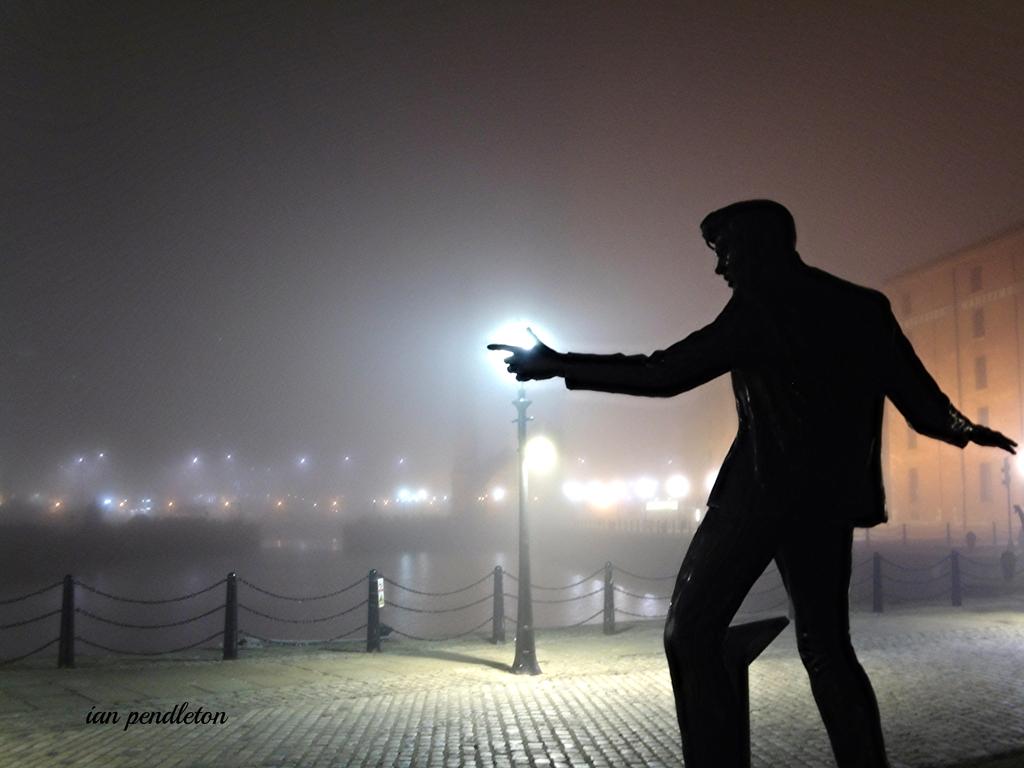
He now has a permanent memorial there through a proud statue which adorns the Albert Dock – an appropriate location for a man who spent two years working as a deck hand on a Mersey tug boat The Formby.

Embed from Getty Images

*

Billy as you can see from the image above was moodily handsome in the vein of James Dean, Chet Baker and Elvis.

He also sported a mighty quiff and looked dynamite in neon coloured jackets!

Moreover, in contrast to almost all his pre Beatles contemporaries, he had a sense of the creative energy and spontaneity at the heart of the revolutionary music sweeping all over the world from the American South.

Billy, like millions of us, had his head, his heart and his soul set aswirl by the epoch shattering sounds of Elvis, Jerry Lee Lewis, Chuck Berry and Little Richard. He also had affection for the folk art masterpieces produced by the Orpheus of Alabama, Hank Williams.

Perhaps it was Billy’s childhood experience of rheumatic fever resulting in a permanently damaged heart that gave him his fatalistic sense that he would die young, his aura of diffident vulnerability and a wounded charisma that was particularly attractive to his female fans.

His career proper began in 1958 in, ‘You wouldn’t dare make it up’ circumstances. Eighteen year old Billy attended a Birkenhead, Liverpool rock/pop revue concert featuring a series of artists promoted by the Svengali like show business manager Larry Parnes.

Hearing the self penned songs Billy (then known as Ronald Wycherley!) was pitching to Marty Wilde and instantly recognising his marketability Parnes pushed the trembling Billy onto the stage and by the next morning Ronald Wycherley was rechristened Billy Fury and off on the road in the tour bus!

Girls liked Billy’s looks and his sometimes shy, sometimes shameless, performing manner while the male members of the audience had to admit that he really could rock out when he wanted to.

Both sides of the Fury persona were featured on the 10 song album, ‘The Sound Of Fury’ with every song written by Billy, that he recorded in a single day in April 1960. The, ‘not too far from Sun Studio’ lead rockabilly guitar was provided by Joe Brown and the solid drums by Alan White.

The whole album is over in half an hour yet it had then and still now retains the visceral impact of true Rock ‘n’ Roll.

Listen here to Billy bring some heat and style into the grey 1950s London with his own, ‘Turn My Back On You’

Now, hear his heart stilling, heart breaking, blood on the tracks ballad, ‘You Don’t Know’

Billy on record at least never really approached the kind of ecstatic abandon Elvis and Jerry Lee reached (who ever has?) but uniquely for Britain at the time he embodied an affecting personal engagement with his material and vocals that I still find admirable and moving.

His recurring poor health, lack of driving ambition and the erratic tides of popular taste left his career as a Rock ‘n’ Roll star effectively marooned once the Beatles led beat boom hit its stride in the mid 60s .

Yet amazingly, it turns out he had as many 60s hits (24) in Britain as his fellow Liverpudlians though their sales both in Britain and worldwide would, of course, have dwarfed his.

Though he continued to write and record and always had a core of life long devotees he became one of those, ‘Whatever happened to’ figures so plentifully present in music history.

Billy, whose health was never robust, finally succumbed to his heart problems and died in 1982 aged only 42.

Looking back, few who listen carefully will ever forget his look and his alluring voice.

There is a poignancy about him that clutches at the heart.

To my mind Billy’s ability to inhabit a mysteriously powerful vulnerability reached its zenith with a record that haunted Billy (he recorded it three times) and will surely haunt you too – ‘Wondrous Place’.

This is one of those songs where you feel like you are eavesdropping, in an unsettling yet addictive way, to a very intimate psychic drama.

Billy seems to be singing to himself as he walks alone in the pre dawn early morning hours down some lonesome moonlit road; perhaps some Merseyside dockland version of Hank Williams’ lost highway.

There is a sleepy reverie suggested by the slow river drifting tempo and the heartbeat percussion. Billy’s lovely humming breaks and artful hesitations combined with his tender, airy vocal seems that of a man trying, not entirely successfully, to persuade himself that the wondrous place he hymns is his to revisit when he wills.

There is more of the wistful goodbye to love lost in this performance than a celebration of a continuing relationship.

‘Wondrous Place’ lasts less than two and a half minutes but as you listen you feel it lasts a much longer time.

Somehow it makes you aware of all the individual breaths of life that fill all the seconds, all the minutes of all the days and nights you have left to you.

And, perhaps all of us carry memories; recalled on moonlit walks or quiet moments snatched from the hourly burly of everyday life of a wondrous place that we can never quite recapture though we can revisit it in the echoing halls of our imaginations – especially when a singer like Billy Fury shows us the way.
Canned Heat – Going up The Country and Working Together!

The subject of today’s post on The Immortal Jukebox, Canned Heat, have had many, many incarnations since the first proto form of the band emerged from Topanga Canyon, Los Angeles in 1965. By my reckoning they have had almost 40 different line ups featuring more than 50 musicians and issued dozens of recordings in a career that still continues to this day.

If you are in the area you can see them play at the Southside Shuffle in Port Credit, Ontario, Canada tomorrow night (September12). No doubt a fine time will be had by all.

I have neither the space or the inclination to provide a comprehensive history of their overall career here. Instead, I’m going to concentrate on what I consider to be their golden period, 1967 to 1970, when they released a series of superb records which managed to be both classic blues performances and, Lord be praised! world wide hits.

The sides featured here, ‘On The Road Again’, ‘Going Up The Country’ and, ‘Let’s Work Together’ are respectfully rooted in the blues tradition yet have nothing of the musty museum about them. Rather, they are enchanting recordings which sizzle with optimistic life.

They were created by an outstanding group of musicians whom I will always regards as the definitive Canned Heat line up. They comprised; Bob ‘The Bear’ Hite on vocals, Alan ‘Blind Owl’ Wilson on harmonica, guitar and vocals, Henry ‘Sunflower’ Vestine on guitar, Larry ‘The Mole’ Taylor on bass and, Adolfo ‘Fito’ de la Parra on the drums.

It was the above configuration that recorded the glorious, ‘On The Road Again’ at Liberty Studios in September 1967 for the album, ‘Boogie With Canned Heat’ issued in January 1968 with the edited single version following in late April. I’m featuring the album version here.

I can’t resist saying – isn’t that just hypnotic! The slightly eerie introduction, seeming to evoke the, ‘entre chiens et loups’ fading light of the Mississippi evening, signals that the journey we are about to embark on will take us, on the blue highways, to the strangely familiar yet mysteriously alluring world inhabited by the southern bluesmen.

A world where the endless road, battered as it is by the rain and the snow, offers the only comfort available to a man abandoned to his fate by his dead mother and his erstwhile lover. Now he has no special friend just the relentless road ahead.

Clearly, Al Wilson drew heavily from Tommy Johnson’s, ‘Big Road Blues’ from 1928 and Floyd Jones’, ‘Dark Road’ and, ‘On The Road Again’ from 1951 and 1953 to fashion the Canned Heat recording. However, the triumph here is to have so thoroughly absorbed those recordings and influences that his own treatment goes way beyond homage to become a thrilling new creation that is guaranteed to haunt you.

Canned Heat and Wilson in particular were devotees of the one chord E/G/A droning blues form quintessentially represented on record by the great John Lee Hooker. The Canned Heat rhythm section lock in and drive the song forward while Al Wilson works wonders with his spectral hoot owl harmonica and his ghostly high pitched vocals (owing much to his devotion to Skip James). Add in the colour of the exotic Tambura and you have a record that makes its own imaginative weather.

Al Wilson was I believe the soul of Canned Heat and a very remarkable person. He was a highly intelligent and devout scholar of the blues who had listened and thought deeply about what made it special and how it should be played. He aded an intensity of focus and concentration (owing something perhaps to a personality that was somewhere on the autistic spectrum) which allowed him to make spectacular progress as a singer and instrumentalist from teenage neophyte to a genuine master by his early 20s.

Embed from Getty Images

It says something about his marrow deep love and understanding of the blues that it was Al who coaxed the rediscovered Son House to remember how his great pre war recordings should sound and be played.

John Lee Hooker wondered how this skinny white kid from Arlington Massachusetts with the baby face, who could barely see, had developed an ear and a heart for the blues so sympathetically attuned to his own way of playing. Al’s contributions to House’s, ‘Father Of The Delta Blues’ (1965) and, ‘Hooker and Heat’ from 1971 are marvels of empathetic accompaniment.

He was a distinctive singer, fine rhythm guitarist, virtuoso harmonica player and a gifted song arranger. Al Wilson’s death in September 1970 (in circumstances involving barbiturates which will never be fully understood) at the tender age of 27 was an immeasurable loss to music.

Listen to him here displaying all the above qualities on the sunlit, ‘you can’t play it only once’ Woodstock era anthem, ‘Going Up The Country’.

The root of this song lies in, ‘Bull Doze Blues’ (1928) by the almost mythical Texan bluesman/songster Henry Thomas. Al Wilson and Canned Heat catch Thomas’ mixture of sturdy danceability and decorative detail. Thomas often used the quills or panpipes to showcase surprisingly delicate melodies. In the Canned Heat version Jim Horn plays the delightful flute parts.

Many will remember this song being used in the movie of the Woodstock Festival and it has since been used countless times in feature films and adverts seeking to call up nostalgia for the bucolic hippy dreams of the late 60s.

Al Wilson was an early member of the conservation movement and the song perhaps reflects both his love of the redwood forests and his disquiet with the lack of respect paid to the nation’s environmental heritage. The song has sunlight but shadows too (the shadows are more prominent in his song, ‘Poor Moon’).

Henry Vestine’s plays subtly brilliant guitar throughout the track. Vestine (who died in 1997) was a superb lead player who, encouraged by his physicist father, had built up a staggering voluminous collection of blues and other roots music recordings during his teenage years in Takoma Park, Maryland. It was there that he formed a boyhood friendship with another legendary figure in American Music – John Fahey.

Through Fahey and a move to the West Coast he met Al Wilson and Bob Hite (a fellow record collector of heroic proportions – in fact Bob Hite did everything to heroic proportions up to and including his drug intake resulting in his untimely 1981 death). With the addition of supple bassist Larry Taylor (whose credits in addition to Canned Heat include work with the original Monkees, John Mayall and Tom Waits) and endlessly energetic drummer Adolfo de la Parra the classic line up was complete.

But,stormy relations between Henry Vestine and Larry Taylor led to the former’s precipitate departure before the recording of their 4th album. They found a very able replacement for Henry in Harvey Mandel.

It is with Mandel on guitar that Canned heat recorded a massive world wide hit with their stupendous pile driving take on Wilbert Harrison’s, ‘Let’s Work Together’. There’s no point thinking you can sit in your chair while this one plays: like Bob Hite says – ‘Aw come on!’

This is a record that takes no prisoners. The Bear grittily bears down on every word as Harvey Mandel, with Al Wilson and the rhythm section shadowing and supporting him, wails and wails on lead guitar.

This record came out when I was 15 years old and something of a studious cove – but I can tell you I did some mighty, mighty, head banging and air guitar pyrotechnics to this one as I tested out the patience of my parents and neighbours as I pushed my amplifier and speakers to their absolute limits.

Canned Heat have often, not without some merit given their post 1970 career, been caricatured as one more routine boogie band. But, for those few years as the 1960s ended they were one hell of a band who played the blues with respect, good spirit and no little style. They should have an honoured place on every downtown jukebox.

Notes:

The best Canned Heat collections I am aware of are the extensive ‘Uncanned’ for those who really get with the groove and, ‘Let’s Work Together’ for those who prefer to cut to the chase.

Henry Thomas – the magnificent collection, ‘Texas Worried Blues’ on the Yazoo label would be one of the very few records I would run into a fire to save!

Though Floyd Jones lacked the drive of many of his blues contemporaries he was a smart and serious songwriter and an interesting performer. See the Classics set, ‘Floyd Jones 1948-1953’.

Little Eva – Making You Happy when You’re Feeling Blue!

Featuring : The Locomotion, Keep Your Hands off My Baby, Swinging on a Star.

Belhaven is a small, poor town in North Carolina. It was there that David and Laura Boyd struggled to raise their large family which would eventually, by the mid 1940s, include thirteen children.

From the point of view of music history it’s fortunate they didn’t stop at nine children because Number 10, born in late June 1943, was a girl whom they named Eva Narcissus Boyd who later came to be known on pop charts all around the world as, ‘Little Eva’.

Embed from Getty Images

*
Under that soubriquet in 1962 and 1963 she would record a glorious series of life affirming pop records – one of which, ‘The Locomotion’ is indelibly imprinted on the memory of anyone who has ever heard it (though the steps to the dance may remain a little hazy for most of us!).

I defy anyone not to light up a smile as this record speeds along propelled by Carole King’s driving piano and spurred by Art Kaplan’s insistent sax.

On top Eva sings her heart out winning our affections with the unbridled enthusiasm, the sheer pizazz, with which she lives out the song.

Pretty soon everyone was doing a brand new dance and Eva by August 1962 was looking down on the world from the fabled Number One spot on the charts!

In Belhaven Eva had soaked up all the enormous music available on the radio and honed her singing chops with a family Gospel group, ‘The Boyd Five’.

Eva was naturally ebullient and it was inevitable that she would feel as she grew up that Belhaven was not the place to get ahead and forge your dreams into reality. Of course, she was inevitably drawn to the great magnet city on the Hudson, New York, which continually called out to all who wanted to make a new life – come on up! If you can make it here you can make it anywhere!

So, having had a taster of life there in 1959 staying with her brother Jimmy as 1960 dawned Eva boarded the bus out of town to try her luck in the Big Apple. Initially she got a job as a maid on Long Island. Brother Jimmy’s wife was friends with Earl-Jean McCrea who sang with established vocal group The Cookies who had backed up many prominent artists on the Atlantic label including the King of them all – Ray Charles.

Earl-Jean copping that Eva could really sing asked her to try out for a vacant position in The Cookies in 1961.

Her successful audition piece had been one of the greatest ever yearning love songs, ‘Will You Still Love Me Tomorrow’ written by the immortal songwriting team of Carole King and Gerry Goffin.

Carole and Gerry with inspiration at full flood and publishers beating down their door for the next big hit decided that it was essential to employ a nanny for baby Louise to free them up to attend, full time, to their muse (especially as another child was on the way!).

So in short order Eva became a member of the Cookies and a live in nanny in Sheepshead Bay Brooklyn. Eva could also on hand to demo some of the songs pouring out of the Goffin/King hit machine.

Eva is heard for the first time on record on a Ben E King session adding punch to, ‘Gloria, Gloria’ and the marvellous, ‘Don’t Play That Song (You Lied)’.

Around that time street wise Publisher Don Kirshner asked/demanded Gerry and Carole to come up with a smash hit dance song in the vein of, ‘Mashed Potato Time’ which had been a number 2 record for Dee Dee Sharp in May 1962. Don wanted the new Goffin/King composition to be Dee Dee’s follow up to Mashed Potato.

But, canny operator that he was, when he heard the demo of Locomotion by Little Eva he was certain he had a major hit on his hands and if he set up his own label (Dimension) to issue the record he would really accumulate the greenbacks!

In fact the demo was so good, so infectiously captivating, that a big time studio re-recording could not match it’s magic and the issued version was thus simply the demo with some added vocals from Eva and Carole.

Eva was now a long way from Belhaven – appearing on the premier pop TV show of the day, ‘American Bandstand’ and settling into a whirlwind schedule of demos for Goffin/King, recordings with The Cookies and her own solo career – it would be the time of her life. With The Cookies she can be heard on another certified Goffin/King pop classic, ‘Chains’ from November 1962.

In Liverpool The Beatles, aficionados of the Girl Group sound, listened intently and, ‘Chains’ sung by George Harrison, would feature on the lads debut LP (though I have to say their version does not have the overwhelming vitality of The Cookies version).

The Beatles also heard, liked and performed live, Eva’s follow up to Locomotion, ‘Keep Your Hands Off My Baby’


There’s nothing of the novelty song about that one!

This is a tough girl group song which gives Eva the chance to show what a fine fluent singer she could be and how she could effectively vary the volume and tone of her singing to convey the emotion of the song.

Like many of the girl group songs it’s a song nominally about a boy but really about the complex web of relationships between girls.

Keep Your Hands was a number 12 hit but alas, effectively the last solo hit Eva would have (though she recorded some other fine sides).

This can, at least in part, be ascribed to the demands on Goffin/King to write and reserve their best songs for more big name artists and the lack of a savvy manager figure to look out for Eva’s interests (there’s the almost inevitable murky story of how little money she made from her days in the pop limelight).

But, there would be one last hurrah, and a mighty one at that, for Eva on record and in the charts in the essential (though mysteriously uncredited!) contribution she made to one of the most charming records of the early 60s, ‘Swinging On A Star’ by Big Dee Irwin.

Now, if that doesn’t give an enormous boost to your happiness index I have to say you must be seriously depressed!

The record overflows with wit and sheer love of life with Eva providing the joyously sassy vitality of youth. You can hear the vocal chemistry and warmth of the relationship between Big Dee and Eva in their relaxed banter that makes the song such a pleasure to listen to (the flip, ‘Just A Little Girl’ is excellent too).

And as 1963 closed so did Eva’s career as a hitmaker though she kept recording through to 1971 when she determined to return home to North Carolina following the death of her mother. Eva had a troubled marriage with James Harris which reportedly involved extensive domestic violence (they were later reconciled).

When she returned home her purse was virtually empty despite her hits and she had three young children to care for. Taking whatever work was available she showed she was made of stern stuff and settled down to the obscure life she had left behind for those dizzying few years of the early 1960s.

Though Locomotion was a re-released hit in the UK and a Number One US hit for the second time through Grand Funk Railroad (!) Eva saw no boost to her bank balance.

Strangely it was the bland Kylie Minogue version from 1988 which opened the door for Eva to be seen and heard again. She appeared on retro, ‘Golden Oldies’ shows, recorded some gospel material and toured with pop contemporaries like Bobby Vee and Brian Hyland.

Eva died in April 2003 from cervical cancer.

For many years her grave in the Black Bottom Cemetery was marked by nothing but a tin marker. However, through the good offices of the town of Belhaven and monumental mason Quincy Edgerton a fitting headstone featuring a speeding locomotive now rests atop her final resting place.

It is no small thing, as Eva did, to have made records which will always evoke the joy of youth and the glorious gift of life.

There are times when we all need a song which will make us happy even when we are feeling blue.

Thank you Eva – may you rest in peace.

Notes:

In addition to the songs mentioned above I suggest you give a listen to the following attractive performances by Eva:

‘The Trouble With Boys’

‘What I Gotta Do (To Make You Jealous)

‘Takin’ Back What I Said’

Rod Stewart & The Faces Live – Twisting The Night Away : A Magnificent Racket!

Most of the posts published here on The Jukebox are (as I hope you will have judged) the result of contemplation, decades of listening history, careful planning and rigorous research. Not this one!

No, today’s post was generated through the mysteries of the algorithms that produce, ‘random’ selections on my Brennan JB7 music system. So, from the very instant that the first notes of, ‘Twisting The Night Away’ by Rod Stewart and The Faces exploded into my consciousness it was clear to me that any plans made for today’s post were null and void!

And, after I had hit the repeat button seven or eight times in a row and reached a state of exhausted elation having danced myself into a virtual stupor I was willing – if not wholly ready and able to write.

So, ‘My Lords, Ladies and Gentlemen’ for your pleasure and delight let me transport you back to London in the Summer of 1973 so that you too can joyfully release your inner dolphins (so much better as a phrase for explaining the appearance of abandoned glee than the bare, ‘endorphins’ the physicians and chemists would have me use).

Dr Thom’s Jukebox prescription is that you now turn all your dials up way into the red zone and press play now! Repeat as necessary

In the early 1970s furious intoxicant fuelled arguments raged in bars all over the world when one of the company would muse – ‘Who would you say is the greatest live Rock ‘n’ Roll band in the whole wide world?’

The general view was that the crown was the property of The Rolling Stones but strong counter arguments were made for Led Zeppelin or The Who and some, with a more global perspective, would advance the case for Bob Marley and The Wailers.

Listening sagely, as is my wont, I would agree that the above bands were very fine outfits indeed but then with a glint in my eye, I would add that if I could conjure up one group to appear in a puff of dry ice before our very eyes and play their show right here, right now, none of the previously mentioned could be guaranteed to deliver the righteously raucous; let’s turn this place into the best party you’ve ever had or die in the attempt, good time that Rod Stewart and The Faces were sure to give us.

If I had added top up Tequila to my staple pints of Guinness I would clinch the argument (at least in my mind) by extravagantly miming Rod’s microphone stand gymnastics before adding – which of the other bands could really thrill you one minute, then bring a tear to your eye before making you laugh with sheer uproarious delight the next, like they could?

Now I know that this was a band whose brilliance was a matter of fits and starts dependent on their mood on the night and whether they were liquored up just enough to play freely or so overloaded that they could barely stand up.

But, but, on a good night, and there were scores and scores of those, they made a bloody, bluesy, madly magnificent racket that could lift your spirits in a way no other outfit has ever matched.

Yes, It is true to say that as instrumentalists they weren’t exactly virtuosos but there are times when I don’t want my music to be like a sip of smooth bourbon. I want it to be like a shot of illegally distilled Moonshine, from back in the hills, which you half fear will send you stone blind as you take another hit because it just tastes so damn fine. That’s the kind of music they made.

The Faces – Rod Stewart, Ronnie Wood, Ronnie Lane (RIP), Kenney Jones and Ian McLagan (RIP) were to my mind the most glorious gang of vagabonds, rounders and reprobates ever to have taken the stage. They lived the Rock ‘n’ Roll lifestyle to the max and while I’ve never seen a copy of the rider they would have given to promoters of their shows I’d be very surprised if, ‘Cigarettes, Whiskey and Wild, Wild Women’ (among other hedonistic delights) didn’t feature very prominently!

Embed from Getty Images

I love the way they often sounded like they were falling pell-mell down several flights of very steep stairs; hitting each tread with bone shaking force yet somehow, miraculously, landing pat on their feet as they finally hit bottom ready to set off again for another fantastic foray towards Nirvana!

When you hear them launch into,’Twisting The Night Away’ you hear a band surging with the magical power of true Rock ‘n’ Roll. By the end you will agree with Rod that you sure feel a whole lot better now!

And, if you are anything like me you will firmly believe that the bounds of the earth can’t hold you anymore – if you want to nothing can stop you from sailing straight up into the moonlit sky. Some band! Some band!

I’m going to write much more about Rod Stewart in future posts but I should say here that his early solo albums from 1969’s, ‘An Old Raincoat Won’t Ever Let You Down’ through to 1974’s, ‘Smiler’ represent one of the most enduringly satisfying bodies of work in the history of post war music.

All his apprentice period gained busking with folk legend Wizz Jones, blues shouting with Steampacket and patrolling the big stages in front of guitar great Jeff Beck allied to his intelligent and sensitive appreciation of soul, country and R&B and the songwriting genius of Bob Dylan and Sam Cooke gave him the experience necessary for him to produce performances from that period which are a rare conjunction of immense popular success and lasting achievement.

Each member of The Faces made their own distinctive contribution to the glories of the overall sound. For me, the key member was Ronnie Lane who provided not just fine anchoring bass but also the earthing heart of the band. The louche guitar of Ronnie Wood and the never let the beat go drums of Kenney Jones synching with the tough when necessary, tender when necessary keyboards of Ian McLagan made a very potent combination.

The Faces best work was only sporadically captured on their albums. Rather, their true testament is to be found on the live sessions they recorded for the BBC; often for their greatest fan and champion the legendary DJ John Peel.

The five years or so Rod Stewart and The Faces were together made for one hell of a ride! We were lucky to have had them.

Time to hit that play button again.

Peter Green, Lonnie Mack, Gatemouth Brown – Guitar! Guitar! Guitar!

When we are children we spend much of our lives dreaming of the future. A future in which we will be fearless captains of storied lives. What wonders we will accomplish! Idly staring out of windows at home or at our school desks, seemingly in a daze, we lay out scenarios of heroic movies in which we are the writer, producer, director and multi Oscar winning star.

A lot of young men dreams swirl around images of themselves as the epitome of cool at the wheel of a gleaming, glamorous car (a Chevrolet Corvette or perhaps an E type Jaguar) which will make all their male friends envious and all the girls of their acquaintance, especially the girl of their dreams (there’s always a luminously lit girl in these dreams) stop, stare and ask – ‘Can I have a ride?’

Others disdain these petrol head reveries. Instead, their dreams see them on stage wowing the audience (and their fellow musicians) with the virtuosity of their six string genius. Doodling on their school notebooks they picture themselves strutting their soon to be recognised stuff elegantly armed with a Fender Telecaster or Stratocaster, a Gibson Flying V, Firebird or a 1959 Les Paul.

They just know that one day like Johnny B Goode their name will dazzle the night in neon lights as people come from miles around to hear them make that guitar ring, ring, ring like a bell.

Often these dreams vanish into the ether only to be recalled when the dust covered yearbook is once more brought into the light. But, but, there are always those who through determination, application and sheer willpower realise those dreams of childhood and as is the way of these things provide models for another generation of dreamers.

Today the Jukebox features three Guitar heroes who dreamed those dreams and who then burned those dreams into vinyl masterpieces in the 1950s and 1960s which continue to provide dreamscapes for aspiring axe-men to this day.

The Jukebox needle drops first on, ‘Okie Dokie Stomp’ a joyously swinging 1954 Peacock Records Rhythm & Blues gem by a guitarist, Clarence Gatemouth Brown, who defined Americana long before the term was invented. Gatemouth was from Orange Texas and man oh man could he cut a rug whether he was playing the blues, Zydeco, Rhythm & Blues or Country music! Like the man said he played American and World music – Texas style.

The version above was recorded at Radio City Music Hall in February 2003 and can be found on the highly recommended DVD, ‘Lightning In A Bottle’. The sharp eyed among you will recognise that behind the drums is the great Levon Helm from The Band.

Levon lays down a killer beat urging Gatemouth on as he magisterially wails through his signature tune. The fine horn section issues hot blast after hot blast lifting Gatemouth to ever greater instrumental heights on guitar.

The whole version puts me in mind of The Texas Special streamliner train as it flashed through the night on its way home to San Antonio. Gatemouth’s guitar style was full of fleet flair but never needlessly flashy. His sweetly stinging solos are those of a professional going enjoyably about his business with dexterous skill.

I’m delighted that I met Gatemouth at London’s 100 Club in the mid 1970s on one of his frequent European tours. He was quite a sight to see in his trademark black outfit featuring a feathered hat, pointed cowboy boots and studded Western shirt. To top it off when not on stage he smoked a pipe!

Embed from Getty Images

With the enthusiasm of youth I waylaid him as he walked back to the stage for his second set and near begged him to play, ‘Okie Dokie Stomp’. To my eternal delight two minutes later he announced, ‘Here’s one Tom over there says I just have to play’ before launching into a blistering take on Okie Dokie. What a tune, what a musician, what a man!

While Gatemouth was laying down, ‘Okie Dokie Stomp’ in Houston in the heartland of unfashionable rural Indiana a young man born to play guitar, Lonnie Mack, was practicing obsessively while absorbing and incorporating influences from rock n roll, rockabilly, the blues and crucially gospel music.

On the family farm while there was no electricity there was a battery powered radio – usually tuned to The Grand Ol’ Opry. Keen eared Lonnie could hear that Merle Travis was a great player and when his parents went to bed he could tune the radio into black stations and hear T Bone Walker and other bluesmen and dream of a style which would marry Merle and T Bone’s imaginative fluency while adding an intensity he had heard in Ray Charles and the Blind Boy gospel groups.

In 1958 Gibson issued the distinctive Flying V guitar and teenage Lonnie who had been working the Kentucky, Indiana and Ohio roadhouse circuit since he was 13 got himself the 7th Flying V off the production line. And, boy did he put that guitar through its paces!

http://www.youtube.com/watch?v=1isW4s7rWpc

Wow! I think that bears repeating, Wow! And that was what practically every guitar player who heard, ‘Wham’ in 1963 said as they played the record over and over again trying to figure out how a chubby kid from the sticks could come up with such a sound that seemed to be savagely wild while being perfectly contained and controlled. With wonder most realised that if it came to a musical, ‘cutting contest’ there could only be one winner – Lonnie Mack.

Embed from Getty Images

Lonnie Mack’s guitar playing here and throughout his stunningly brilliant 1964 LP, ‘The Wham Of That Memphis Man’, recorded for Fraternity Records in Cincinnati, has the overwhelming onrushing power of a field shredding tornado as it cuts a swathe through your brain cells while you desperately try to keep up with his prodigious invention.

Soon, guitar vibrato bars were popularly called Whammy Bars in tribute to the astounding sounds Lonnie coaxed and commanded from his own Bigsby vibrato tailpiece.

Lonnie’s admiration of Gospel music is reflected in the intensity of his performances and the way he thrillingly builds and releases tension to hold and lift both his audience and his fellow musicians. Using techniques borrowed from the blues, bluegrass and gospel Lonnie can fit blindingly fast licks and choruses into a finely judged musical structure and still shift into overdrive to guide a tune to its breathless conclusion. Once heard I’m telling you that you will not be able to get enough of the wham of Lonnie Mack.

While these American giants were scorching their groove into guitar history a generation of fanatical young Englishmen swore undying devotion to the Blues and dreamed that they too might capture and discharge lightning in their playing just like Elmore James, B B King or Buddy Guy.

The mentor and bandleader for many of these guitar tyros was one of the key figures in British Blues history, John Mayall. From 1963 onwards he led a series of bands called, ‘The Bluesbreakers’ who became an amalgam of finishing school and military academy for would be bluesmen – especially guitar players.

As most will know Mayall’s first great guitar slinger was none other than Eric Clapton who showed on the 1966 LP, ‘Bluesbreakers with Eric Clapton’ that Britain had produced its first guitar player who could genuinely be considered to be on the level of the Chicago scene masters.

So it was genuinely shocking for producer Mike Vernon to learn as he set up the studio in 1967 to record Mayall’s LP, ‘A Hard Road’ that Eric had left the band. It was even more shocking to be told by John Mayall not to worry about that as the new lead guitarist, Peter Green, was even better than Eric! How could that be?

Well, heretical though it may be in many critical circles, I agree with John Mayall’s 1967 bravado. To my mind in the three years or so from 1967 to 1970 before his musical genius was effectively crippled by over indulgence in drugs, LSD especially, and mental instability, Peter Green was the most brilliant and extraordinarily affecting guitar player on the planet.

In later posts I will write about his career at some length. Today I will limit myself to some general observations about his sound and present in illustration his wondrous performance on, ‘The Supernatural’ from the, ‘Hard Road’ LP. Here, Peter Green and his, ‘Magic’ 1959 Les Paul will take you to places few guitar players can even imagine let alone reach.

http://www.youtube.com/watch?v=PWFFqffopb8

Perhaps the simplest way to comment on that incredible performance would be just to quote someone, B B King, who knew a little bit about guitar playing – ‘He has the sweetest tone I ever heard; he was the only one who gave me the cold sweats’. Amen, B B, Amen!

‘The Supernatural’ was the first recorded evidence that Peter Green had a very special quality as a musician: he had a feeling for the shivering essence of music. The critic Greil Marcus talks about the, ‘Yargh’ when trying to pinpoint the veil piercing quality of Van Morrison’s voice.

I think we could use the term, ‘The Touch’ to identify the same quality found in the voice of Peter Green’s guitar. Through an inspired use of vibrato, sustain and controlled harmonic feedback he conjures up soundscapes that open up such deep interior realms of feeling that listening to him can be a deeply emotional experience.

I have always thought that Peter Green and his Les Paul worked together like two brave but vulnerable living creatures voyaging into terra incognita when he took his guitar solos. It’s the mixture of musical daring with emotional vulnerability and depth that distinguishes Peter Green for me from all his contemporaries.

Embed from Getty Images

Peter Green in his searching songs and performance seems to offer reports back from dark reaches within himself and I suspect all of us. In his playing we can come to recognise both the embracing warmth of those sub conscious depths and perhaps also their chill threat. The timber of humanity is always twisted and knotted and Peter Green’s guitar brilliantly illuminates that truth.

A great writer, Franz Kafka, once gave his view on what the function of a book should be and I think it holds up just as well for music:

‘ I think we ought to read only the kind of books that wound or stab us. If the book we’re reading doesn’t wake us up with a blow to the head, what are we reading for? … Good Lord, …. we need books that affect us like a disaster, that grieve us deeply, like the death of someone we loved more than ourselves, like being banished into forests far from everyone …. A book must be the axe for the frozen sea within us’.

Listening to Peter Green I feel that the axe has indeed split the frozen sea.

Notes:

Gatemouth Brown died at 81 in September 2005 in his childhood home town of Orange Texas having just escaped the ravages of Hurricane Katrina. In a macabre twist his coffin was floated away from his burial site by flooding caused by Hurricane Ike in September 2008. Happily, he was later reinterred securely in Orange’s Hollywood Cemetery where his resting place is properly marked by a fine headstone and a plaque from the Texas Historical Commission.

Gatemouth made many fine recordings. I recommend the original albums:

1975 Bogalusa Boogie Man (Barclay)
1979 Makin’ Music (with Roy Clark) (One Way)
1981 Alright Again! (Rounder)
1982 One More Mile (Rounder)
1999 American Music, Texas Style (Verve/Blue Thumb)
2001 Back to Bogalusa (Verve/Gitanes)

For compilations:

1987 Texas Swing (Rounder) Rounder recordings
1990 The Original Peacock Recordings (Rounder) Peacock recordings

Lonnie Mack:

‘The Wham Of That Memphis Man’ should be in every collection – if you haven’t got it order it today!

In addition to his staggering guitar playing Lonnie is also a wonderfully intense singer who brings a gospel grace and intensity to his country soul vocals. The combined qualities are well captured on his Elektra albums, ‘Glad I’m In The Band’ and, ‘Whatever’s Right’ from 1969. His live, rampaging roadhouse blues sound is showcased on, ‘Live At Coco’s.

Two albums on Alligator Records from 1984 and 1986 are also well worth investigating, ‘Strike Like Lightning’ (extensively featuring Stevie Ray Vaughan) and, ‘Second Sight’.

Peter Green:

Everything Peter recorded with John Mayall and with Fleetwood Mac should be a mandatory purchase!

Knocking The Beatles Off Number 1 : The Dixie Cups! Chapel of Love, Iko Iko

‘They were the shyest, sweetest group …. You rooted for them – wanting them to be successful … They exuded innocence, they listened, they performed … What you heard was who they were .. And they just sang from the heart. They deserve recognition and respect.’ (Ellie Greenwich on The Dixie Cups).

Embed from Getty Images

By the middle of 1964 The Beatles had virtually annexed the Number One position in the US Hot 100 chart. ‘I Want To Hold Your Hand’, ‘She Loves You’ and ‘Can’t Buy Me Love’ rested atop the chart for fourteen straight weeks and surely, ‘Love Me Do’ which hit the summit at the end of May would extend their imperial sway even further.

Who could stop them? Well, as no one but Nostradamus could have predicted The Beatles were turfed out of the top spot not by another British Beat group or one of the titans of American Pop but by three shy young girls from New Orleans, collectively known as The Dixie Cups.

The members were sisters Barbara and Rosa Hawkins and their cousin Joan Johnson. Their debut single, the immortal, ‘Chapel of Love’ elbowed John, Paul, George and Ringo aside and selling over a million copies took up glorious residence at Number One for the first three weeks of June 1964.

Unless you’ve wholly surrendered to soul deadening cynicism the sheer romantic charm of, ‘Chapel of Love’ is bound to win you over as it celebrates in a tone of sure hearted happiness the delights of marriage and the dizzy joy of a wedding day.


Doesn’t everybody want, or remember with affection, the day when the sky was blue and the birds sang, as if they knew, that this precious day was the much longed for and now finally here, ‘I Do Day’?

Doesn’t everybody want, once in their life, for the sun to shine brightly and believe, or at least hope, that, ‘I’ll be his and he’ll be mine until the end of time’?

Doesn’t everybody want to believe, hoping against hope, that they will never be lonely any more?

I do. I did on the day I got married all those years ago and I still do now.

And listening to the lovely innocence of The Dixie Cups familial harmonies I believe once again in the power of simple words and simple melodies to illuminate and provide inspiration and comfort throughout the dramatic phases and stages of life in all its simplicity and infinite complexity.

I love; the relaxed tempo of the song, the finger snaps cueing in the bass and drums, the angelic affirmation of the vibes, the haze of the horns seeming to wish the happy couple bon voyage as they set sail for the future and the way the vocals suggest joy being welcomed and embraced as a natural fact.

I love the almost intoxicated wonder of the line, ‘Gee, I really love you and we’re gonna get married, Goin’ to the Chapel of love’. (I think one day I will have to write a whole post dedicated to the use of the word, ‘Gee’ in fifties and sixties pop – you have been warned!)

Listening to the song it sometimes feels like I’m taking time out to swathe my spirit temporarily in a cocoon of bliss. Perhaps I’m also seeking reassurance and fortitude for the day ahead – whatever it may bring. All I really know is that, ‘Chapel of Love’ is a song I never tire of.

Though this was a debut single for The Dixie Cups the team behind the record reveals a gallery of some of the most important figures in the popular music of the 1960s. The girls had been brought to New York by their musical mentor, Joe, ‘You Talk too Much’ Jones. He was involved in selecting songs for them and in producing, ‘Chapel Of Love’.

The song was written by the (then!) husband and wife duo of Jeff Barry and Ellie Greenwich who rank with Lennon & McCartney and Holland, Dozier, Holland as authors of classic hits. Think of, ‘Da Doo Ron Ron’, ‘Then He Kissed Me’, ‘River Deep – Mountain High’, ‘Do – Wah – Diddy’, and, ‘Leader Of The Pack’ just for starters!
Embed from Getty Images

The record was also a debut for Red Bird Records run by the legendary songwriting/production team, Leiber and Stoller, and a storied figure in the New York City music scene and the vocal group world, George Goldner, who between them had helmed dozens and dozens of hits.

I was once told that there are 8 million stories in the naked city and I’m sure there’s at least that many stories behind every great song

The truth of the above statement is surely proved by the (largely fruitless) attempts that have been made to explain what The Dixie Cups other great hit from March 1965, ‘Iko Iko’ is really all about.

I could (as is my frequent wont) launch into a scholarly disquisition on the role of West African tonal languages and folkloric culture in Haiti, Cuba and New Orleans on the genesis of the song with footnoted excursions into Native American interaction with slave populations and the tangled web of copyright and intellectual property rights (summed up in the music business with the wise saw, ‘Where there’s a hit there’s a writ!).

But, I think, on mature reflection you would rather just hear an unforgettable song which returns us all to the playground of our youth (which many of us think we should not wholly abandon) with memories of rhymes we never knew the meaning of but which just made us happy and strangely empowered when chanting them out in unison.

Some words just sound wonderful when run together – whether they hold the key to the universe or are pure gibberish (I’m using my own anglicised version of the lyrics)

‘Talkin’ ’bout, Hey now! Hey now! I-KO I-KO … Jock-a-mo-fee-na-nay!!’

The legend goes that The Dixie Cups were goofing off in the studio and launched, impromptu, into a song they had learned at their grandmothers’ knee. The percussion effects are supposedly provided by striking a chair and metal ashtrays! In the booth, the ever canny Leiber and Stoller realised that such magic must not be allowed to vanish into the ether. So, they kept the tape running and with minimal overdubbing – Voila! A never to be forgotten hit was produced.

The Dixie Cups only had a short 18 month or so career as hit makers (though they still perform even now). Yet, there is no doubt in my mind that the gloriously open hearted records celebrated here will forever retain a place in the annals of pop music and more importantly in the lives of all who listen to them.

Elvis listened closely yet the world barely knows him : Junior Parker!

Given the machinations of the music business, the powerful currents of cultural and social history and the mysteries of public taste it is entirely possible to be a magnificent singer, to have written and recorded some classic songs covered by giants such as Elvis Presley and to have made wonderful records at every stage of a two decade career (‘Mystery Train’, ‘Next Time You See Me’, ‘Feelin’ Good’, ‘Driving Wheel’) and yet remain a shadowy figure usually referred to only with regard to figures of more popular note.

My Lords, ladies and gentlemen and music lovers everywhere I give you an artist you’ve been longing for – if only you had known he was there – Junior Parker!

Embed from Getty Images
Born in 1927 and growing up in West Memphis, Arkansas in the 1930s and 1940s Junior Parker was exposed to a thriving Blues and Rhythm and Blues scene. He learned to play the harmonica at the feet of Rice Miller (the second Sonny Boy Williamson) and in his teenage years he befriended and played with Johnny Ace, Roscoe Gordon, B B King and the mighty Howling Wolf. He also hooked up with bandleader/talent spotter/musical fixer Ike Turner who got him his initial shot at recording with Modern Records in 1952.

However, as with so many artists, it was after he met one of the most significant figures in twentieth century cultural history, Sam Phillips, and recorded at his Memphis Sun Studios that Junior Parker’s extraordinary talent as a singer, writer and performer first blossomed. Sun 187, ‘Feelin’ Good’ issued in 1953 and a sizeable R&B hit is Junior’s calling card showcasing his brilliantly controlled vocal style which combines supple variety with graceful flow.


Backed by guitarists Floyd Murphy and Pat Hare, pianist Bill Johnson and John Bowers on drums Junior takes a John Lee Hooker template and fashions (no doubt with the aid of the sharp eared Sam Phillips behind the desk) a record that pulses with energy and life. The hard wood floor sprung rhythm and the heart lifting guitar lines seem to clear a path for Junior to demonstrate the virtuosity of his singing.

He seems to gloriously glide and pirouette through the song ; now almost whispering hoarsely, now soaring into full throated release, all the while driving the song forward. Every time I hear this record I’m impelled to echo Junior, ‘Well I feel so good – Woooooooh!

Junior brought a song of his own, ‘Mystery Train’ to his next Sun session – one that would go on to be an epochal classic when covered by Sam Phillips’ greatest discovery, Elvis Presley. Junior’s version evokes an almost eerie atmosphere of a train slowly pulling its way in sultry heat through hazy southern fields.

Elvis, Scotty Moore and Bill Black (taking their cue from the urgent, ‘Love My Baby’ the flip side of Junior’s Mystery Train) up the tempo and energy level to evoke a streamlined locomotive blurring past astonished bystanders. Elvis sings with bravura élan and on the spot brings to life the sound of Rock ‘n’ Roll that Sam Phillips had so fervently been searching for. Junior’s version can’t match Elvis though it’s fair to say no one on earth has ever managed to either!

As Sam Phillips, for obvious reasons, concentrated on promoting the careers of Elvis, Jerry Lee Lewis and Carl Perkins, Junior found a home from home at Don Robey’s Duke Records, Memphis’ premier black music label. During his time with Duke Junior made a string of excellent records while relentlessly touring on the, ‘Chitlin’ Circuit’ for the black communities throughout the nation.

Junior benefitted in these live shows from a fine band that had attack and colour through a well drilled rhythm team and a punchy brass section. This combination is shown to advantage on the wonderful, ‘Next Time You See Me’ from 1957. This one made the Hot 100 at 74 as well as top 5 R&B.

Essentially a blues shuffle, ‘Next Time’ establishes itself as an irresistible standard from the first few notes. You are swept along by the exhilarating licks and riffs traded between the brass section, the guitar and the piano.

Junior’s vocal has regal command as he tells the old, old story’s folk wisdom – ‘If it hurts you my darling – you only have yourself to blame.’ Junior never seems to strain for effect: his thoroughbred vocals have power in reserve allowing him to cruise through the song while effortlessly stirring the audience.

My next two selections illustrate Junior’s versatility and ability to inhabit the heart of a song to illuminate its overt and hidden dramas. For, ‘I Need Love So Bad’ he draws on the song writing pen of Percy Mayfield, the peerless poet and professor of the blues, and produces a performance that glows with passion.

I’m awestruck by Junior’s vocal here. Listen to the way he wraps his voice round Percy’s melody and lyric in a tender loving embrace. The song is one of those 3am in the locked bar blues expertly anatomising the never plumbed depths of male despair and angst (not to mention self-pity!). Junior manages to sing in a manner that suggests a man who is exhausted and world weary though not, yet, wholly defeated. It’s a wondrous performance that slays me no matter how often I hear it.

Contrast that performance with the almost Sam Cooke like elegance (there is no higher praise for a singer) that he brings to, ‘Someone Somewhere’.

http://www.youtube.com/watch?v=SjGY6j4NqCg

Junior, here, shows what a great soul singer he would have been if he’d followed that path. While the horns mistily wreathe around him and the guitar glistens Junior’s vocal traces beautifully delicate emotional patterns that linger in the mind long after the record has ended.

Perhaps one of the hallmarks of a great singer is the way their voices enter and find a home in our hearts; imprinting themselves on our consciousness ever more deeply as we replay their songs on our turntables or in our waking and dreaming imaginations. Junior Parker belongs in that hallowed company as a singer.

I’ll close with Junior showing how he could take a hoary blues standard and reveal new depths. Eddie Boyd’s, ‘Five Long Years’ has had hundreds of covers but I doubt any have had the deeply affecting power of Junior’s version below recorded soon before his death.

I would call that chamber music blues – relaxed, intimate, exquisitely paced, deeply felt. Though Junior’s vocal seems wholly natural and spontaneous it conceals the craft of an absolute master.

Junior Parker was a great singer who, without grandstanding, artfully achieved total control of his instrument – his glorious voice. Though his life was cut short his legacy will be long lasting. Do yourself a favour and investigate his catalogue. Trust me you will not regret it.

Further Listening:

Junior Parker’s recorded legacy is desperately in need of an expertly curated box set. In the meantime look out for compilations of his Sun material and 2 MCA compilation of his Duke sides. Hard to find but wonderful to listen to are the, ‘Lion in winter’ recordings he made in 1970/1971 for Groove Merchant and United Artists.

Doug Sahm: San Antone, Adios Mexico – Bringing It All Back Home (To Texas)

‘I wanna bring up one of my really old buddies, Doug Sahm! Everybody knows Doug and we go back a long way … ‘ (Bob Dylan welcoming Doug to the stage in 1995)

‘You just can’t live in Texas if you don’t have a lot of soul’ (Doug Sahm)

Embed from Getty Images

Doug Sahm was a walking, talking, totally, ‘Texas Texture’ kind of a guy. A Texan’s Texan. Texas is a very, very, big place and is home to a staggering variety of music which is nourished in beery roadhouses, sprung floor dance halls and honky tonks heavy with the aroma of marajuana.

Music there is avidly listened to, played and danced to by a knowledgeable audience who know which songs are the best to two-step to, which are the best to slow dance to and which are the best to get you ready for a first class fist fight.

Doug Sahm growing up in a largely black section of San Antonio in the 1940s and 1950s absorbed the music blasting out from the radio and the clubs and stored it away as the treasury he would draw on, honour and add to for the rest of his life. You name it Doug Sahm knew it, loved it and could play it with the affection of a true devotee.

Doug was your man if you wanted to hear honkytonkin’ country, some gritty R&B, gutbucket or romantic blues, a Cajun two step, a once round the floor again polka, western swing or Tex-Mex border ballads. And, you could hear all these styles in one night and dance till you dropped! Whether you were a redneck or a hippie, a fan of Willie Nelson, The Grateful Dead or T Bone Walker, Doug had just the groove you were looking for.

Doug has been a boy wonder musician playing fiddle, steel guitar and mandolin on radio from the age of 6 – he was never anything other than a working musician until he died at the tragically young age of 58 in 1999.

Though Doug was widely known in Texas where he had played paying gigs before he turned 10 (once sharing the stage with the great Hank Williams) he first came to wider notice in 1965 with a fabulous record, ‘She’s About A Mover’. This was issued under the name The Sir Douglas Quintet as legendary producer Huey Meaux hoped buyers would assume the band were members of the all conquering British Invasion.

The subterfuge couldn’t last long once it was noticed that two of the band were clearly of Mexican heritage and they all had rich Texas accents. No matter, radio play was duly delivered and once heard, ‘Mover’ was an unstoppable hit!

Doug and the boys had managed to blend Ray Charles, The Beatles and a Texas two-step rhythm into an addictive confection which still has the freshness and impact of a classic song (Texas Monthly No 1 Texas tune of all time!). The Quintet lock into the rhythm as the magnificent Augie Meyers adds bite, colour and texture on the Vox Organ.

Front and centre Doug shows what a marvellously soulful, warm and winning singer he was; always true to the spirit of the song he was singing, always connecting with his fellow musicians and his audience. As I might have said in 1965 – it’s a gas! An absolute gas!

Doug was launched into a career which featured national TV spots and tours with James Brown, The Rolling Stones and The Beach Boys. There was never a major hit follow up to, ‘Mover’ but the initial version of the Quintet produced albums with gems a plenty including, ‘Mendocino’ and, ‘Nuevo Laredo’.

The next Doug Sahm record I want to draw your attention to is the Jerry Wexler produced album, ‘Doug Sahm And Band’ on Atlantic from 1973.

Embed from Getty Images

The record is notable for extensively featuring Bob Dylan who at that time was still largely in reclusive mode. More importantly it is one of those records which has such a consistently attractive musical character and personality that it seems to glow in your imagination as you listen to it. And, believe me as someone who has listened to this record hundreds of time its charm never palls.

It’s one of those records like Van Morrison’s, ‘Moondance’ which alters your mood for the better every time you hear it. One of those records that just as you are about to put it back in the sleeve you decide with a smile that you should play again, just one more time!

Every track has been my favourite at one time or another. Doug, the Cosmic Cowboy, assisted by musicians of the calibre of Dr John, Flaco Jimenez, ‘Fathead’ Newman, David Bromberg and his indispensable musical brother Augie Meyers cooks up a richly flavoured Texas stew which continually whets and satisfies your musical appetite.

There is a glorious sense of relaxed enjoyment in making music, a sense, listening , that we are neighbours of Doug’s dropping in on a house party that will last for days, each song suggesting another, as everyone is having so much damn fun! It’s Texas blues, Texas country, Tex-Mex and 100% the magic of Doug Sahm.

Forced to choose one song to play here I’ve selected his anthem for his hometown, ‘(Is Anybody Going)To San Antone’ which features Dylan on guitar and harmony vocals. This song, like so many on the album and throughout Doug’s career, conjures joy out of thin air – which will do for me as the definition of what music at its best can do in our lives.

Doug was always touring, always making music whether he was in or out of fashion. Mind you, he was always in fashion with fellow Texas musicians and musicians and listeners everywhere who appreciated a man who talked a mile a minute, wore his heart on his sleeve and was always ready to play one more song.

Doug made a lot of records featuring wonderfully productive collaborations because he put the music first not his ego. He brought a lot to any group venture but he knew that it’s the combination of flavours that makes for the tastiest meals.

The ideal example of the above is the glorious series of records he made with his friends, Flaco Jimenez, Freddie Fender and Augie Meyers under the banner of The Texas Tornados. Listening to these albums offers a feast of pleasures as they carry you through a loving history of Texan musical culture. A few days spent with these wonders virtually guarantees you a PhD in Texas Studies!

To give you a sense of the prowess and generosity of Doug as a bandleader here’s a deliriously enjoyable clip of him with the Tornados featuring a properly rowdy version of, ‘Adios Mexico’ followed by a lovely take on Butch Hancock’s exquisite ballad (Number 1 in my Texas pantheon), ‘She Never Spoke Spanish To Me’. If you’re not up and dancing at the first and crying after the second there’s no hope for you.

Doug Sahm lived every day with a smile on his face. All over the world from Stockholm to San Antone, from London to Lubbock his music made him friends and followers. When you dig a groove as wide and deep as Doug did it can never vanish. I usually like to recommend selected records to illustrate an artist’s career. But for Doug Sahm I would simply advise you to buy as many as you can.

Adios compadre. Vaya con Dios.


Thanks to Cheryl Sahm, Doug’s daughter for approving this post.


Fathers Day : Paul Simon, John Gorka, Seamus Heaney, Slievenamon & My Dad

Fathers and Sons. Sons and Fathers. Sons carry their Father’s in their bloodstream, in their mannerisms and gestures and in the echoing halls of their memories. No matter what you do in life, no matter how radically you roam from where you started you remain in some part of you (in more parts that you usually like to acknowledge) your Father’s son.

The process of becoming a man might be defined as honouring and taking the best from the experiences of your Father’s life while finding through your own experiences the kind of man and Father you want to be yourself.

Coming to terms with your Father, the Son you were and are and the man and Father you have become is the work of a lifetime. A story that’s always unfolding, always being rewritten as you learn more about the man you are and understand more about the man your Father was. Sons, schooled by the abrasive tides of life, sometimes learn to have a certain humility about the easy certainties of their youth as to who their Fathers was and what made him that way. It’s easy to be a Father until you become one.

‘What did I know? What did I know of
Love’s austere and lonely offices?’ (Robert Hayden)

Sons writing about Father’s is one of the great themes of all literature and songwriting because that story is always current, always unfolding, always full to the brim with all that is human in all its bloody and terrible glory. No two stories of Fathers and Sons are the same though most will recognise something of themselves in every story.

Here’s a cry from the soul. Paul Simon’s, ‘Maybe I Think Too Much’ from his aptly titled, ‘Hearts And Bones’ record. Fathers and Sons – Hearts and Bones, Hearts and Bones. Sons never know when they will need to call for their Fathers to appear in their dreams.

‘They say the left side of the brain dominates the right
And the right side has to labor through the long and speechless night
In the night my Father came and held me to his chest.
He said there’s not much more that you can do
Go Home and get some rest.’

The song about Father’s and Sons that grips my heart every time I hear it and which calls to me in the middle of the night is John Gorka’s, ‘The Mercy Of The Wheels’ Forgive the initially muffled sound.

‘I’d like to catch a train that could go back in time
That could make a lot of stops along the way
I would go to see my Father with the eyes he left behind
I would go for all the words I’d like to say
And I ‘d take along a sandwich and a picture of my girl
And show them all that I made out OK’

I miss my Father. My Dad.

I miss the smell of Old Holborn tobacco as he smoked one of his thin roll your own cigarettes.

I miss the days of childhood when I would buy him a pouch of Old Holborn for Father’s Day.

I miss getting up in the middle of the night with him to hear crackly radio commentaries on Muhammad Ali fights.

I miss the early Sunday mornings when we walked to a church two parishes away because he had been advised to walk a lot after his heart attack.

I miss hearing him roar home Lester Piggott as he brought the Vincent O’Brien horse into the lead in The Derby with half a furlong to go!

I miss hearing him say, ‘There’ll never be another like him’ as Jimmy Greaves scored another nonchalant goal for Spurs.

I miss hearing him say, ‘That was a complete waste of electricity’ as he glanced at the TV screen as some worthy drama concluded.

I miss sharing a pot of very, very strong tea with him well before six o clock in the morning – because as anyone with any sense knew the best of the day was gone before most people bothered to open an eye.

I miss sitting with him in easeful silence.

I miss him always expecting me to come top in every exam while always expecting me not to count on that.

I miss his indulgence in Fry’s Chocolate Cream bars.

I miss him saying, ‘You’ll be fine so ..’ whenever I had to face a daunting new challenge in life.

I miss him calling out the names of the men who worked with him on the building sites – Toher and Boucher and O’ Rahilly with me double checking the spellings as we filled out (creatively) the time sheets accounting for every hour of effort in the working week

I miss watching him expertly navigating his way to a green field site not marked on any map to start a new job and then watching him get hopelessly lost a mile from home on a shopping trip

I miss watching his delight as David Carradine in the TV show Kung Fu, unarmed, took on another gang of armed swaggering bullies and reduced them to whimpers in a few moments – ‘You watch he’ll be catching bullets next’.

I miss hearing his wholly unexpected but wholly accurate estimation of Bruce Springsteen’s cultural importance when seeing him featured on a news special when he first came to England: ‘He’ll never be Elvis’

I miss the way he remained a proud Tipperary man and Irishman despite living for more than 40 years in England.

I miss his quiet certainty that there was an after life – a world where Father’s and Sons divided by death could meet again.

I regret not being able to introduce him to the beautiful woman who, amazingly, wanted to be and became my wife.

I regret not watching him watch my Daughter and my Son grow up into their glorious selves.

I regret not watching him enjoying the pleasures of retirement and old age.

I miss alternating between thinking I was nothing like him and thinking I was exactly like him!

I miss the shyness of his smile.

I miss the sound of his voice.

I miss the touch of his leathery hands.

I miss the way he swept his left hand back across his thinning scalp when he was tired (exactly as I do now).

I miss the sound of my name when he said it.

I miss my Dad.

My dad lies in the green pastures of his beloved Tipperary now under the sheltering slopes of Slievenamon (he would never have forgiven me had he been buried anywhere else!) You can almost hear this song echoing in the silence all around him.

I walked many roads with my Father. I’ve walked many miles without him by my side now (though I sometimes feel his presence). I hope I have many miles to walk until I join him again. As I walk I will lean on him as I face the twists, turns and trip hazards ahead, accompanied by the words of
Seamus Heaney:

‘Dangerous pavements … But this year I face the ice with my Father’s stick’

Sam Cooke brings it on home! (Hors Categorie)

This week is School Half-Term in our part of the world. So there will be little time for blogging! Instead, there will be lots of cycling, lots of swimming, trips to see favourite aunts and visits from my extended family.

We are also going to be touring England’s West Country; gazing at the eternally mysterious ancient standing stone circle at Stonehenge, sampling the delights of the grandeur of Bath and idling through charming sleepy small towns and villages.

Following tradition my son Tom will be in charge of in car entertainment. So, lots of Louis Prima, Julie Andrews, Bobby Darin, Ruth Brown and now, top of his charts with a bullet – Meghan Trainor!

While I’m away I’ve cued up on The Immortal Jukebox an artist very dear to my heart – Sam Cooke (about whom I will write much more later!)

Embed from Getty Images

*
Sam was (is – greatness is always current) an artist of immense talent and cultural impact; a musical exemplar, a guiding spirit able to illuminate life’s arc of sorrows, joys and struggles with power, wit and grace.

Sam Cooke resists all easy categorisation. Artists of this stature can’t be neatly filed in genre racks!

When I think about how to describe him I’m drawn to a term taken from the greatest of all cycling races – Le Tour de France. Anyone hoping to complete the race, let alone win it, has to be able to complete a series of lung wracking, muscle burning, mountain ascents seemingly designed to test the absolute limits of human endurance. Mountain stages receive, ‘Categorie’ ratings exquisitely calibrating the brutality of the challenge presented.

Categories of difficulty are assigned taking into account how far the riders have cycled before they begin to climb and the subsequent length and steepness of the ordeal to the summit. The, ‘easiest’ climbs are rated Categorie 4 and the most arduous Categorie 1. And then, then, there are some climbs, climbs like Alpe d’Huez with it’s terrifying 21 hair pin bends on the route to the summit at over 6000 feet involving gradients up to a near impossible 13% that merit the extraordinary term, ‘Hors Categorie’ – beyond category.

When I contemplate the stature of Sam Cooke I now use the term, ‘Hors Categorie’ as my own shorthand for those rare artists who rule imperiously over their own artistic realm.

When you hear a characteristic performance by Sam Cooke the use of classifications like, ‘Soul’, ‘Gospel’, ‘Rhythm and Blues’, ‘Jazz’ and, ‘Pop’ becomes insignificant.

Sam was a musical explorer; never intimidated by any map that might proscribe the limits of the world he might journey to and claim for himself and his audience. Artists of this stamp have the wherewithal and ambition to redraw all our maps.

Let’s start off with his electrifying, ‘Any Day Now’ when he was still a member of The Soul Stirrers.

This is singing that invites you to share in a transcendent experience.

An experience that can’t really be described in prose but which might be just glimpsed through the medium of a poem or here via a song taking us to a place we’ve never known yet still somehow recognise.

Sam’s vocal here glides through the song like a raptor effortlessly riding the air currents – now ascending, now swooping down, now wheeling for the sheer life-affirming thrill of it! Sam Cooke sang, at all emotional temperatures, with an ease and elegant poise that is genuinely awe-some, in it’s proper sense.

I’m listening to this performance on the feast of Pentecost – who can doubt that tongues of fire can descend on human heads when you listen to Sam Cooke sing, ‘Any Day Now’!

Now let’s hear Sam taking the church-wrecking skills displayed above into another dimension as he ignites the Harlem Square Club in 1963 with an out of the ball park grand slam performance of his own, ‘Bring It On Home To Me’.

http://youtu.be/_l0hoPy2IX8

This is a man entirely at home on stage, entirely at home with the audience surrounding him; the audience he can seduce, thrill and command with regal authority. He’s not exaggerating when he sings, ‘Everybody’s with me tonight!’

Sam Cooke seems to live inside rhythm; pushing or lagging the beat in time with the demands of his and our own beating hearts. Crescendo after crescendo rains down on us until we are intoxicated, elated, finally enraptured. Very few singers have genuinely had the gift of opening up the gates to rapture and bringing it on home as Sam could.

When I hear Sam Cooke sing time after time I hear myself saying, ‘Now, That’s How You Sing!’