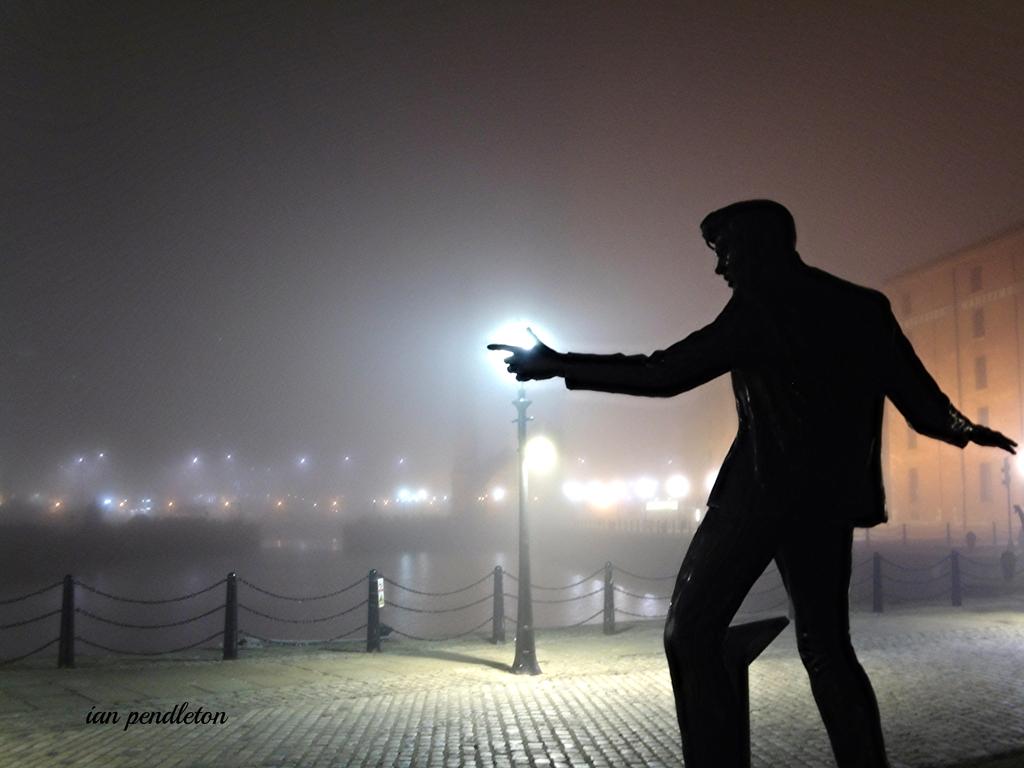
Riding High On Bob Dylan’s Jukebox – Warren Smith!

Now, to be clear your Honour, I can’t say for certain that Bob Dylan has a Jukebox and if he has I can’t be 100% sure which artists it features. But, but, I have to say that there is enough compelling evidence from Bob’s recording and performing history to say with some force that Bob really digs Warren Smith and has spent many an hour listening to the fabulous sides he cut for Sun Records in the late 1950s.

Consider; Bob’s tender tribute recording of Warren’s, ‘Red Cadillac And A Black Moustache’, his (unissued) take on, ‘Rock ‘n’ Roll Ruby’, his regular 1986 tour performances of, ‘Uranium Rock’ and the aforementioned ‘Moustache’, his thanks in the sleeve notes of, ‘Down In The Groove’ to a, ‘Gal shaped just like a Frog’ (surely referencing Warren’s explosive, ‘Miss Froggie’), and, his repeated featuring of Warren on his Theme Time Radio shows and it becomes obvious that Bob in his boyhood Hibbing days, ear pressed to a transistor radio listening to John R and Hoss Allen, was hit hard by Warren and never forgot him.

Taking all that into account I think we can say with some confidence that Bob’s Jukebox, real or imaginary, will definitely be stocked with some Warren Smith 45s! So let’s cue up Warren’s April 1956 debut single for Sun (No 239), ‘Rock ‘n’ Roll Ruby’, a prime slice of Rockabilly that turned many a head beyond Bob’s.

Ruby rock some more indeed! Warren here is backed by the excellently named Snearly Ranch Boys with whom he had been playing at the Cotton Club in West Memphis when spotted by Sun Records supremo Sam Phillips. The song is credited to Johnny Cash (though those in the know say it was actually written by George Jones – presumably in his ‘Thumper’ incarnation). All agree that it cost Warren $40. Money well spent as it went on to be a regional Number 1 record with some 70,000 sold, outselling the debuts of Elvis, Jerry Lee Lewis and Carl Perkins.

Warren’s vocal is propulsively assured and the record bounces along like a well sprung pickup truck with some fine piano from Smokey Joe Bauch and neat guitar fills from Buddy Holobauch on lead and Stan Kessler on the steel.

Warren, then 24, born in 1932, brought up in Louise Mississippi, and a USAF veteran was ecstatic at the success of his first recording (the B side of which has a lovely vocal on the fine pure country, ‘I’d Rather Be Safe Than Sorry’). As a man with plenty of ambition and a very strong ego Warren looked forward confidently to becoming a huge star in emulation of Elvis.

Yet, life has a habit of throwing roadblocks in the way of the broad highway to fame and fortune we so fondly imagine in the days of youth. So it was for Warren. Despite recording some brilliant records, showcased below, the glittering prizes eluded him due to a mixture of the vagaries of fate, his own deficiencies, the limited marketing budget available to Sam Phillips and the appearance of more irresistible forces onto the scene (step forward Jerry Lee Lewis!).

His story, awaiting the screenplay, included a life threatening car crash taking a year out of his career, addiction to pills and booze, a spell in prison and an unexpected late renaissance courtesy of British Rockabilly fanatics before sudden death at the shockingly young age of 47 in January 1980.

Warren’s second outing for Sun (No 250) issued in september 1956 had as its flip side a somewhat strange version of the Child ballad, ‘Black Jack David’ which must be the oldest tune ever recorded on the Sun label. Its inclusion probably signified Sam Phillips trying to court the country market as well the burgeoning Rockabilly/Rock ‘n’ Roll scene.

The A side, in all its 1 minute 58 seconds of glory was the wholly ludicrous, politically incorrect, yet wholly addictive, ‘Ubangi Stomp’ penned by Charles Underwood then a student at Memphis State. I think the cartoon lyric shows that Charles was not studying Anthropology!

Warren’s band now included the excellent Al Hopson on guitar and Marcus Van Story on bass. The record sold some 100,000 copies but alas for Warren not in a rush but in a leisurely fashion over some 18 months.

Warren next recorded at in Sun Studios at 706 Union Avenue in early 1957 and the results were issued in April. The A side, written by fellow Sun artist Roy Orbison, was the thoroughly engaging, ‘So Long I’m Gone’ but it’s the electrifying, nay crazed, B side, ‘Miss Froggie’ featuring stellar incendiary guitar playing by Al Hopson and brilliant, ‘Look out! we ain’t gonna stop for no one’ drumming by Jimmy Lott that will ensure a place in Rock ‘n’ Roll eternity for Warren Smith.

My diligent scientific research over many decades has conclusively proved that it is impossible (and potentially injurious) to try to resist a song that opens with the epochal couplet:

‘Yes, I got a gal, she’s shaped just like a frog
I found her drinking’ muddy water, sleepin’ in a hollow log’

Warren Smith’s singing on this record is utterly magnificent. He generates heart stopping, heart bursting, levels of excitement smoothly increasing the pressure on the accelerator so that you half expect to hear the boom of the sound barrier being broken before the song ends.

I have to confess that in my youth as I prepared for a Saturday night out in London sure to be filled with alcoholic and romantic excess (the former inevitably more often delivered than the latter!) I would always sing repeatedly, as I made my way to the tube station, at the maximum volume I could get away without without being arrested or beaten up:

‘Well it’s Saturday night, I sure am feelin’ blue
Meet me in the bottom, bring me my boots and shoes’

It never failed to lift me up, bringing me energy and untold innocent delight. Thanks Warren.

The record was a substantial regional hit and took Warren to No 72 on the Billboard Hot 100, his highest ever placing there. However, it was, for commercially and culturally compelling reasons, Jerry Lee Lewis’, ‘Whole Lotta Shakin’ Going On’ that monopolised Sam Phillips attention and promotional energies. Head shakingly Warren perhaps then realised that talent, good looks and brilliant recordings don’t always guarantee the brass ring will be yours.

Warren had four more sides issued by Sun including an intriguing cover of Slim Harpo’s swampy R&B classic, ‘Got Love If You Want It’ before he and Sam called it a day in January 1959. Indeed, one of the records Warren will always be remembered for, ‘Red Cadillac and a Black Moustache’ was never even issued by Sun when recorded only seeing the light of day in the early 1970s.

Well that got me croonin’ along and gliding elegantly round my kitchen! I love the unhurried tempo of the song and Warren’s mellifluous vocal which charms me every time. This is another one that’s always playing in my head somewhere. ‘Who you been lovin’ since I been gone’ has to be one of the eternal questions we repeat to ourselves as we replay earlier scenes in the autobiographical movie of our lives.

Warren never made the big time yet he made records that will always live every time they are played. No records sums up the primal attraction of Rockabilly more perfectly for me than, ‘Miss Froggie’. That’s why, whatever’s actually on Bob Dylan’s Jukebox, ‘Miss Froggie’ now proudly takes up its place on The Immortal Jukebox as A12.

I’ve promised myself that one day I’m going to hire a Red Cadillac Convertible and drive down Union Avenue in Memphis, having brushed my moustache (taking cars to dye the strands of grey), with the top down blasting out, ‘Rock ‘n’ Roll Ruby’, ‘Ubangi Stomp’, and ‘Red Cadillac’ before stopping outside 706 where I’m going to get out and dance like I’ve danced before as, ‘Miss Froggie’ plays and I’m going to shout with all the force I can muster – that’s for you Warren!

Notes:

Warren Smith’s Sun Sides can be found on excellent compilations on either the Bear Family or Charly record labels.

Warren also recorded some attractive, quite commercially successful, country sides for Liberty Records in the mid 1960s before his addictions, car crash and prison experience largely sabotaged his career.

Warrens renaissance concerts in London in 1977 were issued on vinyl as, ‘Four R ‘n’ R Legends’. It is cheering to learn how appreciative the London audience was of Warren and how moved he was at their response to him.

Robert Plant, Tom Waits, Del Shannon (and Phil Phillips) dive into The Sea Of Love!

‘The cure for anything is salt water: sweat, tears or the sea.’ (Isak Dinesen)

‘There is one knows not what sweet mystery about this sea, whose gently awful stirrings seem to speak of some hidden soul beneath’ (Herman Melville)

The sea begins at the shore. Standing at its edge we can only marvel at its immensity and otherness. Yet we know that some aspects of ourselves can only be brought to life by deserting the comforting security of the land and the harbour.

You have to put to sea; surrendering to its call, to discover the worlds of wonder which surely lie somewhere beyond the horizon. What’s true for the rolling deep and briny sea is true just as much for that other sea which consumes so much of our waking and dreaming hours – the sea of love.

Come with me now, come with me now and surrender to Phil Phillips and The Twilights original from 1959 and be borne back again to The Sea Of Love.

Phil Phillips wrote the song and sang lead vocals on this classic slice of swamp pop which was a million selling Number 1 R&B hit and Number 2 on the Billboard Hot 100 chart. He was born John Phillip Baptiste in Lake Charles Louisiana in March 1931. His roots lay in gospel music with the family group The Gateway Quartet. It was his barely required love for Verdi Mae Thomas that inspired him to switch to the secular realm and Sea Of Love was the dreamily hypnotic result.

Originally recorded as a demo at a local radio station the song came to the attention of George Khoury a sharp local music mogul with a downtown record shop who had enjoyed some chart success already as a producer and record label owner through the lovely, ‘Mathilda’ by Cookie And The Cupcakes.

Indeed it’s Cookie And The Cupcakes, with Ernest Jacobs prominent on piano, along with the mysteriously unnamed Twilights who back up Phil on the recording made at Eddie Shuler’s Goldband Records Studio.

Despite the phenomenal sales which accrued once the original Khoury label recording was leased to big time Mercury Records Phil always claimed that he only ever earned $6,800 from his song with the rest disappearing into the coffers of George Khoury, Eddie Shuler and Mercury. A sadly familiar tale!

What can never be taken away from Phil is the glory of his song and his performance on the record. Sea Of Love drifts along at a stately, one might almost say somnambulant pace as it carries us along. There’s a quality of eyes closed pre dawn hours reverie about the record that allows it to dive fathoms deep into our unconscious.

I love the hummed opening which speaks as eloquently of the yearning for love as the reticent yet straight from the heart vocal which follows. To my ears the lyric and vocal have more than a tinge of the lyrical and romantic tradition of the french/creole culture Phil grew up in.

The song almost seems like a creole chanson translated into English. Perhaps this gives the song something of its woozy surreal charm. Listening repeatedly to the song I felt adrift in a free floating dream – buoyed up by the depths of the sea with only the cool gaze of the forgiving moon to light my way.

The mysterious allure of the song has attracted many singers, both famous and obscure, keen to steer their own course through The Sea Of Love. The first cover I’ve chosen to feature today is by the erstwhile Charles Weedon Westover who became one of the princes of early 1960s pop under the more familiar name of Del Shannon!

As you will have heard this is a much more rhythmically forceful version befitting its 1982 vintage and the confident swagger of Del’s backing band on the song – none other than Tom Petty And The Heartbreakers.

If Phil Phillips original brings to mind a pirogue calmly meandering through the bayou this version has the thrust of a powerful diesel engined motor boat beating back the deep sea channel waves. There’s an artful use of swirling keyboards in the middle of the song as a nod and wink tribute to Del’s own, never to be forgotten ‘Runaway’.

This version was a top 40 hit, the last of Del’s career (which ended so tragically with his suicide in 1990) and a highlight from the highly recommended, ‘Drop Down And Get Me’ album.

Del Shannon (who will feature more extensively on The Jukebox later) was throughout his life a highly distinctive and affecting singer who seemed in his voice to evoke the aura of someone who had never quite recovered from some awful secret hurt. A hurt that left him so wounded and anxious that any happiness on offer appeared bound to be fleeting if not wholly illusory. It’s a voice that suits the plangent mood of Sea Of Love holding you enthralled as the song unfolds.

Next from 1985 a version showcasing a plethora of Rock music, ‘Big Beasts’ on a retro R&B spree in the form of The Honeydrippers who featured Led Zeppelin alumni Robert Plant and Jimmy Page as well as Jeff Beck and Chic maestro Nile Rodgers. Paul Shaffer, famed for fronting the Letterman Show Houseband, held down the keyboard chair. Together they fashion a knowing homage to their 1950s roots in their swooning take on Sea Of Love which went top 5 on The Billboard Hot 100 chart.

And now as they used to say on, ‘Monty Python’ for something completely different. Here’s a, ‘Toasting’ master from Jamaica, U Roy (Ernest Beckford) with a deliriously enjoyable version rechristened, ‘Do You Remember’ which references both Phil Phillips original and a fine 1970 cover by The Heptones drawing on the production smarts of Joe Gibbs.

You can surely feel the hot Caribbean sun and the sea breezes wafting all about you as the irresistible rhythms take you over while U Roy extemporises with a winning mixture of cheeky humour and romantic ardour. You won’t be able to play this only once!

Follow that! Well, fortunately I’ve kept a take on Sea Of Love to conclude which can hold its own against any competition. This, by the one, the only Tom Waits, was a key element in the 1989 noiresque thriller movie, ‘Sea Of Love’ (starring a resurgent Al Pacino and Ellen Barkin), which was named after and featured Phil Phillips original song.

Tom Waits! there’s no one like him. Tom, here, gives us an intense, emotional, spooky hall of distorted mirrors Sea Of Love that leaves your head spinning and your heart battering threateningly against your ribcage. This is the diving deep, claustrophobic, submarine version which alters your sense of time and space with its strange charm.

Embed from Getty Images

Tom Waits is a true American original who wouldn’t know how to just copy a song. His Sea Of Love is a loving recreation of a classic love song and Tom, having written a few of those himself, does it full justice by doing it entirely his own way,

As Tom showed Phil Phillips songs from the late 1950s still has endless depths to sound. Depths to sound in the always flowing, always churning, Sea Of Love.

Notes:

Phil Phillips career was effectively hamstrung by a lengthy contract with Mercury which he fought hard to escape from. Disillusioned with the record industry and never seeing any significant windfalls from later versions of his classic song he went on to be a well regarded radio DJ in Louisiana.

The always commendable German collectors label Bear Family has issue a compilation, inevitably titled Sea Of Love, which with excellent sound collects all the highlights of Phil’s career. Well worth a listen for more examples of his haunting vocal style.

Phil was quite properly inducted in 2007 into the Louisiana Music Hall Of Fame.

Addendum – Since writing this post I’ve discovered this wonderful clip of Phil singing his classic song at The Louisiana hall Of Fame – prepare to feel your eyes moisten!

Steve Winwood – Teenage Titan! … Keep on Running, Gimme Some Lovin’

‘ I think a lot of people came into rock ‘n’ roll to try to change the world. I came into rock ‘n’ roll to make music’ (Steve Winwood)

‘ Spencer Davis Group: Of all the bands I saw in those days, they impressed me the most. They had this small public address system and were very unassuming on stage, and then this spotty kid on the organ (Steve Winwood) suddenly opens his mouth and screamed, ‘I LOVE THE WAY SHE WALKS …’ and launched into a John Lee Hooker number. My mouth fell open and I felt a chill down my spine!’ (Noddy Holder lead singer of Slade)

Embed from Getty Images

Sometimes the Muses are very generous, even profligate, with their gifts. Sometimes they decide not to bestow slow maturing potential but instead choose to invest the golden one with overflowing talent in the rosy days of youth.

Think of Boris Becker fearlessly winning the greatest title in Tennis, Wimbledon, at 17. Read Mary Shelley’s, ‘Frankenstein’ and marvel that it was written by a teenager or wonder how Rimbaud could, comet-like, appear as a fully fledged poetic genius with, ‘Le Bateau Ivre’ aged only 16!

Today’s The Immortal Jukebox features one of the great figures in popular music, Steve Winwood, a musician, songwriter and singer of prodigious accomplishment who, when yet a boy in Birmingham, as a member of The Spencer Davis Group announced to the world in a series of thrilling recordings that a teenaged white youth, only recently an angelic Church of England chorister, could, astonishingly; play, sing, shout and scream Blues, Rhythm & Blues and Soul music with the power and authority of a veteran from Memphis or Chicago.

Listen to Steve Winwood here, at 17, raising the roof and the hairs on the back of the neck with his vocal and driving keyboards as along with brother Muff on bass, Spencer Davis on guitar and Pete York on drums, he takes Jamaican Jackie Edwards lovely summer splashed, sashaying, ‘Keep On Running’ and turbo charges it to suit the throbbing clubs and the mean industrial streets of his native Birmingham.

http://www.youtube.com/watch?v=kamXvqoL_JA

No surprise that this fantastically vibrant rave up, released in November 1965 became a Number 1 record on the British charts.

If I was directing a documentary about the club scene in mid 60s Britain I would insist on having Steve Winwood’s exuberantly brilliant vocals blasting out at maximum volume as the camera lovingly took in the boiling energy and the wonderful, ‘you’re not going out dressed like that!’ fashions sported by the young men and women having the time of their lives grooving on the dance floor.

Very few records shout, ‘Its the 1960s and a brave, beautiful new world!’ as clearly as those made by The Spencer Davis Group in their 65/67 heyday.

Steve Winwood was fortunate that his brother, christened Mervyn but nicknamed Muff, was five years his senior. It meant that as a musically omnivorous youngster he got to hear Fats Domino, Little Richard, Buddy Holly and Charles Mingus courtesy of tape recordings made from Radio Luxembourg and Voice of America ( the same ones Van Morrison was listening to over the Irish Sea in Belfast!).

Muff, no mean musician himself, realising that his baby brother had really extraordinary talent, particularly as a piano player, called up the 11 year old Steve (wearing long trousers too big for him) when he joined a trad jazz band.

At first sight of the skinny kid fellow musos laughed but their laughter turned to wonder as soon as they realised the younger Winwood’s prowess as a player and his astonishing facility to hear a number once and be instantly able to play it with complete confidence and conviction.

As he became a teenager Steve’s pure choir boy soprano voice inevitably broke and miraculously metamorphosed into a glorious husky tenor ideally suited to emulation of the singer he had just discovered and whom he would idolise – the High Priest himself, Ray Charles.

Steve and Muff formed The Muff Woody Jazz band which with with the addition of Spencer Davis became The Rhythm and Blues Quartette with a residency at the Golden Eagle pub in Birmingham by 1963.

They played with fiery intensity a mélange of blues, and jazzy R&B that soon won a fanatical following around their Midlands stomping grounds.

A key development in late ‘ 63 was Steve’s enraptured discovery of the endless musical landscapes that could be opened up by the Hammond B3 organ. It was the sight and sound of the impossibly youthful Steve imperiously playing the B3 before launching into, ‘Ray Charles on helium’ vocals that persuaded Chris Blackwell, the musically and commercially alert founder of Island Records that this was a band who could take his fledgling music mogul career beyond its beginnings in the Jamaican community into the cash rich world of the mainstream record buying public.

And so, the Spencer Davis Group launched what would turn out to be a highly successful career.

The success of, ‘Keep On Running’ proved the point! And, a March 1966 second number 1 again written by Jackie Edwards – the slow burning, rolling on a river, ‘Somebody Help Me’ showed it was no fluke.

But Steve was more than a superb interpreter of other writers material he was also a natural composer with a marked ability to invest a song with rhythmic drive and attractive melodies.

In mid 1966 Steve, collaborating with Muff and Spencer Davis as they jammed, at one of their Marquee club rehearsals, around a riff from Homer Banks’ ‘Whole Lott Lovin’, came up with a delirious vocal and organ part to drive one of the most exciting records ever made, ‘Gimme Some Lovin’. You want to start a party? Play this loud and watch the sparks fly!

This was the record that first properly let America know that there was a new kid on the block with talent to burn – a top 10 hit as was the follow up, the relentless whippin’ up a storm, ‘I’m a Man’

Steve Winwood by the time, ‘I’m a Man’ came out in January 1967 was already restless and keen to explore the more expansive musical territory he had glimpsed through his encounters with the musicians he would go onto found Traffic with. With Traffic and in his later, still happily current, solo career he would show over and over again that he had taken proper care of his plentiful natural talent to produce songs and records that positively glow with musical grace. But, that’s a story for another day.

Today, I’m celebrating the dazzling achievements of the teenage Steve with The Spencer Davis Group. This was the time when Steve astonished all who heard him with a soul filled voice that had power, tenderness and flexibility to spare. A voice which commanded and held your attention as he took songs and lit them up – projecting them deep into your heart.

At the same time his piano and organ playing showcased a deep instinctive musicality that could by turns be stately, impassioned, riotously rowdy or even drowsily melancholic according to the demands of the song being played.

I’ll leave you with Steve, at 18, 18! channeling Ray Charles with a breathtaking cover of, ‘Georgia On My Mind’.

It shouldn’t have been possible for one so young to hold himself up against one of the very greatest figures in modern music but incredibly Steve succeeds and puts himself in the company of the musical elect.

Somehow, through some mysterious alchemy and inner fire he was able to have an incarnate grasp of the essence of music so that no challenge was seemingly beyond him.

Notes:

My recommended Spencer Davis Group compilation is ‘the 2 disc ‘Eight Gigs A Week – the Steve Winwood Years’ on Universal/Island which will provide endless delights for anyone taken with Steve’s awesome talents.

Jackie Edwards:

Jackie who died in 1992 was a very fine singer and songwriter whose work was both languorously sexy, humorous and effortlessly charming. One listen to a classic from the early 1960s like, ‘Tell Me Darling’ should have you seeking out one of one of his hits collections.

Before The Beatles – Billy Fury! (Wondrous Place)

British Beat – Some Other Guys 2

John Lennon, with characteristic force, once famously observed that before Elvis there was nothing.

When you consider the lamentable history of Rock ‘n’ Roll in Britain in the years preceding the advent of The Beatles it’s hard not to agree with my friend Barclay Butler who once regaled me, over several pints of beer, with a Shakespeare parody proclaiming that, ‘Before The Beatles, in this Sceptred Isle, this other Eden, this demi-paradise, this precious stone set in the silver sea – there was nothing, nowt, nada, Zilch!’

Now, I like a sweeping generalisation as much as the next man but as an old grey-beard I’ve also learned that the rule tends to be proved by the inevitable exception.

So I feel it incumbent on me to say that Lonnie Donegan, the founder of Skiffle music in Britain, really did strum the first immortal chords of Rock ‘n’ Roll in the United Kingdom.

In addition,in the the process of recording fine records such as, ‘Rock Island Line’, ‘Grand Coulee Dam’ and, ‘Cumberland Gap’ he inspired every superstar British rocker who followed, from Paul McCartney to Mark Knopfler, to launch their careers in music.

There are also two other pre Beatles records, both featuring wonderful lead playing by disgracefully under appreciated guitarist Joe Moretti, which would fully merit their place on any roadhouse jukebox.

I urge you to spare some of your precious time to listen to 1959s magnificently kinetic, ‘Brand New Cadillac’ by the enigmatic Vince Taylor (the supposed model for David Bowie’s immortal creation Ziggy Stardust) and the thrillingly evocative film noir swagger and strut of, ‘Shakin’ All Over’ by Johnny Kidd and The Pirates from 1960.

As is the way of things most people who know, ‘Cadillac’ know it from the properly rowdy cover by The Clash while, ‘Shakin’ found wide fame through inferior versions by, ‘Guess Who’ in North America and Normie Rowe in Australia. Sometimes the originals really are the best!

Everyone knows that The Beatles were from Liverpool and it was also from that great city on The Mersey that Billy Fury, Britain’s only remotely credible pre Fab Four rocker, hailed.

He now has a permanent memorial there through a proud statue which adorns the Albert Dock – an appropriate location for a man who spent two years working as a deck hand on a Mersey tug boat The Formby.

Embed from Getty Images

*

Billy as you can see from the image above was moodily handsome in the vein of James Dean, Chet Baker and Elvis.

He also sported a mighty quiff and looked dynamite in neon coloured jackets!

Moreover, in contrast to almost all his pre Beatles contemporaries, he had a sense of the creative energy and spontaneity at the heart of the revolutionary music sweeping all over the world from the American South.

Billy, like millions of us, had his head, his heart and his soul set aswirl by the epoch shattering sounds of Elvis, Jerry Lee Lewis, Chuck Berry and Little Richard. He also had affection for the folk art masterpieces produced by the Orpheus of Alabama, Hank Williams.

Perhaps it was Billy’s childhood experience of rheumatic fever resulting in a permanently damaged heart that gave him his fatalistic sense that he would die young, his aura of diffident vulnerability and a wounded charisma that was particularly attractive to his female fans.

His career proper began in 1958 in, ‘You wouldn’t dare make it up’ circumstances. Eighteen year old Billy attended a Birkenhead, Liverpool rock/pop revue concert featuring a series of artists promoted by the Svengali like show business manager Larry Parnes.

Hearing the self penned songs Billy (then known as Ronald Wycherley!) was pitching to Marty Wilde and instantly recognising his marketability Parnes pushed the trembling Billy onto the stage and by the next morning Ronald Wycherley was rechristened Billy Fury and off on the road in the tour bus!

Girls liked Billy’s looks and his sometimes shy, sometimes shameless, performing manner while the male members of the audience had to admit that he really could rock out when he wanted to.

Both sides of the Fury persona were featured on the 10 song album, ‘The Sound Of Fury’ with every song written by Billy, that he recorded in a single day in April 1960. The, ‘not too far from Sun Studio’ lead rockabilly guitar was provided by Joe Brown and the solid drums by Alan White.

The whole album is over in half an hour yet it had then and still now retains the visceral impact of true Rock ‘n’ Roll.

Listen here to Billy bring some heat and style into the grey 1950s London with his own, ‘Turn My Back On You’

Now, hear his heart stilling, heart breaking, blood on the tracks ballad, ‘You Don’t Know’

Billy on record at least never really approached the kind of ecstatic abandon Elvis and Jerry Lee reached (who ever has?) but uniquely for Britain at the time he embodied an affecting personal engagement with his material and vocals that I still find admirable and moving.

His recurring poor health, lack of driving ambition and the erratic tides of popular taste left his career as a Rock ‘n’ Roll star effectively marooned once the Beatles led beat boom hit its stride in the mid 60s .

Yet amazingly, it turns out he had as many 60s hits (24) in Britain as his fellow Liverpudlians though their sales both in Britain and worldwide would, of course, have dwarfed his.

Though he continued to write and record and always had a core of life long devotees he became one of those, ‘Whatever happened to’ figures so plentifully present in music history.

Billy, whose health was never robust, finally succumbed to his heart problems and died in 1982 aged only 42.

Looking back, few who listen carefully will ever forget his look and his alluring voice.

There is a poignancy about him that clutches at the heart.

To my mind Billy’s ability to inhabit a mysteriously powerful vulnerability reached its zenith with a record that haunted Billy (he recorded it three times) and will surely haunt you too – ‘Wondrous Place’.

This is one of those songs where you feel like you are eavesdropping, in an unsettling yet addictive way, to a very intimate psychic drama.

Billy seems to be singing to himself as he walks alone in the pre dawn early morning hours down some lonesome moonlit road; perhaps some Merseyside dockland version of Hank Williams’ lost highway.

There is a sleepy reverie suggested by the slow river drifting tempo and the heartbeat percussion. Billy’s lovely humming breaks and artful hesitations combined with his tender, airy vocal seems that of a man trying, not entirely successfully, to persuade himself that the wondrous place he hymns is his to revisit when he wills.

There is more of the wistful goodbye to love lost in this performance than a celebration of a continuing relationship.

‘Wondrous Place’ lasts less than two and a half minutes but as you listen you feel it lasts a much longer time.

Somehow it makes you aware of all the individual breaths of life that fill all the seconds, all the minutes of all the days and nights you have left to you.

And, perhaps all of us carry memories; recalled on moonlit walks or quiet moments snatched from the hourly burly of everyday life of a wondrous place that we can never quite recapture though we can revisit it in the echoing halls of our imaginations – especially when a singer like Billy Fury shows us the way.

Canned Heat – Going up The Country and Working Together!

The subject of today’s post on The Immortal Jukebox, Canned Heat, have had many, many incarnations since the first proto form of the band emerged from Topanga Canyon, Los Angeles in 1965. By my reckoning they have had almost 40 different line ups featuring more than 50 musicians and issued dozens of recordings in a career that still continues to this day.

If you are in the area you can see them play at the Southside Shuffle in Port Credit, Ontario, Canada tomorrow night (September12). No doubt a fine time will be had by all.

I have neither the space or the inclination to provide a comprehensive history of their overall career here. Instead, I’m going to concentrate on what I consider to be their golden period, 1967 to 1970, when they released a series of superb records which managed to be both classic blues performances and, Lord be praised! world wide hits.

The sides featured here, ‘On The Road Again’, ‘Going Up The Country’ and, ‘Let’s Work Together’ are respectfully rooted in the blues tradition yet have nothing of the musty museum about them. Rather, they are enchanting recordings which sizzle with optimistic life.

They were created by an outstanding group of musicians whom I will always regards as the definitive Canned Heat line up. They comprised; Bob ‘The Bear’ Hite on vocals, Alan ‘Blind Owl’ Wilson on harmonica, guitar and vocals, Henry ‘Sunflower’ Vestine on guitar, Larry ‘The Mole’ Taylor on bass and, Adolfo ‘Fito’ de la Parra on the drums.

It was the above configuration that recorded the glorious, ‘On The Road Again’ at Liberty Studios in September 1967 for the album, ‘Boogie With Canned Heat’ issued in January 1968 with the edited single version following in late April. I’m featuring the album version here.

I can’t resist saying – isn’t that just hypnotic! The slightly eerie introduction, seeming to evoke the, ‘entre chiens et loups’ fading light of the Mississippi evening, signals that the journey we are about to embark on will take us, on the blue highways, to the strangely familiar yet mysteriously alluring world inhabited by the southern bluesmen.

A world where the endless road, battered as it is by the rain and the snow, offers the only comfort available to a man abandoned to his fate by his dead mother and his erstwhile lover. Now he has no special friend just the relentless road ahead.

Clearly, Al Wilson drew heavily from Tommy Johnson’s, ‘Big Road Blues’ from 1928 and Floyd Jones’, ‘Dark Road’ and, ‘On The Road Again’ from 1951 and 1953 to fashion the Canned Heat recording. However, the triumph here is to have so thoroughly absorbed those recordings and influences that his own treatment goes way beyond homage to become a thrilling new creation that is guaranteed to haunt you.

Canned Heat and Wilson in particular were devotees of the one chord E/G/A droning blues form quintessentially represented on record by the great John Lee Hooker. The Canned Heat rhythm section lock in and drive the song forward while Al Wilson works wonders with his spectral hoot owl harmonica and his ghostly high pitched vocals (owing much to his devotion to Skip James). Add in the colour of the exotic Tambura and you have a record that makes its own imaginative weather.

Al Wilson was I believe the soul of Canned Heat and a very remarkable person. He was a highly intelligent and devout scholar of the blues who had listened and thought deeply about what made it special and how it should be played. He aded an intensity of focus and concentration (owing something perhaps to a personality that was somewhere on the autistic spectrum) which allowed him to make spectacular progress as a singer and instrumentalist from teenage neophyte to a genuine master by his early 20s.

Embed from Getty Images

It says something about his marrow deep love and understanding of the blues that it was Al who coaxed the rediscovered Son House to remember how his great pre war recordings should sound and be played.

John Lee Hooker wondered how this skinny white kid from Arlington Massachusetts with the baby face, who could barely see, had developed an ear and a heart for the blues so sympathetically attuned to his own way of playing. Al’s contributions to House’s, ‘Father Of The Delta Blues’ (1965) and, ‘Hooker and Heat’ from 1971 are marvels of empathetic accompaniment.

He was a distinctive singer, fine rhythm guitarist, virtuoso harmonica player and a gifted song arranger. Al Wilson’s death in September 1970 (in circumstances involving barbiturates which will never be fully understood) at the tender age of 27 was an immeasurable loss to music.

Listen to him here displaying all the above qualities on the sunlit, ‘you can’t play it only once’ Woodstock era anthem, ‘Going Up The Country’.

The root of this song lies in, ‘Bull Doze Blues’ (1928) by the almost mythical Texan bluesman/songster Henry Thomas. Al Wilson and Canned Heat catch Thomas’ mixture of sturdy danceability and decorative detail. Thomas often used the quills or panpipes to showcase surprisingly delicate melodies. In the Canned Heat version Jim Horn plays the delightful flute parts.

Many will remember this song being used in the movie of the Woodstock Festival and it has since been used countless times in feature films and adverts seeking to call up nostalgia for the bucolic hippy dreams of the late 60s.

Al Wilson was an early member of the conservation movement and the song perhaps reflects both his love of the redwood forests and his disquiet with the lack of respect paid to the nation’s environmental heritage. The song has sunlight but shadows too (the shadows are more prominent in his song, ‘Poor Moon’).

Henry Vestine’s plays subtly brilliant guitar throughout the track. Vestine (who died in 1997) was a superb lead player who, encouraged by his physicist father, had built up a staggering voluminous collection of blues and other roots music recordings during his teenage years in Takoma Park, Maryland. It was there that he formed a boyhood friendship with another legendary figure in American Music – John Fahey.

Through Fahey and a move to the West Coast he met Al Wilson and Bob Hite (a fellow record collector of heroic proportions – in fact Bob Hite did everything to heroic proportions up to and including his drug intake resulting in his untimely 1981 death). With the addition of supple bassist Larry Taylor (whose credits in addition to Canned Heat include work with the original Monkees, John Mayall and Tom Waits) and endlessly energetic drummer Adolfo de la Parra the classic line up was complete.

But,stormy relations between Henry Vestine and Larry Taylor led to the former’s precipitate departure before the recording of their 4th album. They found a very able replacement for Henry in Harvey Mandel.

It is with Mandel on guitar that Canned heat recorded a massive world wide hit with their stupendous pile driving take on Wilbert Harrison’s, ‘Let’s Work Together’. There’s no point thinking you can sit in your chair while this one plays: like Bob Hite says – ‘Aw come on!’

This is a record that takes no prisoners. The Bear grittily bears down on every word as Harvey Mandel, with Al Wilson and the rhythm section shadowing and supporting him, wails and wails on lead guitar.

This record came out when I was 15 years old and something of a studious cove – but I can tell you I did some mighty, mighty, head banging and air guitar pyrotechnics to this one as I tested out the patience of my parents and neighbours as I pushed my amplifier and speakers to their absolute limits.

Canned Heat have often, not without some merit given their post 1970 career, been caricatured as one more routine boogie band. But, for those few years as the 1960s ended they were one hell of a band who played the blues with respect, good spirit and no little style. They should have an honoured place on every downtown jukebox.

Notes:

The best Canned Heat collections I am aware of are the extensive ‘Uncanned’ for those who really get with the groove and, ‘Let’s Work Together’ for those who prefer to cut to the chase.

Henry Thomas – the magnificent collection, ‘Texas Worried Blues’ on the Yazoo label would be one of the very few records I would run into a fire to save!

Though Floyd Jones lacked the drive of many of his blues contemporaries he was a smart and serious songwriter and an interesting performer. See the Classics set, ‘Floyd Jones 1948-1953’.

Little Walter – Blues Giant – Harmonica Genius!

‘You gotta say Little  Walter invented the blues harmonica .. No one had that sound before him. No one could make the thing cry like a baby and moan like a woman.

No one could put pain into the harp and have it come out so pretty. No one understood that the harmonica – just as much as a trumpet, a trombone or a saxophone – could have have a sound that would drop you in your tracks!’. (Buddy Guy)

Embed from Getty Images

Some people have just got it. And, by it, I mean IT – the mojo that definitively separates the great from the very good and the merely good.

From the sidelines or from the stalls we can often recognise, without expert knowledge ourselves, some invisible aura that marks out the special one, the summiteer, from those still scrambling up Mount Parnuss’ lesser slopes.

It’s not necessary to have been a Major League Baseball player to have recognised, on first sight, that Ted Williams was a great hitter or that Sandy Koufax was the pitcher you’d want pitching for you if your life was at stake.

Intensive years of conservatoire schooling are not needed to know, for certain, that Maria Callas had a gift for dramatic singing that is beyond compare or that Glenn Gould as he hunched over the keyboard and played Bach’s divine music was some kind of angel himself.

Anyone, after watching even one round of Muhammad Ali boxing in his peerless prime would in head shaking wonder have had to exclaim, ‘There’s never been anyone like him!’.

Little Walter (Jacobs) a bluesman and instrumentalist of undoubted genius and the subject of today’s Immortal Jukebox post is assuredly one of that elect company.

With the certainty that advancing age brings, I confidently declare that there never will be a harmonica player to equal, let alone out do, Little Walter for drive, flair, command, show-stopping technical skill and outrageously imaginative musical daring.

Listen to the brilliance of his playing on, ‘Juke’ his first solo 45 from 1952, recorded with his colleagues in Chicago blues finest ever outfit – The Muddy Waters band.

I believe the proper expression after bearing that is, ‘Lord, Have Mercy!’.

This is Little Walter stepping up the stage, front and centre, to announce to his fellow musicians and the wider world that he was the new royal ruler of the blues harmonica.

Sure, on his way up he had been influenced by the two blues harpists named Sonny Boy Williamson and Big Walter Horton. He had arrived in Chicago as WW2 ended by way of his birthplace, Marksville Louisiana, New Orleans, Helena Arkansas, Memphis and St Louis – all the while soaking up music and developing his awesome technique.

It is clear that he had also been listening intently to thrusting saxophonists like Big Jay McNeely in addition to harp masters. But, then Walter took everything he had learned and at the warp speed of his imagination, moved into interstellar overdrive, taking the humble harmonica into uncharted territory. The territory all subsequent blues harmonica players live in.

Juke, recorded at the end of a Muddy Waters session for Chess subsidiary, Checker Records, became an enormous hit. It was biggest seller the label had up to that point and the first (and still only) harmonica led instrumental to top the R&B charts.

Walter and the commercially savvy Chess Brothers realised that while Walter should remain an essential part of the Muddy Waters sound he now needed to have his own band, The Jukes, for recording and touring purposes.

Walter was obviously the star of the show but he was fortunate to have such alert and sympathetic sidemen as guitarists, Louis and David Myers and drummer Fred Below.

Together in the period 1952 to 1958 they had 14 top ten R&B chart successes – records that are rightly regarded as blues classics. The general pattern was for each 45 to feature an instrumental allowing Walter to swoop and soar wherever his seemingly unlimited imagination took him coupled with a tough, street wise vocal side.

Walter was not a great singer but he could give a lyric a dramatic authority that lodged a song deep into your memory. It’s hard to believe that any set of sides were ever more perfectly engineered to blast out of South Side Chicago Jukeboxes!

On, ‘the threatening ‘You Better Watch Yourself’ below his harmonica doubles as a switchblade slicing the air powered by intoxicant fouled male bravado. Or perhaps that should be doubles as a, ‘Saturday Night Special’ handgun waved to all and sundry in the joint as a signal – a declaration, that, ‘look out brothers and sisters! I’m a mean, mean dude and you had best not get in my way or mess with MY woman’.

More evidence here of Walter’s ability not simply to plug in to use the power of electricity to add volume to his harmonica but his understanding that testing the limits of the amplifiers could produce feedback and other distorting effects which he could harness to produce ever more individual and wondrous sounds.

There was something of the sorcerer about Walter – casting mysterious musical spells from a book unreadable to all but him.

Walter was a genius. He was also mean, moody and unreliable though he could be charming when he wanted to. Easily slighted, especially when drunk (and he was rarely without a bottle to hand) he was always one step, one sideways look, away from a fight.

His hungry indulgence in booze and drugs inevitably wore down his body and though his talent was immense it could not survive in its true glory beyond the late 1950s given the sustained onslaught of self abuse he visited upon it.

But when he was in his prime there was no one in Chicago or the whole wide world to touch him!

Walter, certain in his mastery of his instrument could play at the fastest tempos to whip an audience into a frenzy. But, like all the great musicians, he could exercise a mesmeric hold on his listeners playing at very slow tempo.

Listen to him on, ‘Quarter To Twelve’ sounding like some orchestral nocturnal spectre briefly visiting this material world to pass on some vital message.

http://www.youtube.com/watch?v=xgqVO8QM2f4

I hear many things in the harmonica sounds of Little Walter.

I hear the cry and moan Buddy Guy heard. I also hear air renting sobs of pain, sly seduction, bitter rage – sometimes suppressed sometimes inescapably aimed right between our eyes and ears.

I hear terror and exultation, anxiety and ambition, lust, longing, and oceans of loss. Oceans of loss. I hear a proud and angry grown man and a bewildered, bereft child.

I hear all the swirling sea of human emotions we are heir to drawn from the very air and brought to shining dramatic life through Walter’s miraculous sound.

A last treat – here he is, courtesy of the pen of blues godfather WIllie Dixon, with what has become a blues standard, ‘My Babe’.

What a huge sound! No fooling, this is Chicago blues at its best – this is the stuff of life.

Goodnight Walter. May your story be heard and your tears dried. You gave us treasure from your magnificent gifts.

Notes

The Chess catalogue has zig zagged through many incarnations for reissue purposes with complications appearing and disappearing with frustrating frequency.

The compilation I listen to most is the Chess 50th Anniversary Collection. You could also investigate the sets from the Proper and Jasmine labels.

A record not to miss is, ‘The Blues World of Little Walter’ on blues specialist label Delmark. This is a quartet outing with Muddy Waters, Jimmy Rogers and Leroy Foster. Their 1950 version of ‘Rollin’ and Tumblin” will send shivers through your whole being.

Little Eva – Making You Happy when You’re Feeling Blue!

Featuring : The Locomotion, Keep Your Hands off My Baby, Swinging on a Star.

Belhaven is a small, poor town in North Carolina. It was there that David and Laura Boyd struggled to raise their large family which would eventually, by the mid 1940s, include thirteen children.

From the point of view of music history it’s fortunate they didn’t stop at nine children because Number 10, born in late June 1943, was a girl whom they named Eva Narcissus Boyd who later came to be known on pop charts all around the world as, ‘Little Eva’.

Embed from Getty Images

*
Under that soubriquet in 1962 and 1963 she would record a glorious series of life affirming pop records – one of which, ‘The Locomotion’ is indelibly imprinted on the memory of anyone who has ever heard it (though the steps to the dance may remain a little hazy for most of us!).

I defy anyone not to light up a smile as this record speeds along propelled by Carole King’s driving piano and spurred by Art Kaplan’s insistent sax.

On top Eva sings her heart out winning our affections with the unbridled enthusiasm, the sheer pizazz, with which she lives out the song.

Pretty soon everyone was doing a brand new dance and Eva by August 1962 was looking down on the world from the fabled Number One spot on the charts!

In Belhaven Eva had soaked up all the enormous music available on the radio and honed her singing chops with a family Gospel group, ‘The Boyd Five’.

Eva was naturally ebullient and it was inevitable that she would feel as she grew up that Belhaven was not the place to get ahead and forge your dreams into reality. Of course, she was inevitably drawn to the great magnet city on the Hudson, New York, which continually called out to all who wanted to make a new life – come on up! If you can make it here you can make it anywhere!

So, having had a taster of life there in 1959 staying with her brother Jimmy as 1960 dawned Eva boarded the bus out of town to try her luck in the Big Apple. Initially she got a job as a maid on Long Island. Brother Jimmy’s wife was friends with Earl-Jean McCrea who sang with established vocal group The Cookies who had backed up many prominent artists on the Atlantic label including the King of them all – Ray Charles.

Earl-Jean copping that Eva could really sing asked her to try out for a vacant position in The Cookies in 1961.

Her successful audition piece had been one of the greatest ever yearning love songs, ‘Will You Still Love Me Tomorrow’ written by the immortal songwriting team of Carole King and Gerry Goffin.

Carole and Gerry with inspiration at full flood and publishers beating down their door for the next big hit decided that it was essential to employ a nanny for baby Louise to free them up to attend, full time, to their muse (especially as another child was on the way!).

So in short order Eva became a member of the Cookies and a live in nanny in Sheepshead Bay Brooklyn. Eva could also on hand to demo some of the songs pouring out of the Goffin/King hit machine.

Eva is heard for the first time on record on a Ben E King session adding punch to, ‘Gloria, Gloria’ and the marvellous, ‘Don’t Play That Song (You Lied)’.

Around that time street wise Publisher Don Kirshner asked/demanded Gerry and Carole to come up with a smash hit dance song in the vein of, ‘Mashed Potato Time’ which had been a number 2 record for Dee Dee Sharp in May 1962. Don wanted the new Goffin/King composition to be Dee Dee’s follow up to Mashed Potato.

But, canny operator that he was, when he heard the demo of Locomotion by Little Eva he was certain he had a major hit on his hands and if he set up his own label (Dimension) to issue the record he would really accumulate the greenbacks!

In fact the demo was so good, so infectiously captivating, that a big time studio re-recording could not match it’s magic and the issued version was thus simply the demo with some added vocals from Eva and Carole.

Eva was now a long way from Belhaven – appearing on the premier pop TV show of the day, ‘American Bandstand’ and settling into a whirlwind schedule of demos for Goffin/King, recordings with The Cookies and her own solo career – it would be the time of her life. With The Cookies she can be heard on another certified Goffin/King pop classic, ‘Chains’ from November 1962.

In Liverpool The Beatles, aficionados of the Girl Group sound, listened intently and, ‘Chains’ sung by George Harrison, would feature on the lads debut LP (though I have to say their version does not have the overwhelming vitality of The Cookies version).

The Beatles also heard, liked and performed live, Eva’s follow up to Locomotion, ‘Keep Your Hands Off My Baby’


There’s nothing of the novelty song about that one!

This is a tough girl group song which gives Eva the chance to show what a fine fluent singer she could be and how she could effectively vary the volume and tone of her singing to convey the emotion of the song.

Like many of the girl group songs it’s a song nominally about a boy but really about the complex web of relationships between girls.

Keep Your Hands was a number 12 hit but alas, effectively the last solo hit Eva would have (though she recorded some other fine sides).

This can, at least in part, be ascribed to the demands on Goffin/King to write and reserve their best songs for more big name artists and the lack of a savvy manager figure to look out for Eva’s interests (there’s the almost inevitable murky story of how little money she made from her days in the pop limelight).

But, there would be one last hurrah, and a mighty one at that, for Eva on record and in the charts in the essential (though mysteriously uncredited!) contribution she made to one of the most charming records of the early 60s, ‘Swinging On A Star’ by Big Dee Irwin.

Now, if that doesn’t give an enormous boost to your happiness index I have to say you must be seriously depressed!

The record overflows with wit and sheer love of life with Eva providing the joyously sassy vitality of youth. You can hear the vocal chemistry and warmth of the relationship between Big Dee and Eva in their relaxed banter that makes the song such a pleasure to listen to (the flip, ‘Just A Little Girl’ is excellent too).

And as 1963 closed so did Eva’s career as a hitmaker though she kept recording through to 1971 when she determined to return home to North Carolina following the death of her mother. Eva had a troubled marriage with James Harris which reportedly involved extensive domestic violence (they were later reconciled).

When she returned home her purse was virtually empty despite her hits and she had three young children to care for. Taking whatever work was available she showed she was made of stern stuff and settled down to the obscure life she had left behind for those dizzying few years of the early 1960s.

Though Locomotion was a re-released hit in the UK and a Number One US hit for the second time through Grand Funk Railroad (!) Eva saw no boost to her bank balance.

Strangely it was the bland Kylie Minogue version from 1988 which opened the door for Eva to be seen and heard again. She appeared on retro, ‘Golden Oldies’ shows, recorded some gospel material and toured with pop contemporaries like Bobby Vee and Brian Hyland.

Eva died in April 2003 from cervical cancer.

For many years her grave in the Black Bottom Cemetery was marked by nothing but a tin marker. However, through the good offices of the town of Belhaven and monumental mason Quincy Edgerton a fitting headstone featuring a speeding locomotive now rests atop her final resting place.

It is no small thing, as Eva did, to have made records which will always evoke the joy of youth and the glorious gift of life.

There are times when we all need a song which will make us happy even when we are feeling blue.

Thank you Eva – may you rest in peace.

Notes:

In addition to the songs mentioned above I suggest you give a listen to the following attractive performances by Eva:

‘The Trouble With Boys’

‘What I Gotta Do (To Make You Jealous)

‘Takin’ Back What I Said’

Rod Stewart & The Faces Live – Twisting The Night Away : A Magnificent Racket!

Most of the posts published here on The Jukebox are (as I hope you will have judged) the result of contemplation, decades of listening history, careful planning and rigorous research. Not this one!

No, today’s post was generated through the mysteries of the algorithms that produce, ‘random’ selections on my Brennan JB7 music system. So, from the very instant that the first notes of, ‘Twisting The Night Away’ by Rod Stewart and The Faces exploded into my consciousness it was clear to me that any plans made for today’s post were null and void!

And, after I had hit the repeat button seven or eight times in a row and reached a state of exhausted elation having danced myself into a virtual stupor I was willing – if not wholly ready and able to write.

So, ‘My Lords, Ladies and Gentlemen’ for your pleasure and delight let me transport you back to London in the Summer of 1973 so that you too can joyfully release your inner dolphins (so much better as a phrase for explaining the appearance of abandoned glee than the bare, ‘endorphins’ the physicians and chemists would have me use).

Dr Thom’s Jukebox prescription is that you now turn all your dials up way into the red zone and press play now! Repeat as necessary

In the early 1970s furious intoxicant fuelled arguments raged in bars all over the world when one of the company would muse – ‘Who would you say is the greatest live Rock ‘n’ Roll band in the whole wide world?’

The general view was that the crown was the property of The Rolling Stones but strong counter arguments were made for Led Zeppelin or The Who and some, with a more global perspective, would advance the case for Bob Marley and The Wailers.

Listening sagely, as is my wont, I would agree that the above bands were very fine outfits indeed but then with a glint in my eye, I would add that if I could conjure up one group to appear in a puff of dry ice before our very eyes and play their show right here, right now, none of the previously mentioned could be guaranteed to deliver the righteously raucous; let’s turn this place into the best party you’ve ever had or die in the attempt, good time that Rod Stewart and The Faces were sure to give us.

If I had added top up Tequila to my staple pints of Guinness I would clinch the argument (at least in my mind) by extravagantly miming Rod’s microphone stand gymnastics before adding – which of the other bands could really thrill you one minute, then bring a tear to your eye before making you laugh with sheer uproarious delight the next, like they could?

Now I know that this was a band whose brilliance was a matter of fits and starts dependent on their mood on the night and whether they were liquored up just enough to play freely or so overloaded that they could barely stand up.

But, but, on a good night, and there were scores and scores of those, they made a bloody, bluesy, madly magnificent racket that could lift your spirits in a way no other outfit has ever matched.

Yes, It is true to say that as instrumentalists they weren’t exactly virtuosos but there are times when I don’t want my music to be like a sip of smooth bourbon. I want it to be like a shot of illegally distilled Moonshine, from back in the hills, which you half fear will send you stone blind as you take another hit because it just tastes so damn fine. That’s the kind of music they made.

The Faces – Rod Stewart, Ronnie Wood, Ronnie Lane (RIP), Kenney Jones and Ian McLagan (RIP) were to my mind the most glorious gang of vagabonds, rounders and reprobates ever to have taken the stage. They lived the Rock ‘n’ Roll lifestyle to the max and while I’ve never seen a copy of the rider they would have given to promoters of their shows I’d be very surprised if, ‘Cigarettes, Whiskey and Wild, Wild Women’ (among other hedonistic delights) didn’t feature very prominently!

Embed from Getty Images

I love the way they often sounded like they were falling pell-mell down several flights of very steep stairs; hitting each tread with bone shaking force yet somehow, miraculously, landing pat on their feet as they finally hit bottom ready to set off again for another fantastic foray towards Nirvana!

When you hear them launch into,’Twisting The Night Away’ you hear a band surging with the magical power of true Rock ‘n’ Roll. By the end you will agree with Rod that you sure feel a whole lot better now!

And, if you are anything like me you will firmly believe that the bounds of the earth can’t hold you anymore – if you want to nothing can stop you from sailing straight up into the moonlit sky. Some band! Some band!

I’m going to write much more about Rod Stewart in future posts but I should say here that his early solo albums from 1969’s, ‘An Old Raincoat Won’t Ever Let You Down’ through to 1974’s, ‘Smiler’ represent one of the most enduringly satisfying bodies of work in the history of post war music.

All his apprentice period gained busking with folk legend Wizz Jones, blues shouting with Steampacket and patrolling the big stages in front of guitar great Jeff Beck allied to his intelligent and sensitive appreciation of soul, country and R&B and the songwriting genius of Bob Dylan and Sam Cooke gave him the experience necessary for him to produce performances from that period which are a rare conjunction of immense popular success and lasting achievement.

Each member of The Faces made their own distinctive contribution to the glories of the overall sound. For me, the key member was Ronnie Lane who provided not just fine anchoring bass but also the earthing heart of the band. The louche guitar of Ronnie Wood and the never let the beat go drums of Kenney Jones synching with the tough when necessary, tender when necessary keyboards of Ian McLagan made a very potent combination.

The Faces best work was only sporadically captured on their albums. Rather, their true testament is to be found on the live sessions they recorded for the BBC; often for their greatest fan and champion the legendary DJ John Peel.

The five years or so Rod Stewart and The Faces were together made for one hell of a ride! We were lucky to have had them.

Time to hit that play button again.

Peter Green, Lonnie Mack, Gatemouth Brown – Guitar! Guitar! Guitar!

When we are children we spend much of our lives dreaming of the future. A future in which we will be fearless captains of storied lives. What wonders we will accomplish! Idly staring out of windows at home or at our school desks, seemingly in a daze, we lay out scenarios of heroic movies in which we are the writer, producer, director and multi Oscar winning star.

A lot of young men dreams swirl around images of themselves as the epitome of cool at the wheel of a gleaming, glamorous car (a Chevrolet Corvette or perhaps an E type Jaguar) which will make all their male friends envious and all the girls of their acquaintance, especially the girl of their dreams (there’s always a luminously lit girl in these dreams) stop, stare and ask – ‘Can I have a ride?’

Others disdain these petrol head reveries. Instead, their dreams see them on stage wowing the audience (and their fellow musicians) with the virtuosity of their six string genius. Doodling on their school notebooks they picture themselves strutting their soon to be recognised stuff elegantly armed with a Fender Telecaster or Stratocaster, a Gibson Flying V, Firebird or a 1959 Les Paul.

They just know that one day like Johnny B Goode their name will dazzle the night in neon lights as people come from miles around to hear them make that guitar ring, ring, ring like a bell.

Often these dreams vanish into the ether only to be recalled when the dust covered yearbook is once more brought into the light. But, but, there are always those who through determination, application and sheer willpower realise those dreams of childhood and as is the way of these things provide models for another generation of dreamers.

Today the Jukebox features three Guitar heroes who dreamed those dreams and who then burned those dreams into vinyl masterpieces in the 1950s and 1960s which continue to provide dreamscapes for aspiring axe-men to this day.

The Jukebox needle drops first on, ‘Okie Dokie Stomp’ a joyously swinging 1954 Peacock Records Rhythm & Blues gem by a guitarist, Clarence Gatemouth Brown, who defined Americana long before the term was invented. Gatemouth was from Orange Texas and man oh man could he cut a rug whether he was playing the blues, Zydeco, Rhythm & Blues or Country music! Like the man said he played American and World music – Texas style.

The version above was recorded at Radio City Music Hall in February 2003 and can be found on the highly recommended DVD, ‘Lightning In A Bottle’. The sharp eyed among you will recognise that behind the drums is the great Levon Helm from The Band.

Levon lays down a killer beat urging Gatemouth on as he magisterially wails through his signature tune. The fine horn section issues hot blast after hot blast lifting Gatemouth to ever greater instrumental heights on guitar.

The whole version puts me in mind of The Texas Special streamliner train as it flashed through the night on its way home to San Antonio. Gatemouth’s guitar style was full of fleet flair but never needlessly flashy. His sweetly stinging solos are those of a professional going enjoyably about his business with dexterous skill.

I’m delighted that I met Gatemouth at London’s 100 Club in the mid 1970s on one of his frequent European tours. He was quite a sight to see in his trademark black outfit featuring a feathered hat, pointed cowboy boots and studded Western shirt. To top it off when not on stage he smoked a pipe!

Embed from Getty Images

With the enthusiasm of youth I waylaid him as he walked back to the stage for his second set and near begged him to play, ‘Okie Dokie Stomp’. To my eternal delight two minutes later he announced, ‘Here’s one Tom over there says I just have to play’ before launching into a blistering take on Okie Dokie. What a tune, what a musician, what a man!

While Gatemouth was laying down, ‘Okie Dokie Stomp’ in Houston in the heartland of unfashionable rural Indiana a young man born to play guitar, Lonnie Mack, was practicing obsessively while absorbing and incorporating influences from rock n roll, rockabilly, the blues and crucially gospel music.

On the family farm while there was no electricity there was a battery powered radio – usually tuned to The Grand Ol’ Opry. Keen eared Lonnie could hear that Merle Travis was a great player and when his parents went to bed he could tune the radio into black stations and hear T Bone Walker and other bluesmen and dream of a style which would marry Merle and T Bone’s imaginative fluency while adding an intensity he had heard in Ray Charles and the Blind Boy gospel groups.

In 1958 Gibson issued the distinctive Flying V guitar and teenage Lonnie who had been working the Kentucky, Indiana and Ohio roadhouse circuit since he was 13 got himself the 7th Flying V off the production line. And, boy did he put that guitar through its paces!

http://www.youtube.com/watch?v=1isW4s7rWpc

Wow! I think that bears repeating, Wow! And that was what practically every guitar player who heard, ‘Wham’ in 1963 said as they played the record over and over again trying to figure out how a chubby kid from the sticks could come up with such a sound that seemed to be savagely wild while being perfectly contained and controlled. With wonder most realised that if it came to a musical, ‘cutting contest’ there could only be one winner – Lonnie Mack.

Embed from Getty Images

Lonnie Mack’s guitar playing here and throughout his stunningly brilliant 1964 LP, ‘The Wham Of That Memphis Man’, recorded for Fraternity Records in Cincinnati, has the overwhelming onrushing power of a field shredding tornado as it cuts a swathe through your brain cells while you desperately try to keep up with his prodigious invention.

Soon, guitar vibrato bars were popularly called Whammy Bars in tribute to the astounding sounds Lonnie coaxed and commanded from his own Bigsby vibrato tailpiece.

Lonnie’s admiration of Gospel music is reflected in the intensity of his performances and the way he thrillingly builds and releases tension to hold and lift both his audience and his fellow musicians. Using techniques borrowed from the blues, bluegrass and gospel Lonnie can fit blindingly fast licks and choruses into a finely judged musical structure and still shift into overdrive to guide a tune to its breathless conclusion. Once heard I’m telling you that you will not be able to get enough of the wham of Lonnie Mack.

While these American giants were scorching their groove into guitar history a generation of fanatical young Englishmen swore undying devotion to the Blues and dreamed that they too might capture and discharge lightning in their playing just like Elmore James, B B King or Buddy Guy.

The mentor and bandleader for many of these guitar tyros was one of the key figures in British Blues history, John Mayall. From 1963 onwards he led a series of bands called, ‘The Bluesbreakers’ who became an amalgam of finishing school and military academy for would be bluesmen – especially guitar players.

As most will know Mayall’s first great guitar slinger was none other than Eric Clapton who showed on the 1966 LP, ‘Bluesbreakers with Eric Clapton’ that Britain had produced its first guitar player who could genuinely be considered to be on the level of the Chicago scene masters.

So it was genuinely shocking for producer Mike Vernon to learn as he set up the studio in 1967 to record Mayall’s LP, ‘A Hard Road’ that Eric had left the band. It was even more shocking to be told by John Mayall not to worry about that as the new lead guitarist, Peter Green, was even better than Eric! How could that be?

Well, heretical though it may be in many critical circles, I agree with John Mayall’s 1967 bravado. To my mind in the three years or so from 1967 to 1970 before his musical genius was effectively crippled by over indulgence in drugs, LSD especially, and mental instability, Peter Green was the most brilliant and extraordinarily affecting guitar player on the planet.

In later posts I will write about his career at some length. Today I will limit myself to some general observations about his sound and present in illustration his wondrous performance on, ‘The Supernatural’ from the, ‘Hard Road’ LP. Here, Peter Green and his, ‘Magic’ 1959 Les Paul will take you to places few guitar players can even imagine let alone reach.

http://www.youtube.com/watch?v=PWFFqffopb8

Perhaps the simplest way to comment on that incredible performance would be just to quote someone, B B King, who knew a little bit about guitar playing – ‘He has the sweetest tone I ever heard; he was the only one who gave me the cold sweats’. Amen, B B, Amen!

‘The Supernatural’ was the first recorded evidence that Peter Green had a very special quality as a musician: he had a feeling for the shivering essence of music. The critic Greil Marcus talks about the, ‘Yargh’ when trying to pinpoint the veil piercing quality of Van Morrison’s voice.

I think we could use the term, ‘The Touch’ to identify the same quality found in the voice of Peter Green’s guitar. Through an inspired use of vibrato, sustain and controlled harmonic feedback he conjures up soundscapes that open up such deep interior realms of feeling that listening to him can be a deeply emotional experience.

I have always thought that Peter Green and his Les Paul worked together like two brave but vulnerable living creatures voyaging into terra incognita when he took his guitar solos. It’s the mixture of musical daring with emotional vulnerability and depth that distinguishes Peter Green for me from all his contemporaries.

Embed from Getty Images

Peter Green in his searching songs and performance seems to offer reports back from dark reaches within himself and I suspect all of us. In his playing we can come to recognise both the embracing warmth of those sub conscious depths and perhaps also their chill threat. The timber of humanity is always twisted and knotted and Peter Green’s guitar brilliantly illuminates that truth.

A great writer, Franz Kafka, once gave his view on what the function of a book should be and I think it holds up just as well for music:

‘ I think we ought to read only the kind of books that wound or stab us. If the book we’re reading doesn’t wake us up with a blow to the head, what are we reading for? … Good Lord, …. we need books that affect us like a disaster, that grieve us deeply, like the death of someone we loved more than ourselves, like being banished into forests far from everyone …. A book must be the axe for the frozen sea within us’.

Listening to Peter Green I feel that the axe has indeed split the frozen sea.

Notes:

Gatemouth Brown died at 81 in September 2005 in his childhood home town of Orange Texas having just escaped the ravages of Hurricane Katrina. In a macabre twist his coffin was floated away from his burial site by flooding caused by Hurricane Ike in September 2008. Happily, he was later reinterred securely in Orange’s Hollywood Cemetery where his resting place is properly marked by a fine headstone and a plaque from the Texas Historical Commission.

Gatemouth made many fine recordings. I recommend the original albums:

1975 Bogalusa Boogie Man (Barclay)
1979 Makin’ Music (with Roy Clark) (One Way)
1981 Alright Again! (Rounder)
1982 One More Mile (Rounder)
1999 American Music, Texas Style (Verve/Blue Thumb)
2001 Back to Bogalusa (Verve/Gitanes)

For compilations:

1987 Texas Swing (Rounder) Rounder recordings
1990 The Original Peacock Recordings (Rounder) Peacock recordings

Lonnie Mack:

‘The Wham Of That Memphis Man’ should be in every collection – if you haven’t got it order it today!

In addition to his staggering guitar playing Lonnie is also a wonderfully intense singer who brings a gospel grace and intensity to his country soul vocals. The combined qualities are well captured on his Elektra albums, ‘Glad I’m In The Band’ and, ‘Whatever’s Right’ from 1969. His live, rampaging roadhouse blues sound is showcased on, ‘Live At Coco’s.

Two albums on Alligator Records from 1984 and 1986 are also well worth investigating, ‘Strike Like Lightning’ (extensively featuring Stevie Ray Vaughan) and, ‘Second Sight’.

Peter Green:

Everything Peter recorded with John Mayall and with Fleetwood Mac should be a mandatory purchase!

I happen to be a Swede myself – Sweden, Ingrid Bergman and Billy Bragg

We are spending two weeks of our summer vacation here in the delightful ancient university town of Lund in Skane, Sweden.

With its squares, cobbled streets, army of bicyclists and plethora of book and coffee shops Lund inescapably reminds me of my own Alma Mater, Cambridge.

Like Cambridge Lund empties out in the summer as students return home or fill backpacks for exotic travel. Meanwhile the more well heeled professors pack their Volvos and head for their southern European Villas, Trulli and Gites.

As we stroll around the delightful Statsparken listening to the strains of a tango ensemble drifting over from the bandstand my mind, in holiday, ‘powering down’ mode idly rambles around my memory bank searching under the tags of Sweden.

The first outputs, unsurprisingly given my interests, are the names of a series of actors, writers, sports stars and musicians. First out was Ingemar Johansson who was briefly World Heavyweight Boxing champion in 1959/1960.

I chuckled as I recalled that his,’ send the opponent to sleep’ right hand was variously christened, ‘Toonder and lightning’, ‘Thor’s Hammer’ and, my favourite, ‘Ingo’s Bingo!’

Embed from Getty Images
I’m sure millions of Swedes, listening on the radio to his first fight with reigning champ Floyd Patterson, must have let out a mighty multiple chants of Bingo! as Ingemar decked Floyd seven times in the third round to bring boxing’s premier crown home to Sweden!

Moving onto a somewhat more elevated intellectual plane my memory numbskulls next presented me with a series of powerful images attached to the name of Ingmar Bergman. I remembered that when programming the Sixth Form film club in the early 1970s I had insisted that we show Bergman’s intense masterpiece, ‘The Seventh Seal’ to balance out contemporary cult classics. Bergman was also my go to Auteur to demonstrate to prospective girlfriends that I was a deep thinker!

Embed from Getty Images

I was a little chastened to think that the next Swede in my memory download had not been the first – Raoul Wallenberg who was surely one of the great heroes of the twentieth century. Through a combination of bravery and immense resourcefulness he was principally responsible, as Sweden’s special envoy to Nazi occupied Hungary, for providing the means for tens of thousands of Jews to escape their inevitable fate in the Death Camps.

His own fate, still in some measure mysterious, was to be captured, imprisoned and executed by the Soviets. His name and the light of his life will live forever.

Embed from Getty Images

Of course being a devotee of Scandinavian noir fiction and film I fairly quickly brought to mind Henning Mankell and his moody, brilliant and affecting detective Kurt Wallander. Our family devotion was proved by taking the highly enjoyable, recommended, vintage fire engine borne tour of Ystad the scene of so many of Wallender’s cases.

That said my favourite Swedish detective remains Martin Beck the complex, introspective hero of ten magnificent novels by Maj Sjowall and Per Wahloo. I also affect that when I wear my finest Saville Row overcoat that I cut a figure not dissimilar to that of the actor Mikhail Persbrandt when playing the role of Beck’s maverick sidekick, Gunwald Larsson.

I remain convinced that to be a poet is the highest calling in literature. So I soon thought of one of my own, ‘lifeboat poets’ (see forthcoming series!) Tomas Transtromer. His poetry deals might and main with life in all its human complexity.

So he is a nature poet, a religious and mystical poet and a poet of everyday life. This is highly charged poetry creating a force field of words to capture essential truths. It takes a poet to say:

‘Every abstract picture of the world is as impossible
As a blueprint of a storm. Don’t be ashamed because you’re human – be proud!
Inside you vaults beyond vaults open endlessly
You will never be finished, and that’s as it should be.’

Embed from Getty Images

Tomas Transtromer died in March this year. Following the earlier death of Seamus Heaney it feels to me as if the tent poles of poetry have been felled.

Turning to the arena of music a plethora of names crowded into my mind each crying out for my attention. Jazz greats like saxophonist Lars Gullin and pianist Bengt Hallberg recorded music fully the equal of their American counterparts in the 1950s and they were the role models for a marvellous Swedish film about the jazz life, ‘Sven Klang’s Combo’.

This is some seriously cool music. I suggest you pour yourself an Akvatit and lean back in your easiest chair with eyes closed and let Lars and Bengt illuminate your spirit with their Northern sounds.

Ann Sofie von Otter is a mezzo soprano with a wide stylistic range stretching as far as a collaborative album with Elvis Costello!

It would be remiss of me not to mention ABBA – surely no one alive in the 1970s hasn’t lustily sang along to, danced along to and said (even if sotto voce) thank you for the music to Bjorn, Benny, Agnetha and Anni – Frid. If you’re too hip to appreciate the pop perfection of Abba I have to tell you buddy you’re too hip!

I should add that Agnetha’s 2004 album, ‘My Colouring Book’ filled with beautifully sung, heartfelt covers of 60s classics is a largely overlooked gem of a record you are strongly advised to investigate.

But, the song that kept bobbing to the top of my consciousness was not by a Swedish artist but a song about a Swede – ‘Ingrid Bergman’ a recording of a ‘lost’ Woody Guthrie lyric with added tune by Billy Bragg from the album, ‘Mermaid Avenue’ also featuring Americana kings, Wilco.

I should, in confession, say now that I lied when I said the first Swedish name that occurred to me was Ingemar Johansson. No, in truth one name kept flashing like a lighthouse beam illuminating my mind – Ingrid Bergman, Ingrid Bergman, Ingrid Bergman.

As her name and a succession of images of Ingrid played in my mind the soundtrack accompaniment was provided by Woody Guthrie’s lovely, sensual love letter to Ingrid touchingly performed here by Billy Bragg. Play it one time Billy!

Under two minutes long but expressing a world of emotion. Sitting in thrall in our cinema seats gazing at the vision of the soft, womanly, beauty of Ingrid Bergman generations of boys and men fell irrecoverably in love.

In our dreams we would all have manned the oars willingly and set sail to the island of Stromboli oblivious to the risk of catastrophic volcanic explosion!

Ingrid benefitted from the genius of the great lighting cameramen and cinematographers so that her naturally fresh and intoxicating beauty literally glowed from the screen. However, for me, Ingrid in addition had a rare earthy quality that gave all the characters she played an approachable humanity who could combine moral strength with vulnerability.

I never thought of Ingrid Bergman as a ‘Goddess’ but simply as the loveliest, most heart and soul affecting actress to ever grace the silver screen.

‘If you’ll walk across my camera
I will flash the world your story’

Ingrid Bergman, Ingrid Bergman, Ingrid Bergman. Here’s looking at you kid.

Now the reach of this blog might not encompass the entire world (though over 150 countries so far is a good start) but it does definitely cover Britain and Sweden and I hope this short tribute from a Brit to Sweden and Swedes finds favour in both nations. We will definitely be coming back to Sweden.

Tak sa mycket Sverige. Vi kommer att se dig snart igen.

Note – in case you are wondering where the, ‘I happen to be a Swede myself’ phrase comes from I can tell you it was the typically disorienting reply from Bob Dylan in 1966 to Swedish broadcaster Klas Burling’s simple question, ‘Do You know any Swedes?’