Songs by Maura O’ Connell (Helpless Heart) & SÍOMHA (July Red Sky)
A Poetry reading by Eiléan Ní Chuilleanáin (Studying The Language).
A Painting by Lilian Lucy Davidson (1879-1954) : Wicklow Goats.
A Paul Brady song sung by Maura O’Connell – it really doesn’t get any better.
Maura inhabits a song, finds its essence and then using all the considerable craft at her command sets it free to bloom in our imaginations.
There is a repertoire of traditional songs and modern folk classics that generations of Irish Women singers have returned to over and over again seeking to release and reveal the wisdom and mystery these masterworks contain.
Time after time I find it is to the Maura O’Connell versions I turn to first and last because these songs shine brightest and settle deeper in the heart when she sings them.
There is reverie and rapture here.
Reverie and rapture.
And, the video clip is enormously nostalgic!
Our painting today comes from Lilian Davidson who was born in Bray, County Wicklow.
Her work shows she was aware of movements in European Art and had secure painterly skills.
I am struck by the vivacity of the light and colour in her paintings which seem to gleam before the viewer.
In addition to her paintings she also wrote plays, poems and short stories under the name Ulick Burke.
The National Gallery of Ireland keeps her portrait of W B Yeats.
Our Poetry reading today comes from Eiléan Ní Chuilleanáin.
For almost half a century now she has been adding magical poems to the cairn of Irish poetry and the global word hoard.
In her poems language is thrillingly allusive and alive.
It is in the testing of thought and belief through charged engagement with language that Poetry is made.
Eiléan Ní Chuilleanáin has said that her Poems emerge out of her desire, need, to question – Is this true? Do I really believe this? Do I really feel this?
If the Poem lives the question is answered.
Often in ways that could not have been anticipated.
True Poetry is always surprising both to the Poet and the reader.
Eiléan Ní Chuilleanáin has written many true poems.
SÍOMHA (Brock) is, in her music, wholly Irish and wholly international.
She draws deeply on the traditions of traditional music, folk music, chanson and gypsy jazz to create an alluring synthesis.
On stage she has an energy, expertise and magnetism in her singing and guitar playing which wins and holds audiences.
We are all going to hear a lot more from SÍOMHA!
This post in memory of Mary O’Sullivan and Nora McElligott.
If you enjoyed this post and know anyone who is Irish or of Irish heritage (and you do!) share it with them and ask them to share it further.
March is the month when the Immortal Jukebox, in the run up to the St Patrick’s day festivities, celebrates the enormous contribution Irish artists have made to the World’s treasury of Poetry, Song and Paintings.
This year’s posts are in celebration of the works, so often under regarded, of the Women of Ireland.
Each post will feature a song by an established singer and another by a singer or group who may not yet have gained fame outside of Ireland.
I will also be showcasing a Poetry reading and a Painting.
I hope I will be making introductions that will lead you to further exploration.
Today :
Songs by Dolores Keane and The Evertides.
Eavan Boland reading :
‘The Lost Art of Letter Writing’, ‘Quarantine’ and ‘The Emigrant Irish’.
A Painting by Mildred Anne Butler (1858-1941) : A Murder of Crows
My admiration for Dolores Keane knows no bounds.
In her voice you can hear Ireland speaking with power and authority.
In her voice you can hear Ireland speaking of pain, exile and loss.
In her voice you can hear Ireland speaking with faith and joy.
Listen to Dolores Keane.
Listen to Ireland.
Our painting today comes from Mildred Anne Butler who looked deep into the domestic and the animal life all around her Kilkenny home.
She painted en plein air and there is a startling freshness shining from her works.
She is well represented in galleries and latterly was commemorated on an Irish postage stamp.
Eavan Boland is a Poet of patience and fortitude.
Throughout her career she has attended to the whispers and looked unflinchingly into the dark shadows of Irish life and culture – particularly as experienced by Irish Women.
There is a complexity and precision of language and weight of thought in her work which is the mark of a major Poet.
The Evertides are a trio of wonderfully talented Irish Women – Ruth McGill, Alma Kelliher and Ruth Smith.
Their instrumental and vocal blend is that of Sisters in Song.
Their three part harmonies surround, enchant and elevate our senses.
The ability to enchant and to open doors into the numinous makes The Evertides a very special group.
In memory of Julia O’Sullivan and Hannah Hartnett.
If you enjoyed this post and know anyone who is Irish or of Irish heritage (and you do!) share it with them and ask them to share it further.
Notes :
In addition to her role in The Evertides Ruth Smith presents one of my, ‘Must Listen’ radio programmes, ‘Simply Folk’ which airs on RTÉ Radio 1 on Sundays at 10pm.
Seek it out!
The next Post in the series will be published on Tuesday 12 March – Don’t miss it!
Christmas is a time to allow Mystery its proper place at the centre of our being.
There is no master chart for our lives.
That is life’s beauty and its terror.
The older I get the more I believe that the essence of intellectual and spiritual maturity is to understand that each of us is a Mystery surrounded by the Mystery.
We live catching glimpses, if we would but look, of harmonies within Mysteries.
Mystery is a Gift awaiting acceptance.
In deep valleys and high peaks and on grey suburban streets the door to Mystery waits to be opened.
Reports of the Mystery often come from the daydreamers; the madcaps, the geeks with the alchemist’s stone.
In meditation and madness and holy merriment they can hear the grass grow and the heartbeat of the squirrel.
They bring back reports from the other side of silence.
One such voyager is Jimmy MacCarthy, an Irish songwriter steeped in The Mystery.
His song, ‘Bright Blue Rose’ is an invitation to and an invocation of The Mystery.
And it is a holy thing and it is a precious time.
Forget-me-nots among the snow.
It’s always been and so it goes.
For all of you who would discover.
For all of you who seek to understand.
Strike out on your own path.
You’ll find a very special hand.
One bright blue Rose.
Two thousand years and still it grows.
Life and Death Eternally.
One bright Blue Rose.
One bright Blue Rose.
Now, if you want to find a singer who can invoke The Mystery, who can make a song a Holy and precious thing, you need look no further than Maura O’ Connell.
She has a voice that can with spare elegance illuminate the Forget-me-nots among the snow.
She has a voice that can with proper discretion usher us towards the bloom of one bright Blue Rose.
One bright Blue Rose.
Two thousand years and still it grows.
One bright Blue Rose.
The Series continues on 19 and 21 December – Don’t Miss One!
The Sea’s a swell that’s been there since the very beginning.
And, it will keep on heaving until time stops and God clangs The Bell.
Nowadays I don’t stir my stumps beyond this Headland.
Oh, but there was a time when I had an awful yen for things and places remote.
Nothing for it but to sail for forbidden Seas and sport on barbarous Coasts.
The wild call of the running tide.
Flung spray. Blown spume. Gulls crying and the white clouds flying.
White sails straining in a wind like a whetted knife.
I followed The Leviathan.
Sailed the length and breadth of The Whale Road.
A grand gypsy life.
Hermanus. Plettenberg. Luderitz.
Walvis Bay. Cape Lopez. Baia dos Tigres.
Ponta do Ouro. Tristan Da Cunha. Bahia.
Tierra del Fuego. Deseado. Wilson’s Promontory. Macquarie Island.
The Cocos Islands. Diego Garcia. Kiribati.
The Coast of Malabar.
The Coast of Malabar.
That’s where I met her.
Far away across the Ocean anchored under an Indian Star.
Sometimes I take a walk along the strand.
And, I scribe her name right there on the sand.
Ah Sure I know the rolling Sea will wash it away but as long as my legs hold out I’ll write it there again and again and again.
Some things you never forget though the decades pass and you grow old.
You might look at me and see a rheumy eyed Rummy.
Aye and you’d be right.
But, Tornado blasted as I am there’ll always be a part of me deep down, despite all the woes, that’s bathed in joy.
Until I reach the final harbour I’ll always have the memory of my dusky dark eyed maiden.
Shy and sweet with the wild waves at her feet.
Oh my thoughts keep ever turning to that far off distant shore.
To that dark eyed girl who loved me.
Loved me.
I hear her calling across the ocean wild and far.
From The Coast of Malabar.
In my heart I live forever on The Coast of Malabar.
On The Coast of Malabar.
The Coast of Malabar.
Ry Cooder and The Chieftains are great musical collaborators.
And, here their partnership casts an oceanic musical spell.
Together Ry, Paddy Moloney, Sean Keane, Kevin Conneff, Matt Molloy and Derek Bell set our spirits and imaginations surging far beyond our hearts harbour.
The deep sway of the recording is very rarely achieved since only imusicians of great technical resource, emotional intelligence and artistic humility can play with such transfixing simplicity.
Take a voyage with them to The Coast of Malabar.
This Post for my Brother Ger on his Birthday.
Three score years we have shared and supported each others dreams.
Sail on Brother. Sail on.
Notes :
There are fine versions of the song by Liam Clancy & Tommy Makem and Sean Tyrell.
Except he holds theses titles in Capital Letters while ours are lower case.
That’s because through his enormous gifts as a songwriter, singer and performer he has been able to make present experiences we have all had but are generally unable to express.
Experiences we so often let pass by.
Pass by.
Experiences he makes present in all their Revelation.
In all their Revelation.
And, it’s everpresent everywhere.
Everpresent everywhere.
The alchemy of his genius is through incandescent song to evoke, make present, states of being that are, at least in this world, necessarily fleeting.
A song like, ‘And it Stoned Me’ is a miraculous transmission from beyond the threshold (one of several such works of wonder on the Moondance Album).
An everyday event – a Boyhood fishing trip in the country blessed by Rain and Sun – gives us glimpses of Eternity.
Glimpses that once seen can neve be unseen.
Oh the Water. Oh the Water. Oh the Water.
Rest and Grace.
Coming to you like a mountain stream.
Oh, Oh, and it will Stone you right to your very Soul.
And, out of the corner of your inner eye you can see the steps of time dissolve.
And, see yourself and the world in a new light.
Hey! There You Are!
There You Are.
Just like going Home.
Going Home.
Van’s vocal here flows with the authority of a great River making its peaceful way to The Sea.
On Guitar John Platania, as always, plays with elegant passion.
Jeff Labes, on Piano, makes us feel the flow and dappled delight of that River.
The Horns of Jack Schröer and Colin Tilton bring us the warmth of the Sun.
John Klingberg and Gary Mallaber On Bass and Drums provide the motive current sweeping us along.
Together with their leader they bring us balm and blessing as they stone us to our very Souls.
Loyal readers of The Jukebox will know that as St Patrick’s Day approaches each March, honouring my heritage, I tip my hat to Irish Writers, Painters and Poets especially dear to my heart.
I had thought to include the Poet Michael Hartnett and Master Musicians The Gloaming in my St Patrick’s Parade 2019.
But, last week, I found the line, ‘Their talons left on me scars not healed yet.’ echoing through my night and daytime dreaming mind.
Scanning the Poetry section of my bookshelves I lighted upon Michael Hartnett’s Collected Poems and soon found his revelatory, ‘A Necklace of Wrens’ in both the English and Irish Language versions.
As the poem tells us Hartnett accepted a Mystic invitation into the Poet’s life
Initiation would bring both wound and blessing and gathering understanding that the craft demanded lifelong fidelity.
A necklet of feathers is yet a collar.
It is the Poet who, through the craft, makes us see the wet meadow, the otherness of the realighting birds and the sharpness of their talons.
Michael Hartnett had the precious gift of revealing to us the sharp wonder of the world all around us.
Now, let’s hear him read the Poem and tell the story of its genesis including his poignant relationship with his Grandmother.
A Necklace of Wrens For Mícheál Ó Ciarmhaic, file
When I was very young
I found a nest
Its chirping young
were fully fledged.
They rose and re-alighted
around my neck,
Made in the wet meadow
a feather necklet.
To them I was not human
but a stone or tree:
I felt a sharp wonder
they could not feel.
That was when the craft came
which demands respect.
Their talons left on me
scars not healed yet.
Michael was a Poet in both Irish and English.
It seems to me that this Poem, deeply etches itself into the imagination with the simplicity and unsounded depths of an ancient fable.
This surely takes it’s inspiration from the Irish Bardic tradition.
There is a haunting yet spare music in his reading of the Poem in it’s native Irish form that will not leave you.
An Muince Dreoilíní Do Mhícheál Ó Ciarmhaic, file
I mo bhuachaill óg, fadó fadó,
d’aimsíos nead.
Bhí na gearrcaigh clúmhtha, fásta,
is iad ag scread.
D’éirigh siad – is thuirling
arís ar m’ucht
Ormsa bhí muince clúimh
sa mhóinéar fliuch.
Níor dhuine mé ach géag crainn
nó carn cloch
ach bhí iontas crua nár bhraith said
ag bualadh faoi m’ucht.
B’in an lá ar thuirling ceird
a éilíonn ómós:
is d’fhág a n-ingne forba orm
nár leigheasadh fós.
The Irish musicians of The Gloaming also specialise in bringing us home to our sense of wonder.
Martin Hayes from County Clare plays the Fiddle, Dennis Cahill Chicago born with Kerry lineage plays the Guitar, Iarla O Lionáird from West Cork provides the Vocals, Dubliner Caoimhin O Raghallaigh plays the Fiddle and Thomas Bartlett from Vermont plays the Piano.
Together they open up the music of the heart’s core.
Sometimes, in the darkest hours of the night when dawn is not yet even promised I like to climb to the top of the ridge and shed the distractions of the electronic buzz and the timetable of planned activities.
At first it is hard to simply stand still and still the whirling mind.
Persevere and breathe.
Persevere and breathe.
At first the senses search for what’s not there – the bright light, the sounds of cars and conversation before adjusting to what is there – the hoot owl singing, the glimmer of the constellations, the beating of your own heart.
And then, only then, a vacancy waiting to be filled, can you hear the music of the night.
That’s what the music of The Gloaming sounds like to me.
Notes :
Michael Hartnett’s Collected Poems published by Gallery is one of the greatest achievements of modern Irish literature.
The Gloaming have released three CDs, ‘The Gloaming’, ‘Gloaming 2’ and ‘Live at the NCH (National Concert Hall’. I can not recommend them highly enough.
My son and I – The Two Toms – are about to set out on a trip, actually a Pilgrimage to the Far North.
To God haunted Northumbria.
The land of Celtic saints and the Roman Wall.
The land of St Cuthbert, St Aidan, St Oswald and Bede.
Oak Groves, high moorland, the Cheviot Hills.
Bluebells, Campion, Hawthorn.
The rushing sibilant waters of the Tyne, the Tweed, the Coquet and the Rede.
Lindisfarne and the Farne Islands – thin places where eternity whispers in the wind.
Ringed Plovers, Redshanks, Turnstones and Oystercatchers.
It’s a Pilgrimage I’ve made many times now drawn by History and deep friendship.
I’m by nature a Pilgrim.
I need to be physically present in those places, landscapes, which have challenged and nurtured the Souls of Pigrims for thousands of years.
There are two other Pilgrimages I’m planning.
First, The Way of St James.
The Camino, from my front gate to Santiago de Compostella.
More than a thousand miles.
That one requires a lot of research before I’m ready to go (though you’re never really ready – one morning you just have to tie your cloak, take up your Staff and go!).
The other Pilgrimage will be far easier to organise.
Across the Irish Sea to Ulster.
With Van Morrison, a Pigrim Soul if there ever was one, sign posting the Way.
The Way to Coney Island.
Coming down from Downpatrick to visit St Patrick’s grave and maybe a few scoops in Mullan’s Bar.
On and On and On.
Stopping off at St John’s Point.
Birdwatching – scanning the Sky for Arctic Terns, Red-throated and Great Northern Divers, Curlew and Purple Sandpipers.
Stop off at Strangford Lough early in the morning.
On and On and On.
Drive through Shrigley enjoying the craic and taking pictures as we go.
On to Killyleagh.
At Lecale District we’ll take a breath and read the papers.
On and On and On as Pilgrims must.
Over the hill to Ardglass.
Glorying in the sunshine carrying the light that has shone for thousands and thousands of years on Pilgrims – lighting their Way.
In case we get famished before dinner let’s stop of here for a couple of jars of mussels and some potted herrings.
On and On and On we go heading on over the hill, lit up inside, heading towards Coney Island.
Living, Being, in the moment, sunlight streaming, all the time journeying towards Coney Island.
Wouldn’t it be great if it was like this all the time?
Wouldn’t it!
Take it away Van.
A moment of eternity captured.
That’s what Van can do.
Epiphanies.
Time present.
Time past.
Time Future.
Captured in 120 seconds or so.
Cymbals, Strings, G and F.
Harp and Guitar.
Summoning up the previous time – the 1950s – before the career, before the fame.
A day trip with his Mother.
Images that enter the Soul – if you will allow them to.
Intimations of Immortality.
With Mussels and Potted Herrings.
Breathing life into reverie and reminiscence – Van Morrison.
Here’s Van demonstrating that there is a sense of humour animating the Visions.
And here’s another Son of Ulster, Liam Neeson, with a sonorous version.
On and On and On.
Things won’t ever be great all the time – this side of Paradise.
Be grateful for the Epiphanies.
Have Faith Pilgrim.
Have Faith.
On and On and On.
On and On and On.
Notes :
The Musicians on Van’s original recording are :
Van Morrison – vocal, guitar
Clive Culbertson – Bass Guitar
Neil Drinkwater – Synthesiser
Roy Jones, Dave Early – drums, percussion
Arty McGlynn – guitar
There is an excellent short Film set on Coney Island. ‘The Shore’ directed by Terry George and starring the brilliant Ciaran Hinds.
This Post for my boon companions of The Way – Tom & Ian.
Lilian hosts the 6am to 8am Irish RTE Radio Show, ‘Weekend on One’ on Saturdays and Sundays.
Whether you listen in real time or later on line you will be rewarded by music chosen with intelligence and insight which will offer surprises, introductions and cherished memories.
Notes :
John Spillane who wrote, ‘Dance of The Cherry Trees’ is a songwriter who has mastered the very difficult art of saying truthful, complex things, with simplicity.
His songs both sensitive and steel strong arrest and hold the imagination.
John sings his songs with open hearted candour and fearlessness.
There is beauty, awe, humour and wonder in John’s songs.
He is Irish, a Cork native, who has the song of the River Lee in his soul.
Do yourself a favour and seek out his work.
Recommended Records :
The obvious starting point to explore John’s wonderful song catalogue is the compilation, ‘So Far So Good, Like’.
As for individual albums my favourites are:
‘All the Ways you Wander’ – a luminous acoustic collection.
‘Life In An Irish Town’ – Illuminating insights into life beyond the urban bubble.
‘My Dark Rosalien and the Island Of Dreams’ – heartfelt meditations on Ireland.
The more adventurous will also relish John’s Irish language records including the wonderful, ‘Irish Songs We Learned At School’
Before launching his solo career John was in a very fine group, ‘Nomos’. Their second CD, ‘Set You Free’ Features several excellent Spillane songs as well as superb instrumental playing.
You can learn more about John’s history and catalogue at
Rainer Maria Rilke, Wendy Cope, L M Montgomery, Elizabeth Bishop, Gerard Manley Hopkins, Ecclesiastes, D H Lawrence, Delmore Schwartz, Anne Stevenson, Thomas Wolfe, Anton Chekhov, Billy Collins, Philip Larkin, Amy Gerstler, Robert Burns, John Clare and Wild Bill Shakespeare for the open hearts, the poetry and the inspiration.
Today one of the definitive Irish Traditional Songs sung by the regal Mary Black and an extraordinarily powerful Poem by an Irish Poet of world stature, Eavan Boland.
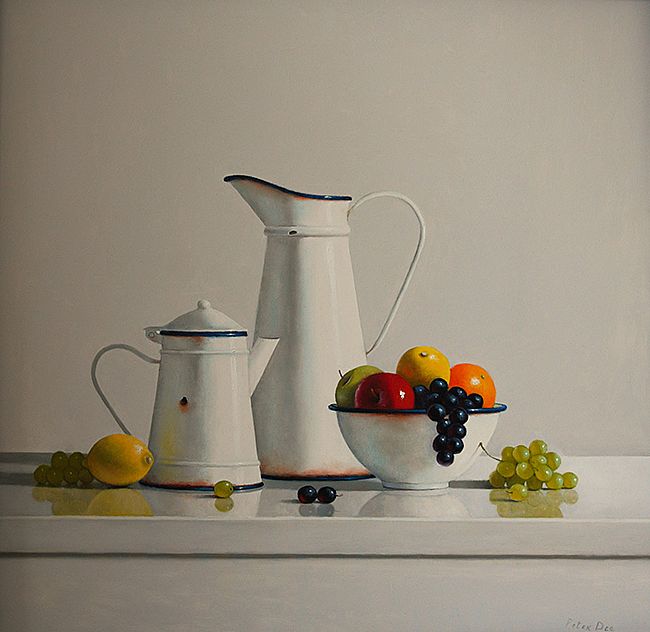
The Painting today is by a contemporary Irish Artist, Peter Dee, whose arresting and highly covetable Still Life works are the fruit of deep contemplation and confident technical accomplishment.
She Moves Through The Fair is a Song that we will never get to the bottom of.
It contains details of everyday life and a mysterious, swirling, intermingling of the known and supernatural Worlds we all move within.
There are some sorrows, some griefs, that can only be borne through Song being too deep for common speech.
The common speech of hand clapping dealers striking bargains at the fair.
While we move, half-blind, through our lives the stars look down and the swans fly over the lake.
All the while the soft fluttering of moths fill the night and dew will glisten on the meadow.
While we bear our burden of loss and longing the wide world turns and turns oblivious.
All as we move through the fair.
Through the fair.
Mary Black’s singing embodies the humanity and the other worldliness of the song with glowing assurance.
Mary Black can flat out sing!
She Moves Through The Fair
I once had a sweetheart, I loved her right well
I loved her far better than my tongue can tell
Her parents did slight me for the want of guile
Adieu to all pleasure since I lost my dear
She went away from me and moved through the fair
Where hand-clapping dealers’ loud shouts rent the air
The sunlight around her did sparkle and play
Saying, “It will not be long, love, ’til our wedding day”
When dew falls on meadows and moths fill the night
When glow from the greesach on half-froze, half-light
I’ll slip from my casement and I’ll run away
Then it will not be long, love, ’til our wedding day
I dreamed last night that my love came in
She came in so easy, her feet made no din
She came stepping up to me and this she did say
“It will not be long, love, ’til our wedding day”
Eavan Boland’s Poetry is characterised by fierce intelligence and a determination to fearlessly examine the toxins of Ireland’s history as understood and experienced by a modern Irish Woman.
So, it is a Poetry which utters outrage, anger and bewildered frustration as well as ease and joy.
I sometimes feel as if her work has served to redraw the map of Irish Poetry – significantly expanding the imaginative territory and cutting a path for others to follow.
The Poem I have selected today is the work of a Major Poet.
Eavan Boland : Quarantine
In the worst hour of the worst season
of the worst year of a whole people
a man set out from the workhouse with his wife.
He was walking — they were both walking — north.
She was sick with famine fever and could not keep up.
He lifted her and put her on his back.
He walked like that west and west and north.
Until at nightfall under freezing stars they arrived.
In the morning they were both found dead.
Of cold. Of hunger. Of the toxins of a whole history.
But her feet were held against his breastbone.
The last heat of his flesh was his last gift to her.
Let no love poem ever come to this threshold.
There is no place here for the inexact
praise of the easy graces and sensuality of the body.
There is only time for this merciless inventory:
Their death together in the winter of 1847.
Also what they suffered. How they lived.
And what there is between a man and woman.
And in which darkness it can best be proved.
A Poem written and read by Richard Murphy (1927 – 2018)
A Painting by Paul Kelly
Today a farewell homage to one of Ireland’s most treasured Poets – Richard Murphy and what I am sure for many of you will be an introduction to a singer/songwriter particularly close to my own heart, Ger Wolfe, whose stature as an artist has not yet been properly reflected in popular awareness.
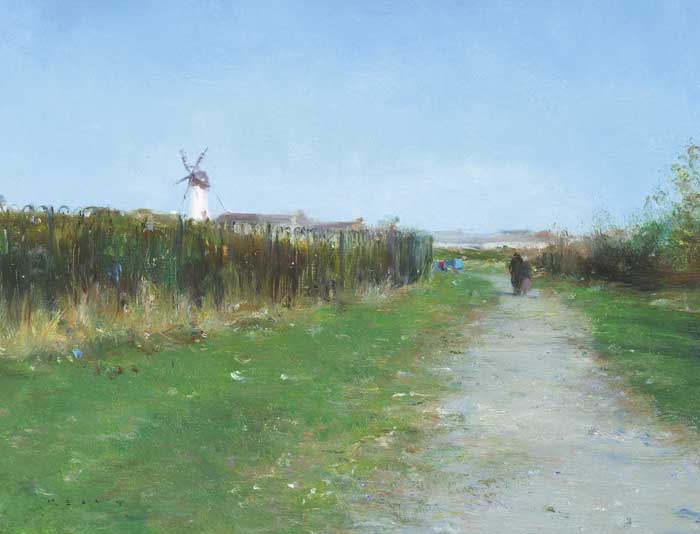
The painting today is by a contemporary Irish Artist, Paul Kelly, whose landscapes of County Dublin cast a spell.
Ger Wolfe in ‘The Curra Road’ has written a song that beautifully captures the sense of being at home and at peace in the physical, emotional and spiritual landscape of Home.
The hallowed Home we always want to carry within us as we walk down other roads on our pilgrimage through Life..
The Curra Road is undoubtedly a classic Irish Song and its luminous lyricism is entirely characteristic of Ger Wolfe’s catalogue.
I heard a story the other day that Bob Dylan would test out the compatibility of prospective musicians by asking, sotto voce, do you know, ‘Pretty Peggy-O’?
If the answer was Yes and they could follow and augment Bob’s version they were hired!
I have the same sort of test for anyone who considers themselves well informed on Irish Music – Do you know, ‘The Curra Road’?
If the answer is Yes I’m up to the Bar to buy them a pint – content there will lots to talk about that evening!
The Curra Road
In the summer we’ll go walking
Way down to the river down the Curra road
There’s a blue sky we’ll walk under
Listen to the humming bees and on we’ll go
We won’t worry about the Winter
Worry ‘bout it raining , worry about the snow
In the summer we’ll go walking
Way down to the river down the Curra road
Past the cattle at their grazing
Through the woods of hazel, holly, birch and oak
Past the robin on the gatepost
Singing to the bluebells, sunlight is their host
We won’t worry about the radio
Worry about the traffic, worry about the phone
In the summer we’ll go laughing
Way down to the river down the dusty road
There is music in the river
Listen to it dancing underneath the bridge
And the wind is hardly breathing
Words onto the willow branches overhead
We won’t worry about the government
Worry about the video, worry about the day
In the summer we’ll go waltzing
Hand in hand together down the dusty way
You can’t go wrong with any of his CDs – my favourites are, ‘I Have Been Loved’, ‘No Bird Sang’ and, ‘The Ragged Ground’.
I’m eagerly anticipating a forthcoming compilation, ‘The Lark Of Mayfield’.
Richard Murphy, who died at the end of January this year, had tremendous poetic gifts and a capacity for disciplined hard work at his craft over many decades.
His collection, ‘The Pleasure Ground: Poems 1952-2012’ (Lilliput Press) is a must-have for anyone interested in modern Irish Poetry.
Murphy had deep feeling for the Irish landscape and the Seas around The Island (and its offshore Islands).
There is a profound physicality present in his verse which makes responding to his work an uplifting whole-body experience..
I have always been particularly impressed by his ability to make history come alive in verse especially through long narratives allowing for exposition, diversions and deliberation.
Reading Richard Murphy will open up new imaginative territory and offer revelatory perspectives on the worlds we imagined we knew well.
Listen to him below reading one of his early triumphs – ‘Sailing To An Island’
Such sinewy, living language!
SAILING TO AN ISLAND
The boom above my knees lifts, and the boat
Drops, and the surge departs, departs, my cheek
Kissed and rejected, kissed, as the gaff sways
A tangent, cuts the infinite sky to red
Maps, and the mast draws eight and eight across
Measureless blue, the boatmen sing or sleep.
We point all day for our chosen island,
Clare, with its crags purpled by legend:
There under castles the hot O’Malleys,
Daughters of Granuaile, the pirate queen
Who boarded a Turk with a blunderbuss,
Comb red hair and assemble cattle.
Across the shelved Atlantic groundswell
Plumbed by the sun’s kingfisher rod,
We sail to locate in sea, earth and stone
The myth of a shrewd and brutal swordswoman
Who piously endowed an abbey.
Seven hours we try against wind and tide,
Tack and return, making no headway.
The north wind sticks like a gag in our teeth.
Encased in a mirage, steam on the water,
Loosely we coast where hideous rocks jag,
An acropolis of cormorants, an extinct
Volcano where spiders spin, a purgatory
Guarded by hags and bristled with breakers.
The breeze as we plunge slowly stiffens:
There are hills of sea between us and land,
Between our hopes and the island harbour.
A child vomits. The boat veers and bucks.
There is no refuge on the gannet’s cliff.
We are far, far out: the hull is rotten,
The spars are splitting, the rigging is frayed,
And our helmsman laughs uncautiously.
What of those who must earn their living
On the ribald face of a mad mistress?
We in holiday fashion know
This is the boat that belched its crew
Dead on the shingle in the Cleggan disaster.
Now she dips, and the sail hits the water.
She luffs to a squall; is struck; and shudders.
Someone is shouting. The boom, weak as scissors,
Has snapped. The boatman is praying.
Orders thunder and canvas cannodades.
She smothers in spray. We still have a mast;
The oar makes a boom. I am told to cut
Cords out of fishing-lines, fasten the jib.
Ropes lash my cheeks. Ease! Ease at last:
She wings to leeward, we can safely run.
Washed over rails our Clare Island dreams,
With storm behind us we straddle the wakeful
Waters that draw us headfast to Inishbofin.
The bows rock as she overtakes the surge.
We neither sleep nor sing nor talk,
But look to the land where the men are mowing.
What will the islanders think of our folly?
The whispering spontaneous reception committee
Nods and smokes by the calm jetty.
Am I jealous of these courteous fishermen
Who hand us ashore, for knowing the sea
Intimately, for respecting the storm
That took nine of their men on one bad night
And five from Rossadillisk in this very boat?
Their harbour is sheltered. They are slow to tell
The story again. There is local pride
In their home-built ships.
We are advised to return next day by the mail.
But tonight we stay, drinking with people
Happy in the monotony of boats,
Bringing the catch to the Cleggan market,
Cultivating fields, or retiring from America
With enough to soak till morning or old age.
The bench below my knees lifts, and the floor
Drops, and words depart, depart, with faces
Blurred by the smoke. An old man grips my arm,
His shot eyes twitch, quietly dissatisfied.
Ha has lost his watch, an American gold
From Boston gas-works. He treats the company
To the secretive surge, the sea of his sadness.
I slip outside, fall among stones and nettles,
Crackling dry twigs on an elder tree,
While an accordion drones above the hill.
Later, I reach a room, where the moon stares
Through a cobwebbed window. The tide has ebbed,
Boats are careened in the harbour. Here is a bed.


 The Immortal Jukebox