Songs by Eleanor Shanley ( Come Back Paddy Reilly) & Inni-K (Teardrop).
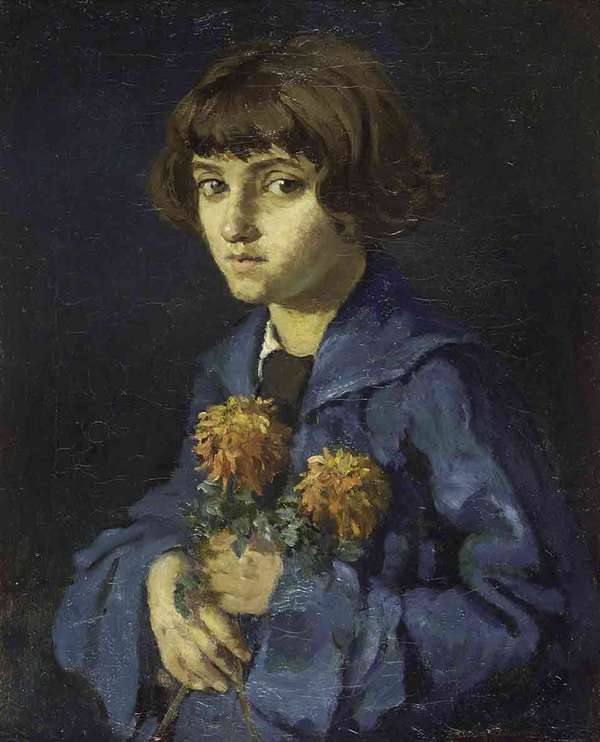
A Painting by Estella Solomons (1882-1968) ‘Moppie Morrow’.
A Poetry Reading by Rita Ann Higgins : ‘The Hedger’.
The Irish temperament is formed out of the knowledge that, in the end, no one survives this world without a broken heart.
Irish singers, painters and poets have for millennia embodied this truth in their works.
Tragedy abides but the true artist, not ignoring the darkness, finds within themselves sparks of joy to light up the glowering sky.
In the voice of Leitrrim’s Eleanor Shanley we find a tenderness and sustaining sweetness that glows in the heart.
The song she sings here Percy French’s, ‘Come Back Paddy Reilly’, has a special poignancy for me as it was my late mother’s favourite song and its haunting air accompanied her coffin as we carried her out of the church at her funeral.
It was also sung as a lullaby to my wife by her late father.
We think of them both with love and gratitude and with smiles and tears whenever we hear this song.
The garden of Eden has vanished they say But I know the lie of it still Just turn to the left at the bridge of Finea And stop when half way to Coote Hill
Tis there I will find it I know sure enough When fortune has come to my call Oh, the grass it is green Around Ballyjamesduff And the blue sky is over it all
And tones that are tender and tones that are gruff Are whispering over the sea “Come back Paddy Reilly to Ballyjamesduff Come home Paddy Reilly to me”
My mother once told me that when I was born The day that I first saw the light I looked down the street on that very first morn And gave a great crow of delight
Now most newborn babies appear in a huff And start with a sorrowful squall But I knew I was born in Ballyjamesduff And that’s why I smile on them all
The baby’s a man now, he’s toil-worn and tough Still whispers come over the sea
“Come back Paddy Reilly to Ballyjamesduff Come home Paddy Reilly to me”
The featured Painter today is Estella Solomons who was a Dubliner.
She was a member of a distinguished Jewish family with both her father and brother being mentioned by he great chronicler of Dublin life – James Joyce.
Her mother was a Poet and her Sister an opera singer.
She was deeply involved in the Irish Republican movement as a member of Cumann na mBan and in the cultural life of post revolutionary Ireland through her own work and that of her Poet and publisher husband, Seamus O’Sullivan.
The humble steady gaze of her paintings and prints have a meditative stillness which can be intensely moving.
Rita Ann Higgins is a Poet whose work has fierce feminine energy and lacerating emotional force.
As a Galway Woman from a large working class family she has broadened the canvas of Irish Poetry through an alert, inventive voice charged with righteous anger and absurdity.
This is a Poetry responding to and teeming with life in all its maddening plenitude.
Every now and again you hear a record that startles you by the freshness of its imagination.
‘The King has Two Horse’s Ears’ by Inni-K (Eithne Ni Chathain) from 2015 was one such record for me.
Irish Folk? Certainly.
But experimentally infused with Pop, Jazz and World Music accents.
All carried off with tremendous confidence and élan.
A record that repaid repeated listening.
Her new album, ‘The Hare & The Line’ has much to live up to!
In memory of Sheila Doyle and Joan Hickey.
Notes :
Eleanor Shanley recorded three highly recommended albums with the legendary group De Danann : ‘Jacket of Batteries’, Half Set in Harlem’ & ‘Wonderwaltz’.
I particularly prize her Solo albums – ‘Desert Heart’, and ‘A Place of My Own’ .
The two records she made with Ronnie Drew – ‘A Couple More Years’ & ‘El Amor De Mi Vida’ have a wonderful warmth.
If you enjoyed this post and know anyone who is Irish or of Irish heritage (and you do!) share it with them and ask them to share it further.
Songs by Maura O’ Connell (Helpless Heart) & SÍOMHA (July Red Sky)
A Poetry reading by Eiléan Ní Chuilleanáin (Studying The Language).
A Painting by Lilian Lucy Davidson (1879-1954) : Wicklow Goats.
A Paul Brady song sung by Maura O’Connell – it really doesn’t get any better.
Maura inhabits a song, finds its essence and then using all the considerable craft at her command sets it free to bloom in our imaginations.
There is a repertoire of traditional songs and modern folk classics that generations of Irish Women singers have returned to over and over again seeking to release and reveal the wisdom and mystery these masterworks contain.
Time after time I find it is to the Maura O’Connell versions I turn to first and last because these songs shine brightest and settle deeper in the heart when she sings them.
There is reverie and rapture here.
Reverie and rapture.
And, the video clip is enormously nostalgic!
Our painting today comes from Lilian Davidson who was born in Bray, County Wicklow.
Her work shows she was aware of movements in European Art and had secure painterly skills.
I am struck by the vivacity of the light and colour in her paintings which seem to gleam before the viewer.
In addition to her paintings she also wrote plays, poems and short stories under the name Ulick Burke.
The National Gallery of Ireland keeps her portrait of W B Yeats.
Our Poetry reading today comes from Eiléan Ní Chuilleanáin.
For almost half a century now she has been adding magical poems to the cairn of Irish poetry and the global word hoard.
In her poems language is thrillingly allusive and alive.
It is in the testing of thought and belief through charged engagement with language that Poetry is made.
Eiléan Ní Chuilleanáin has said that her Poems emerge out of her desire, need, to question – Is this true? Do I really believe this? Do I really feel this?
If the Poem lives the question is answered.
Often in ways that could not have been anticipated.
True Poetry is always surprising both to the Poet and the reader.
Eiléan Ní Chuilleanáin has written many true poems.
SÍOMHA (Brock) is, in her music, wholly Irish and wholly international.
She draws deeply on the traditions of traditional music, folk music, chanson and gypsy jazz to create an alluring synthesis.
On stage she has an energy, expertise and magnetism in her singing and guitar playing which wins and holds audiences.
We are all going to hear a lot more from SÍOMHA!
This post in memory of Mary O’Sullivan and Nora McElligott.
If you enjoyed this post and know anyone who is Irish or of Irish heritage (and you do!) share it with them and ask them to share it further.
March is the month when the Immortal Jukebox, in the run up to the St Patrick’s day festivities, celebrates the enormous contribution Irish artists have made to the World’s treasury of Poetry, Song and Paintings.
This year’s posts are in celebration of the works, so often under regarded, of the Women of Ireland.
Each post will feature a song by an established singer and another by a singer or group who may not yet have gained fame outside of Ireland.
I will also be showcasing a Poetry reading and a Painting.
I hope I will be making introductions that will lead you to further exploration.
Today :
Songs by Dolores Keane and The Evertides.
Eavan Boland reading :
‘The Lost Art of Letter Writing’, ‘Quarantine’ and ‘The Emigrant Irish’.
A Painting by Mildred Anne Butler (1858-1941) : A Murder of Crows
My admiration for Dolores Keane knows no bounds.
In her voice you can hear Ireland speaking with power and authority.
In her voice you can hear Ireland speaking of pain, exile and loss.
In her voice you can hear Ireland speaking with faith and joy.
Listen to Dolores Keane.
Listen to Ireland.
Our painting today comes from Mildred Anne Butler who looked deep into the domestic and the animal life all around her Kilkenny home.
She painted en plein air and there is a startling freshness shining from her works.
She is well represented in galleries and latterly was commemorated on an Irish postage stamp.
Eavan Boland is a Poet of patience and fortitude.
Throughout her career she has attended to the whispers and looked unflinchingly into the dark shadows of Irish life and culture – particularly as experienced by Irish Women.
There is a complexity and precision of language and weight of thought in her work which is the mark of a major Poet.
The Evertides are a trio of wonderfully talented Irish Women – Ruth McGill, Alma Kelliher and Ruth Smith.
Their instrumental and vocal blend is that of Sisters in Song.
Their three part harmonies surround, enchant and elevate our senses.
The ability to enchant and to open doors into the numinous makes The Evertides a very special group.
In memory of Julia O’Sullivan and Hannah Hartnett.
If you enjoyed this post and know anyone who is Irish or of Irish heritage (and you do!) share it with them and ask them to share it further.
Notes :
In addition to her role in The Evertides Ruth Smith presents one of my, ‘Must Listen’ radio programmes, ‘Simply Folk’ which airs on RTÉ Radio 1 on Sundays at 10pm.
Seek it out!
The next Post in the series will be published on Tuesday 12 March – Don’t miss it!
Lifted up in the chill night air surrounded by heady scent of white blooms all the moon long.
Blanketed in sulphurous Fog you walk hand in hand with Dad and though you can’t see road or pavement and don’t know where you are going you do know you are safe and will arrive – because you are hand in hand with Dad.
The Walnut of the radiogram gleams to reflect your face.
And, when the knob is turned a lovely green light blushes the room.
You know you’re not allowed to switch it on.
But .. and from the speakers emerges something wonderful, miraculous :
Don’t want your love anymore
Don’t want your kisses, that’s for sure
I die each time I hear this sound
Here he comes, that’s Cathy’s clown.
Now, the room is filled and your heart is filled and your soul is filled and you will never forget this moment.
Happy Highways.
Blue remembered hills.
Shining plain forever in the memory.
When you are small you are told and might believe you know nothing worth knowing.
Ah! but to be the prince of apple town.
To be green and carefree, huntsman and herdsman, in the Sun that is young once only.
First knowing.
First morning song.
Young and easy, oblivious of the mercy.
Angel infancy.
Shadows of eternity.
Bright shoots of everlastingness.
Oh, to travel back and tread again on that ancient track to the land of lost content.
The slender tops of fir trees close against the sky.
Now there’s more to do than watch my sailboat glide.
In 1966 Carole King and Gerry Goffin gave us a magic carpet ride song that looked poignantly back to the childhood land of lost content and tremulously forward to a world where thinking young and growing older is no sin.
A world where the game of life can be played to win.
Catch me if you can.
Streaming, filled with light, through the eye of a needle.
Going back.
Sing it for me Dusty.
Take me back.
Dusty Springfield.
Unquestionably thev finest pop/soul singer ever to come from the British Iles.
A singer of both power and delicacy.
Dusty finds the deep melancholy and the fragile hope in Goin’ Back.
Dusty knew that great songs were rare and precious things.
Time after time Dusty found depths of meaning within songs few had even guessed at.
Time after time singing these songs Dusty found something within them that brought out aspects of herself she had barely guessed at.
Beauty emerging out of Hide and seek with her fears and ours.
Catch me if you can ….
Now let’s fly high, eight miles high, with The Byrds for a panoramic take on Goin’ Back.
I think I’m goin’ back to the things I learned so well in my youth.
Catch me if you can.
Catch me if you can.
Carole King left an indelible mark on the 1960s threading veins of pure gold through the decade with the songs she wrote with Gerry Goffin.
Come the 1970s she was ready to move to the centre of the stage and put her own stamp on the songs she had gifted to other singers and groups.
Listening to her version of Goin’ Back it occurs to me that she has rarely received due praise for the singer element in the Singer/Songwriter appellation so often ascribed to describe her solo records.
There is aching truth and no little heartbreak in the way she tells herself and us that she could recall a time when she wasn’t afraid to reach out to a friend.
Hide and seek.
Hide and seek.
Carole King’s songs reach out in faith and friendship.
Thinking young and growing older is no sin.
Plaing the game of life to win.
Catch me if you can.
Catch me if you can.
Goin’ Back.
Nils Lofgren – Guitar Slinger for the greats.
Neil Young. Bruce Springsteen.
Yet, too often forgotten a very fine artist in his own right.
From his early years with Grin and throughout his solo albums you hear the sound of an extravagantly gifted musician whose greatest gift was the depth of heart he brought to every performance whether on record or on stage.
With Nils Goin’ Back really does become a magic carpet ride.
Catch me if you can.
Catch me if you can.
Goin’ Back.
Happy Highways.
Blue remembered hills.
Shining plain Forever.
Catch me if you can.
Catch me if you can.
I’m Goin’ Back.
Streaming, filled with life through the eye of a needle.
Goin’ Back.
Now, here’s that hidden track you sometimes find when you think the CD/LP has no more gifts to give.
Guitar Gurus Roger McGuinn and Richard Thompson with a 6 string colloquy.
Starry eyed and laughing.
Bright shoots of everlasting ness.
Catch me if you can.
Catch me if you can.
Goin’ Back.
Goin’ Back.
Notes :
Thanks due to Dylan Thomas, Seamus Heaney, Thomas Hood, A E Houseman and Henry Vaughan for their wisdom and inspiration.
Look out for the annual St Patrick’s Parade series of posts starting on Sunday – this year celebrating Mná na hÉireann – The Women of Ireland.
For most of last week as I took my early morning walk up the Ridge Top I all but vanished into an all encompassing Fog.
Confident in the way I have trod so often and leaning on my staff I pressed on.
I love the wreathing silence of the Fog and the air’s damp embrace.
High above the hidden sun would surely appear and the Fog would withdraw as silently as it advanced.
Descending, I met one of the local Farmers who said as he looked askance at the Fog and me – ‘Reasons to be Cheerful – Eh?’.
He was not a little taken aback when instead of responding with a pat motto I launched into the opening of Ian Dury’s late 70s leery litany of Reasons to be Cheerful;
‘Some of Buddy Holly, the working folly, Good Golly Miss Molly and boats!’
And, as I bad him farewell I vanished back into the Fog my voice ebbing away singing:
‘Hammersmith Palais, the Bolshoi Ballet, Jump back in the alley and nanny goats!’
Let’s cede to Ian Dury now in his persona of part pirate king, part fairground carney, part ‘ain’t he awful’ top of the bill music hall maestro and all around diamond geezer leading his magnificent troupe of musicians The Blockheads in a proper celebration of the oh so many reasons to be Cheerful.
Diamond like in the brilliance of his mind and talent as a lyricist and performer but also diamond like in the hardness of his resolve and the sharpness with which he could slice apart the ego of anyone foolish enough to imagine they could out banter him.
He could, according to his mood and alcohol intake, be the most brilliant raconteur and most charming man you could ever hope to meet or a manipulative demon searching out weaknesses with laser like focus.
Surviving Polio from childhood and the mental, emotional and physical savagery of subsequent boarding school left an enduring mark on his soul.
He was saved through his innate toughness, his intelligence and sharp wit.
Exposure to the discipline of a Painter’s necessary painstaking observation at Art School and the riotous anarchy of 50s Rock ‘n’ Roll informed an aesthetic credo which also took in the craftsmanship of Cole Porter, the rumbustious energy of Charles Mingus, the end of the pier vulgarity of Max Miller and the surreal style of Max Wall.
All carried off with a uniquely English ribald humour and brio.
The songs were the product of rich talent and the long labours of a true craftsman always searching for the exact word, the proper rhythm.
Some have said that, ‘Reasons ..’ is merely a shopping list song – well as Ian Dury observed, ‘You try writing one then!’.
Cole Porter wrote one in, ‘You’re the Top’ and there’s no doubt in my mind that Ian Dury would fit right into that song’s list of exemplary excellence along with Napoleon Brandy, Mahatma Gandhi, the Mona Lisa and Mickey Mouse!
Of course his undoubted genius as a lyricist needed The Blockheads for the songs to take flight in the studio and on stage.
The most important figure here was Chaz Jankel whose melodic inventiveness and rhythmic assurance made for irresistible songs that permanently branded themselves into the imagination and heart of the listener.
Norman Watt Roy, Charely Charles and Davey Payne had the magical ability to meld the sound of Memphis Soul, English Music Hall and Free Jazz into a seamless funky whole.
And, with Ian as the louche and lecherous ringmaster centre stage they were an enthralling live band seemingly inexhaustibly inventive and endlessly committed to maintaining a groove that just wouldn’t quit.
One, Two, Three …
Why don’t you get back into bed
Why don’t you get back into bed
Why don’t you get back into bed
Why don’t you get back into bed
Why don’t you get back into bed
Why don’t you get back into bed
Why don’t you get back into bed
Why don’t you get back into bed
Why don’t you get back into bed
Why don’t you get back into bed
Reasons to be cheerful part 3
1 2 3
Some of Buddy Holly, the working folly
Good golly Miss Molly and boats
Hammersmith Palais, the Bolshoi Ballet
Jump back in the alley and nanny goats
18-wheeler Scammels, Domenecker camels
All other mammals plus equal votes
Seeing Piccadilly, Fanny Smith and Willy
Being rather silly, and porridge oats
A bit of grin and bear it, a bit of come and share it
You’re welcome, we can spare it – yellow socks
Too short to be haughty, too nutty to be naughty
Going on 40 – no electric shocks
The juice of the carrot, the smile of the parrot
A little drop of claret – anything that rocks
Elvis and Scotty, days when I ain’t spotty,
Sitting on the potty – curing smallpox
Reasons to be cheerful part 3
Reasons to be cheerful part 3
Reasons to be cheerful part 3
Reasons to be cheerful part 3
1 2 3
Reasons to be cheerful part 3
Health service glasses
Gigolos and brasses
Round or skinny bottoms
Take your mum to Paris
Lighting up the chalice
Wee Willy Harris
Bantu Stephen Biko, listening to Rico
Harpo, Groucho, Chico
Cheddar cheese and pickle, the Vincent motorsickle
Slap and tickle
Woody Allen, Dali, Dimitri and Pasquale
Balabalabala and Volare
Something nice to study, phoning up a buddy
Being in my nuddy
Saying okey-dokey, Sing Along With Smokey
Coming out of chokey
John Coltrane’s soprano, Adi Celentano
Bonar Colleano
Reasons to be cheerful part 3
Reasons to be cheerful part 3
Reasons to be cheerful part 3 Reasons to be cheerful part 3
1 2 3
Yes yes
Dear dear
Perhaps next year
Or maybe even never
In which case
Reasons to be cheerful part 3
Reasons to be cheerful part 3
Reasons to be cheerful part 3
Reasons to be cheerful part 3
1:2,3
Reasons to be cheerful part 3
Reasons to be cheerful part 3
Reasons to be cheerful part 3
Reasons to be Cheerful – 1,2,3.
And, as a homage from me to Ian, here’s some further Reasons to be Cheerful (Part 4) :
Shredded Wheat and Did those feet …. Jimmy Greaves and Bicycle Thieves …
All of Buddy Holly – two cones and a Lolly ….
Red Socks and grandfather clocks … The Ragman’s Daughter and a pint of Porter ..
Sons and Lovers and a Four through the covers …
Beckett Sam and Blueberry Jam .. Ginger Rogers and the Brooklyn Dodgers ..
Dave Mackay and The Sheltering Sky .. Winterreise and a bottle of Tizer ..
A Citroen DS and The Orient Express .. Gerard Manley and Holloway Stanley ..
Ulysses S Grant and seeing things aslant … Redwing Boots and Pressure Drop Toots ..
Montgomery Clift and the Berlin Airlift … Martin and Vincent … Redgrave and Pinsent.
Reasons to be Cheerful.
Reasons to be Cheerful.
Notes :
I decided not to provide an annotated listeners guide here for Ian’s references and my own. See what Mr Google tells you and you’ll learn a lot!
And, when we are in Love reason is buffeted like wind-blown smoke.
Our lives are but feathers helplessly teased and tormented by the winds of Love.
All the winds sigh for sweet things dying, dying.
The wind from all points of the compass; north, east, south or west gathers and remembers our voices, the whispers of our hearts, and broadcasts them in the calls of the birds and the threshing of the leaves and fields.
The wind feeds the fires of Love and in the end is there to extinguish the flames too.
The east wind brought the locusts.
Two riders were approaching.
The wind began to Howl.
Howl.
Love me, love me, love me, love me.
Say you do.
My love is like the wind and wild is the wind.
Wild is the wind.
Wild is the wind.
Wild Is the WInd was written by Dimitri Tiomkin and Ned Washington (previously featured here as composers of High Noon) for a 1957 romantic melodrama of the same name starring Anthony Quinn and Anna Magnani.
Johnny Mathis gave the song a poised and polished performance gliding atop sweeping strings.
Yet, there is no sense in his reading of the desperation implicit in the lines :
’With your kiss my life begins .. you’re spring to me .. All things to me …
Don’t you know you’re life itself’.
No, the song would have to wait until an artist of genius took possession of the song and through the alchemy of her art transformed a leaf trembling breeze into a heart shattering hurricane.
It’s the same song in tne way that someone returning home after the trauma of war is the same person who departed.
Nina Simone in 1959 at NYC Town Hall in her vocal and piano playing evokes layer after layer of bruised and battered feeling.
The euphoria of the sound of mandolins and the shocking abandonment and abasement of the wild wind of the obsessed Lover are made present in every breath and every note so that the listening audience must have felt emotionally wrung out as the last note subsided into exhausted silence.
Don’t you know you’re life itself!
Better to die than to live without this Love.
The leaf clinging to the tree.
We are like creatures, creatures, in the wind.
Cling to me. Cling to me. Cling to me.
Wild is the Wind.
Wild is the Wind.
Nina Simone would return over and over again to Wild Is the Wind.
In the tour de force version below, issued in 1966, the wind she evokes is a tornado that sweeps us into a tumult of a Love that is nothing less than Life and Death to the Lover.
An eternally entwined trinity.
Life and Love and Death.
Don’t you Know you’re Life Itself!
Creatures, creatures of the Wind.
The sound of Mandolins.
With your kiss my Life Begins.
Don’t you know you’re Life Itself.
Cling to me.
Life and Love and Death.
Wild is the Wind.
Wild Is the Wind.
David Bowie in free fall after the Ziggy Stardust years found in the artistic persona of Nina Simone an anchor and a ladder.
Especially in her performance of Wild is The Wind which must have attracted him as the quintesssntial demonstration of how a true artist could summon and surrender to a tsunami of emotion yet remain in control through craft and discipline so that it is the audience and not the artist who is overwhelmed.
Bowie recorded the song for his bravura 1976 album, ‘Station to Station’.
Being the very smart guy he was he knew not to attempt to sing the song to piano accompaniment for that could only cast him into Nina’s Olympian shadow.
Instead, with extraordinary care, he arranged a version that had oceanic sway as intertwined guitars (Carlos Alomar and Earl Slick) and percussion (Dennis Davis) urged his vocal to reach, reach, reach until we are bereft – leaves clinging to the tree , helpless.
For we are creatures, creatures, sweet things dying.
With your kiss My Life Begins.
Don’t you know you’re Live Itself.
Wild Is The Wind.
Wild is The Wind.
Tne wind bloweth where it Listeth.
Where it listeth.
And we are nought but chaff in the wind.
Chaff in the wind.
When David Bowie performed at Glastonbury in tne year 2000 he had been through many storms, many of his own making, and had survived them to emerge as a magus in complete command of his art.
The sound of Mandolins
Love me, love me, love me, love me.
Life Itself.
Cteatures In The Wind.
Creatures.
Life and Love and Death.
An eternally entwined trinity.
We are all helpless before the Wind.
Leaves clinging to the trees.
Wild Is The Wind.
Wild Is The Wind.
Wild Is the Wind.
Wild Is the Wind.
Thanks due to The King James Bible. Truman Capote, Christina Rossetti and William Shakespeare for inspiration.
Oh, someday, someday, I’ll be the vision of your happiness.
Happiness. Happiness. Happiness.
Please be mine.
Darling dear.
Darling dear.
One Moonbeam.
Two Moonbeam.
A street corner symphony indeed.
A subway psalm for sure.
Oh to be just such a Fool.
A Fool in Love.
In Love.
Today, another ordinary/extraordinary Jukebox story surrounding a Doo Wop classic from 1954.
An ordinary/extraordinary story featuring:-
Two sets of high school friends recording a demo in a Los Angeles garage that goes on to sell at least 10 Million copies and feature in a succession of Hollywood movies.
A court case, with singing from the witness box, to determine who wrote the song and hence who gets the royalties (for it is a music business truth that where there’s a Hit it won’t be long before there’s a writ).
The near bankruptcy of the first independent record label to achieve a national smash hit.
One definite murder and one highly suspicious death.
A guest appearances by Frank Zappa.
So, let’s begin with The Penguins.
They took their name from ‘Willie’ the iconic mascot for the Kool Cigarette brand.
The members who recorded, ‘Earth Angel’ were Cleve Duncan (lead vocal), Curtis Williams (bass), Dexter Tisby (tenor) and Bruce Tate (baritone).
Curtis and Bruce were alumni of Jefferson High while Cleve and Dexter met at Fremont High.
The piano on the recording was played by Gaynel Hodge (who had previously been in The Hollywood Flames with Curtis Williams and who would go on to be a founder member of The Platters).
No one is sure who played the drums though some speculate that Bongo King Preston Epps was in the garage on that fateful October day.
It seems that Earth Angel emerged out of the collective consciousness and unconscious of Curtis Williams, Gaynel Hodge and Jesse Belvin (a prolific songwriter and melting vocalist who had been their mentor in The Hollywood Flames).
Jesse’s song from 1952, ‘Dream Girl’ is an obvious influence on ‘Angel’ as is The Swallows’, ‘Will You be Mine’.
Close listening to Patti Page’s, ‘I Went to Your Wedding’ (which The Hollywood Flames had demoed) and The Flames own, ‘I Know’ will reveal pre echoes of Earth Angel.
And. there’s a definite sonic signature traceable back to Rodgers and Hart’s, ‘Blue Moon’ which occupied some part of everybody’s musical memory.
When the royalties battle came to court Jesse Belvin’s virtuoso vocals convinced the Judge that he deserved his share of the greenback bonanza along with Curtis and Gaynel.
The Penguins were in the 2190 West 30th Street Garage because that was where Dootone Label owner, Dootsie Williams, liked to record.
The Garage Studio was owned by Ted Brinson, a relative of Dootsie’s, who had been a Bass player for the Jimmy Lunceford and Andy Kirk swing bands.
Dootsie is the beaming bespectacled gent below next to Johnny Otis a legendary black music mover and shaker who wearing his Disc Jockey hat (Johnny wore a lot of hats) gave, ‘Earth Angel’ many a spin to push it to the top of the LA Charts.
Dootsie heard something winning in The Penguins sound and, as a music publisher, thought that their songs might set the cash registers chiming.
Thinking of those cash registers and Juke Box Nickels it wasn’t, ‘Earth Angel’ that Dootsie heard as the Hit.
No, he preferred, ‘Hey Senorita’ and that was the official ‘A’ side when the record was issued (the choice perhaps not unconnected with Dootie’s name having a writing credit on Senorita!).
Now, I like the Latin feel of Senorita and the heart racing bongos (hello Preston!) but even in 1954 I could have told you that the treasure was on the ‘B’ side.
And, if you want to know how a record will sell ask a man who sells records and then ask a man who spins records on the radio.
They know!
Dootise took an acetate of the two sides to John Dolphin of Dolphin’s of Hollywood an all night record shop and a network centre for the black community.
Broadcasting out of Dolphin’s front window was White Disc Jockey Dick, ‘Huggy Boy’ Hugg who attracted a loyal audience across the Black and Latino communities.
John Dolphin and Huggy Boy told Dootise that there was there was absolutely no need for any instrumental overdubs as the ravishing beauty of, ‘Earth Angel’ lay in the impassioned foregrounded vocals.
Still, it was Senorita which went out as the A side but radio DJs and the public were in no doubt – flip that platter and give us more of, ‘Earth Angel’!
And, that’s exactly what happened.
Earth Angel tore up the charts in every territory and raced to the top of the R&B list and steadily climbed the Billboard Pop ladder.
Dootsie pressed as many sides as he could though the strain on his cash flow pushed him close to bankruptcy as the distributors took their time reimbursing him for the sales.
Eventually Dootsie made sweet dollars from Earth Angel as did Jesse, Curtis and Gaynel.
As for the rest of The Penguins the story was not so happy.
Through the smarts of Buck Ram (pictured below) they got out of their contract with Dootone and landed with major label Mercury.
Buck’s interest in The Penguins was not perhaps as fervid as his interest in the group he insisted be part of the ‘transfer deal’ – a group called The Platters for whom he would write a series of immortal hits including, ‘The Great Pretender’!
So, while The Platters were launched into the showbiz stratosphere The Penguins languished and never really troubled the charts again.
Yet, they carried with them forever more memories of high times at the Moulin Rouge in Las Vegas and their name in lights at the gala reopening of Harlem’s Small’s Paradise.
They played Alan Freed’s Labor Day show at the Brooklyn Paramount with legends such as Fats Domino, the Teenagers, the Cleftones, the Harptones and the Moonglows.
And, deep in their hearts they knew that on an October day in 1954 they had made a record that would never die.
Cleve Duncan led a version of The Penguins for decades before his death in November 2012. It was the power of the plea in his tenor lead along with Dexter Tisby’s tender stewardship of the bridge section that made, ‘Earth Angel’ so distinctive and unforgettable.
In one of those, ‘you couldn’t make it up’ happenstances a deeply knowledgeable fan of The Penguins and all the greater and lesser Doo Wop groups was none other than Frank Zappa and when he wrote a song, ‘Memories of El Monte’ in 1963 he turned to Cleve Duncan’s Penguins to bring it to charming life.
El Monte is based on the chords of Earth Angel and celebrates rock ‘n ‘roll dances at El Monte Legion Stadium where the young Frank and like minded teenagers – Black, White and Latino mixed to listen to and dance to music they all loved.
The song and Cleve’s lovely vocal hymns The Heartbeats, Marvin & Johnny and The Medallions among others.
A wonderful homage that sends you right back to the original because through The Jukebox we can travel back to the past and find a sound and a love that will always last.
Earth Angel … Earth Angel .. will you be mine?
My darling dear .. love you all the time
I’m just a fool .. a fool in love with you
Earth Angel the one I adore
Love you forever and ever more.
And, that’s how long, ‘Earth Angel’ will be listened to and swooned over.
Forever and ever more.
In memory of Cleve Duncan 1935 – 2012, Curtis Williams 1934 – 1979 and Bruce Tate 1937 – 1973. Wishing long life and good health to the surviving Dexter Tisby.
Notes :
Those murders?
Sadly John Dolphin was sadly shot to death in 1958 in his own store. A murder that was witnessed by Bruce Johnston ( later in the Beach Boys) and sandy Nelson (of Let There Be Drums fame).
Dolphin’s death was a profound loss to his community where he had been prominent as a business man, music promoter and producer and networker.
Jesse Belvin died in a car crash with mysterious circumstances on a tour of The South at the age of 27.
Jesse’s signature song was the exquisite, ‘Goodnight My Love’ which pioneer Rock ‘n ‘ Roll DJ Alan Freed used as his show ending song.
His 2 LPs, ‘ Just Jesse Belvin’ and, ‘Mr Easy’ are wonderful records ideal for late night reverie listening.
Dick ‘Huggy Boy’ Hugg 1932 – 1960 was a Rhythm & Blues and Latino music Evangelist.
The DJ persona in Dave Alvin’s great song ‘Border Radio’ (previously featured here on The Jukebox) is believed to be Huggy Boy.
What I need is music that is melodious and comforting and hauntingly familiar without being hackneyed which will faithfully abide with me as my state of consciousness veers from ten fathoms deep slumber to stunned heavy eye lidded awareness.
So, for the last 72 hours on constant repeat as the moon and sun replace each other in the heavens and my mind races with scudding dreams I have been listening to Teddy Thompson’s magnificent tribute to the Country Ballad : ‘Upfront and Downlow’ and marveling at the way his love and respect for these classic songs gives them new dimensions of beauty without any disrespect to the wonders of the original versions.
if I could sing this is exacttly how I would want to sound like singing songs of hard won wisdom and care worn truth.
Teddy is not imitating anyone.
Neither is he intimidated by any of the great artists who have taken on these songs before.
He gives an extra patina to these songs – burnishing their brilliance.
My mind performs slow aquatic somersaults as the songs flow in and out echoing each other and the all voices that sang them.
Don and Phil. Hank and Ernest. Elvis and Dolly.
Fragments of Fractured dreams abound.
Goodbye to all those castles in the air.
Guess you had a change of heart.
A change of heart.
Sing it for me Teddy.
Oh, oh, if we only could go right back to the start.
But the river flows. The river flows one way. One way.
Everyone wants, needs to believe the things the loved one says and everyone feels the same pangs when it turns out not to be that way.
In my hallucinatory dreams songs and images entwine and drift apart.
Entwine and drift apart.
Echoes echo on into infinity.
Boris Karloff as Frankenstein relentlessly pursues me through the splashy salt marshes as a fireball lights up the sky.
Elisha Cook Jr gibbers as he pulls out his gat ready to drill me full of holes.
He would have done it too if Ida Lupino hadn’t beaten him to the trigger.
Echoes. Echoes. Echoes.
There’s an emptiness tonight.
There’s a longing in my heart.
Though we said that we were through …
I’ll be waiting here for you.
Waiting here for you.
And, diving to the deepest depths of my deepest dream the entwined voices, balm and blessing, of Teddy Thompson and Iris Dement.
The heart echoes every time it beats.
Til the day it echoes no more.
What time is it?
What day is it?
Where am I?
Have a care! Chap here’s run absolutely amok.
Lilian Gish rocking on her armchair cradling a shotgun.
Is it 2019 or 1959 or 1969?
Ah, I must be sick but it’s ok my mum will be coming up the stairs soon with my favourite comic, a glass of orange squash and some ice cream.
There’s a baby crying somewhere.
Is that my sister, my daughter or my granddaughter (or my son)?
Mitchum and me never should have trusted Jane Greer.
Those string arrangements swirling around my head – there’s a signature there.
Whose?
Ah .. 1974. I’m in my room in college listening to the music of a previous alumni – Nick Drake and the strings are arranged by another Cambridge alumni – Robert Kirby.
Thanks to Teddy and Iris and Tift and Don and Phil and Elvis and Dolly and Felice and Boudeloux for seeing me through.
Thanks Teddy.
Note : As always if for corporate/copyright reasons any of these clips fail to play you will find they or an alternative clip can be quickly found by a quick Google/YouTube search.
Note : This Post is best read in conjunction with the previously published,’Phil Everly Remembered’ from January 2017.
Don Everly was born on February 1st 1937
Don is the elder of the two brothers – almost two years older than Phil.
When they started out on the radio singing before they went to elementary school they were billed as, ‘LIttle Donnie and Baby Boy Phil’.
Don had the deeper baritone tenor voice.
Phil had a pure strong tenor and generally harmonised one third above Don.
Together, singing in harmony for decades, they achieved an ambrosial sound that has never been matched in popular music.
When they started to record it was Don who played the punchy rhythm guitar licks that signalled that though deeply grounded in Country Music these young men were true Rock ‘n’ Rollers who had been listening to the thunderous groove of Bo Diddley.
That influence is unmistakeable from the intro to their breakthrough single ‘Bye, Bye Love’.
As no lesser an authority than Keith Richard put it :
’Don’s acoustic guitar, that rhythm guitar, was rocking man! I guess that rubbed off on me’.
Here’s Don and Phil at their epic, ‘Reunion Concert’ from 1983 showing that they had lost none of their instrumental and vocal potency.
Sadness never sweeter.
Bye, bye Love.
Bye, bye, Happiness
Hello Loneliness.
I think I’m gonna Cry.
Bye, bye Love.
It was generally Don who sang the solo parts in Everly Brothers songs.
There was a quality in his voice, a seeming deep acquaintance with the heartaches that assail us all, that never fails to move me deeply.
And, when he and Phil found a song like, ‘All I Have To Is Dream’ they graduated from being upcoming hit makers into an immortal presence in millions of hearts.
Gee whiz. Gee whiz.
Dream, dream, dream.
In 1960 Don wrote, ‘So Sad (To Watch Good Love Go Bad)’ allowing The Everly’s to demonstrate their unparalleled control of the slow harmony ballad.
Teddy Thompson (Richard & Linda’s son) said that he had spent thirty years seat hing for singers as good as The Everly Brothers before realising that it was an impossible pursuit.
Who could argue with the truth of that verdict?
Inevitably, two brothers who have been singing together since early childhood will have fallings out and Tne Everlys, deeply contrasting personalities, certainly did.
Working apart tney both made fine records.
I’ve chosen to showcase here a sublime duet recording of a Louvin Brothers song Don cut with Emmylou Harris.
I remember the first time I heard this thinking – Emmylou is a magnificent singer and a great harmoniser but Don Everly, Don Everly! has clearly been blessed with a gift that is very rare indeed.
A gift that he shared in such generous measure with all of us.
Happy Birthday Don.
Thanks for all the songs and all the singing.
I’ll conclude with an Everly Brothers performance of, ‘Kentucky’.
This is singing that goes beyond singing.
Singing that is the heart in pilgrimage and the soul in paraphrase.
This Day won’t, can’t come again – though you may remember it for every Day you have left to live.
Bless the Light.
Today is all we have and whatever happens today you have the absolute existential freedom to choose how you act, how your react, to whatever this Day brings.
Bless the light.
And, when you come to the end of this Day you will have much to give thanks for – not least that the lightning bolt of death has stayed sheathed in the heavens.
Give thanks for the day that is done and pray that tomorrow will dawn for you and gift you one more sacred day.
Bless the light.
And, as you walk through the world of your alloted days you will find that the steps of others will from time to time fall in step with yours.
If you are very fortunate you will find that another’s steps will match yours for mile after mile after mile and that if you lose your footing and fall behind they will stay their steps until you catch up.
Thank you for the Days.
I won’t forget a single day believe me.
Bless the light.
There will be guides and spirits along the way who will befriend and show you t e way before going their own way.
On this road of Days you will find that those who once walked so companionably by your side now seem to marched ahead or taken another turn to take them out of sight.
Yet, as you come to give thanks for another Day of your alloted number you can give thanks for the miles you shared and wish them well wherever they are on the highway of their own Days.
The night is dark and sorrow comes to us all so give thanks for the Days you shared.
Thank you for the Days.
Those sacred days.
Bless the light.
Don’t forget a single Day.
A single Day.
Another bitter sweet classic from the pen of Ray Davies brought to vivid, shimmering life by The Kinks.
One of the hallmarks of Ray’s greatness as a songwriter is the ability to tell stories distilling complex emotions we all share into endlessly satisfying three minute vignettes which are faithful both the joy and the sadness in our lives.
Ray has acknowledged that a songwriter is frequently, at the time a song is created, unaware of the effect it will have on its audience :
‘The song has grown in intensity over the years … you don’t think about it, but it’s built up quite a mystique over the years. It certainly left me. It belongs to the world now.’
That’ll do for me as the definition of a great song!
The beauty of the lyric, tenderly evocative but unspecific, is that will be apposite for so many of us in so many times and stations of our lives.
Recollection of those sacred days will always as the days pass have elements of regret.
Loss and sorrow are not to be feared in this world – they come with the territory.
The song starts as an almost busked folk song before building to a tremendous crescendo as the piano, drums and harmony vocals take the song deep into our hearts.
And, as we will see below, it’s a song that can even surprise its author with its keening power.
In 2010 Ray Davies played the Glastonbury Festival just after the death of Pete Quaife, the Bass player in the original Kinks lineup.
Pete Quaife had quit The Kinks just after ‘Days’ was recorded so playing the song must have had particular resonance for Ray as he looked out on the thronged audience (each of whom will have had their own days to remember and bless as they sang along).



 The Immortal Jukebox