Under Clery’s Clock, Faithful Departed & Thousands Are Sailing
A Poem by Francis Ledwidge : To One Dead
One of the roles of a true writer is to bring all the gifts of their being to the task of creating art which though conscious of history and artistic tradition demands that you attend to how it feels to be alive NOW in this particular society and culture in all its messy complexity.
And, if you can accomplish this task by creating songs, lyrical ballads, which speak urgently to their time while having depth of humanity and beauty of composition you will find that such songs do not wither and die.
Rather, they take on a life of their own and become beloved by audiences and fellow artists from different eras and cultures who will find universal truths emerging from these particular songs.
Songs, filed with the quick life of the day, if they are good enough, find entry into the hallowed treasury of traditional song. Such songs will always find an audience and always find singers to sing them.
Ireland was fortunate to find, in Philip Chevron from his 70s days with Ireland’s pioneer punk heroes,’The Radiators From Space’ through to his solo work and triumphs with The Pogues, a songwriter who wrote with fierce aching truth about the life he lived and the times he lived in.
Philip Chevron (born Philip Ryan) in 1957 grew up in Santry, Dublin.
In his writing he chronicled with deep feeling, literary finesse, puzzlement and pain the realities of growing up in the Dublin of the 1970s.
Few punk bands anywhere had a singer and writer with the ambition and artistic scope of Philip Chevron.
The Radiators 1977 debut record, ‘TV Tube Heart’ was filled with urgent songs displaying the frustrations and anger of urban youth in a society that seemed in many respects ossified and coldly indifferent to all those who in any sense lived lives which crossed the borders of catholic propriety.
The Radiators second album, ‘Ghostown’ produced by Tony Visconti is simply a great record including two songs, ‘Kitty Ricketts’ and, ‘Song of the Faithful Departed’ which demonstrated beyond argument that Philip Chevron was a world class songwriter.
Critical acclaim came plentifully but this was not reflected in record sales. Moving to London Philip found a home in the expatriate community and became friends with Shane McGowan of The Pogues and became a member of the band at the time of their second album, ‘Rum, Sodomy and the Lash’.
His abilities as a guitarist, singer and songwriter became crucial especially in view of the increasingly erratic behaviour of Shane McGowan.
To celebrate Philip Chevron on The Immortal Jukebox I’m going to feature three wondrous songs.
The first, ‘Under Clery’s Clock’ is a miraculous song which finds heart rending beauty in a situation where a young gay man struggles to find dignity and love in a world which stonily refuses to admit that love has never been limited to that between men and women.
The use of Dublin districts like Burgh Quay and the cultural landmark of the department store clock – for generations a meeting place for trysting lovers anchors the song in time and place.
The regretful melody adds poignancy to the protagonist’s situation; living with urges he can’t fight wanting to be able to meet a lover in the light not in a dark and stinking place. The sense of outraged dignity and desperate longing in this song is palpable and overwhelmingly moving.
Let’s turn now to ‘The Song of the Faithful Departed’, which may be Philip’s masterpiece. A compendious song which, without strain, artfully and compassionately invokes the literary, religious and historical crosses and legacies that Ireland stumblingly shouldered in the 20th century.
No better man to take on such a song than the eminence grise of Irish music, Christy Moore, whose radar always picks up on songs which speak with power and humanity.
The version here is from a July 2013 live performance – a benefit for Philip in the last months of his life. Christy introduces the song by reading a letter from Philip Chevron which shows the measure of both men.
A line like, ‘The graveyard hides a million secrets’ resonates with increasing power with every passing year as the sins and scandals of Official Ireland have been brought shamefully into the light.
But, impressively, this is not a finger-pointing song it’s a song of empathy and fellow feeling. Its a song from a writer at the height of his powers.
There will be no end to the singing of this song.
The emigrant ballad is one of the staples of Irish song. Philip Chevron with The Pogues produced in, ‘Thousands Are Sailing’ a deeply felt and formally sophisticated song which yearningly evokes the shared experiences of Irish emigrants to America over two centuries.
Again the song does not hesitate to face up to the painful realities that spurred emigrants to leave home and the challenges they faced when arrived in the long dreamed of America.
It was one of the signal hallmarks of Philip Chevron songs that they beguile rather than batter and that while conscious of the painful realities of life in the end they urge us to sing out the darkness and dance into the light.
Philip Chevron’s funeral service in October 2013, attended by family, friends, fellow musicians and artist in their hundreds, saw his coffin carried in accompanied by ‘Faithful Departed’ and borne out to the strains of ‘Thousands Are Sailing’.
Among the tears there must have been enormous pride.
For poetry today I turn to a lesser known Irish poet, Francis Ledwidge who died at the third battle of Ypres in 1917.
Sometimes referred to as the poet of the blackbird or as a peasant poet he was, as all true poets are a protean figure always remaking himself to write the poetry demanded of him. Contradictions prove creativity. I urge you to seek out his work.
A blackbird singing
On a moss-upholstered stone,
Bluebells swinging,
Shadows wildly blown,
A song in the wood,
A ship on the sea.
The song was for you
and the ship was for me.
A blackbird singing
I hear in my troubled mind,
Bluebells swinging,
I see in a distant wind.
But sorrow and silence,
Are the wood’s threnody,
The silence for you
and the sorrow for me.
My dad, God rest him, was sparing with praise. Only those truly outstanding in their fields got the nod. Sportsmen such as jockey Lester Piggott and Hurler Jimmy Doyle were credited as being, ‘As Good as it got’.
The other accolade, very rarely bestowed, on someone considered unique in character and achievement was, ‘Now, he’s a one to himself’ which I remember him saying only about the actor Robert Mitchum and Muhammad Ali.
Taking up these terms I now use them myself though characteristically with more profligacy than he ever did! Even so it’s rare for me lavish both terms on an individual no matter how high my esteem for them.
But, the exception proves the rule. So, today’s post concerns an extraordinary Irish artist, Derek Bell; harpist, harpsichordist, pianist, oboist, arranger, composer and conductor and bona fide eccentric. If ever any man deserved to be called, ‘As good as it got’ and, ‘One to himself’ it is Derek Bell.
He was born in Belfast in 1935 and before he was a teenager he was an accomplished pianist and the composer of a concerto. He had rigorous classical training at The Royal College of Music before taking up a series of prestigious posts with classical orchestras as an Oboist.
Incredibly, given his virtuoso status, he did not take up the harp until he was in his 30s. Searching through the harp repertoire in the Irish Tradition he inevitably came upon the work of the great 17th/18th century Harper, Turlough O’ Carolan.
O’ Carolan is a mythic figure in Irish music and history. A bard, blind from the age of 18, who equipped with harp and horse roamed Homerically throughout Ireland composing and playing exquisite tunes that have immense melodic charm.
O’Carolan’s music has had no better champion than Derek Bell. His perfectly paced performance of the haunting, ‘Farewell To Music’ has a limpid beauty that pierces to the soul.
Here Derek puts me in mind of the great jazz pianist Bill Evans’ playing on, ‘Blue in Green’ ; only musicians of the highest order, secure in their craft and selfless before their music, can play with such simplicity.
It was a 1972 St Patrick’s Day concert of the music of O’Carolan that first brought Derek into contact with The Chieftains (referred to by one of his orchestral colleagues as a, ‘Tatty Folk Group’). The ever alert Paddy Moloney, the ringmaster of The Chieftains, recognised Derek as a great musician and knew that the the addition of a brilliant harpist would give the group an even more distinctive sound and expand their repertoire
So from 1975 Derek was a full time Chieftain, an inveterate tourer and a beaming collaborator with musicians running the gamut from Ry Cooder to Chinese Folk Orchestras. Beyond his musical genius he brought a wholly individual character and impish sense of humour to The Chieftains.
Derek cut a distinctive figure on stage: attired as he invariably was in a crumpled suit, tie and pullover with the short legs of his trousers allowing view of cartoon socks! He was often forgetful of the mundane elements of life. He was once arrested at Moscow airport for carrying a ticking alarm clock in his jacket pocket as he was about to board a flight!
Listen to him here with The Chieftains as they hymn O’Carolan and demonstrate their eminence as traditional musicians – individually brilliant and collectively harmonious.
For Derek what really counted was the music. Like Van Morrison he was a dweller on the threshold who devoted his life to his art with an open heart, an elevated spirit and religious fidelity .
His death in 2002 at the age of 66 was an incalculable loss to music. Ones to themselves don’t come along very often.
Ireland in the 20th Century was blessed with a dazzling gallery of Poets, Playwrights and Novelists who won critical acclaim, popular success and serial Nobel Prizes. To my mind the most eminent of them all was Samuel Beckett.
I freely admit that I have been obsessed with the man and his work ever since I first encountered, ‘Waiting For Godot’ as a teenager. I have a zealot’s conviction that the tender Irish musicality, humour and precision of Beckett’s prose combined with the rigour of his thought and the scarifying uniqueness of his dramatic vision mark him out as the greatest writer of his era.
Beckett found in the actress Billie Whitelaw a muse who responded with dedication, wholehearted courage and endless commitment to the enormous technical and emotional challenges involved in the roles written for her by Beckett.
He acted as a composer/conductor and she as a brilliant instrumentalist determined to play a seemingly impossible piece perfectly. The work they did together, just to cite, ‘Happy Days’ and, ‘Not I’ must constitute one of the most significant partnerships in the history of the theatre.
Today I’m sharing a film which showcases one of Beckett’s most intense and poignant late works, ‘Rockaby’. The artful structure and deep musicality of this short play reflects Beckett’s immense theatrical craft and imaginative daring.
The play expertly deploys rhythmical language in descending loops to evoke a dreamlike state where buried memories swirl around a mind and being that is closing down.
Rockaby faces head on some of the deepest questions in human life? Who am I? How do we know ourselves and how do we know another? What moves the rocking chair? How do we come to terms with our extinction?
Billie Whitelaw found the play, ‘very frightening to do’ yet trusting to the truth of Beckett’s vision she produced a performance which is note perfect and almost unbearably moving.
Now, as they say, for something completely different. There was a time when the humour was on me and pints of porter were freely flowing when I would stand up, whatever the company and launch into the mock epic ‘Sucking Stones’ speech from Beckett’s novel, ‘Molloy’. A wondrous performance of the speech can be found on YouTube embedded in Barry McGovern’s legendary one man Beckett show, ‘Beginning to End’
I would suggest you read the text below out loud to catch the full brilliance of its humour. Only Samuel Beckett could have written this. After all, he was one to himself and as good as it gets.
I took advantage of being at the seaside to lay in a store of
sucking-stones. They were pebbles but I call them stones. Yes, on
this occasion I laid in a considerable store. I distributed them
equally between my four pockets, and sucked them turn and turn
about.
This raised a problem which I first solved in the following
way. I had say sixteen stones, four in each of my four pockets these
being the two pockets of my trousers and the two pockets of my
greatcoat.
Taking a stone from the right pocket of my greatcoat, and
putting it in my mouth, I replaced it in the right pocket of my
greatcoat by a stone from the right pocket of my trousers, which I
replaced by a stone from the left pocket of my trousers, which I
replaced by a stone from the left pocket of my greatcoat, which I
replaced by the stone which was in my mouth, as soon as I had
finished sucking it.
Thus there were still four stones in each of my four pockets,
but not quite the same stones. And when the desire to
suck took hold of me again, I drew again on the right pocket of my
greatcoat, certain of not taking the same stone as the last time.
And while I sucked it I rearranged the other stones in the way I
have just described. And so on.
But this solution did not satisfy me fully. For it did not escape me that,
by an extraordinary hazard, the four stones circulating thus might always be the same four.
In which case, far from sucking the sixteen stones turn and turn about, I was
really only sucking four, always the same, turn and turn about.
But I shuffled them well in my pockets, before I began to suck, and
again, while I sucked, before transferring them, in the hope of
obtaining a more general circulation of the stones from pocket to
pocket. But this was only a makeshift that could not long content a
man like me. So I began to look for something else …
I might do better to transfer the stones four by four, instead of one
by one, that is to say, during the sucking, to take the three stones remaining
in the right pocket of my greatcoat and replace them by the four in the
right pocket of my trousers , and these by the four in the left pocket
of my trousers, and these by the four in the left pocket of my greatcoat,
and finally these by the three from the right pocket of my greatcoat,
plus the one, as soon as I had finished sucking it, which was in my mouth.
Yes, it seemed to me at first that by so doing I would arrive at a better
result. But on further reflection I had to change my mind and confess that
the circulation of the stones four by four came to exactly the same thing
as their circulation one by one.
For if I was certain of finding each time, in the right pocket of my greatcoat, four stones totally different from their immediate predecessors,
the possibility nevertheless remained of my always chancing on the same stone, within each group of four, and consequently of my sucking, not the sixteen turn and turn about as I wished, but in fact four only, always the same, turn and turn about.
So I had to seek elsewhere than in the mode of circulation. For no matter how I caused the stones to circulate, I always ran the same risk. It was obvious
that by increasing the number of my pockets I was bound to increase my
chances of enjoying my stones in the way I planned, that is to say one
after the other until their number was exhausted.
Had I had eight pockets, for example, instead of the four I did have, then even the most diabolical hazard could not have prevented me from
sucking at least eight of my sixteen stones, turn and turn about.
The truth is I should have needed sixteen pockets in order to be quite easy in my mind. And for a long time I could see no other conclusion than this,
that short of having sixteen pockets, each with its stone, I could never reach the goal I had set myself, short of an extraordinary hazard.
And if at a pinch I could double the number of my pockets, were it only by dividing each pocket in two, with the help of a few safety-pins let us say, to quadruple them seemed to be more than I could manage. And I did not feel inclined to take all that trouble for a half-measure.
For I was beginning to lose all sense of measure, after
all this wrestling and wrangling, and to say, All or nothing. And if I
was tempted for an instant to establish a more equitable proportion between
my stones and my pockets , by reducing the former to the number of the
latter, it was only for an instant. For it would have been an admission
of defeat. And sitting on the shore, before the sea, the sixteen stones
spread out before my eyes, I gazed at them in anger and perplexity …
One day suddenly it dawned on me, dimly, that I might perhaps achieve
my purpose without increasing the number of my pockets, or reducing the
number of my stones, but simply by sacrificing the principle of trim.
The meaning of this illumination, which suddenly began to sing within
me, like a verse of Isaiah, or of Jeremiah, I did not penetrate at once,
and notably the word trim, which I had never met with, in this sense,
long remained obscure.
Finally I seemed to grasp that this word trim could not here mean anything else, anything better, than the distribution of the sixteen stones
in four groups of four, one group in each pocket, and that it was my refusal to consider any distribution other than this that had vitiated my calculations until then and rendered the problem literally insoluble.
And it was on the basis of this interpretation, whether right
or wrong, that I finally reached a solution, inelegant assuredly, but
sound, sound.
Now I am willing to believe, indeed I firmly believe, that
other solutions to this problem might have been found and indeed may still
be found, no less sound, but much more elegant than the one I shall now
describe, if I can …
Good. Now I can begin to suck. Watch me closely. I take a stone from
the right pocket of my greatcoat , suck it, stop sucking it, put it
in the left pocket of my greatcoat, the one empty (of stones).
I take a second stone from the right pocket of my greatcoat, suck it put it
in the left pocket of my greatcoat. And so on until the right pocket
of my greatcoat is empty (apart from its usual and casual contents)
and the six stones I have just sucked, one after the other, are
all in the left pocket of my greatcoat.
Pausing then, and concentrating, so as not to make a balls of it, I transfer to the right pocket of my greatcoat, in which there are no stones left, the
five stones in the right pocket of my trousers, which I replace by the five stones in the left pocket of my trousers, which I replace by
the six stones in the left pocket of my greatcoat.
At this stage then the left pocket of my greatcoat is again empty of stones, while the right pocket of my greatcoat is again supplied, and in the
right way, that is to say with other stones than those I have just
sucked.
These other stones I then begin to suck, one after the other,
vand to transfer as I go along to the left pocket of my greatcoat,
being absolutely certain, as far as one can be in an affair of this
kind, that I am not sucking the same stones as a moment before, but
others.
And when the right pocket of my greatcoat is again empty (of
stones), and the five I have just sucked are all without exception
in the left pocket of my greatcoat, then I proceed to the same
redistribution as a moment before, or a similar redistribution,
that is to say I transfer to the right pocket of my greatcoat, now
again available, the five stones in the right pocket of my trousers,
which I replace by the six stones in the left pocket of my trousers,
which I replace by the five stones in the left pocket of my
greatcoat. And there I am ready to begin again. Do I have to go on?
There was something more than a principle I abandoned, when I
abandoned the equal distribution, it was a bodily need. But to suck
the stones in the way I have described, not haphazard, but with
method, was also I think a bodily need.
Here then were two incompatible bodily needs, at loggerheads.
Such things happen. But deep down I didn’t give a tinker’s curse about being off my balance, dragged to the right hand and the left, backwards and
forewards.
And deep down it was all the same to me whether I sucked
a different stone each time or always the same stone, until the end
of time. For they all tasted exactly the same. And if I had
collected sixteen, it was not in order to ballast myself in such and
such a way, or to suck them turn about, but simply to have a little
store, so as never to be without.
But deep down I didn’t give a fiddler’s curse about being without,
when they were all gone they would be all gone,
I wouldn’t be any the worse off, or hardly any.
And the solution to which I rallied in the end was to throw away all
the stones but one, which I kept now in one pocket, now in another,
and which of course I soon lost, or threw away, or gave away, or
swallowed …
Christmas. New Years Day. Spring Solstice. Easter. Midsummer Day. First leaf fall. First fall of snow.
Way markers of the passing year. Each new feast chiming with all those that have gone before in the quickening parade of our lives.
And, if you are Irish, or of Irish stock, St Patrick’s Day.
On my twitter account (@thomhickey55 – sign up now if you’re not signed up already!) I describe myself, among other things, as, ‘Almost Irish’. That’s because though I was not born in Ireland both my parents and all my forebears were.
So, I unhesitatingly believe that whatever literary or rhetorical gifts I possess are drawn from a deep Celtic well. My mother told me a million stories and taught me how to tell them too. My Dad taught me how to listen to the important things that are always said in silences.
Stories and silences. Silences and stories. Of such things are true songs and poems made. By singers and poets who have listened, learned and dwelt in the silences surrounding the stories they offer up to us.
So, for the week that’s in it, I’m going to feature on The Immortal Jukebox some of the Irish singers, musicians and poets who have told the stories, sung the songs and made the poems that have touched my heart and lifted the spirits as the parade of my own life has passed by.
There are many stars in the firmament of Irish roots/traditional music and the nation has been particularly blessed by a generation of luminously talented women singers including Dolores Keane and Mary Black.
But, for me, the singer who has always shone the brightest and heartrendingly illuminated the miraculous combination of power, poetry, joy and tragedy contained within a really great song is Maura O’ Connell.
Some mysterious quality in her voice, which frequently brings me to tears, seems to bring out the truth that, ‘behind every beautiful thing there’s some kind of pain’. I can’t think of another singer who marries the story and the silence with such delicate grace as Maura O’Connell.
Her ability to find and reveal the beating heart of a song after searching within herself for the truest way to offer up its gifts, without histrionics or affectation, is achingly exemplified in, ‘When You and I Were Young Maggie’.
There is no grandstanding when Maura O’Connell sings. She once said that, ‘My intention was to just sing the song clearly. I just wanted to be there to serve the song, rather than to show off a particular vocal style’.
She seems to me to have perfected the art of sifting a song for the precious metal at its core. Through instinct and craft she finds the stillness and silence within a song. Then, with respect, discretion and measured emotion using all the resources of her vocal talent and personal presence; the very essence of her being – she sings. And we encounter a true artist.
Maura O’Connell knows that a true song though anchored in the time and culture of its creation will, if performed with a true heart and true art, live on into the future and speak to peoples never imagined by its author.
In W. B Yeats, ‘Down by the Salley Gardens’ Maura found such a song. Though thousands of singers have sung this song it’s Maura O’Connell who sounds the deepest depths of Yeats’ incantatory cadences. Surrender, with gratitude, to the spell she and Yeats have cast.
Now a poem from a true inheritor of Yeats’ bardic role in the life of Ireland and the life of poetry, Seamus Heaney. The sudden manner of his death was a profound shock for Ireland and the world wide poetic community. Yet, while acknowledging our grief we draw sustenance from the poems which will surely continue to speak of the human condition down the ages as do the poems of Homer, Virgil and Yeats.
In his wonderfully vigorous poetry we are brought into imaginative contact with earthed lightning. And, sometimes we are guided to a realm that is usually just out of our vision, though always there.
A place where known and strange things pass right in front of us and the world is made anew. Seamus Heaney made poetry which caught our hearts off guard and blew them open.
Postscript
And some time make the time to drive out west
Into County Clare, along the Flaggy Shore,
In September or October, when the wind
And the light are working off each other
So that the ocean on one side is wild
With foam and glitter, and inland among stones
The surface of a slate-grey lake is lit
By the earthed lightening of flock of swans,
Their feathers roughed and ruffling, white on white,
Their fully-grown headstrong-looking heads
Tucked or cresting or busy underwater.
Useless to think you’ll park or capture it
More thoroughly. You are neither here nor there,
A hurry through which known and strange things pass
As big soft buffetings come at the car sideways
And catch the heart off guard and blow it open
Dedicated to Peg Brosnan, Mikey Brosnan (RIP) and Kevin and Nora McElligott (RIP).
Featuring : ‘Freedom’, ‘High Flying Bird’, ‘The Time’s They Aare a Changing’, ‘ Here Comes The Sun’ & ‘Going Back to my Roots’
‘I only know the first and last song I am going to sing when I go onstage. That’s the way I have always done it. I was moved to do this and sing these songs. My whole thing was that I was sharing something with everyone else that was give to me.’ (Richie Havens)
Richie Havens didn’t spend too much time, ‘strategising’ his career. He didn’t worry about developing his, ‘Brand’ or murmur in the night about the magnitude of his digital reach.
No! What Richie did is what great musicians have always done – he searched for true songs to sing and sang them with all the passion at his command to make a powerful physical, spiritual and emotional connection with his audience be they numbered in the dozens or the hundreds of thousands.
It seems to me that Richie Havens triumph as an artist was to make the whole world a tribal campfire through his musicality and the generosity and intensity with which he shared his gifts. Performing music was for him a freely chosen vocation and a sacramental act.
It is appropriate then that the opening performer for the epochal 1969 Woodstock Festival which would rightly come to be regarded as an historic event in popular culture and American history was Richie Havens.
At 5pm he took the stage before an audience of some 400,000 souls and launched into a legendary set well captured in Michael Wardleigh’s documentary film of the event.
Due to the mother and father of all traffic jams on the roads leading to Yasgur’s Farm other acts on the bill struggled to arrive on time.
So Richie played and played and played until his fingers were raw and his shirt was drenched in sweat.
And, finally, when he was told he was about to be relieved he came back for a final encore with the inspired idea to take the tried and tested spiritual, ‘Sometimes I Feel Like A Motherless Child’ and meld it into a shamanistic celebratory chant of, ‘Freedom! Freedom! Freedom!’ summing up, in a single word, the underlying hope and theme of the Festival and the generation which gave it birth.
Whatever happened later to that hope; on that day, on that stage, Richie Havens made it a shining reality.
Richie Havens was born in the Bedford-Stuyvesant district of Brooklyn in 1941, the eldest of 9 children. His mother’s family had West Indian heritage and his father was a Native American from the Blackfoot tribe (his grandfather had landed in New York through joining Buffalo Bill’s Wild West Show!).
Richie, naturally musical, absorbed the gospel and DooWop sounds that echoed all around the stoops and avenues of 1950s Brooklyn.
Though no academic scholar, he was also intensely curious and inquisitive and these qualities led him to venture into and become a habitual visitor to the crucible of the late 50s/early 60s beatnik universe, Greenwich Village.
There, in the wild ferment of painters, poets, songwriters and social revolutionaries, inspired by charismatic folk maestro Fred Neil, he took up the guitar and swiftly developed his own mesmerising style on the instrument featuring open tunings and a tremendous rhythmic drive.
Adding to this his gravelly, ‘You can’t doubt I believe every word I’m singing’ vocal style and you have a formidable performer who audiences couldn’t help but surrender to.
Richie’s catalogue is distinguished by his constant ability to find songs with emotional resonance and then to arrange and perform them with visionary force.
Listen to his definitive take on a song about freedom and loss, ‘High Flying Bird’ from his major label debut album, ‘Mixed Bag’. Richie will have learned the song, written by Billy Ed Wheeler, from the recording by an under appreciated figure from the era, Judy Henske.
Playing the folk clubs of Greenwich Village, in the early 60s, Richie Havens was bound to run into the tousled kid who had just blown in from the windswept Iron Range – Bob Dylan.
Richie, presciently, recognised that the kid was a genius and that the songs he was writing so furiously had a unique beauty of imagery and an imaginative depth which were manna from heaven for an interpretative singer who was willing and able to live them in performance.
Richie Havens would build a wonderful treasure hoard of Dylan recordings most notably, ‘Just Like A Woman’ which in concert he often segued with Van Morrison’s luminous, ‘Tupelo Honey’ (head on over to YouTube as soon as you’ve finished reading this post!).
I have chosen to feature here his deeply moving, elegiac, elegantly patinated, version of one of the key songs of the 1960s, ‘The Times They Are A-Changin’.
From this performance it is obvious that Richie knows that in the present time, in time past and time future, there is, was, and always will be, as an inescapable part of the human condition, ‘tears in things’ as Virgil wrote as well as hope for a brave new world.
Richie brings out the truth that the burdens of mortality leave none of our hearts and minds unscarred. Yet, we continue, must continue, to hope for, believe in, and work for a better tomorrow for us all.
Hope may seem to hide for years – yet it always returns.
As has our Sun rising from the East every blessed morning for the last 4.5 billion years or so. And that hope, attached to the returning sun, has never been better captured than by George Harrison in his exquisitely beautiful, ‘Here Comes The Sun’.
Richie Havens knew in his bones that The Beatles were, along with Dylan, the supreme artists of the age gifting their contemporaries with songs vividly illuminating what it felt like to be alive, in all its joy and puzzled pain, in their times.
Listen to the way, in live performance, that Richie prayerfully rings out the song; sunbursts of hope goldenly showering upon us from his flying fingers and the gospel truth of his voice.
Don’t you feel lifted up!
Richie Havens, who died in April 2013, never stopped looking out for songs that could reach out and make a connection.
I’m going to conclude this tribute with, what might have seemed a surprising choice to many, his gloriously exhilarating recording of Lamont Dozier’s, ‘Going Back To My Roots’.
Don’t think you can sit in your chair once this one starts!
In truth Richie Havens never strayed from his roots as a troubadour.
A musician earning his living and living his life to the full through playing his music. Famously, he said that he had never had a bad day on stage.
Listening to him who can disbelieve him?
Richie Havens was a big man in every respect.
What distinguished him most, of course, was not his height of six foot six or his striking full beard and huge hands. Rather, it was the largeness of heart and spirit he shared so unceasingly throughout a half century of recorded and live performance.
Richie Havens lent a might hand and heart to changing his times for the better: leaving all of us in his debt.
Notes:
Thankfully Richie Havens has a large recorded legacy.
The records of his I play most are:
‘Mixed Bag’ from 1967 featuring, ‘Handsome Johnny’, ‘Just Like A Woman’ and, ‘Eleanor Rigby’
‘Richard P Havens 1983’ from 1969 featuring, ‘I Pity The Poor Immigrant’, ‘She’s Leaving Home’, ‘The Parable of Ramon’ and, ‘Run, Shaker Life’
‘Stonehenge’ from 1970 featuring, ‘Minstrel from Gault’, ‘It’s All Over Now Baby Blue’ and ‘I Started A Joke’
Alarm Clock’ from 1971 featuring, ‘Here Comes The Sun’ and, ‘Younger Men Grow Older’
‘Nobody Left to Crown’ from 2008 was his recorded swan song. It features a brilliant take on, ‘Won’t Get Fooled Again’ and the incandescently reflective title track.
Many superb in concert performances can be tracked down on YouTube.
‘I do not know much about gods; but I think that the river is a strong brown god – sullen, untamed and intractable,
Patient to some degree, at first recognised as a frontier;
Useful, untrustworthy, as a conveyor of commerce;
Then only a problem confronting the builder of bridges.
The problem once solved, the brown god is almost forgotten
By the dwellers in cities – ever, however, implacable,
Keeping his seasons and rages, destroyer, reminder
Of what men choose to forget. Unhonoured, unpropitiated
By the worshippers of the machine, but waiting, watching and waiting.’
(T. S. Eliot – ‘The Dry Salvages’)
The river is a strong brown god.
In our lives we all have many rivers to cross. And, so often, we can’t seem to find our way over. Over to the land of milk and honey. Over to the land of lost content. Over to the home we are sure is there waiting, waiting.
So filled now with hope, now with faith, now firm in resolve, now lost and abandoned without hope or faith or resolve we stand silent and shivering on the river bank. Wondering will I ever cross over and what will await me when I do?
The river is a strong brown god.
Beside a river man is a paltry thing despite all the majesty of our boats and bridges. The river ran before man ever drew breath and will run and run long after our last breath.
The river is a strong brown god.
And, we are attracted to the power and mystery of rivers even as we fear their mystery and power. And, sometimes the river, in spate and flood, asserts its power and authority and reminds us brutally that beside a river man is a paltry thing.
A river, in flood and spate, can, in a moment, sweep away our idle dreams of the future and leave us chastened, bereft, beached and fearful of rivers for the rest of our lives.
The river is a strong brown god.
Merle Haggard know this. Merle has always seemed to me have the far away look of a man who knows how unfair and brutal life can be. A man who learned hard lessons in youth which he can never dismiss or deny.
Embed from Getty Images
A man who does not flinch to tell uncomfortable truths. A man who honed his craft as a songwriter so that his songs seem like the folk takes or fables we use to illustrate the wisdom of the race.
And, being the great songwriter and performer he is in 1995 he recorded my favourite river song, ‘Kern River’, a song as deep and mysterious as a river. A song filled with flinty, implacable power.
A song which has eddied and swirled through my imagination since the first time I fell under the current of its spell. It still runs through my dreams.
In a few short verses of spare telling detail delivered with a measured, dry-eyed, rueful tone Merle sums up a life stalled and cauterised by sudden trauma. Sudden trauma, when a river’s swiftness swept the love of a man’s life away.
On one side of the river life on the other death. Oblivious the river, Kern River, flows on. And, when your life has been cleft in two; into before and after what can you be sure of now?
Only that a river can be mean, meaner than you ever imagined. All you can be sure of now is that you will never, never, swim Kern River again. Oh, it may be that drowning may still be your fate for a man can’t escape his fate wherever he is, wherever he escapes to.
We all have an appointment in Samarra or Lake Shasta and you can drown in still water just as you can drown in a raging torrent.
Now, he is alone, a shattered survivor, weightless like chaff in the wind to be swept up into the mountains. Now he stares ahead remembering the town he grew up in where the oil flowed though his gusher never came in.
Now, as the hours and days fall like soft sift through the hourglass he remembers his lost love, his best friend, who he must live without for all the hours and days his life has left. All the hours and days he has left.
All around him the mountains remind him that beside nature man is a paltry thing. And that the river is a strong brown god. So he may cross, with care on the highway but he will never swim Kern River again.
Merle Haggard’s, ‘Kern River’ is a masterpiece from an American master. A song whose depths can never be sounded.
It takes up its place on The Immortal Jukebox as A15
Though nothing can match the Homeric authority of Merle’s own take on, ‘Kern River’ the song has attracted fellow songwriters and singers who know that it is a song of rare power.
Listen here to Dave Alvin’s meditative live in the studio version which has a lovely flow.
Dave Alvin, a mighty songwriter in his own right, has always listened closely to the masters of American song and it is clear that he has learned how to allow the power of a true song to flow through his guitar and his voice.
Emmylou Harris has spent decades mining the songbook of American roots music. To each of these treasures she brings the tender beauty of her voice and her unerring knack of finding superb musicians to make the songs come alive in performance.
Below, with The Red Dirt Boys she brings a dreamy, revival meeting by the river, passion to the song. You might believe for an instant that the river would be lulled and stilled.
Yet, we know the river can never really be propitiated. It will flow and flow on no matter how lovely the song sung on its banks.
The river is a strong brown god.
Notes:
Kern River was the title track of a CD Merle issued in 1995.
Dave Alvin has recorded the song on a lovely multi artist tribute CD to Merle called, ‘Tulare Dust’ and also on his own wonderful, ‘West of the West’
Emmylou Harris’ version can be found on her, ‘All That I Intended To Be’
A true message, a strong signal always gets through. People are waiting. People are always waiting for a true message. And, especially when you are in your teens you seem to spend your life waiting. Waiting for the person, the thing, the sound which will release you from the prison you seem to have been entombed in for so long.
Oh, you don’t know what it is you are waiting for, exactly. How could you? You just know as you stare for hours and hours at the walls of your bedroom that something, something big, something important, something meant just for you, is on its way.
Something, out there somewhere, is coming. And, you know, you just know, that when it comes you will recognise it and fall upon it like a hungry wolf. It is bound to take you somewhere you’ve never been before opening up a whole new life. A whole new world.
There is always a Promised Land to long for, to believe in with all your heart. Whatever sensible people, older, wiser people tell you, YOU know that the Promised Land is real and just over the horizon.
In 1950s America the musical message, the true musical message came through the ether on radio waves. Border radio stations with 50,000 watts of power sent the message to distant parts of the land. And, in distant parts of the land people were waiting. People were waiting.
Sitting in his car, late at night, in Lubbock Texas with his friend Sonny Curtis, Charles Hardin Holly always and forever after to be known as Buddy Holly, tuned in to stations playing Blues and Rhythm and Blues music and had an epiphany.
Bomp-ba-domp-ba-domp, ba-domp-domp.
Bomp-ba-domp-ba-domp, ba-domp-domp.
Bomp-ba-domp-ba-domp, ba-domp-domp.
‘Bo Diddley bought his babe a diamond ring …..’
And that was it! If a smart young musician who already knew his Hank Williams, Bob Wills and Louvin Brothers and who knew the young Elvis Presley could incorporate this thunderous rhythm into the songs he was writing (oh yes, this was a young man who was going to write and record his own songs and play the hell out of them on the Fender Stratocaster he had bought for the princely sum of $249.50) then surely the world beyond Lubbock would sit up and take notice.
So, when he got to Norman Petty’s Clovis, New Mexico studio in 1956,’Bo Diddley’ was one of the first songs he tried out with the ever faithful Jerry Allison on the drums.
That version didn’t see the light of day for many a year but Buddy now had THAT RHYTHM in his bones. And, so when he came up with a song called, ‘Not Fade Away’ it was pounded out to Bo’s immortal Rhythm.
Gathered, in Clovis, on May 27 1957, Buddy now a certified star, turned to the Rhythm and with Joe Maudlin on bass and Jerry Allison on cardboard box drums he laid down a record which was a great tribute to Bo and one which would perk up the waiting ears of Paul McCartney and John Lennon in Liverpool and in the outer reaches of London, Mick Jagger and Keith Richard (and we know what they then did!)
Listening to Buddy here you hear the sound of someone entirely present in their work. Present in the mixture of choppy propulsion and gleeful, aint it grand to be alive lyricism of his guitar work. Present in the distinctive alluring timbre of his vocal style.
Present in the easeful assurance of his lyric which characteristically combines assertiveness and romantic sweetness. Buddy Holly had one of the most vivacious sounds ever achieved in Rock n’ Roll and his blend of instrumental flow and aggression with tough yet tender songs set a template for generations of musicians that followed him. Few have ever caught up with Buddy.
Bomp-ba-domp-ba-domp, ba-domp-domp.
Bomp-ba-domp-ba-domp, ba-domp-domp.
Bomp-ba-domp-ba-domp, ba-domp-domp.
Fast forward to 1963. Up in Canada, the big lonely, Arkansas native Ronnie Hawkins has found his niche purveying prime rockabilly and rock ‘n ‘ roll to the denizens of the toughest bars in Toronto and any other town where there’s an audience ready for a band filled with crack musicians led by a natural showman.
Ronnie Hawkins is a figure out of myth. A bear of a man, a larger than life hustler, a supreme tall tale teller some of whose juiciest takes may even be true no matter how outrageous they seem. Ronnie has been down all the blue highways and seen just about everything a man can see and not go blind.
One thing about Ol’ Ronnie; he may not be even close to being a great musician himself but he sure as hell can spot one when he hears one. And, given that Ronnie helmed the hottest band in Canada which offered a young musician a full date book, the opportunity to hone their musical skills and the promise of unlimited carnal delights, there was no shortage of would be members of The Hawks.
Joining The Hawks was like a raw recruit being sent to the toughest possible military base for intensive training. If you survived there was no other band’s ass you couldn’t kick to kingdoms come.
And, by 1963 when Ronnie and the latest vintage went into the studio to record Bo’s classic, ‘Who Do You Love’ Ronnie had assembled the best band he would ever have. A band that had talent to burn, fire and finesse and the stamina to play all night long, night after night after night.
On drums and vocals the only American in the troupe, Levon Helm (the eldest at 23). On rhythm guitar (soon to switch to bass) and vocals Rick Danko, on piano and vocals Richard Manuel and on guitar, a prodigy, Robbie Robertson. Completing the line up for this record was another stellar axeman, Roy Buchanan, here on bass.
Waiting in the wings was the greatest musician of them all the mighty Garth Hudson who was a revelatory master of the organ, the accordion and a bunch of saxophones. On that day in 1963 as they launched into, ‘Who Do You Love’ they brought all Bo’s ominous pealing thunder to the song while adding strike after strike of earth scorching lightning which lit an unquenchable match in the hearts of anyone who ever heard it.
This set of Hawks, as we know, would go on to collaborate with the greatest popular music artist of the 20th Century, Bob Dylan, accompanying him on epochal tours and making distinguished contributions to his recordings.
As, ‘The Band’ their first two albums would be certified masterpieces melding all the traditions of American music into a glorious seamless whole in songs of depth and fervour. The whole project of Americana music might be seen as trying to explore the territory opened by The Band.
But, in 1963 they were not Rock aristocrats – they were hot as hell sons of guns and their playing on, ‘Who Do You Love’ has rarely, if ever, been matched for incendiary passion. Robbie Robertson’s guitar playing here is simply astounding.
It’s as if Ronnie Hawkins had chained him up for a month, without his beloved guitar and then given it back saying, ‘You don’t get to keep it unless you set this studio ablaze!’
Robbie Robertson conjures more magic out of his guitar here in under three minutes than most guitarists manage in a lifetime. Out front Ronnie intones Bo’s lyric with lip smacking relish conscious that this record must be his finest hour.
Bomp-ba-domp-ba-domp, ba-domp-domp.
Bomp-ba-domp-ba-domp, ba-domp-domp.
Bomp-ba-domp-ba-domp, ba-domp-domp.
The message certainly got through to a kid growing up in Freehold, New Jersey. The songs Bruce was drawn to, enraptured by, were songs filled with drama. Songs that swept you up and away with their passion. Songs that were emotional twisters. Bruce got Bo.
Bruce Springsteen has always understood that it’s essential power of rhythm that holds a song together. And as a writer and performer he has always understood, in a way that few others have, that a great artist performing on stage is invoking timeless ritual energies that have to have their being confirmed and released through rhythm now controlled, now unleashed, now controlled, now unleashed until the ritual is complete and artist and audience are elated, exhausted and free.
Bruce gets Bo. In particular he gets, the howling past the graveyard depths of ‘Mona’ which in some mysterious fashion called forth his own song, ‘She’s The One’. So often in concert he runs the two songs together doffing his cap to Bo and proving his devotion to tradition by adding to it not merely copying it.
The version I’m featuring here is from a spectacularly intense concert he and The E Street Band gave at LA’s Roxy in July 1978.
You’d think Bruce and the band would have needed to take an ice bath to recover after that! This is Bruce using every muscle and sinew to inhabit the spooked landscape of Bo’s song. Bruce shape shifts to become a shamanistic vessel for THE RHYTHM. Listening to this I would never quibble with his honorary title as, ‘The Boss’.
Bomp-ba-domp-ba-domp, ba-domp-domp.
Bomp-ba-domp-ba-domp, ba-domp-domp.
Bomp-ba-domp-ba-domp, ba-domp-domp.
Over in Britain and Ireland in the 1950s and early 60s just knowing the name of Bo Diddley showed that you were one of the musical elect. He wasn’t exactly a household name and was very rarely played on the radio.
His records had to be tracked down in record shops like Dobells in London, NEMS in Liverpool or Belfast’s Atlantic Records who might stock or might order for you those precious 45s of Bo Diddley or Mona.
These singles issued on the black and silver London label and later on the yellow and red Pye label were fetishistic objects for a core group of fanatical rhythm and blues fans who included such future luminaries as Dick Taylor of The Pretty Things (named after a Bo Diddley song), Eric Burdon of The Animals and Brian Jones of The Rolling Stones. Being an R&B devotee was akin to joining a secret confraternity. Once you had heard Bo you were a changed being.
The hallmark of being an R&B band that really knew their stuff was that you could lock into THE RHYTHM you had learned from Bo and through ecstatic dance take your audience to a whole new level of consciousness. So, if you were in the know and danced at The Cavern, The Marquee, The Flamingo or Club A Go Go you wouldn’t go long without that Bo Diddley Rhythm starting to take you over.
Bomp-ba-domp-ba-domp, ba-domp-domp.
Bomp-ba-domp-ba-domp, ba-domp-domp.
Bomp-ba-domp-ba-domp, ba-domp-domp.
Now, it’s undoubtedly the case that the 1960s represents the high water mark of the Blues Boom in Britain and Ireland. But, the signal, the Rhythm never went away. The signal continued to be sent and received.
In the 1970s out of the Thames Delta and the extraordinary landscape of Canvey Island came a cutthroat crew, Dr Feelgood, who committed themselves 100% to the rhythm every time they launched into their tempestuous version of Bo’s I Can Tell.
You haven’t lived until you’ve seen lead singer Lee Brilleaux’s eyeballs out attack on the song or stood open mouthed in amazement as Guitarist Wilko Johnson ricocheted across the stage strafing everyone with machine gun lead and rhythm licks.
As the 20th Century came to a close far from hip metropolitan Dublin four boys were born in Cavan who destined to be nothing less than mojo men.
By 2012, while still schoolboys, Ross Farrelly (harmonica, vocals), Josh McClorey (lead guitar/vocals), Peter O’Hanlon (bass, vocals) and Evan Walsh (drums), bursting with energy, home recorded a debut EP which featured a series of R&B rave-ups on songs by Billy Boy Arnold and Slim Harpo.
The killer cut being their 100 miles an hour down a dead end street take on Bo’s, ‘You Can’t Judge A Book ..’
The Strypes get Bo.
You can see that as they strut their stuff on stage.
You can hear it in every note they play.
When you get down to it, when you really get down to it, Rhythm rules.
And you either get the rhythm or you don’t. You’ve either got it or you haven’t got it.
The Strypes have definitely got it!
If you get a chance to go and see them Go!
A true message, a strong signal always gets through. People are waiting. They will always be waiting. And, Bo Diddley’s message and signal will always be out there – waiting to be picked up.
Bomp-ba-domp-ba-domp, ba-domp-domp.
Bomp-ba-domp-ba-domp, ba-domp-domp.
Bomp-ba-domp-ba-domp, ba-domp-domp.
Hey, Bo Diddley!
P.S. If you havent read the previous post on Bo himself – what are you waiting for!
When you get down to it, when you really get down to it – rhythm rules.
Before you can utter a sound you can feel and respond to the rhythm of your mothers beating heart. And it’s your first and dearest tune; the lullaby a part of you will always live by. Rhythm rules.
You are then born suddenly into a world of seeming blooming and buzzing confusion where you must learn again to tune in to the essential rhythms of life. Heat and cold. Hunger and thirst. Night and day. Summer and Winter. Spring and Autumn. Rhythm rules.
Meanwhile the planets and the stars rotate in their ancient dance while the tides of the sea rise and fall, rise and fall, obedient to the imperial moon as they beat, beat, beat, rhythmically on the shores of the waiting land. Rhythm rules.
Rhythm rules. It always has and it always will. You don’t need to be able to read and write. You don’t need to speak a particular language. All you need is a beating heart.
And to demonstrate the utter primacy of the power of Rhythm there is only one man to turn to: he was born Ellas Otha Bates in McComb, Mississippi in the dying days of 1928. As a boy he became Ellas McDaniel but the world will always know him as The Originator, the one, the only Bo Diddley.
In March 1955, as I rocked safely in my mother’s womb, Bo Diddley took his Guitar and went into Universal Studios in Chicago in the company of Otis Spann (piano), Jerome Green (maracas), Frank Kirkland (drums) and Lester Davenport (harmonica) and laid down two tracks, ‘Bo Diddley’ and ‘I’m A Man’ that would be issued as a 45 in April on the Chess Records subsidiary label Checker with the serial number 814. I will brook no argument that this is the greatest debut single of all time!
Listen here to Bo announcing himself to the world with the supreme confidence of a man who knows, absolutely knows, that he has found and can incarnate the rhythm which will sweep the globe and revolutionise popular music.
A primordial, irresistible Rhythm which will lift listeners out of the everyday world reconnecting them with their essential physicality and, as the beat pounds relentlessly on, a door to a buried collective unconscious is opened and bodies drenched in sweat discover a reinvigorated sense of their animal and numinous nature.
Now we can call up the musicologists (there’s usually a brace or two of them in a dusty corridor of your local university!) and learn that the, ‘Bo Diddley rhythm’ melds elements from Latin America, West Africa and the Southern States of America.
We can talk artfully about the influences of latin clave and body slapping, ‘hambone’ performers. We might refer to the beat as three stroke/rest/two stroke or say, ‘Shave and a hair cut (pause) two bits’ or bomp-ba-domp–ba-domp, ba-domp-domp.
Now, that’s all very well but what really counts is that unless you are being forcibly restrained by experts once you hear that Bo Diddley Beat you won’t have the inclination to think about any descriptive terms for the beat that you must get in sync with, must get down to. The beat that you feel in the soles of your feet, in your loins, in the pit of your stomach, in the very chambers of your heart.
A beat that is and was a musical earthquake and which continues to produce aftershocks in the work of those who listened hard to what Bo was laying down.
People like Buddy Holly, Bob Dylan, Paul McCartney, Mick Jagger and Keith Richard, Pete Townshend, Eric Burdon, Jeff Beck, Bob Seeger, Van Morrison, Stevie Wonder, George Clinton and Bruce Springsteen all fell under Bo’s spell and wrote and recorded songs with Bo’s Rhythm flowing through every bar and every line. Look out in a few days time for a further post illustrating Bo’s astounding influence on popular music.
Now, though it’s time to return to the original source. Here’s Bo from April 1957 with the spooky, hypnotic mantra, ‘Mona’.
Well you sure can hear the field holler here. And, you can feel, have to feel, the sweet agony of the longing and the lust. Some say Bo wrote this in homage to an exotic dancer who piled her trade at the Flame Show Bar in Detroit. If true, she must have been some dancer!
Mona is music stripped down to the barest elements needed to carry its message; like a rope bridge strung over a chasm that somehow stays in place when it seems it must fall into the depths below.
Listen to the eerie, I will not be denied vocal. Listen to the febrile, I just don’t know how much of this I can stand guitar, and tell me you are not shaken and stirred. Tell me that your heart is not going bumpety-bump! Mona, Oh Mona!
Bo was by no means a prisoner of his own Beat. He was a very fine songwriter with storytelling flair able to write lines that invoked the well known tropes of folk tales with wit and wisdom.
Musically he knew all about what Muddy Waters and Chuck Berry were doing in Chicago as well as the what was coming out of New Orleans from Fats Domino and Dave Bartholomew. His youthful training as a violinist had given him a feeling for melody and harmony that he brought into play when needed.
In 1956 he had written a song, in a rockabilly style shuffle rhythm which was immediately recognised as a classic – ‘Who Do You Love?’
I remember laughing out loud with pleasure the first time I heard the opening lines:
‘I walk forty-seven miles of barbed wire, I use a cobra snake for a neck tie,
I got a brand new house on the roadside, made from rattlesnake hide,
I got a brand new chimney made on top, made out of a human skull,
Now come on baby let’s take a little walk, and tell me, ‘Who do you love?’
Indeed! Why wouldn’t Arlene go for a walk with Bo- given the entrancing, hucksterish, nature of his lyrical come-on and the scintillating excitement of the lead guitar played here by Jody Williams.
You’re sure to have a fine, fine, time with a man who just rode a lion to town using a rattlesnake whip. A man with a tombstone hand and a graveyard mind who’s just 22 but don’t mind dying. Sure, he will probably be gone in a puff of smoke tomorrow morning. But, today’s the only day that counts Arlene – Carpe Diem!
Bo must have had an ear cocked to the rippling rhythms emerging from the interplay of musicians in dance bands from New Orleans and Caribbean. You can hear this loud and clear in a lovely, slyly humour filled record he cut in December 1958 – ‘Crackin’ Up’
Bo’s marvellous reading of the phrase, ‘What’s buggin’ you?’ on its own would have me happily laying down my cash to buy this one! Add to that Bo’s pretty, shimmering, glitterball guitar and the virtually DooWop backing vocals and you have a perfect pop confection that hits the spot every time.
In 1962 the Eminence grise of Chess Records, Willie Dixon, presented Bo with a guaranteed hit with the charming cracker-barrel philosophy treatise, ‘You Can’t Judge a Book by the Cover’. Once Bo and the band lock in you are going nowhere till the song ends! Like Bo says … Come on in closer… Turn it up!
Bo Diddley was a radical innovator who respected the tradition he was heir to. He was a primitive artist and an avant garde artist. He was thoroughly modern and post modern before his time.
Imagine him here strapping on his square bodied guitar and sending everybody reeling with the so good you’re going to have to keep this one on repeat for an hour or so, ‘Mumblin’ Guitar’.
In any universe that I can imagine Bo Diddley will always be out in front of the pack. Bo Diddley is and was as cool as cool can be.
Notes:
‘The Story of Bo Diddley’ double CD on Chess/Universal should be a corner stone of any collection of the best of 20th Century music!
As stated above, my next post, due very soon will showcase the depth of Bo’s influence on the generations of musicians who followed him. Don’t you dare miss it!
An artist who delights in the sensual world of earthly love and light and linear time while understanding in the very core of his being that we are also citizens of co-existing realms beating to the rhythms of a different eternal drum.
In his art he seeks to demonstrate that there are no walls between these realms but rather permeable membranes we can pass through if we would but release the flickering fires of our imaginative and spiritual nature.
So, when Van heard the song, ‘It’s All In The Game’; bizarrely written in posthumous collaboration by a Noble prize winning Vice President of The United States (Charles Dawes) and a savvy professional songwriter (Carl Sigman) he recognised that this slight, sentimental ballad from the 50s was ripe for transformation into a kaleidoscopic revelation of the simultaneously transitory and eternal landscape where the travails of all of us as winners and losers in the dance of the love are truly all in the game.
Van’s performance here as a singer, arranger and bandleader is proof of his genius as an artist. Surely, listening to such a searching performance, each of us will find our own history stirred and evoked; often in surprising, potentially disturbing ways.
One of the great gifts true artists can offer us is the opportunity, through encounters with their art, to come to terms with our unresolved subconscious struggles to find integration and wholeness.
Each of us in our own unique way will discover that we know what they’re writing about and what Van is singing about!
Van recorded, ‘It’s All In The Game’ on his magisterial 1979 record, ‘Into The Music’ which is lit with incandescent grace throughout.
Characteristically he assembled a superb team of musicians who had the technical chops and the imaginative reach to follow where his arrangements and inspirations led.
Herbie Armstrong (rhythm guitar), David Hayes (bass) and Mark Jordan (piano) were Van veterans and in Peter Van Hooke (drums), Toni Marcus (violin) and Katie Kissoon (backing vocals) he found rhapsodically empathetic partners.
The extravagantly talented Mark Isham and Pee Wee Ellis on the horns added enveloping depth and colour to the sound.
Of course, as with every great Van Morrison record, it’s Van’s heart-stirring, heart-stopping vocals which cast the spell we have to surrender to.
Here, Van in a vocal tour de force seems to hold the song up to a series of shades of illumination and heat so that, ‘Your heart will fly away’ can move magically as the song progresses from barely perceptible, deeply tender, softly shimmering candle light to searing, inescapable white hot conflagration.
And, this is not achieved through dramatic changes of tempo but through the vocal and imaginative engagement which Van brings to individual syllables, words and phrases as he utters them – teasing them, testing them, for artistic, spiritual and emotional weight.
Van makes intuitive raids upon the hoard of popular song for the mysterious values bound up in the sheer sound of the words as well as their overt meaning.
Of course, Van knows that words can only take you so far. Sometimes it’s the silences between the words and the accents of their placement which are most revealing.
Van added his own coda to, ‘Its All In The Game’ with its segue into his own, ‘You Know What They’re Writing About’ where he brings it all back home to the landscapes of his Belfast youth which will always haunt his every hour.
To my mind it is a mark of Van’s spiritual, not to say mystic insight, that he knows that there is no need to travel to distant valleys or Himalayan hideaways to find illumination.
Sometimes there’s no more words to say but its all right there in front of you. Right in front of you, wherever you are – down by the river, down by the pylons, down by the pylons, down by the pylons …..
Van Morrison is undoubtedly the living custodian of the hallowed tradition of blues based singing. He has spent a lifetime listening to and learning from those he inherited this tradition from.
So, when Van takes on a, ‘Big ballad’ he draws upon and invokes the shades of Ray Charles, Jimmy Witherspoon and Bobby Blue Bland with their ability to command a band, caress a lyric and move with fluent dynamism within a song from whisper to scream.
Van brings all this lore to his live performances of, ‘It’s All In The Game’ – each time setting forth on a new pilgrimage invoking the muse to descend.
It is possible to spend many days losing yourself while listening to epic performances by Van of this song (believe me I’ve done it!).
From the treasure trove I’ve chosen a performance from Dublin in 2015 where if you can’t see the muses of fire above his head you can certainly feel their presence.
What Van Morrison adds to the grand tradition he inherited is the product of his own unique Celtic soul: his gift for being at the dead centre of a song while being absolutely outside it at the same time.
‘Well, it’s Saturday night and I just got paid
Fool about my money, don’t try to save
My Heart says go, go! Have a time … ‘.
(Little Richard – ‘Rip It Up’ Bumps Blackwell/John Marascalso)
‘Saturday morning, oh Saturday morning All my tiredness has gone away
Got my money and my honey And I’m out on the town to play
Sunday morning, my head is bad
But it’s worth it for the times that I’ve had’.
(Fats Domino – ‘Blue Monday’ Dave Bartholomew/Fats Domino)
‘When I get off of this mountain, you know where I want to go?
Straight down the Mississippi River to the Gulf of Mexico
To Lake Charles, Louisiana, Little Bessie, girl that I once knew ..’
(The Band – ‘Up on Cripple Creek’ Robbie Robertson)
As dawn broke one morning during Christmas holidays I found myself suddenly, startlingly awake with the refrain:
‘Sugar bee, Sugar bee, Sugar bee, Sugar bee,
Sugar bee – look what you done to me’
looping over and over in my head.
While there is nothing approaching the orderly majesty of the Dewey Decimal system about my filing system for songs and song lyrics I am pleased to report that before the refrain had looped ten times a light bulb in my mind had illuminated the name, ‘Cleveland Crochet & Hillbilly Ramblers’ and presented me with a picture of a neon yellow Goldband Records 45 that was securely stored in my collection of essential Cajun singles.
Fifteen minutes later the record was spinning on my old portable deck and the whole house, guests and all, was dancing at a Surrey Woods Fais do-do! (Cajun dance party).
Now it’s only fair that you should have the opportunity to cut a rug and set this classic looping in your head too (and once it’s in your head I have to tell you it’s there for life!) So without further ado:
Sugar Bee was, in 1961, the first slice of pure Cajun music to break into the Billboard top 100. So the whole nation had the chance to catch up with the Saturday night delights that the Lake Charles patrons of The Shamrock and Moulin Rouge had been dancing and carousing to for over a decade.
It’s hot and humid in Lake Charles and when you’ve spent all week breaking your back working construction or in the oil fields you sure as hell need to go out to spend your money on Saturday night somewhere you’re guaranteed to have a whirling fine, fine time drinking and dancing, drinking and dancing – with a side order of flirting and fighting until itstime to fall down or be carried home.
And if that’s what you’re looking for a Cajun dance hall with a Cajun band like Cleveland Crochet and The Hillbilly Ramblers can’t be beat!
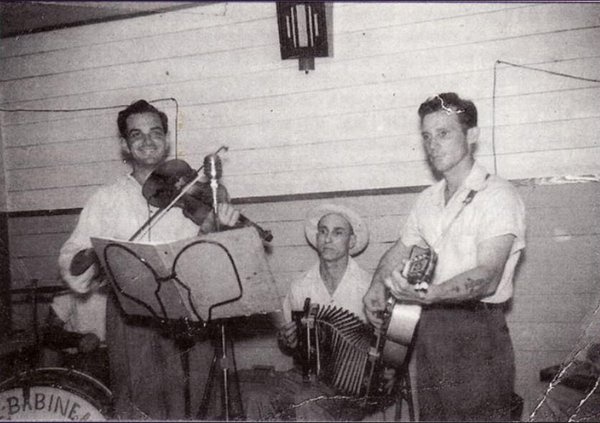
Cleveland’s up there on the Bandstand setting that fiddle on fire while Shorty Leblanc is cutting through the layers of smoke and befuddlement with his wake the dead accordion licks.
Keeping that dancing rhythm always alive is Charlie Babineaux on guitar and gliding over the top on the Steel guitar and laying down the vocals we have Jesse ‘Jay’ Stutes. Allons -y!
Sometimes the songs are sung in Cajun French sometimes in Cajun English – either way the message of loves won and lost and of a proud people celebrating their uncelebrated culture comes through loud and clear.
As Sugar Bee plays you can practically feel the hardwood floor bouncing up and down as the couples foot stompingly circle the dance hall.
This is gloriously rough and rowdy music with the kick of over proof corn liquor. And, the more you have the more you want – don’t worry about Sunday’s hangover it’s going to be more than worth it for the times that you’ve had! Ah! Lets get it man.
Cleveland was a 1919 born native of Hathaway, Louisiana who found, like so many, that Lake Charles offered regular work and all the luridly promised temptations of the city in full measure.
He had formed the Ramblers by 1950 and began recording for Folk-Star and Leader for the local Cajun market. Hooking up with Eddie Shuler’s Goldband Records in 1960, amplifying their sound and singing in English led to their great breakout hit (of course the record business being a cut-throat Business meant that Cleveland wasn’t exactly able to retire on the proceeds of his hit!).
But, he had made an immortal record that would go on to become a Cajun anthem and there are riches in Heaven for that.
And, I hear you ask – is the B side any good?
Damn right it is! ‘Drunkard’s Dream’ is for that time of the night when you and your dance partner are really in step and in tune (and likely more than three floors drunk!).
Now, you’re floating over the floor and the lights are gleaming like jewels and you don’t know or care what time it is and what time, if ever, you will get home. All you really know is that you wish this dance would never end. And the words of the song waltz and waltz around your mind ;
‘J’ai arrive hier au soir (z)a La maison
J’ai cogne, j’ai crie, j’ai pas de reponse
J’ai connu, (z)au moment que t’etais pas la
Quel espoir, quel avenir mais moi j’peux avoir?’
Monday morning, Blue Monday, will, as it always maddeningly does, come around and you will have to sweat and strain through another week of loveless labour. Yet, just at the limit of your vision is always the promise of another Saturday night when the Sugar Bee will fly again and all the drunkard’s can dance and dream to their hearts content.
Notes:
The hard to find Cleveland Crochet compilation on Goldband is well worth the search. Individual Hillbilly Rambler tracks are scattered across many fine Cajun collections.
I recommend versions of Sugar Bee by Canned Heat, Wayne Toups, Jimmy C Newman (live on the excellent Marty Stuart TV show), Jo-El Sonnier, Dr Feelgood and The Interns and Gene Taylor.’
In a time when more than ever we are hectored and daily assaulted by instant, ill informed and ill expressed opinions from commentators and pundits in print, on the airwaves and on social media we need more than ever the considered voice of poetry.
I believe that poetry is one of the glories of our species. Proof, that somewhere in the human spirit there is always a blessed movement towards understanding, reconciliation and wholeness.
Poetry has been a constant nurturing companion in my life. It’s poetry I turn to most for fellow feeling, illumination and consolation.
So today I’m collecting a garland of Christmas poems for you to ponder as you gather round for your seasonal celebrations. Drink deep!
First, ‘December’ by John Clare (1793-1864) a poet who was deeply attuned to the turning of the seasons and the rhythms of rural life.
‘… And some, to view the winter weathers,
Climb up the window-seat with glee,
Likening the snow to falling feathers,
In fancy’s infant ecstacy;
Laughing with superstitious love,
O’er visions wild that youth supplies’
Of people pulling geese above,
and keeping Christmas in the skies.’
Next the short but immensely wise, ‘BC : AD’ by the much under rated
U A Fanthorpe. (1929-2009)
‘… And this was the moment
When a few farm workers and three
Members of an obscure Persian sect
Walked haphazard by starlight straight
Into the kingdom of heaven.’
Now we turn to that great rarity a genuinely popular poet – John Betjeman (1906-1984).
Now for a very distinctive voice. ‘Advent: A Carol’ by Patric Dickinson (1914-1994) a writer who revered and translated the Classical poets while looking at the world himself with a sharply individual measured intelligence.
He’s pictured below with a much more famous poet – Dylan Thomas.
‘In The Bleak Midwinter’ is one of the glories of English poetry.
‘Angels and archangels
May have gathered there,
Cherubim and seraphim
Thronged the air-
But only His mother
In her maiden bliss
Worshipped the Beloved
With a kiss
What can I give Him?
Poor as I am?
If I were a shepherd
I would bring a lamb;
If I were a wise man
I would do my part;
Yet what I can, I give Him-
Give my heart’
Let’s hear that sung with elegant fervour by the very fine choral ensemble, Chanticleer.
‘The Carol Of The Poor Children’ is by Richard Middleton (1882-1911) a fascinating turn of the 19th/20th Century figure now more known for his stories like ‘The Ghost Ship’ than for his striking poetry.
‘Are we naked, mother, and are we starving-poor
Oh, see what gifts the kings have brought outside the stable door
Are we cold, mother, the ass will give his hay
To make the manger warm and keep the cruel winds away
We are the poor children, but not so poor who sing Our Carols with our voiceless hearts to greet the new-born king
On this night of all nights, when in the frosty sky A new star, a kind star is shining on high!’.
Anyone who has been a regular visitor to The immortal jukebox will know that I have deep feeling for the Irish contribution to literature and music.
So it was compulsory for me to include ‘A Christmas Childhood’ by Patrick Kavanagh (1904-1967) the sage of Iniskeen, one of the great figures of 20th Century Irish Literature. Kavanagh became a major figure in Dublin life and is commemorated by a Canal side statue.
Sit back and listen to the wonderful musical of Kavanagh’s words read aloud and linger for a performance of The Wexford Carol.
‘Carol For The Last Christmas Eve’ is by a favourite poet of mine, Norman Nicholson (1914-1987). He came from Millom in England’s rural Cumbria. Never fashionable Nicholson’s work will endure.
‘The first night, the first night,
The night that Christ was born,
His mother looked in his eyes and saw
Her maker in her son.
The twelfth night, the twelfth night,
After Christ was born, the Wise Men found the child and knew
Their search had just begun.
…
But the last night, the last night,
Since ever Christ was born,
What his mother knew will be known again,
And what was found by the Three Wise Men,
And the sun will rise and so will we,
Umpteen hundred and eternity’
Our next poet Charles Causley (1917-2003) had a mythopoetic imagination and the ability to make his words sing with bardic power.
‘Mary’s Song’ has always moved me.
‘Warm in the wintry air
You lie,
The ox and the donkey
Standing by,
With summer eyes
They seem to say:
Welcome, Jesus,
On Christmas Day!
Sleep, King Jesus:
Your diamond crown
High in the sky
Where stars look down.
Let your reign
Of love begin,
That all the world may enter in.’
I am going to conclude and hang my garland with ‘Christmas Night’ by a contemporary English poet, Lawrence Sail (b.1942).
‘On the wind, a drifting echo
Of simple songs. In the city
the streetlamps, haloed innocents,
click into instant sleep.
The darkness at last breathes.
In dreams of wholeness, irony
is a train melting to distance;
and the word, a delighted child
Gazing in safety at
a star solid as flesh.
May you all enjoy every moment and morsel of Christmas Tide.


 The Immortal Jukebox