Curtis Mayfield & Major Lance express the inexpressible : Um, um, um, um, um, um!

‘Now that I’m a man I think I understand sometimes everyone must sing this song

Um, um,um, um, um, um,

Um, um, um, um, um, um,

Um, um, um, um, um, um,

Um, um, um, um, um, um’

The songwriting genius of Curtis Mayfield and the seductive tones of Major Lance combine to create a Chicago Soul masterpiece and an anthem for us all in these, ‘interesting times’.


It may not surprise long term readers of The Jukebox to learn that I am a compulsive journal keeper.

I read a lot of newspapers and subscribe to a wide selection of specialist magazines which I scrupulously annotate before I make journal entries trying to pin down my version of posterity.

To make it easier to look up one of my particular interests later I prefix every entry with a code letter.

So, if an entry concerns Ireland an ‘I’ precedes the text. My memorials of notable deaths have, ‘Obit’ in front.

And so on.

There is one prefix which seems to be cropping up more and more these days demanded by articles I have read which have had my eyebrows shooting up to the skies in my bewildered head. That prefix is (!!).

(!!) does not necessarily indicate approval or disapproval.

It’s rather a chastening reminder that the world, the people in it, and the daily cavalcade of events are more mysterious, various and downright strange than my addled mind can adequately comprehend.

Sometimes all you can say, whistling a happy tune or humming a death tempo dirge, is:

Um, um, um, um, um, um,

Um, um, um, um, um, um,

Um, um, um, um, um, um

Um, um, um, um, um, um ..

Let’s kick off with this entry which burst back into my mind recently.

The source is H L Mencken:

Embed from Getty Images


‘All we got to say on this proposition is this: first, you and me is as good as anybody else, and maybe a damn sight better; second, nobody ain’t got no right to take away none of our rights; third, every man has a right to live, to come and go as he pleases, and to have a good time however he likes, so long as he don’t interfere with nobody else’ (!!)

Um, um,um, um, um, um,


little-auk-calling

‘Normally we see 100 Little Auks a year in St Cuthbert’s beloved Farne Islands. Today on the 89th anniversary of the end of World War 1 we saw 29,000’ (!!)

The Hamza River flows for some 3,700 miles at a depth of 13,000 feet below The Amazon River. (!!)

Um, um,um, um, um, um …
the-champ

‘The death scene in the film, ‘The Champ’ with Ricky Schroder and Jon Voight was found by a psychology professor from the University of California-Berkeley, to represent an emblem of pure sadness. The clip has since been used in experiments that range from testing the tearful responses of depressed people, elderly people and people with eating disorders to tracing the spending habits of sad people.’ (!!)

Um, um,um, um, um, um …

polar-bea

‘Polar Bears are Irish. Modern polar bears share a distinct DNA sequence, passed down the female line, with their now extinct brown ancestors. The same DNA fingerprint is absent from other species of brown bear alive today. It is thought the link arose from interbreeding between prehistoric polar bears and female brown bears when their paths crossed as the Irish climate cooled.’ (!!)

Um, um, um, um, um, um ..

Embed from Getty Images


‘Mary Prince lived in The White House during Jimmy Carter’s presidency as a housekeeper. In addition to his other duties President Carter was her parole officer as she was a convicted murderer. She had previously become Amy Carter’s nanny following assignment to the then Georgia Governor’s mansion.’ (!!)

Um, um, um, um, um, um ..

Embed from Getty Images


‘When former World Heavyweight Champion Sonny Liston’s dead body was discovered all that was found with him was an ounce of heroin, a shot of vodka, a gun and a crucifix (the Mafia like to keep things simple).’ (!!)

Um, um, um, um, um, um ..

juzcar

‘Located 113 km away from the city of Malaga and 25 km from Ronda, in the autonomous province of Andalusia, Juzcar has become a hotspot for worldwide travelers, and one of the most recognizable villages in Spain. Once a traditional white village, the picturesque hamlet changed its look in the summer of 2011, becoming the first and only official Smurfs village in the world.’ (!!)

Um, um, um, um, um, um ..

hudson-super-6

‘In 1930 Charlie Heard a taxi driver from Geelong, Australia hesitated only briefly before accepting a fare to take Ada Beal and her two lady companions to Darwin and back – a distance of some 7,000 miles. Charlie drove a 1928 Hudson, Miss Beal had a wooden leg and always wore a fur coat. The fare was in the order of 9,000 Australian Pounds. All parties returned safely to Geelong with stories to tell. Charlie bought a service station and stayed close to home therafter,’ (!!)

Um, um, um, um, um, um ..
mark-sykes-001

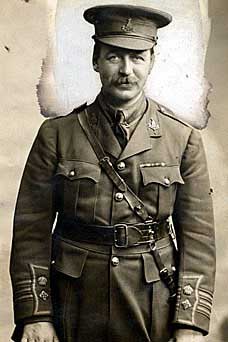
‘At a solemn service before sunset in a rural Yorkshire churchyard a battered lead-lined coffin was reburied hours after being opened for the first time in 89 years. As prayers were recited, samples of the remains of Sir Mark Sykes, the aristocratic diplomat and adventurer whose grave had been exhumed, were being frozen in liquid nitrogen and transported to a laboratory with the aim of saving millions of lives.

During his life, Sir Tatton Benvenuto Mark Sykes made his mark on the world map. As the British government’s lead negotiator in a secret 1916 deal with France to carve up the Ottoman Empire, he laid the groundwork for the boundaries of much of the present-day Middle East and, according to some critics, its current conflicts.

But it was the manner of the death of this Conservative MP, British Army general, and father of six children, that may yet prove the source of his most significant legacy by providing key answers in how medical science can cope with 21st century lethal flu pandemics.

Early in 1919, Sir Mark became one of the estimated 50 million victims of the so-called Spanish flu and died in Paris.

His remains were sealed in a lead-lined coffin and transported to the Sykes family seat in Yorkshire. He was buried in the graveyard of St Mary’s Church, adjoining the house.

Were it not for the fact that Sir Mark’s body was hermetically sealed by a thick layer of lead, the story of his life would have passed quietly into history.

But the accident of chemistry – the decay of soft tissue encased in lead is dramatically slowed – has presented scientists investigating ways to deal with the inevitable mutation of the H5N1 “bird flu” into a lethal human virus with a unique opportunity to study the behaviour of its predecessor.

There are only five useful samples of the H1N1 virus around the world and none from a well-preserved body in a lead-lined coffin. Sir Mark’s descendants are delighted that his influence may reach a different sphere of human endeavour. His grandson, Christopher Sykes, said: “We were all agreed that it was a very good thing and should go ahead. It is rather fascinating that maybe even in his state as a corpse, he might be helping the world in some way.” (!!)

Um, um, um, um, um, um ..

brian-bevan

‘A lifeboatman who saved the lives of at least 300 people and was awarded the service’s equivalent of the Victoria Cross retired on Friday after 27 years spent braving the North Sea.

Coxswain Brian Bevan, 55, would be rejected if he applied to join the Royal National Lifeboat Institution today. The ability to swim 100 metres fully clothed is now a prerequisite – and he gave up learning to swim after he was thrown in at the deep end and nearly drowned in a prank on a school swimming trip in the 1950s.

He observed: “You certainly don’t need to swim to man the lifeboat. Your lifejacket keeps you afloat.”

Pinpoint timing and a cool head helped Mr Bevan to earn the RNLI Gold Medal during a mission in a force 10 storm on Valentine’s Day 22 years ago.

He remains the only lifeboatman to receive the bronze, silver and gold medals of the Royal National Lifeboat Institution at a single ceremony.

He has no plans to learn to swim.'(!!)

Um, um, um, um, um, um ..


fra-angelio

‘When Jean Preston in the 1960s came across two small panels depicting medieval saints in a box of unwanted items up for a quick sale, she thought they they had an enigmatic quality and were, ‘quite nice’.

Miss Preston, from Oxfordshire, was working as a manuscript curator in California. Her father bought them for a couple of hundred pounds to indulge her interest in curious works.

For decades they hung, partly obscured, behind the door of her spare room. It was only after Miss Preston’s death, at the age of 77 that the panels were found to be key works (worth over £1m) by the Renaissance master painter, Fra Angelico, solving the 200 year mystery of their disappearance.’ (!!)

odell


‘For the first time in almost 60 years, Dianne Odell’s family home was silent yesterday. Only a string of well-wishers interrupted the eerie calm that pervaded the house where, for as long as anyone can remember, a noisy electric motor had powered the massive ‘iron lung’ pumping air in and out of her body.

Miss Odell had been in the iron lung for more than 50 years after contracting Polio in her youth. She was believed to be the world’s longest-surviving victim of polio to have spent almost her entire life inside an iron lung, a now virtually obsolete medical device that keeps patients alive by forcing air in and out of their paralysed bodies.

She was cared for by her close family together with a community of friends and admirers, with whom she made eye contact through an angled mirror. Despite the difficulties of Ms Odell’s condition, she managed to get a high-school diploma, take college courses, and even write a children’s book about a “wishing star”‘ called Blinky – all from the confines of the living room of her home.

Miss Odell proved the truth of the observation of the great moral philosopher Victor Frankl; that everything can be taken from you but one thing : the last of human freedoms – to choose your attitude in any set of circumstances, to choose your own way.

Recalling her life Miss Odell said:

I remember walking to a ball game with daddy and I remember being on a train. It seems like I can remember playing out in the mud one day.

But I’ve had a very good life, filled with love and family and faith. You can make life good or you can make it bad. I’ve chosen the good.’ (!!)

Um, um,um, um, um, um,

Um, um, um, um, um, um,

Um, um, um, um, um, um

Um, um, um, um, um, um ..

Sometimes the world is too much to take in. Too much.

In those times I find respite in the gracious words and melodies of Curtis Mayfield and the artless art of Major Lance.

I cue up, ‘Um, um, um, um, um, um’ and dance until my heart is full and my mind is free.

Give it a try.

Rosanne Cash, Eric Bibb, John Phillips and Scott McKenzie sing Hedy West : 500 Miles

‘We leave something of ourselves behind when we leave a place, we stay there, even though we go away. And there are things in us that we can find again only by going back there’  (Pascal Mercier)

‘The desire to go home that is a desire to be whole, to know where you are, to be a point of intersection of all the lines drawn though all the stars, to be the constellation- maker and the center of the world, that center called love.’ (Rebecca Solnit)

‘You can’t go home again.’ (Thomas Wolfe)

‘Lord, I’m one, Lord, I’m two, Lord, I’m three, Lord, I’m four,

Lord, I’m five hundred miles away from home.’ (Hedy West)

Much meaning can be expressed in so few letters of the alphabet

Just four will do.

Good. Evil. Luck. Fate. Time. Fear. Hope. Hate. Womb. Tomb. Life. Love.

And one four letter word might contain them all.

Home. Home.

The home you were born in; the home you grew up in, the home that was your shelter and refuge.

The home you left with tears in your eyes.

The home that lives forever in your heart and your mind’s eye.

The home that was your prison.

The home you left without a backward look.

The home you’ll never go back to now you’ve made a home of your own.

Home, home, home.

Should you write a true song evoking the longing for home when the tides of time have taken you far away you’ll find singers to sing that song for evermore.

Hedy West wrote such a song, ‘500 Miles’


Crystal clear. Mountain dew.

Banjo, voice, Presence, centuries of the ballad tradition.

Fiddle tunes and songs called Rueben’s Train, The Railroader’s Lament and 900 Miles all swirl in the imagination of a young woman growing up in a home suffused with tunes and stories and songs.

Great Uncle Gus plays the fiddle, Gradma Lillie plays the Banjo and has a bottomless well of ballads and laments that seem to float on the breezes all around.

Dad, Don West, is a poet (‘Clods of Southern Earth’), a labor organiser, a civil rights activist, an oral historian and inspiration.

west_don_photo

Hedy has a voice. She plays the Banjo in her own style.

She has the austere gravitas of a classical bard.

When she sings the room stills. When she sings she has something to say.

She has a calling.

A calling to tell the stories of the disregarded rural poor.

A calling to tell their stories in songs that express, and more honour, the depth of their struggles and the fullness of their humanity.

In a career of more than five decades taking her from folk contests in her native Georgia to Greenwich Village, Carnegie Hall, London and venues all over the globe it’s a calling she fulfills with steadfast hope, faith and love.

In the 1950s folk world a song as true and singable as 500 Miles scorches across the continent like a raging forest fire.

It instantly becomes a folk standard with each group or artist adapting the lyric and instrumentation to suit their own style and the image of home they carry with them.

‘Lord, I’m one, Lord, I’m two, Lord, I’m three, Lord, I’m four,

Lord, I’m five hundred miles away from home.’

As far as I can tell the first notable recording of the song is by The Journeymen in 1961.

Now, you’d have to be a scholar of the American Folk Revival to sagely nod once their name is mentioned. Yet, almost all of us came to know the members of the group through their later careers.

journeymen

John Phillips became the leader of prolific hit makers The Mamas & the Papas, Scott McKenzie had a whole generation singing, ‘San Francisco (Be Sure To Wear Flowers In Your Hair) while Dick Weissman achieved eminence as a banjo picking musicologist and folklorist.


Listening to this time suspending version in soft sift black and white dreams I drift through the home of my own childhood.

Streetlights glow the palest yellow as they struggle to penetrate the blanket like London Fog of the 1950s.

Spectral trolley buses are boarded by attentively following their clanging sound until they suddenly loom up before you.

Snow surrounds market stalls piled high with cheap goods sold as wondrous bargains you must not be without – ‘Buy now Mrs! When they’re gone they’re gone!’

Cocooned in a two room first floor flat a young boy, certain in his bones that he is the constellation-maker and centre of the world, learns to read, ‘Treasure Island’ and dreaming of wooden ships, wooden legs, parrots, pirates and buried plunder begins to dream stories of his own.

‘Lord, I’m one, Lord, I’m two, Lord, I’m three, Lord, I’m four,

Lord, I’m five hundred miles away from home.’

As we have seen from the previous post here on The Jukebox when it comes to recognising an American standard Johnny Cash is your go to man.

Johnny took his curatorial role so seriously that he drew up, ‘The List’ – a compendium of great songs he entrusted to his daughter Rosanne.

Following her father’s death Rosanne returned over and over again to The List and the result was a luminously beautiful record featuring haunting tracks like Dylan’s , ‘Girl from the North Country’, ‘Long Black Veil’, Motherless Children’ and, ‘Miss the Mississippi and You’.

The one I come back to the most though is her devoutly heartfelt take on 500 Miles.


Johnny sure would have been proud.

‘Lord, I’m one, Lord, I’m two, Lord, I’m three, Lord, I’m four,

Lord, I’m five hundred miles away from home.’

Great songs call out across the miles, across genres and cultures and across time.

The veteran Acapella group The Persuasions uncover the longing, the loss, the mourning and the journey to the farther shore that awaits us all.

Their Gospel and Spiritual version of 500 Miles makes a congregation of us all.

‘Lord, I’m one, Lord, I’m two, Lord, I’m three, Lord, I’m four,

Lord, I’m five hundred miles away from home.’

500 Miles is a song that speaks from and to the bonds of familial love.

I’ll conclude with a blessed version by a father and son, Leon and Eric Bibb, which has the quality of a foot sore pilgrimage concluding in longed for peace and reconciliation.

‘Lord, I’m one, Lord, I’m two, Lord, I’m three, Lord, I’m four,

Lord, I’m five hundred miles away from home.’


We are all pilgrims.

May we all find peace reconciliation and the home we seek.

Notes:

I love every record made by Hedy West.

Seek out her CDs on the Vanguard, Topic and Bear Family labels for a lifetime of inspirational listening.

The only CD I can find by The Journeymen is, ‘New Directions In Folk Music’ on Collectors Choice from 2010 which is a nice collection of thistledown folk.

Eric and Leon Bibb’s, ‘A Family Affair’ hard to find is a gem well worth the search.


Johnny Cash, Debbie Harry & Gene Autry chase Ghost Riders In The Sky!

The ‘Way out West’ Series No 1

Music hath charms. Music hath charms.

And, among those charms is its uncanny ability to forge bonds of fellow feeling and friendship between people born in wildly different times, places and cultures.

Take me and Carl.

Carl came from the spice Island of Grenada in the Caribbean.

When we met he was seventy years old and I was a callow twenty two.

I had just emerged, blinking, from the ivory tower of Cambridge University awaiting my inevitable discovery as a great novelist.

Carl had spent decades in the fierce factories of Detroit and the searing cane fields of Florida.

We met in Hospital.

I was working there as a porter dramatically rushing the resuscitation trolley to people on the point of death and more prosaically ferrying patients to the X-Ray department and to the operating theatre for surgery.

Carl, having suffered a heart attack, came into Accident & Emergency by ambulance at 3am when I was on night shift.

I watched with a mixture of horror and fascination the team of doctors and nurses, with whom moments before I had been sharing idle banter,  urgently bring all their professional skills to the struggle to to save Carl’s life.

Happily they succeeded and before I left that morning I wheeled Carl to the ward where he would recover.

Normally that would have been the last time I saw him but as I was about to leave Carl said, ‘Will you come and see later?’.

A request I could hardly refuse.

So, that night I made the first of many visits to Carl’s bedside in the three weeks he spent in the hospital.

Walking into the ward I wondered what two such disparate individuals might find to talk about.

Almost without thinking I asked him, having learned of the time he had spent in America, what kind of music he had listened to there.

Given his age, and reading on his chart  that he was a Baptist by religion, I anticipated that he might answer Big Band Jazz or Gospel Music.

I was a little taken aback therefore when he answered by singing in a mellow baritone:

‘An old cowpoke went riding out one dark and windy day,

Upon a ridge he rested as he  went along his way,

When all at once a mighty herd of red-eyed cows he saw

Riding through the ragged skies and up a clouded draw …’

Now, my education, at University, might have been airily academic but luckily on those few occasions when I was not bent over some medieval text I could be found, a huge tub of popcorn by my side, obsessively watching every ‘A’, ‘B’ or series Western that ever came to town.

So, without missing a beat, I joined in as we sang:

‘Their brands were still on fire and their hooves were made of steel,

 Their horns were black and shiny and their hot breath he could feel,

 A bolt of fear went through him as they thundered through the sky,

For he saw the riders coming hard and he heard their mournful cry ..’

And then, to the incredulity of the rest of the ward, we lifted our voices up and sang together lustily:

‘Yippie I aye, Yippie I ooh,

 Yippie I aye, Yippie I ooh,

 Ghost Riders In The Sky’

Then we laughed and laughed until we nearly cried.

And, we sang that song, among many other Western favourites, every time we met until Carl died some two years later.

‘Ghost Riders In The Sky’ was Carl’s favourite song and the version he preferred, ‘Because he don’t mess about with the song’ was the one by Gene Autry from 1949.

This one’s for you Carl:


According to the Western Writers of America, ‘Ghost Riders In The Sky’ is the greatest of all Western songs and I whole heartedly agree with that august body.

The song was written in 1948 by Stan Jones and first recorded by him and his marvelously named, ‘Death Valley Rangers’ that same year.


stan-jones-2

Stan, then a Park Ranger in Death Valley, is reputed to have written the song on his 34th birthday as he recalled a legend told to him when he was 12 by an old cowboy.

Now, all stories told by Stan Jones need to be taken with a fistful of salt as he was a noted fabulist who often valued the effect of a tale above its veracity (as frequently do I!).

The tale of the spectral herd in the skies and the curse of, ‘Stampede Mesa’ probably traces its origins to mythical cautionary stories told around the cowboy campfire in nineteenth century Texas.

Whatever its cultural lineage Stan crafted a certifiable classic which is shot through with haunting images which never leave the mind once heard.

Burning in the mental firelight of my imagination as the song proceeds I feel the hot breath of those red-eyed cows and shudder with fear as their black and shiny horns and steely hooves thunder by.

In my dreams I’m there with the gaunt faced cowboys their shirts soaked with sweat as they endlessly pursue the cursed herd they never, ever, will catch.

Surely that’s my name I hear them calling in the wind at the dead of night!

‘Yippie I aye, Yippie I ooh,

 Yippie I aye, Yippie I ooh,

 Ghost Riders In The Sky’

Stan wrote many more fine Western ballads notably those featuring in the films of the greatest of all Western Film Directors – John Ford.

But, neither he, nor anyone else, ever wrote a better one than, ‘Ghost Riders In The Sky’.

The brilliance and mother lode Americana quality of the song has, for seven decades now, attracted hundreds and hundreds of artists to take a shot of rye, strap on their spurs and saddle up with the Ghost Riders to see if that herd can finally be corralled.

And, if anyone, by force of will and character could carry out that miracle it would surely be none other than Johnny Cash – no mean mythic figure himself.


Johnny sings the song with the oracular power an old testament prophet issuing a grave warning to his tribe to prevent them from sleepwalking to doom.

You want fire-snorting horses brought to life?

You want those ghostly riders coming hard right at you?

You want to feel those mournful cries in the pit of your stomach and the marrow of your bones?

Call for The Man in Black!

‘Yippie I aye, Yippie I ooh,

 Yippie I aye, Yippie I ooh,

 Ghost Riders In The Sky’

Stan Jones’ evocative melody has always attracted guitarists and instrumental groups who like to tell an atmospheric story using six resonant strings instead of the vocal chords.

Today I’ve chosen to feature a top 30 Billboard Chart hit from 1961 (and top 10 in the UK) by The Ramrods  – who had clearly listened closely to Duane Eddy.


The Ramrods were out of Connecticut and had brother and sister Claire and Rich Litke on drums and sax respectively.

Vinny Lee took the lead guitar role with Gene Moore in support.

Embed from Getty Images

They were essentially one hit wonders though I greatly enjoyed listening to their follow up, ‘Loch Lomond Rock’ which, probably uniquely, mashes up twangtastic guitar with a bagpipe solo!

And, now as they say, for something completely, completely different.

I have to say that when I started researching this post I never expected to feature a trance version by Debbie Harry!


‘Yippie I aye, Yippie I ooh, Yippie I aye, Yippie I ooh’ Indeed!

 Debbie’s version comes from Alex Cox’s 1998 film, ‘Three Businessmen’ and in my view is the best thing about it.

The production is by Dan Wool who had worked frequently with Stan Jones’ son who is a music editor – so legal clearances to use the song were easily arranged.

There’s definitely something sexily hypnotic about Debbie’s vocal adding an unexpected dimension to an established standard.

I’m going to conclude with another version out of left field or should I say the firmament.

And, versions of Ghost Riders don’t get more left field than the hipster version by Scatman Crothers!

‘Yippie I aye, Yippie I ooh,

 Yippie I aye, Yippie I ooh,

 Ghost Riders In The Sky’


Everyone has heard Scatman’s distinctive tones through his voice over work for TV and film. That’s Scatman as Hong Kong Phooey and as the hep Jazz playing feline in, ‘The Aristocats’.

Some may remember his appearances on TV in the show, ‘Chico and the Man’ or on film as Dick Halloran in Kubrick’s, ‘The Shining’ (one of four films he shared billing with Jack Nicholson).

Scatman was always a hep cat as evidenced by his drumming with Slim Gaillard. He brings all his vouty hipster presence to this version of Ghost Riders which has me cheering him on while doubled up with laughter.

There will be many more fine versions of Ghost Riders because we all love a good story.

Especially one that’s so incredible it just has to be true.

‘Yippie I aye, Yippie I ooh,

 Yippie I aye, Yippie I ooh,

 Ghost Riders In The Sky’


Notes:

There’s a fine biography of Stan Jones by Michal K Ward published by Rio Neuvo.

The major hit version was by Vaughn Monroe

Basso profundo versions by Lorne Green, Marty Robins, Burl Ives, Frankie Laine

Western versions by Sons of the Pioneers, Riders in the Sky, Chris Ledoux, Jimmy Wakeley, Mary McCaslin

Instrumental versions by The Ventures, The Shadows, The Spotniks, Glen Campbell/Roy Clark, Dick Dale

‘Other’ versions by Spike Jones, Blues Brothers, Brothers Four, Judy Collins, Christopher Lee


Jonathan Richman : Roadrunner! One, Two, Three, Four, Five, Six!


‘… He who kisses the joy as it flies
Lives in eternity’s sun rise.’ (William Blake)

‘We’d come up over a hill and he’d see the radio towers, the beacons flashing, and he would get almost teary eyed .. He’d see all this beauty in things where other people just wouldn’t see it.’ (John Felice, childhood friend of Jonathan Richman)


‘… Roadrunner once, Roadrunner twice, I’m in love with rock & roll

and I’ll be out all night’ (Jonathan Richman)

Embed from Getty Images


It is a matter of some hilarity in our family and eyebrow raising puzzlement to visitors to our home that whenever I perform any kind of count off I don’t echo the rock roadie, ‘One, two – one, two’ or the more conventional, ‘One, two, three, four …’.

Oh no!

When I count off I always chant with a crazed grin and extreme vigour:

One, two, three, four, five, six!

And, the reason for this is simple.

One, two, three, four, five, six!‘ is the intro to what may well be the most exhilarating rock and roll song ever recorded.

A song that never, ever, fails to thrill when you hear it – no matter which of its numerous live or recorded versions you chance upon or carefully select.

I refer, of course, to Jonathan Richman and The Modern Lovers immortal, ‘Roadrunner’.

We should, as they say, begin at the beginning.

Jonathan Richman was born in Natick, Massachusetts 10 miles west of Boston on May 16 1951. After a conventional suburban childhood the teenage Jonathan had a Pauline epiphany which would change his life forever.

On the radio, among 1967’s kaleidoscope of folk rock, blues rock, summery pop and psychedelia something shockingly, wonderfully, NEW crashed into his consciousness.

From the dark heart of New York City strange siren songs filled with sin and secrets – The Velvet Underground.

Embed from Getty Images

The combination of Lou Reed and Sterling Morrison’s relentless guitar attack, Lou’s deadpan vocals, John Cale’s instrumental extremity and Mo Tucker’s zen drumming entirely redrew the map of the world for Jonathan.

From that epochal moment whenever The Velvets played Boston, invariably at the Boston Tea Party at 53 Berkeley Street, Jonathan was there – absorbing the music through every physical and spiritual pore.

A particular favourite of his was, ‘Sister Ray’ a dervish three chord cataclysm that could last for anything up to half an hour until the band and audience were transported to undreamt of dimensions of being.

And, no one listening flew further or higher on the astral plane than Jonathan. For he was a waking dreamer with dreams of his own.

Dreams of his own that would become songs like shooting stars.

Songs influenced by his beloved Velvets but glowingly imbued with the imagination of a young man who intuitively perceived the shining radiance of the everyday world all around him.

A young man who could make that radiant world burst into life through a few chords and the total immersion of his own being in the song he was singing.

A young man who could write and perform a transcendent anthem about listening to the radio as he drove round Boston’s suburbs.

A young man who could turn the, ‘Stop ‘n’ Shop’, Route 128, the suburban trees, the factories, the auto signs and the radio waves saturating the Massachusetts night into holy way-stations on an ecstatic journey to heaven!

Join Jonathan now on that journey.


Va Va Voom! Va Va Voom! Va Va Voom!

There are apocryphal tales of Disc Jockeys in the 1950s locking themselves into the studio as they played, ‘Heartbreak Hotel’ over and over and over until desperate radio station bosses broke in with axes to restore sanity to the airwaves.

I know exactly how those DJs felt.

I remember, as if it were yesterday, buying in August 1976 the vinyl LP, ‘Modern Lovers’ which had, ‘Roadrunner’ as its opening track.

I believe it took me several dazed days and nights before I even attempted to play another track on the record as I obsessively wore out the Roadrunner groove.

As soon as I got back to college I announced with a prophet’s zeal to anyone who would listen that their lives would be transformed by listening to Jonathan Richman and The Modern Lovers, ‘Roadrunner’.

Look what listening to it a couple of hundred times had done for me!

Jonathan wrote Roadrunner in 1970 and recorded it first with John Cale as producer in 1972 – though such were the vagaries of the music business that it took until 1976 for it to emerge.

You can hear the homage to The Velvet Underground and especially Cale’s organ sound all through this version of Roadrunner.

The rhapsodic keyboards are courtesy of Jerry Harrison who would later achieve fame with Talking Heads. David Robinson, later of The Cars, provides the foot to the floor and keep it there drums. Ernie Brooks anchors everything on the bass.

And Jonathan? Well, miraculously, Jonathan brings his innocent eye and his full heart to the song and conjures a lustrous landscape where the spiritual and physical realms we live and move in balletically entwine.

In this song, and to my mind particularly in this version, Jonathan Richman achieves something very rare.

He manages to create a work of art which captures the quantum quick of life.

The reach and energy of his imagination takes him to a place where is viscerally aware of the unique distinctiveness of the people and objects in the world around him.

And, surrendering his ego to that vision he accepts it as a gift and offers it to us.

If we accept it, as he did, we too will have had a glimpse of eternity’s sunrise.


Notes:

There are many versions of Roadrunner.

‘Roadrunner Twice’ a hit single in the UK was recorded in 1974 with Jonathan backed by The Greg Kihn Band.

‘Roadrunner Thrice’ is a wonderful live version.

Jonathan is a mesmeric performer able to fill a room with joy with a capital J.

So the best version of Roadrunner ever may be one he is yet to play.


Dolores Keane : Never Be The Sun – Voice and Vision from Ireland

‘.. Every night their mouths filled with Atlantic storms and clouded-over stars and exhausted birds. And only when the danger was plain in the music could you know their true measure of rejoicing in finding a voice where they found a vision.’ (Eavan Boland)

‘As long as Dolores Keane is walking around this earth, I won’t call myself a singer. I think she’s the voice of Ireland.’ (Nanci Griffith)

To my mind the besetting malady of modern life is atomisation.

Meagre lives lived in migraine-fraught locked and barred isolation.

When I seek a musical antidote to my despair about this situation I turn most often to a singer, Dolores Keane, whose every breath embodies not atomisation but connection. Embed from Getty Images

Dolores had the immense good fortune to be born, in 1953, into a family who were keepers of the flame of Irish Traditional Music in a time when the deep treasures of the tradition were at risk of being swept aside by the glittering lures of commercial modernity.

From the age of four Dolores lived in Caherlistrane, County Galway, with her aunts Rita and Sarah.

The Keane sisters played accordion and fiddle but their greatest accomplishment was their heart stopping prowess as duet singers of ballads in the Sean-nos or old style.

Literally growing up at their feet Dolores imbibed their mastery through every pore of her being. In the kitchen and in the parlour songs sounding the depths of human experience were sung with full hearted candour and artistic delicacy.

Dolores, as a child, was exposed, initiated, into the, ‘Big Music’. Later, while still a young woman she was able to give life to the Big Music herself.

Knowing, in her heart and bones, where she was from set her free to voyage out into the wider world armed with a sense of inner poise.

The golden lesson Dolores learned from Rita and Sarah was that a singer’s duty was to devote all the emotional and technical resources in their gift in service of the song.

To bring a song to quickening life required discipline, engagement and above all attention. Attention to lyric, story and melody.

Attention to breath and pace.

Artistic, emotional and spiritual attention. Dolores listened with rapt attention to the artistry of her aunts. The proof of how diligently she attended can be heard through every moment of her sublime performance of, ‘The May Morning Dew’ from her debut solo record, ‘There Was A Maid’.

There can be no such thing as the definitive performance of such a song.

Traditional singers taking on the challenge are in pursuit of a wild hare which will always eludes capture.

There is always, always, more singing in the song.

Yet we can say that it is hard to imagine that anyone has ever engaged in a more thrilling pursuit than Dolores.

She inhabits, ‘The May Morning Dew’ so intensely that we feel connected to a complete world.

Connected to a living hospitable community.

Connected to the trees and the sky, the flowers in the valley, the calling of the small birds and the farmyard dogs.

Connected to the sound of the kettle boiling on the hob as neighbours converse on matters of great local import under the sky blue and clear.

Feeling the tender warmth of such a world we must feel too the chill and the pang of knowing that all things must pass, all things must pass.

So the beloved house will become but a stone on a stone and the lovingly tended garden a a riot of weeds.

And, like the red rose our parents, our friends and relations and, we cannot deny it ourselves, will perish in the May morning dew.

Dolores’ singing arrests time and allows us, each in our own way, according to our history, to contemplate and perhaps come to terms with the timeless truths of the song.

Next a contemporary song, ‘Never Be The Sun’ written by Donagh Long.

Every listener to this song will recall the one, who for them, will always be the light. Always be the light.

I have never listened to this performance without salt tears cascading down my face.

I really have no words to express how magnificent Dolores singing is here except to say that as she sings I leave the dusty Earth behind as she sets the very sun, the deepest ocean, the moon and the stars in sway.

Listening to Dolores singing epic ballads from the treasury of folk music history has convinced me that very few modern songwriters have works to compete with that great writer, ‘Trad’.

Still, we can all allow that Bob Dylan and Richard Thompson have added mighty stones to the cairn of the song hoard.

And, it is certain that the late Guy Clark, supreme craftsman of the narrative ballad, has too.

The pain and the promise of emigration seems to be always present in Ireland’s history and culture. As such it has proved a rich seam for songwriters to mine.

With, ‘Emigrant Eyes’ Guy Clark, with typical skill, yokes the sweep of history with the hope and the blood and the tears of generations to make a song crying out for a singer who can hold all these in balance.

A singer who can span oceans and centuries and set the heart and imagination ablaze.

In Dolores Keane he finds that singer.

I will leave you with a privileged glimpse into the roots of Dolores Keane’s art.

Together with her beloved Aunts Rita and Sarah she sings, ‘Once I Loved’ .

As they sing they evoke for me all time and no time.

History and pre-history.

Fairy forts and ancient barrows.

Passage graves, beehive chapels and high crosses.

Healing wells and hedge school philosophy.

Blind Harpers and hermit Saints.

The flight of the Heron and the Curlew.

The rush of the wind over the reeds.

The mysterious music of the constant moon and the day-blind stars.

Dolores Keane, while gifting us untold riches, has come through well documented struggles with depression, alcohol and cancer.

She is a singer of the stature of Bessie Smith, Umm Kulthum and Aretha Franklin.

She has sung herself, and us as listeners, back to where the singing comes from.

I wish her health and peace and songs to sing whenever she chooses to sing them.


Notes: Dolores Keane has an extensive catalogue.

Every record she has ever made is worth of your attention.

My personal favourites are:

‘There Was A Maid’

‘Solid Ground’ ‘

Broken Hearted I’ll Wander’ & ‘Farewell To Eirinn’ (With John Faulkner)

‘De Dannan’ & ‘Ballroom’ (from her time with the group De Dannan)


Rita & Sarah Keane’s mesmeric singing can be found on, ‘Once I Loved’ & ‘At The Setting Of  the Sun’.

There is a heart wrenching documentary, ‘A Storm in the Heart’ on Dolores’ life by Liam McGrath.

The best book on Traditional Music I have ever read is Ciaran Carson’s, ‘Last Night’s Fun’.

A fascinating insight into Caherlistrane where Dolores grew up can be found in the history/memoir, ‘Caherlistrane’ by Mary J Murphy – available online from Charlie Byrne’s Bookshop in Galway.

Phil Everly Remembered


Phil Everly’s physical voice was stilled four years ago.

Embed from Getty Images


Yet his voice on record and in the hearts of generations of listeners now and to come will surely never be stilled.

The keen in his and Don’s voices cuts deep. And deeper with the years.

So, its a rare week when I don’t find myself humming an Everly Brother’s song as I go about my daily life.

Phil and Don’s divine harmonies continue to strike chords in my heart.

Today, in his honour, a Reblog of one of the earliest posts on The Immortal Jukebox.

One where I felt my own voice called by Phil’s.

I hope I have done him justice.

There is a magical moment during the Everly Brothers celebrated and triumphant reunion concert at The Albert Hall in 1983 which goes some way to explaining the source of their enduring appeal.

After opening with a heart warming , ‘Bye Bye Love, a rocking Claudette, the magesterial, ‘Walk Right Back’  a forlorn, stately, ‘I’ll Do My Crying In The Rain and the knock-out punch of, ‘Cathy’s Clown’ the band, which featured England’s guitar legend Albert Lee, took a momentary breather.

The two brothers briefly smiled at each other knowing now that a decade apart had in no sense diminished their power as performers.  Reassured, they leaned their heads close together and began to sing acapella, ‘These are the words of a frontier lad who lost his love when he went bad.’

The opening lines of, ‘Take A Message to Mary’.  As their two voices entwined in a rich fraternal harmony of heartbreakingly vulnerable perfection you can feel the whole audience catch their breath as countless personal memories are evoked.

Memories of the passing years with all their freight of love, joy and loss.  Memories of friends, lovers and family happily present and memories of those now separated by distance, time and mortality.

Looking around the auditorium it was clear that few popular music figures have ever burrowed so deep into their fans emotional core or repaid that loyalty and affection with such tender grace.

Simply put the Everly Brothers were the greatest duet singers and brother act in the history of popular music.

It will remain a mystery as to why the sibling relationship and consanguinity combined to supercharge the emotional resonance of Phil and Don’s harmony vocals and how this mysterious power could survive and endure for virtually all their lifetimes as brothers – whatever the state of their personal relationship.

It was surely a mystery to them as much as to anyone else.

Phil Everly’s life began in Chicago but he was in every other sense a son of the South.  His parents were Kentuckians and musicians.  From the age of six he was singing on the radio with elder brother Don and his parents.

The songs they sang were country songs or those weird and wonderful folk songs as Dylan put it about, ‘Roses growing out of people’s heads’.

From the get-go it was clear that these two brothers, influenced by other brother acts like the Delmores and Blue Sky Boys, had a uniquely potent mystical chemistry that made their arousing and keening singing able to thrill and also to pierce the hardest heart.

As they grew older the cute boys became handsome young men, accomplished guitar players and confident performers.  They were thus in prime position in the late 1950’s to shoulder their jet black Gibson guitars ready to ride and help drive the runaway rock ‘n’ roll train as far as it could go.

Settling into their recording career at Cadence Records and supplied with a string of classic teenage angst songs by the likes of Felice and Boudleaux Bryant (‘Bye Bye Love’, ‘Wake Up Little Susie’, ‘All I Have To Do Is Dream’) the Everly’s took up residence in the hearts and memories of a generation.

Phil himself wrote one of their signature teenage classics, ‘When Will I Be Loved’.  Up until the advent of the Beatles led British invasion the Everlys were reigning rock ‘n’ roll royalty enjoying massive chart success and the esteem of their fellow artists.

They were also enormously influential – The Beatles, Simon and Garfunkel, The Hollies and The Beach Boys all freely acknowledged their admiration and desire to emulate the wonder of the brothers’ harmony singing.

Of the two brothers Phil was by all accounts the more outgoing, sensible and grounded of the two.  Though the younger brother it seemed that he was the one looking out for the more mercurial and vulnerable Don.

Don, whose voice seems able to cleave your ribs and pull your heart apart generally took the lead part while Phil intently, watchfully, with a brother’s love and care, held everything together with poignant poised harmony.

Together they made a sound that has rarely been matched for longevity of emotional impact.

Phil had some notable successes as a solo artist including recording the excellent, ‘Star Spangled Springer’ album (1973) which contains the wonderful tracks, ‘The Air That I Breathe’ and ‘Snowflake Bombadier’.

He also worked fruitfully on the soundtracks of the Clint Eastwood  movies, ‘Every Which Way But Loose’ and, ‘Any Which Way You Can’.

Genuine though these successes were they are minor in comparison to the luminous body of work he created with his elder brother.

They were great country singers, great rock ‘n’ roll singers and great pop singers.

Their body of work is sure to provide emotional sustenance and solace long into the forseeable future.  For people will always fall in and out of love and always carry the scars of past hurts even as they embrace new hope.

There will always be an Everly Brothers song to turn to.

Pop Staples : Faith, Friendship & Beguiling Guitar!


‘Think where man’s glory most begins and ends and say my glory was my friends’ (WB Yeats)

‘The greatness of a man is not in how much wealth he acquires but in his integrity and his ability to affect those around him positively.’ (Bob Marley)

Some of us spend our whole lives trying to figure out just exactly who we are.

For some creative artists that pursuit can be both furious and fruitful – consider the late much lamented David Bowie.

But there is a high cost in psychic and emotional wear and tear in living such lives.

Better to my mind to find out who you are early and then just be.

Easier, of course, said than lived.

So, I find that when I encounter that rare person who is entirely comfortable in their own skin and content to be nothing other than themselves I am both surprised and enormously impressed.

And, my ultimate example of such a person would be Roebuck ‘Pop’ Staples; singer, songwriter, guitarist extraordinaire and Patriarch of the greatest Gospel group of the modern era, The Staple Singers.

Embed from Getty Images


I first saw him some time in the mid 1980s at one of my favourite music venues/watering holes of those times ‘The Borderline’ a small basement club in Charing Cross Road London.

Somehow, that night, Pop through his prophetic guitar, beguiling voice and grace filled songs turned a ramshackle crew of booze hounds and music aficionados into a joyful clapping on the off beat congregation.

The inner lit warmth of Pop’s faith and the transparent sincerity of his belief in the fellowship of mankind made for a transformative experience.

I had expected to be affected by his history and his talent.

I had not expected to be so moved by his person.

Actually to feel I was a better person simply by having been in the same room as him.

With Pop there’s no tortured theology, no secret knowledge for the elect alone.

Instead there’s faith, fellowship, fraternity and guitar playing throbbing with power and portent.


What more can I say?

Well, just that if you’re looking for some resolutions for 2017 (and every year thereafter) you might listen closely to the lyric above.

And if you want some watchwords as the year progresses you won’t do better than to remember and embody some more wise words Pop lived out every day of his life:

Respect yourself.

Reach out touch a hand – make a friend if you can.

In these troubled times that will certainly do for me


Happy Christmas from Bob Dylan, Charles Dickens, Judy Garland & Immortal Jukebox!


Twelfth Day:

An Etching by Rembrandt

A Literary extract from Charles Dickens

Music by Shostakovich conducted by Rostropovich, played by Maxim Vengerov, Bob Dylan and Judy Garland

Our painting today is by Rembrandt who may be the most searching anatomist of the human heart who has ever lived.

rembrandt

There is such depth of humanity in Rembrandt’s etching of Mother and Christ Child.

The scene glows with immediate and eternal love and intimacy.

Our first music selection today is one of the great works of the 20th Century.

Shostakovich lived through dark times yet, perhaps because of this, his work while never denying the darkness always returns to the light.

Maxim Vengerov is a musician to his fingertips and urged on by Rostropovich he wrings every scintilla of emotional power from the work.

Onward!

So, at last – the twelfth day of our Sleigh’s journey and it’s Christmas Eve!

I hope you have enjoyed the music and reflections on the way here.

I have agonised over the music choices in this series and have many years worth stored up for Christmases to come (you have been warned!).

But today’s choices were the first I wrote down and were my inevitable selections for the day before the great Feast.

First, the Keeper of American Song, Bob Dylan, with his inimitable spoken word rendition of Clement Moore’s, ‘The Night Before Christmas’.

It is safe to say that Bob’s pronunciation of the word ‘Mouse’ has never been matched in the history of the dramatic arts!

Of course, in the process of his more than 50 year career Bob has continually been reinventing himself and in so doing has gloriously renewed American culture.

The clip, above comes from his wonderful, ‘Theme Time’ radio show where over a 100 episodes he displayed an encyclopaedic knowledge of twentieth century popular music and a wicked sense of humour.

Bob also recorded for the season at hand the deeply heartfelt, ‘Christmas In The Heart’ album which gets better and more extraordinary with every hearing.

It is clear that Bob, who is well aware that it’s not dark yet (but it’s getting there) is consciously rounding out his career by assuming the mantle of the grand old man of American Music tipping his hat to every tradition (hence the deeply stirring Sinatra covers CDs).

The only safe thing to say about Bob is that he will have a few surprises for us yet!

And, indeed this year he assumed in typically enigmatic way the mantle of a Nobel Laureate. The man never known to make a foolish move managed by not attending the investiture ceremony to harvest more publicity than all those who did!

In his nicely judged speech he managed to be both filled with humility and unblinkingly directly compare himself to Shakespeare!

Now that’s the one and only Bob Dylan!

Now we turn to Judy Garland with a Christmas song without peer, ‘Have Yourself A Merry Little Christmas’. Her singing on this song seems to me to be almost miraculous.

It’s as if her singing really came from the secret chambers of the heart all the rest of us keep under guard.

No wonder she has such a deep impact on us – we know she is expressing a profound truth about the human condition – our need to love and know we are loved.

Judy Garland paid a high price in terms of personal happiness for living her life and art with such an exposed heart and soul but she fulfilled a vocation given to very few and left an indelible mark on her age and will surely do for aeons to come.

Today, not a poem but the concluding passages from, ‘A Christmas Carol’ by the incomparable Charles Dickens – a writer for all seasons and situations.

‘Hallo!’ growled Scrooge, in his accustomed voice, as near as he could feign it. What do you mean by coming here at this time of day?

‘I am very sorry, sir’ said Bob, ‘I am behind my time,’
‘You are?’ repeated Scrooge. ‘Yes. I think you are. Step this way, sir, if you please.’
‘It’s only once a year, sir,’ pleaded Bob, appearing from the Tank. ‘It shall not be repeated. I was making rather merry yesterday, sir.’

‘Now I’ll tell you what my friend, said Scrooge, I am not going to stand that sort of thing any longer. And therefore, he continued, leaping from his stool and giving Bob such a dig in the waistcoat that he staggered back into the Tank again, and therefore I am about to raise your salary!’

Bob trembled and got a little nearer to the ruler. He had a momentary idea of knocking Scrooge down with it, holding him, and calling to the people in the court for help and a strait-waistcoat.

‘A merry Christmas Bob! said Scrooge, with an earnestness that could not be mistaken, as he clapped him on the back. ‘A merrier Christmas, Bob, my good fellow, than I have given you for many a year! I’ll raise your salary, and endeavour to assist your struggling family, and we will discuss your affairs this very afternoon, over a Christmas bowl of smoking bishop, Bob! Make up the fires, and buy another coal-scuttle before you dot another i, Bob Cratchit!’

Scrooge was better than his word. He did it all, and infinitely more; and to Tiny Tim, who did NOT die, he was a second father. He became as good a friend, as good a master, and as good a man, as the good old city knew, or any other good old city, town, or borough, in the good old world. Some people laughed to see the alteration in him, but he let them laugh, and little heeded them; for he was wise enough to know that nothing ever happened on this globe, for good, at which some people did not have their fill of laughter in the outset; and knowing that such as these would be blind anyway, he thought it quite as well that they should wrinkle up their eyes in grins, as have the malady in less attractive forms. His own heart laughed; and that was quite enough for him.

He had no further intercourse with Spirits, but lived upon the Total Abstinence Principle, ever afterwards, and it was always said of him, that he knew how to keep Christmas well, if any man alive possessed the knowledge.

May that be truly said of us, and all of us! And so, as Tiny Tim observed, God bless us, Every One!

And who am I to do anything other than echo Mr Dickens and Tiny Tim?

So, to all the readers of the Jukebox I wish you a peaceful and joyous feast – however you choose to celebrate it. God bless us, Every One!


Christmas Cornucopia 2106 : Eleventh Day


Eleventh day:

A Painting by Duccio (c1255 to c1319)

A poem by Lawrence Sail

Music by  The Voice Squad, Patty Griffin and Emmylou Harris

Our Nativity painting today is by a great Master from Sienna, Duccio Di Buoninsegna.

Since I first discovered the work of Duccio as a teenager I have been in thrall to the luminous beauty of his works.

His paintings seem to me to have been deeply pondered in his heart which gives them qualities of stillness and humility which I find overwhelmingly moving.

In particular, something about, ‘Duccio Blue’ sets my heart aflame.


duccio-the-nativity-with-the-prophets-isaiah-and-ezekiel-1308-1311-dw7c5b

For music to take you away from the daily tumult I offer you a precious work of the heart.

‘A Stor mo Chroi’ as performed by The Voice Squad (Phil Callery, Fran McPhail and Gerry Cullen) insists that we each attend to what is truly important in all our lives; the love we offer and the love we share.

Where else is your treasure to be found?


Onward!

We are nearing the end of our journey now with our Sleigh still moving forward following a star.

As you approach the end of any journey there is space for reflection on the path already traveled and anticipation of the welcome to be found at the destination.

The Holy Family, weary and anxious about the straitened circumstances surrounding the impending birth of Jesus had to hold on and have faith that somehow all would be well and they would be a family.

Above all Mary had to have faith that her encounter with the heavenly realm at the annunciation and the event foretold by the Angel Gabriel was miraculously true and that she would indeed be a mother to a saviour (though one she would have to nurse and nurture like any other human child).

There would have been no Christmas birth without Mary’s assent at the Annunciation. From that leap of faith heaven and earth became joined and history eternally altered.

Mary was in a very real sense the first disciple: accepting God’s call and following it never knowing the joys and sorrows it would entail as her son too accepted his destiny.

I was an altar server from the age of seven and I can still recite the responses to the Latin mass if I close my eyes.

I can also recall the way certain prayers had a profound impact on me that was probably based more on their literary and musical cadences than any theological understanding given my youth.

The prayer that always moved me the most was the Loreto Litany Of Mary, the reciting of which even in an almost empty church seemed to set up a palpable spiritual vibration in my being.

‘Mother most admirable, Mother of good Counsel, Mother of our Creator, Mother of our Saviour, ….
Mirror of Justice, Seat of wisdom, Cause of our joy, Spiritual vessel, vessel of honour …..
Mystical rose, Tower of David, Tower of ivory, House of gold ……. ‘

Those flowing phrases will never leave me.

Now a music choice which shares the Litany’s hypnotic attraction.

From Patty Griffin, one of the brim full jars of American song, ‘Mary’.


I spoke earlier about nursing and nurturing and I can think of no more apposite artist to express those qualities than Emmylou Harris as she invokes in, ‘Light Of The Stable’ the glorious mystery which kindled a light which still burns bright today some two thousand years and more since it first shone in Bethlehem.


The poem today is, ‘Christmas Night’ by a contemporary English poet, Lawrence Sail.

‘On the wind, a drifting echo
Of simple songs. In the city
the streetlamps, haloed innocents,
click into instant sleep.
The darkness at last breathes.

In dreams of wholeness, irony
is a train melting to distance;
and the word, a delighted child
Gazing in safety at
a star solid as flesh.


Christmas Cornucopia 2016 : Tenth Day

A painting by Andrei Rublev (approx 1360s to 1420s)

A Poem by Charles Causley (1917 to 2003)

Music by Herbert Howells (1892 to 1983), Big Joe Turner and Fats Waller


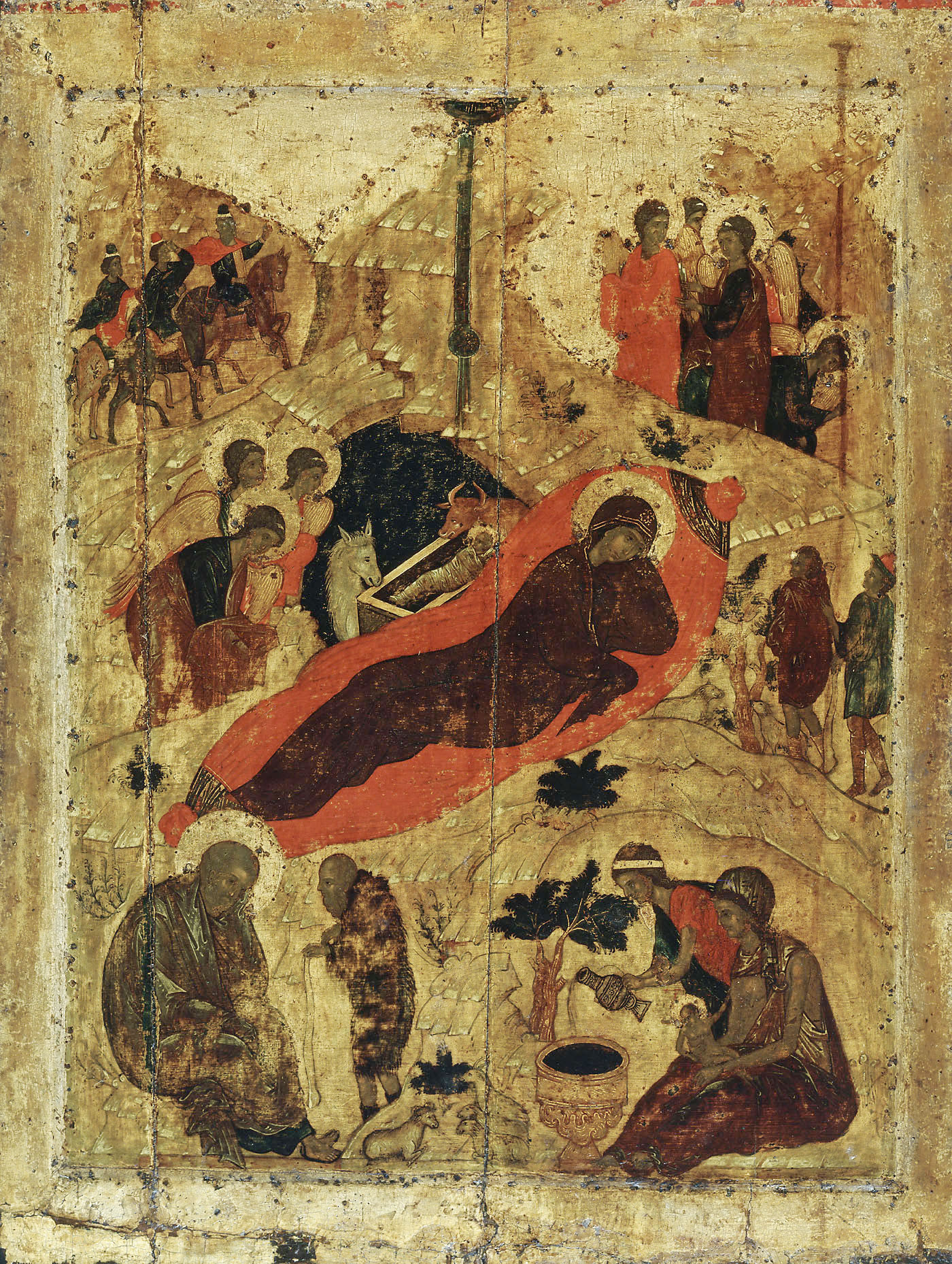
rublev-nativity

Our painting today is by Andrei Rublev whose Icons and Frescos are supreme works of devotional art.

They are works to be still before.

If you surrender to these works they will work in your soul.

Rublev, following the Orthodox tradition, sees the events of The Nativity not as historical episodes but as living events the faithful community participated in as they celebrated the liturgy.

The calm and peace of the image contains immense and complex feeling.

The birth of The Saviour is shown as a cosmic event which is yet an acceptance of human mortality and frailness.

Herbert Howells music has an English reticence which belies the oceanic depths of feeling it can summon from the listener.

His, ‘A Spotless Rose’ especially when sung with the aching purity of The New College Oxford Choir tenderly ushers the cosmic into our mortal consciousness.

Onward!

Today I think it’s time to remember that Christmas is a time for celebration.

A time to meet up with old friends and make new ones.

A time to sing and dance and laugh.

A time to shake our fists in the face of the dark, cruel winter as we affirm our faith in the inevitable restorative power of the light.

For many years I did much of my celebrating in bars, pubs, Honky Tonks and Road Houses soaking up the music and the booze as the nights progressed. The music choices today reflect that biblious spirit.

First, the Boss Of The Blues – Big Joe Turner. Big is no empty boast; Joe was over 6ft 2 and weighed more than 300 pounds so when he arrived in a room you knew he was there!

You would also know Joe was around because his voice could break through walls and wake the dead.

Joe had to develop his shouting style when he worked in the hectic, heaving bars of wide-open Kansas City in the 1920s and early 1930s.

Even though the joints Joe worked in such as the Kingfish and the Sunset would have been rammed to the doors with free spending, free fighting customers Joe never had any problem getting heard from behind the bar.

As, ‘The Singing Barman’ he formed a famous partnership with pianist Pete Johnson immortalised in the standard, ‘Roll ‘Em Pete’.

Embed from Getty Images

If I had been a customer I would have ordered (in honour of the Rudy Toombes song) One Scotch, One Bourbon, One Beer – knocked them back and settled in for a night of peerless blues.

Joe’s career lasted some 60 years and he was variously styled as a bluesman, a jazz singer, a Rythmn and Blues stylist and a pioneer rock ‘n’ roller – whatever the label the big man went his own sweet way launching every song into the stratosphere with the immense power of his vocals.


From the moment, ‘Christmas Date Boogie’ opens we know we are in good hands.

Big Joe is very much the master of ceremonies marshalling the instrumental forces around him. They are all fine players given their chance to shine but there is no doubt who is the star of the show!

You can just imagine the big beaming smile of Joe as he tears into this Christmas frolic.

Resistance is useless – where’s the Bourbon?

I’ll let the very fine Irish poet (I think you may have guessed by now that I am somewhat well disposed to Irish poets) Michael Longley introduce the next music Titan:

‘He plays for hours and hours on end and thought there be
Oases one part water, two parts gin
He tumbles past to reign, wise and thirsty, at the still centre of his loud dominion –
THE SHOOK, THE SHAKE, THE SHEIKH OF ARABY’.

The subject of the poem and the artist featured in our second music selection is, of course, the one and only, one man musical encyclopedia and indefatigable party starter: Thomas ‘Fats’ Waller.

A short list of his accomplishments would have to include his very considerable prowess as a pianist, organist, singer, songwriter, composer and comedian.


Yet any list of talents and achievements would undersell Fats impact on his contemporary artists and his audiences.

Fats was beyond category – he was Fats Waller and The Lord of any room he chose to light up.

He could in the course of a single number go from being rollickingly rumbustious to wistful gentle melancholy.

Sadly his early death meant that the true depth of his talents were never fully sounded but nevertheless he leaves a unique legacy of wondrously entertaining recordings.

If you ever need cheering up and reminding of how good it is to be alive just press the button next to Fats name and you will feel a whole lot better – I guarantee it.

Today’s poem is, ‘Mary’s Song’ by Charles Causley.

‘Warm in the wintry air
You lie,
The ox and the donkey
Standing by,
With summer eyes
They seem to say:
Welcome, Jesus,
On Christmas Day!

Sleep, King Jesus:
Your diamond crown
High in the sky
Where stars look down.
Let your reign
Of love begin,
That all the world may enter in.’