A very generous measure of hot buttered Rum poured.
Now, you need a smoother than smooth sound to maintain the mood.
Nothing better than Bonnie Raitt with Rhythm & Blues legend Charles Brown with a sultry duet version of, ‘Merry Christmas Baby’.
Now, don’t you feel all lit up like a Christmas Tree!
Kick back and pour yourself another (Eggnog anyone?)
Listen now to the Ramsey Lewis Trio’s perfect yuletide groove, ‘Christmas Blues’ beamed to you all the way from 1961.
Rainer Maria Rilke (1875-1926) wrote ravishing visionary poems which settle in the heart.
His Poem, ‘Advent’ will stay with you.
Recitation by Julia Koschitz.
Production and arrangement by Schönherz & Fleer.
Es treibt der Wind im Winterwalde die Flockenherde wie ein Hirt und manche Tanne ahnt, wie balde sie fromm und lichterheilig wird, und lauscht hinaus. Den weißen Wegen streckt sie die Zweige hin, bereit und wehrt dem Wind und wächst entgegen der einen Nacht der Herrlichkeit.
There in the wintry forest the wind blows a flock of snowflakes like a shepherd, and many a fir-tree guesses how soon it will be pious with holy lights, and listens. Towards the white path it stretches out its branches, ready, and braving the wind and growing toward that one Night of Glory.
If you have enjoyed this Post please share as widely as you can.
Set your Calendar now for December 11th and the next Post in the Christmas Alphabet, I for …
There’s no denying that when times are hard (and someone near you right now is having those hard times) Christmas can be a season of worry rather than wonder.
Sometimes you pray that somehow you will make it through December.
When things aren’t going well the prospect of Christmas can make you shiver more than the coldest Winter winds.
When you’ve got a family to support you’ve somehow got to hang on until the warmer winds appear.
You’ve got to make it through December.
Make it through.
Trust Merle Haggard, the working stiff’s balladeer, to tell it straight.
Let’s change the mood with some more Vintage Jazz.
Don Redman leads an All Star band featuring the imperious Tenor Saxophone of Coleman Hawkins.
I think we can safely say that now we have found those warmer winds!
Throw another log on the fire!
Trumpets : Joe Wilder, Charlie Shavers and Al Mattaliano
Trombones : Sonny Russo, Jimmy Cleveland and Bobby Byrne
Saxophones : Don Redman George Dorsey, Milt Yaner, Al Cohn, Seldon Powell and Coleman Hawkins.
Piano : Hank Jones, Guitar : George Barnes, Bass : Al Hall Drums : Osie Johnson
New York, July 1957
Thomas Hardy as Poet and Novelist proved himself to be a fearless, wintery, anatomist of the human heart.
So, his Poem, ‘The Oxen’ has for me a special poignancy in the heart wrenching desire to believe that there yet may be miracles in the gloom.
Christmas Eve, and twelve of the clock.
“Now they are all on their knees,”
An elder said as we sat in a flock
By the embers in hearthside ease.
*
We pictured the meek mild creatures where
They dwelt in their strawy pen,
Nor did it occur to one of us there
To doubt they were kneeling then.
*
So fair a fancy few would weave
In these years! Yet, I feel,
If someone said on Christmas Eve,
“Come; see the oxen kneel,
*
“In the lonely barton by yonder coomb
Our childhood used to know,”
I should go with him in the gloom,
Hoping it might be so.
*
Here’s a gorgeous setting by Jonathan Rathbone sung by The Swingle Singers from their 1994 CD, ‘The Story of Christmas’.
If you have enjoyed this Post please share it as widely as you can!
Set your Calendar now for December 9th and the next Christmas Alphabet Post R for …
A chance to look back at all that you have done and the things you didn’t quite get round to doing.
A chance to look forward and plan for a brighter future.
I hope you and yours have fun.
Take the time to cherish the near and the dear ones and remember those far away in time and space.
Indulge the young and the old.
Be kind to yourself.
Merry Christmas!
The Immortal Jukebox once again celebrates the season with a Christmas Alphabet stuffed with musical and poetic delights.
Let’s begin with a tender meditation from Mary Chapin Carpenter.
‘Still, still, still’ is an Austrian Weihnachtslied a Christmas Carol and a lullaby.
The melody is a mid 19th Century folk tune from Salzburg.
The German Lyric has been attributed to Georg Gotsch.
Mary’s vocal and the arrangement beautifully capture the feeling of vigil, stillness and mystery as the drifting snow wraps us in peaceful sleep while the angels keep their watch.
Sleep, sleep, sleep.
Dream, dream, dream.
Still, still, still.
Still, still, still.
Still, still, still One can hear the falling snow For all is hushed The world is sleeping Holy Star its vigil keeping Still, still, still One can hear the falling snow
Sleep, sleep, sleep ‘Tis the eve of our Saviour’s birth The night is peaceful all around you Close your eyes Let sleep surround you Sleep, sleep, sleep ‘Tis the eve of our Saviour’s birth
Dream, dream, dream Of the joyous day to come While guardian angels without number Watch you as you sweetly slumber Dream, dream, dream
Of the joyous day to come
Our next selection features a giant of Jazz, Benny Carter, who effortlessly combined wit and elegance in his arrangements and Instrumental virtuosity.
Here he is from 1936 leading his Swinging Quintet with my all time favourite version of ‘Jingle Bells’.
Hop aboard the Sleigh!
Jingle Bells was recorded in London in 1936 with Benny on Clarinet and Alto Sax, Scotland’s Tommy McQuater was on Trumpet, England’s Gerry Moore on Piano, Albert Harris on Guitar, Wally Morris on Bass and Al Graig on Drums.
Now a Poem from the great English Poet John Clare (1793-1864).
I discovered John Clare in my late teens and have been a fervent admirer of his work ever since.
His Poem, ‘Christmas Time’ is characteristically generous of heart and acutely observed.
Glad Christmas comes, and every hearth Makes room to give him welcome now, E’en want will dry its tears in mirth, And crown him with a holly bough; Though tramping ‘neath a winter sky, O’er snowy paths and rimy stiles, The housewife sets her spinning by To bid him welcome with her smiles.
Each house is swept the day before, And windows stuck with evergreens, The snow is besom’d from the door, And comfort the crowns the cottage scenes. Gilt holly, with its thorny pricks, And yew and box, with berries small, These deck the unused candlesticks, And pictures hanging by the wall.
Neighbors resume their annual cheer, Wishing, with smiles and spirits high, Glad Christmas and a happy year To every morning passer-by; Milkmaids their Christmas journeys go, Accompanied with favour’d swain; And children pace the crumpling snow, To taste their granny’s cake again.
The shepherd, now no more afraid, Since custom doth the chance bestow, Starts up to kiss the giggling maid Beneath the branch of mistletoe That ‘neath each cottage beam is seen, With pearl-like berries shining gay; The shadow still of what hath been, Which fashion yearly fades away.
The singing waits — a merry throng, At early morn, with simple skill, Yet imitate the angel’s song And chaunt their Christmas ditty still; And, ‘mid the storm that dies and swells By fits, in hummings softly steals The music of the village bells, Ringing around their merry peals.
When this is past, a merry crew, Bedecked in masks and ribbons gay, The Morris Dance, their sports renew, And act their winter evening play. The clown turned king, for penny praise, Storms with the actor’s strut and swell, And harlequin, a laugh to raise, Wears his hunch-back and tinkling bell.
And oft for pence and spicy ale, With winter nosegays pinned before, The wassail-singer tells her tale, And drawls her Christmas carols o’er. While ‘prentice boy, with ruddy face, And rime-bepowdered dancing locks, From door to door, with happy face, Runs round to claim his “Christmas-box.”
The block upon the fire is put, To sanction custom’s old desires, And many a fagot’s bands are cut For the old farmer’s Christmas fires; Where loud-tongued gladness joins the throng, And Winter meets the warmth of May, Till, feeling soon the heat too strong, He rubs his shins and draws away.
While snows the window-panes bedim, The fire curls up a sunny charm, Where, creaming o’er the pitcher’s rim, The flowering ale is set to warm. Mirth full of joy as summer bees Sits there its pleasures to impart, And children, ‘tween their parents’ knees, Sing scraps of carols off by heart.
And some, to view the winter weathers, Climb up the window seat with glee, Likening the snow to falling feathers, In fancy’s infant ecstacy; Laughing, with superstitious love, O’er visions wild that youth supplies, Of people pulling geese above, And keeping Christmas in the skies.
As though the homestead trees were drest, In lieu of snow, with dancing leaves, As though the sun-dried martin’s nest, Instead of ic’cles hung the eves; The children hail the happy day — As if the snow were April’s grass, And pleased, as ‘neath the warmth of May, Sport o’er the water froze to glass.
Thou day of happy sound and mirth, That long with childish memory stays, How blest around the cottage hearth, I met thee in my younger days, Harping, with rapture’s dreaming joys, On presents which thy coming found, The welcome sight of little toys, The Christmas gift of cousins round.
About the glowing hearth at night, The harmless laugh and winter tale Go round; while parting friends delight To toast each other o’er their ale. The cotter oft with quiet zeal Will, musing, o’er his bible lean; While, in the dark the lovers steal, To kiss and toy behind the screen.
Old customs! Oh! I love the sound, However simple they may be; Whate’er with time hath sanction found, Is welcome, and is dear to me, Pride grows above simplicity, And spurns them from her haughty mind; And soon the poet’s song will be The only refuge they can find.
Don’t hesitate to share The Christmas Alphabet as widely as possible – spread the Christmas Cheer!
Notes :
‘Still, still, still’ can be found on Mary Chapin Carpenter’s highly recommended CD, ‘Come Darkness, Come Light’.
My favourite Benny Carter compilation is a 4 CD set from Proper, ‘Music Master’.
‘John Clare : The Major Works’ from Oxford University Press is an excellent compendium of both his Poetry and his autobiographical writings.
‘John Clare : A Biography’ by Jonathan Bate from Picador is a superb critical study fully worthy of its subject.
Set Your Calendar now for December 7th and the next Christmas Alphabet Post – H for ….
Then it is carried on the airwaves a thousand miles north to Hibbing Minnesota where 16 year old Robert Allen Zimmerman experiences an epiphany for which he would be forever grateful.
‘[Billy Lee Riley} … was a true original. He did it all: He played, he sang, he wrote.
… Billy became what is known in the industry—a condescending term—as a one-hit wonder.
But sometimes, just sometimes, once in a while, a one-hit wonder can make a more powerful impact than a recording star who’s got 20 or 30 hits behind him.
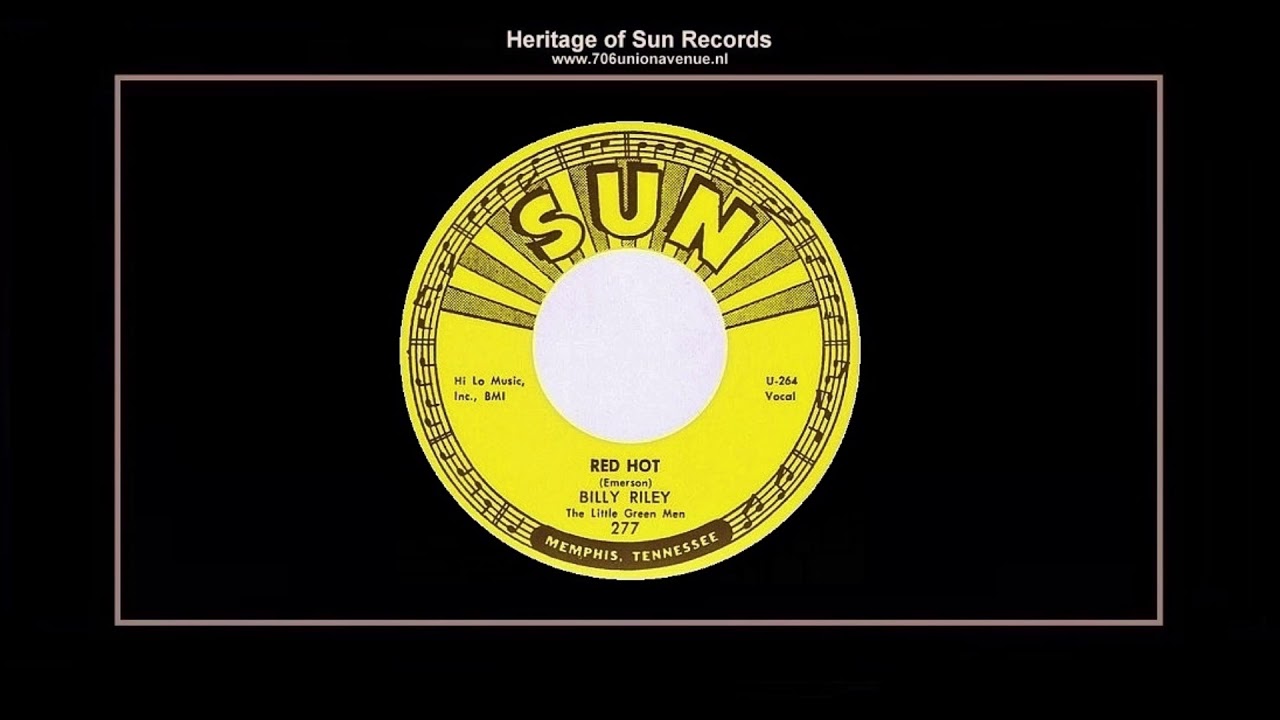
And Billy’s hit song was called “Red Hot,” and it was red hot.
It could blast you out of your skull and make you feel happy about it. Change your life.’ (Bob Dylan)
Well, if that didn’t blast you out of your skull you need a skull transplant!
150 seconds of Bliss.
Pure Bliss.
Billy and his band, the brilliantly named ‘Little Green Men’ explode into your consciousness with the overwhelming impact of a comet crashing to Earth.
Roland Janes and Billy on the searing guitars.
Jimmy Van Eaton on the we will not be denied drums.
Marvin Pepper on the go as fast as you like boys I’ll keep us on the road bass.
Jimmy Wilson on the hold fast here comes the rapids piano.
And Billy’s vocal?
Red Hot. Red Hot. Red Hot. Red Hot. Red Hot.
My Lords, Ladies and Gentlemen here we have the very essence of Rock ‘n’ Roll!
Now, in any well ordered Universe ‘Red Hot’ would have been a No 1 Hit.
But, as we know, things often don’t work out the way they should.
So, Sam Phillips, the Caesar of Sun Records, decided that he didn’t have the resources to properly promote both ‘Red Hot’ and Jerry Lee Lewis’ ‘Great Balls of Fire’ – well which would you have chosen?
Nevertheless, to achieve some sort of cosmic balance, ‘Red Hot’ is now installed as A80 on The Immortal Jukebox!
Billy’s had one minor hit with the fantastic, ‘Flyin’ Saucers Rock and Roll’ (sure to feature here later) and he made important contributions as a sideman in Memphis with Sun and in Los Angeles.
His career got a welcome boost in the late 1970s when Robert Gordon and the mighty Link Wray recorded dynamite covers of Red Hot and Flyin’ Saucers.
Billy played irregularly but every time he hit the stage he carried with him and delivered the elemental white-fiery spirit of Rock ‘n’ Roll.
Here from 2008, just a year before he died, a performance that is a wonderful testament to a true Rock ‘n Roller.
God Bless you Billy Lee!
Notes :
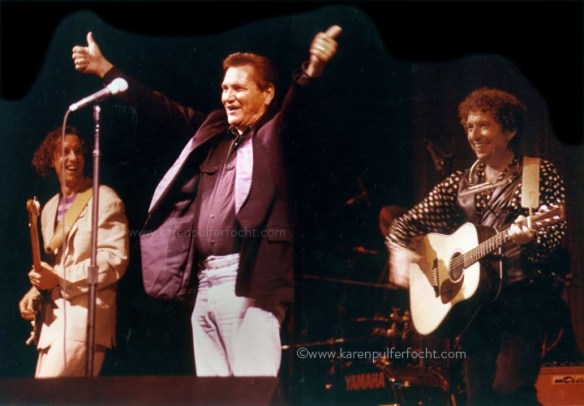
Below, a joyous shot of an obviously delighted Bob Dylan revelling in the rapturous applause Billy Lee received when he joined Bob on stage in 1992.
My go to CD for Billy Lee is ‘Billy Lee Rocks’ on the estimable Bear Family Label.
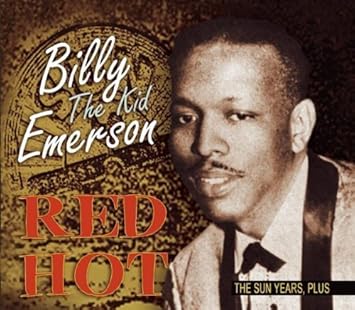
Red Hot was written and first recorded by Billy ‘The Kid Emerson’ in 1955.
Billy also wrote ‘When It Rains, It Really Pours’ covered by Elvis himself and ‘Every Woman I Know (Crazy ‘Bout An Automobile) which was recorded by Ry Cooder.
As far as I know Billy is still alive at the age of 93!
Thanks for the songs Billy!
SET YOUR CALENDARS!
The 2019 Immortal Jukebox ‘Christmas Alphabet’ will begin on Thursday December 5th and continue on the 7th, 9th, 11th, 13th, 15th, 17th, 19th and 21st.

 The Immortal Jukebox